Hello There!

Lorem ipsum dolor sit amet, consectetur adipiscing elit,

Importance of Web Analytics Consulting Services for Data-Driven Growth

Professional Web Analytics Consulting Services Turn Data Into Your Competitive Advantage - Tatvic

Do you think Web Analytics Consulting Services are really significant in this era??

The global web analytics market is projected to reach $20.09 billion by 2032, growing from $5.37 billion in 2024, with a CAGR of 18.1%
~Fortune Business Insights

Welcome to the Era of Data-Driven Decisions

“Marketing groups are flying blind, Big information, but choices based on instinct.”

Analytics ->> Insight ->> Action

Data is the new money, coursing through each click, scroll, and page view.

With each touchpoint creating a rich image of customer intent, likes and behaviors, if you can decipher it. 

58% of businesses fail to translate raw analytics into actionable real-world insights
~Forrester Research

You can get data; it’s a different story to bring out its real value.
Welcome to the Era of Data-Driven Decisions- Tatvic

There are too many teams struggling with dashboards without knowing what’s next, leaving growth on the table.

You need a bridge between numbers and strategy.

That’s where web analytics consulting services come in.

They translate complex datasets into targeted, growth-driven plans and uncover the “why” behind every metric.

Best of all, you don’t need a PhD in data science to reap the rewards.

With the right web analytics services, even lean teams can confidently harness data.

You’ll shift from guesswork to guided decision-making, optimizing campaigns and personalizing journeys in real time.

Because in today’s digital landscape, success isn’t about doing more, it’s about doing what works.

Why Web Analytics Alone Isn’t Enough

Most companies aren’t lacking data, they’re swimming in it.

Even using the latest and greatest web analytics services insights exist in silos: marketing hears one narrative, product teams another, and leadership can’t see how they relate.

The end result is strategies that aren’t aligned, communications that break down, and growth opportunities missed.

More than 87% of organizations have low analytics maturity.
~Gartner.

It’s difficult to respond to data before it becomes outdated.

Dashboards, batched reports, and dedicated analysts can’t remedy a lack of strategy, they can only point out the gaps.

This is not a technology issue; it’s a strategy issue.

Without a cohesive system, even top-notch web analytics services are wasted.

Insights remain trapped or come too late to have an impact, causing teams to speculate rather than develop.

To convert data into actual competitive strength, you must have a sound strategy that ensures each metric is valuable.

The Role of Web Analytics Consulting Services

In today’s constantly changing online world, data is plentiful and actionable information is scarce.

That’s when Web Analytics Consulting Services prove to be invaluable.

These services extend far beyond setup and monthly reporting.

Professional web analytics consultants are strategic partners who close the loop between raw data, digital strategy, and concrete business results.

Their work isn’t merely about monitoring traffic or conversion rates, it’s about breaking down complicated data into simple, actionable recommendations that support your business objectives.
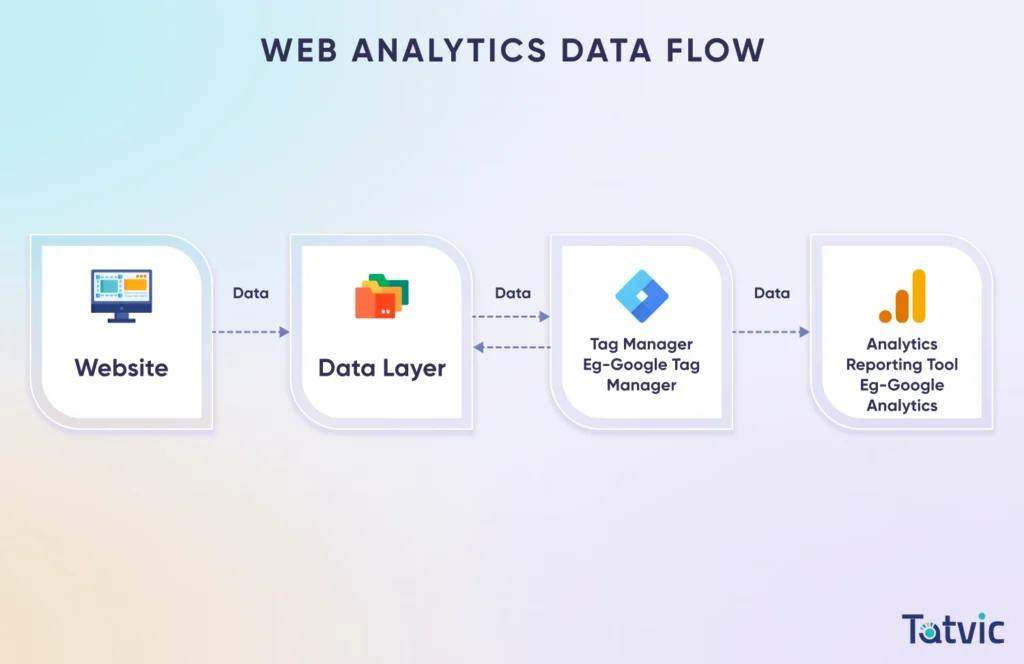
The Role of Web Analytics Consulting Services - Tatvic

An experienced Web Analytics Consulting Partner helps in:

  • Ask the right questions:

    To reveal what’s really influencing user behavior and business performance. Are visitors dropping off because site speed is slow? Is checkout confusing users? Consultants drill down to uncover underlying causes.

  • Pay attention to the most important metrics:

    Not pageviews or bounce rates, but user engagement, lifetime value, and attribution modeling. They allow you to cut through the noise and home in on KPIs that fuel growth.

  • Make insights translate into actual results:

    By suggesting and executing data-driven recommendations. Whether it’s streamlining the user experience, enhancing campaign performance, or optimizing segmentation, consultants facilitate ongoing, evidence-based enhancements.

    With the proper analytics partner, your team is no longer bogged down by dashboards or stuck trying to interpret data in a vacuum. Rather, you have clarity, direction, and quantifiable progress. You stop guessing and start growing.

  • Stat to Note:

    Companies using data-driven strategies are 23x more likely to acquire customers and 19x more likely to be profitable (McKinsey).

Real-World Example: How Web Analytics Service Partner Transitioned A Business from Data Overload to Data-Driven Growth

Depo24, a growing e-commerce brand, had the tools web analytics services, CRM systems but no unified view of their customers.

Information was fragmented, making strategic decisions difficult.

By partnering with professional web analytics consulting services, they:

  • Integrated web and CRM data via a common identifier
  • Achieved 99% data accuracy
  • Optimized marketing ROI
  • Customized user experiences

Let’s See the Results?

  • Clearer Decisions,
  • Better Customer Journeys, and
  • Measurable Growth

Why Professional Digital Solutions Are Critical?

Data is no longer a luxury, it’s the lifeblood of business growth and innovation. But having access to data is only the beginning.

The real challenge lies in making sense of it.

Why Professional Digital Solutions Are Critical

Raw data alone won’t drive performance. Without context, structure, and strategic interpretation, even the most sophisticated data sets become noise.

What sets high-performing companies apart is their ability to transform complex data into clear, actionable strategies and that’s exactly where professional web analytics consulting services make a critical impact.

These solutions bring together technology, expertise, and strategic thinking to unlock the true value of your data. They help businesses:

  • Uncover hidden opportunities in user behavior and engagement patterns.
  • Optimize marketing spend by understanding which channels and touchpoints deliver the highest ROI.
  • Enable real-time decision-making by turning fragmented data into a coherent story.

Quick Stats That Say It All:

Businesses leveraging analytics report a 15-20% increase in ROI, proving that data-driven strategies translate directly into better bottom-line performance.
~Deloitte

70% of digital transformation initiatives fail when not grounded in a strong data strategy, highlighting the cost of going in blind.
~
Boston Consulting Group

In short, professional digital solutions anchored in web analytics are no longer optional, they’re essential for companies that want to scale with confidence, clarity, and competitive advantage.

Key Benefits of Web Analytics Consulting Services

Web analytics consulting services help businesses turn raw website data into clear, actionable insights that drive growth.

From improving user experience to boosting conversions, these services uncover what’s working, what’s not, and where to optimize.

A strategic web analytics partner empowers you to make data-backed decisions, reduce waste and maximize ROI across all digital channels.
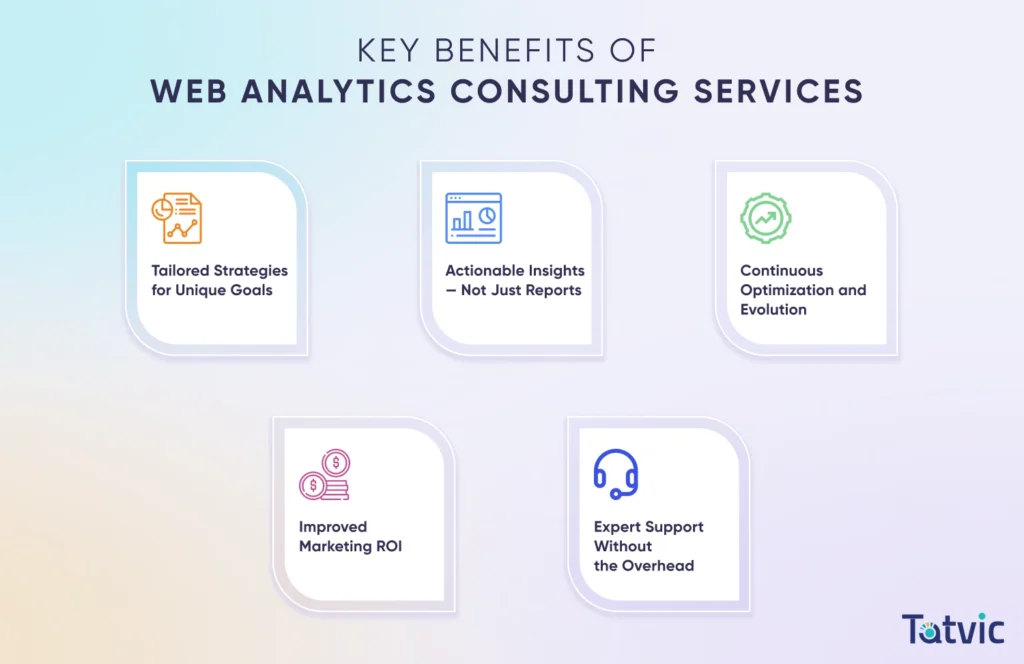
Key Benefits of Web Analytics Consulting Services - Tatvic

Let’s Deep Dive into Key Benefits of Having A Web Analytics Consulting Services:

1. Tailored Strategies for Unique Goals

Every business is different. Expert web analytics consulting services craft strategies tailored to your market, customers, and objectives. This personalized approach drives better results and sharper competitive advantage.

No cookie-cutter solutions.

2. Actionable Insights, Not Just Reports

Move beyond static dashboards. Get analytics consulting that ties every metric back to business decisions-from product launches to ad campaigns. You get real insights that fuel real action-not just another report to file away.

3. Continuous Optimization and Evolution

Markets change fast. Web analytics services continuously analyze, test, and refine your strategies, keeping you ahead of shifting customer behaviors. Continuous evolution ensures your business stays relevant and revenue-focused.

4. Improved Marketing ROI

Tie every click, campaign, and journey to real value. Companies using web analytics consulting services experience up to 30% better campaign performance (Adobe Digital Insights). Smarter data-driven decisions directly boost your marketing return on investment.

5. Expert Support Without the Overhead

Partnering with web analytics consulting services gives you a full team of experts without having to build it in-house. Think of it as your own strategic extension team.

Building Your Data-Driven Foundation: Tatvic’s 5 Step Proven Process

Unlock the true potential of your data with our end-to-end Web Analytics Consulting Services.

We combine deep analytics expertise with a strategic growth mindset to transform your digital efforts into measurable success.

This proven process helps businesses align teams, optimize investments, and scale smarter with data-backed decisions.
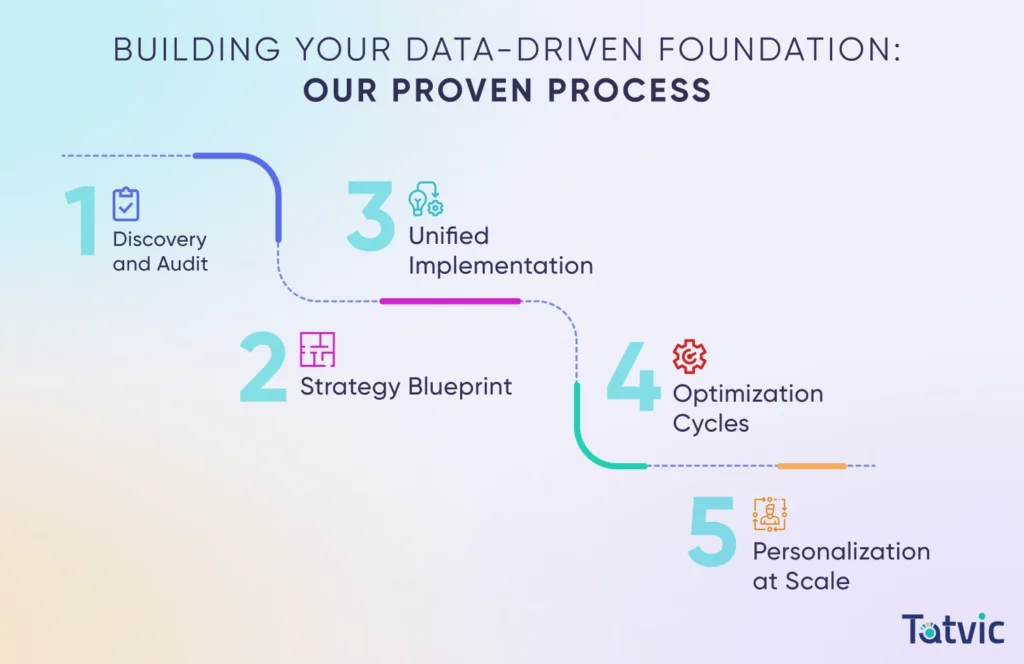
Tatvic's 5 Steps Proven Process to Unlock Data-Driven Growth

Let’s See Tatvic’s 5 Steps Proven Process to Unlock Data-Driven Growth

Step 1: Discovery and Audit:

Comprehensive audits of your web analytics services, CRM platforms, and marketing campaigns reveal critical insights.

We identify gaps, misalignments, and hidden opportunities to set the stage for smarter growth.

Result: You gain a crystal-clear understanding of what’s working, what’s not, and where the biggest wins lie.

Step 2: Strategy Blueprint:

We develop tailored growth blueprints to your actual business requirements and not guesses.

By establishing KPIs, constructing measurement frameworks, and harmonizing data strategies, we establish a clear direction forward.

Result: A focused, data-driven roadmap that synchronizes teams, optimizes resources, and creates measurable success.

Step 3: Unified Implementation:

We seamlessly bring your web analytics, CRM systems, and ad platforms into one cohesive tech stack.

Real-time dashboards become your one source of truth, informing smarter decisions across teams.

Result: Complete visibility throughout marketing and sales efforts, with faster, smarter, and more coordinated execution.

Step 4: Optimization Cycles:

By continued tracking, A/B testing, and performance audits, we continually optimize your strategy.

Real-world evidence drives wiser pivots, staying one step ahead of the competition at each turn.

Result: Ongoing performance improvement metrics, improved campaign effectiveness, and enhanced competitive edge.

Step 5: Personalization at Scale

With behavioral and demographic knowledge, we create tailored experiences across all touchpoints.

Result: Clients are made to feel heard and respected, which leads to enhanced interaction, greater tenure, and more brand advocacy.

The benefits?

  • Higher conversions,
  • deeper loyalty, and
  • a higher lifetime value

By implementing this proven process, we allow you to capture the full value of your data and bring insight to action. From discovery and strategy through implementation, optimization, and individual experiences, our approach ensures that your business is nimble, data-driven, and ready for long-term growth.

Ready to build a smarter, better digital strategy? Let’s turn your data into your most valuable asset.

Case Study: How Tatvic’s Smarter Analytics Drove Growth for upGrad

Challenge: 

UpGrad, a leading online education platform, was grappling with rising customer acquisition costs, an influx of low-quality leads, and inconsistent brand messaging across its marketing channels.

These issues not only strained their budget but also hindered their ability to build trust and convert prospects efficiently.

What Tatvic Did?

Through strategic web analytics consulting services, we:

  • Mapped learner journeys
  • Integrated campaign data with CRM for end-to-end tracking
  • Developed hyper-targeted programmatic ads

Outcomes

  • CPA dropped significantly
  • Quality leads improved
  • Unified brand messaging increased trust and boosted click-through rates

Bottom Line:

upGrad achieved higher growth with lower spend, powered by Tatvic’s smarter data and strategy.

Common Fears While Choosing for Web Analytics Consulting Services 

“Is web analytics reserved for large brands?”

Absolutely not! Web analytics benefits businesses of any size. Startups and SMEs, in fact, experience faster, more substantial returns because minor changes can lead to substantial ROI. Customized web analytics solutions enable these companies to prioritize what is most important to them, making every marketing dollar work harder.

“We already have Google Analytics isn’t that sufficient?”

Google Analytics is a great starting point, but it’s just a tool. Web analytics consulting services take this tool to the next level by setting up custom goals, connecting your CRM, and creating actionable KPIs. This way, you’re not just collecting data, but using it to drive smart, informed decisions that fuel growth.

“What if the ROI isn’t measurable?”

The universal objection, but with professional analytics services, there is no uncertainty. Whether clicks and conversions, or customer lifetime value, each dollar spent is measured and mapped directly back to business results. This transparency allows your marketing activity to always be directed at what matters.

“We don’t have the time to manage it.”

That’s where web analytics consulting is vital. By leaving your analytics management to the experts, you enable them to do the heavy lifting while your staff does what it does best-innovating and growing your business. You make certain that your analytics are always optimized without dipping your internal resources.

“Will it become obsolete soon?”

Digital strategies never remain static, but with a strong analytics underpinning you stay ahead of the game. Consulting services ensure that your strategy is nimble and future-proof, allowing your business to switch direction quickly as new technologies and trends are spearheaded.

Tatvic’s Web Analytics Strategies for Smarter & Faster Growth

Empower your business with Tatvic’s expert Web Analytics Consulting Services that go beyond basic reporting.

Our cutting-edge Web Analytics Strategies help streamline data, personalize experiences, and drive continuous improvement.

By integrating insights across platforms, we ensure you make faster, smarter decisions that fuel sustainable growth.
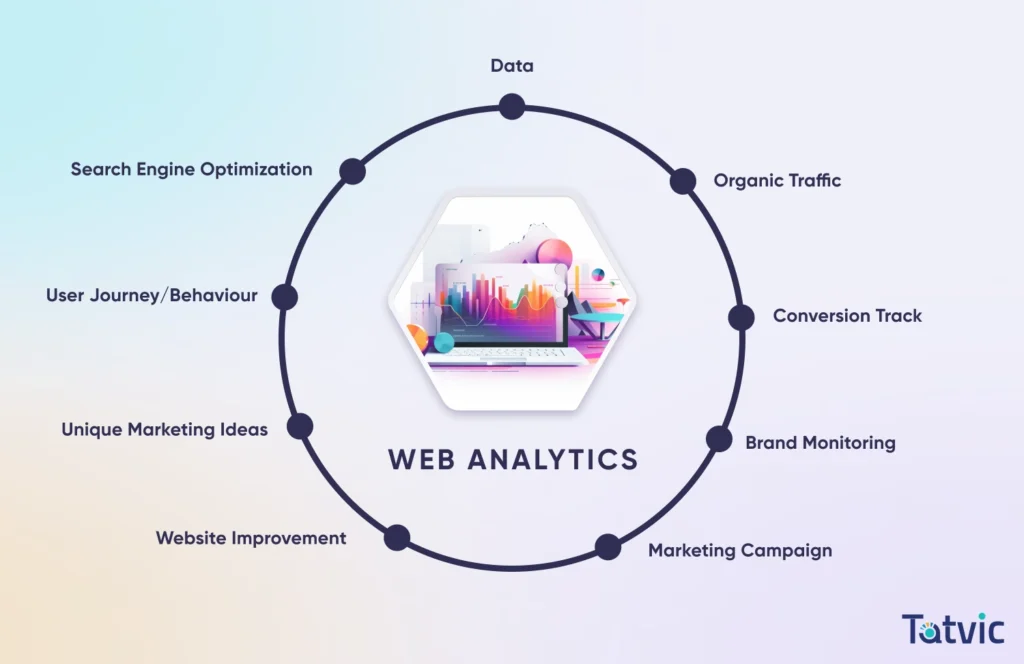
Tatvic's Web Analytics Strategies for Smarter & Faster Growth

Let’s Deep Dive Into Tatvic’s Web Analytics Strategies for Smarter & Faster Growth

  • Simplify Your Data Story:

    Make convoluted measures easy, yet picture-perfect, dashboards. This ease facilitates quick decisions for teams because the story behind the numbers is revealed in simple language. If the “why” is well communicated, action happens quicker and gets closer to the business objectives.

  • Personalize Every Step:

    Take advantage of behavioral segmentation to tailor every customer touchpoint to their individual activity. Rather than trusting in sweeping assumptions, you can personalize emails, ads, and overall user experiences to fit the particular needs and behaviors of specific customers, encouraging engagement and conversions.

  • Test, Learn, Improve:

    A/B testing on a regular basis is how you determine what works with your audience. Through testing varying components of your campaigns, not only do you refine performance but you also encourage the continuous improvement process. Even businesses that repeatedly test campaigns observe up to 37% improvement in their conversion rates (HubSpot). 

  • Integrate Everything:

    Unite information from your CRM, web analytics, and ad platforms into a single view. This integrated approach enables faster, wiser decisions, so that your strategies are based on a holistic picture of customer behavior, and not on siloed insights.

Why Leading Brands Choose Professional Web Analytics Consulting Services?

With growing data complexity, businesses are turning to Professional Web Analytics Consulting Services to uncover actionable insights, streamline decision-making, and stay agile in a dynamic market.

These services empower brands to move beyond guesswork and toward strategies that are measurable, scalable, and results-driven.

Companies that excel in analytics outperform their competitors by 5% in productivity and 6% in profitability. ~MIT Sloan

Leading brands understand the power of web analytics in driving growth and staying competitive.

Let’s See Clearly why Leading Brands invest in Professional Web Analytics Consulting Services:

  • Customized Strategies Based on Real Needs

    Brands know that generic solutions don’t work. Web analytics services create strategies tailored to specific business goals and market conditions, ensuring that every decision is data-driven and impactful.

  • Deep Expertise Without Hiring Costs

    Rather than creating an in-house team, brands hire expertise through consulting services. It provides them access to specialized skills and intelligence without having to invest heavily in recruitment and retention costs.

  • Continuous Growth and Optimization

  • The online world is ever-changing. Web analytics services render continuous analysis and optimization, enabling brands to remain nimble and continually enhance their strategy for improved performance.
  • Scalable, Future-Proof Solutions

    As companies expand, so do their analytics requirements. Professional analytics services provide scalable solutions that evolve with changing circumstances to ensure your analytics approach expands with your business and remains relevant in the long term.

With professional web analytics services, brands can get an edge over their competitors with customized, expert-led strategies that achieve long-term business development and success.
Professional Web Analytics Consulting Services Turn Data Into Your Competitive Advantage - Tatvic

Final Thoughts: Professional Web Analytics Consulting Services Turn Data Into Your Competitive Advantage

Your competition is constantly changing and evolving and so should you.

In this day and age of digital change, information can be your biggest asset.

By using the proper web analytics tools and expert consulting, you realize the full value of your information, placing you one step ahead of the competition.

The right web analytics services, supported by expert web analytics consulting, gives you:

  • Clean, connected data: Eliminate silos and ensure all your digital touchpoints tell a unified story.
  • Actionable insights: Go beyond basic metrics to uncover trends that directly impact performance.
  • Personalized customer journeys: Understand user behavior at every stage to tailor experiences that convert.
  • Clearer, faster decisions: Empower teams with real-time insights that reduce guesswork and drive results.
  • Sustainable growth: Build a scalable strategy rooted in data, not assumptions, for long-term impact.

With clean, connected data, you have a unified view that enables smarter decision-making across every team.

No longer do you need to deal with disparate data points or lost opportunities, just plain and actionable insight.

These insights enable you to tailor customer journeys to individual preferences, so that your marketing and sales efforts are precisely optimized to address customer requirements and drive interaction.

Web analytics services empower you to make sharper, quicker decisions by delivering real-time information that spotlight what’s working and where to concentrate your efforts.

That means you can optimize processes and drive growth with precision.

Above all, the correct analytics approach fuels lasting expansion by responding to market changes and growing with your company.

It’s not about merely measuring progress, it’s about actively propelling it towards success.

Ready to Turn On Your Data into a Revenue Machine?

Leave the guesswork and tap into the potential of data-driven decisions.

Join a future of unambiguous insights, better strategies, and irrepressible growth.

Access Intelligent Growth! Schedule Your Personalized Web Analytics Strategy Call Today.

No jargon, No pressure, Just clarity, confidence, and measurable results.

It’s time to turn your data into your biggest advantage.

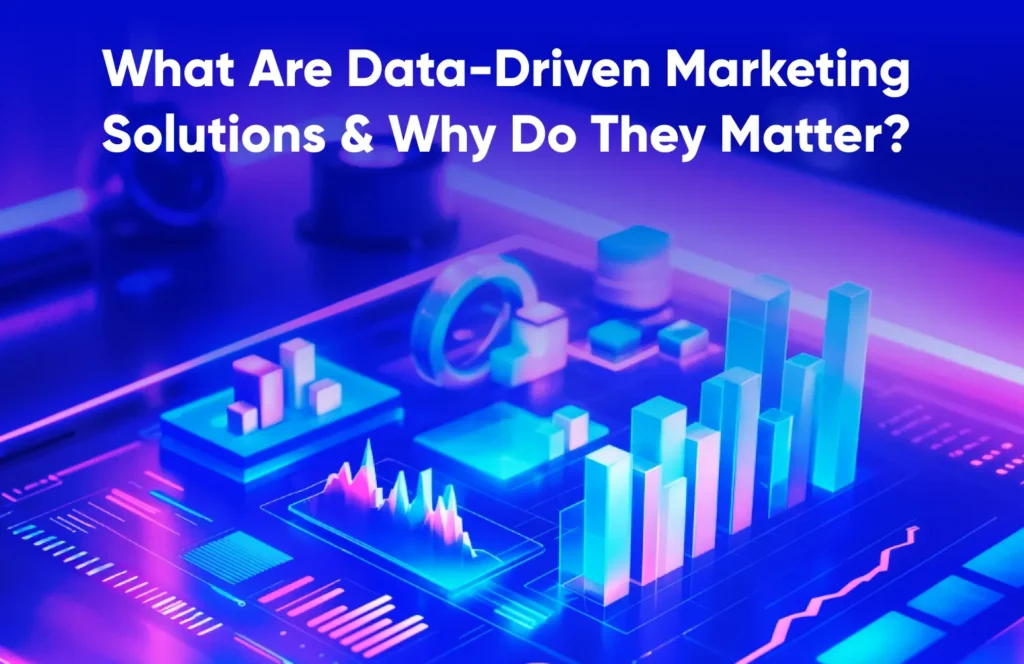
What Are Data-Driven Marketing Solutions & Why Do They Matter?

What Are Data-Driven Marketing Solutions & Why Do They Matter - Tatvic

Is your Data Driven Marketing Solutions helping you convert or just sitting there?

Having access to data is only the first step, how you use it that counts!

87% of marketers say data is their company’s most under-utilized asset.

Most companies spend money on data driven marketing solutions but fail to act on insight.

40% of brands plan to increase their data-driven marketing budgets.

Getting it right, though, can turn raw data into wiser campaigns, deeper customer relationships, and improved conversions.

If your data isn’t actually delivering results, it’s time to reassess your approach.

The Digital Shift: Why Data-Driven Marketing Is Non-Negotiable!

In today’s digital-first landscape, data driven marketing solutions are not optional, they’re essential. Every click, tap, and scroll leaves behind data, and that data holds the key to smarter marketing, better customer experiences, and measurable business growth.

Yet too many organizations fall into the trap of collecting dashboards full of data without ever turning those insights into action. That’s where modern data driven marketing solutions come in.

As a leading data analytics services company, we’ve seen firsthand how the right data driven marketing solutions and managed services can transform a business.

When you partner with a data analytics services company that embeds data and analytics into every marketing decision, you unlock growth that’s predictable, scalable, and sustainable.

What is Data-Driven Marketing?

Data-driven marketing is where you act on actual customer intelligence rather than relying on intuition. You draw information from every click, scroll, and buy to know precisely what your audience desires.

Through this method, you can test concepts rapidly, tailor messages and fine-tune campaigns on the fly. Rather than waiting for weeks for a report, you’re adjusting on the fly where every dollar spent contributing to growth.

How Data-Driven Marketing Solutions Fix Traditional Marketing Tactics - Tatvic

How Data-Driven Marketing Solutions Fix Traditional Marketing Tactics

Let’s see how Data Driven Marketing Fix shortcomings of Traditional Marketing: 

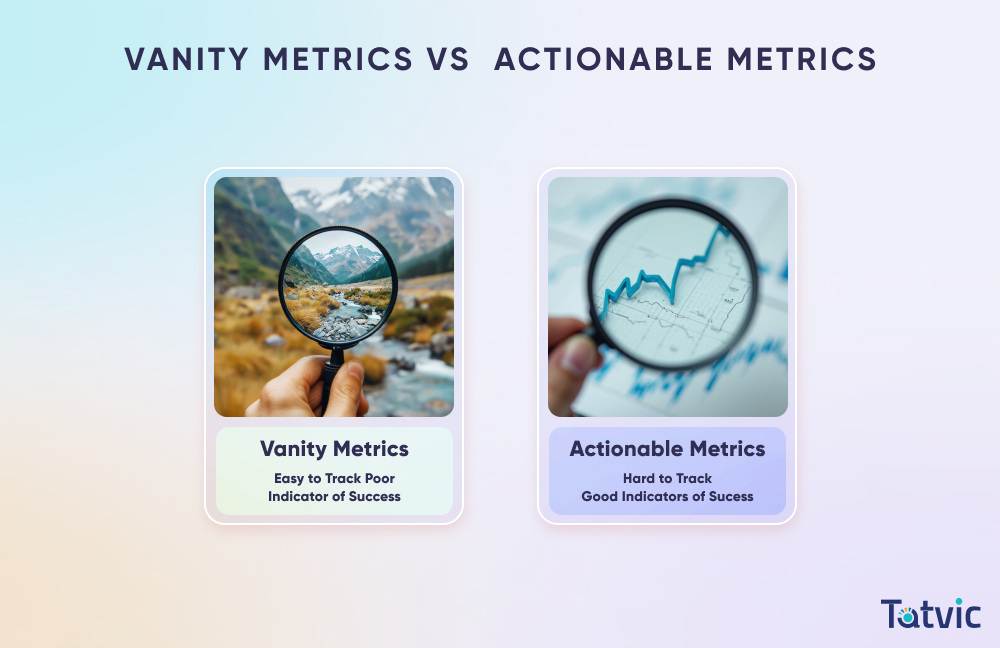
1. Vanity Metrics Over Value

  • “How many likes did we get?” is a question of vanity, not value.
  • True progress lies in KPIs like conversion rate, cost per acquisition, and customer lifetime value-not raw click counts.
  • Data driven marketing solutions refocus your teams on the metrics that drive profit, not just buzz.

2. Siloed Systems & Fragmented Data

  • Too many brands juggle multiple dashboards like Google Analytics, CRM reports & AD platform stats without a unified view.
  • Siloed data leads to missed opportunities and wasted ad spend.
  • A holistic data driven marketing solutions approach breaks down these silos, creating a single source of truth.

3. Guesswork vs. Guidance

  • Gut instinct alone can’t scale. In the race for market share, marketing without data is a gamble.
  • By contrast, data driven marketing solutions infuse every decision with evidence from your own data, turning guesswork into guaranteed gains.

“81% of marketers consider implementing data driven marketing strategies somewhat to extremely complicated. The struggle is real” 

In a Nutshell:
Traditional Marketing Tactic Issue How Data-Driven Marketing Solutions Fix It
Vanity Metrics Over Value Focus on likes, shares, and impressions rather than true business impact Shift focus to KPIs like conversion rate, CPA, and CLTV-metrics that drive growth
Siloed Systems & Fragmented Data Multiple disconnected dashboards cause inefficiencies and blind spots Unifies data from all platforms into one source of truth for actionable insights
Guesswork vs. Guidance Reliance on gut feelings leads to inconsistent results Uses first-party data and analytics to drive strategic, evidence-backed decisions

The Most Frequent Challenges Marketers Like You Encounter with the Data

Before you can deploy data driven marketing solutions, you first need to overcome a few obstacles.

The Most Frequent Challenges Marketers Like You Encounter with the Data

These are the pain points we most frequently see and how to identify them in your own operation:

1. Data Silos and Fragmentation:

Multiple tools, disconnected dashboards, and scattered spreadsheets lead to confusion. Without a unified view, you’re left gluing insights together by hand instead of focusing on high-value strategy.

1. Poor Data Quality

Incomplete tags, broken tracking pixels and inconsistent naming conventions mean you’re often making decisions on shaky ground. Garbage in, garbage out, so the first step is cleaning up your foundation.

3. Swamping Volume:

“Too many metrics” is the lament. With so many metrics created for every click, view, and micro-conversion, teams suffer from paralysis of analysis. Identify your North Star KPI and let the rest of your metrics roll up to that one.

4. Shortage of In-House Analytics Capacity:

Not all teams have a resident data scientist. Without the necessary skills to create dashboards, read trends, or craft queries, you won’t be able to take raw numbers and turn them into concrete next steps.

5. Slow or Manual Reporting:

Waiting days or weeks for performance reports means you’re perpetually behind the curve. Real-time data driven marketing solutions demand automated pipelines and alerts so you can pivot on a dime.

6. Ambiguous Action Strategy:

Data gathering is merely half the battle. Far too many marketers are unclear about how to turn insights into A/B tests, creative adjustments, or budget reallocations. A well-defined playbook coupled with a trusted partner bridges that gap.

Recognizing these roadblocks is the first step to more, faster and better data driven marketing solutions. Now that you understand what’s holding you back, you can aim your solution and begin to transform raw data into tangible growth.

Ready to Turn Data into Decisions That Actually Convert?

Enough with endless dashboards, half-watched metrics and campaigns that almost hit the mark.

It’s time to shift gears from:

  • vanity to value,
  • from traffic to traction, and
  • from “meh” to measurable results.

If you’re done guessing and ready to grow, let data lead the way today not tomorrow.

With the right data analytics services company, you won’t just react to numbers; you’ll build your entire marketing strategy around them. The result? Smarter decisions, seamless customer journeys, and real business growth.

“2 out of 3 leading marketers admit that Data based decisions beats gut instinct” 

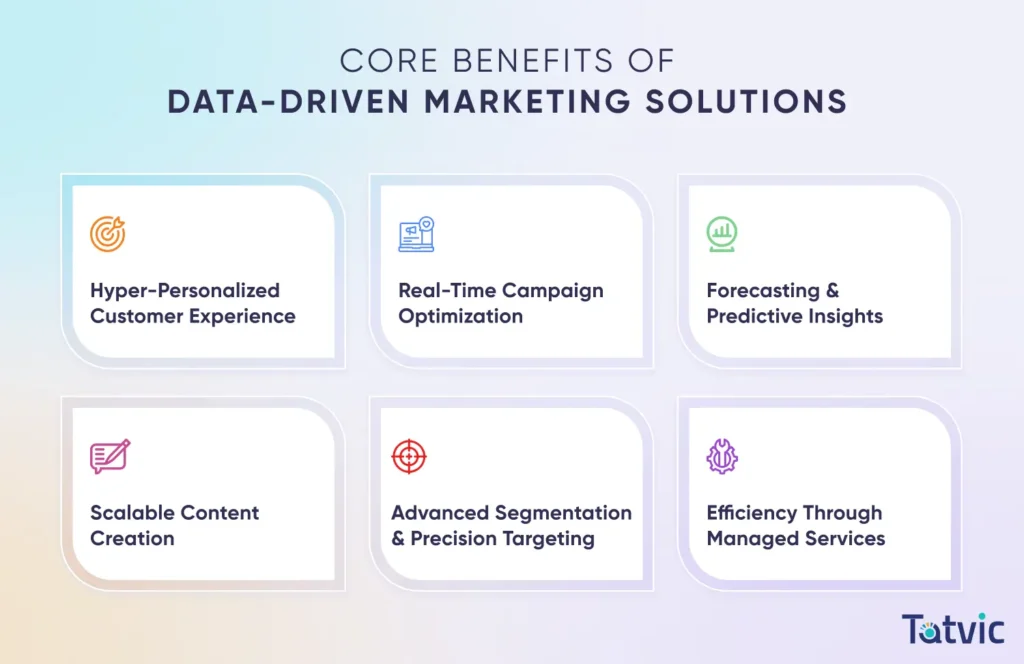
Core Benefits of Data-Driven Marketing Solutions

Benefits of doing Data-Driven Marketing are numerous which generate better visible results than the instinct based marketing.

Core Benefits of Data-Driven Marketing Solutions - Tatvic

Let’s deep-dive on some of the key benefits:

  1. Hyper-Personalized Customer Experience:

    Through the use of real-time data and machine-learning analytics, contemporary data driven marketing solutions dynamically segment audiences and deliver customized messages that appeal to individual’s preference, translating raw behavioral metrics into customized journeys that increase engagement and conversions.

  1. Real-Time Campaign Optimization:

    Merging real-time data streams and automated analytics into data driven marketing solutions allows continuous monitoring of performance, so budgets immediately move to best-performing channels and creative versions tripling ROI in the moment without delaying weeks for reports.

  1. Forecasting & Predictive Insights:

    Historical patterns drawn by powerful analytics platforms drive predictive models that predict customer actions and market shifts, providing you a proactive advantage to influence campaigns ahead of competitors’ reactions.

  1. Scalable Content Creation:

    Audience analytics powered AI-driven content engines automate copywriting, image recommendations and video script creation, maintaining brand consistency and best-in-class performance at scale without bogging down creative teams.

  1. Advanced Segmentation & Precision Targeting:

    Analyzing purchase behavior, browsing, and demographic data, advanced marketing solutions create micro-segments that identify high-value customers, supporting precision targeting tactics that drive high engagement and ROAS.

  1. Efficiency Through Managed Services:

    Seamless data integration, automated reporting, and real-time bid management are integrated with expert analytics governance in full-spectrum managed services allowing your team to concentrate on strategy while maintaining continuous optimization and scalability.

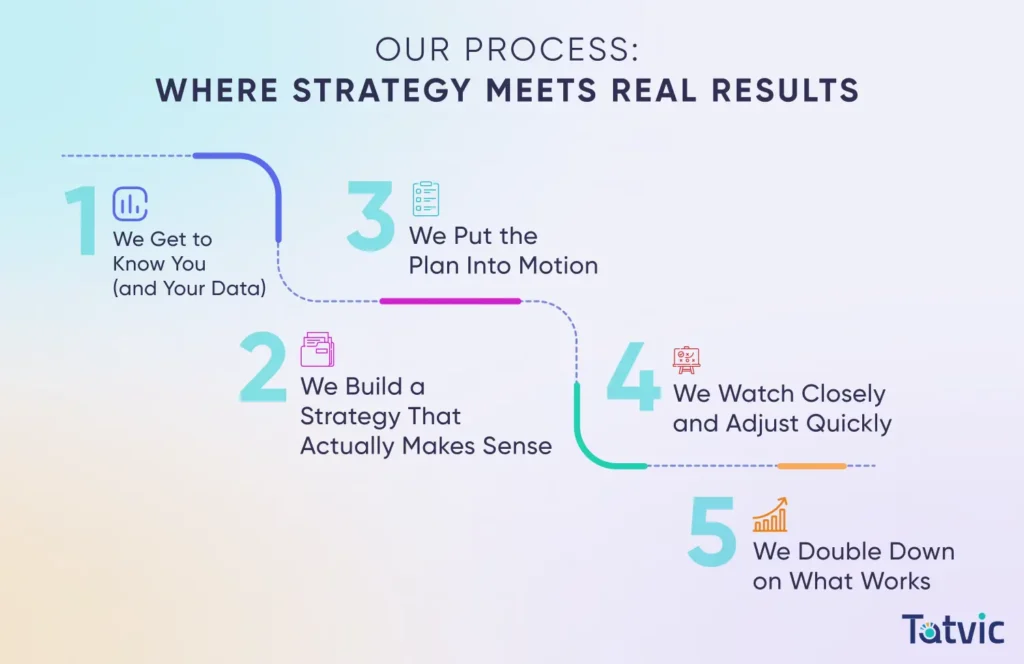
Tatvic’s Proven 5-Step Playbook for Data-Driven Marketing That Delivers Results

Tatvic’s 5 Steps Playbook isn’t just a strategy it’s a roadmap to real business impact. We begin by understanding your audience deeply, not just demographically but behaviorally. From there, we unify all your data sources to create a single, clear picture of what’s working and what’s not.

Our experts then craft tailored experiments like: A/B tests, journey mapping, and segmentation strategies, that are driven by evidence, not assumptions. Using predictive insights, we guide real-time optimizations that scale. And finally, we measure what truly matters: ROI, customer retention and lifetime value. At every step, the focus stays on turning data into growth not just dashboards.

Tatvic’s Proven 5-Step Playbook for Data-Driven Marketing That Delivers Results

Let’s deep-dive into the Steps:

  • Step 1: We Get to Know You (and Your Data):

    Before we change anything, we take a good, honest look at what’s already happening.
    Where are people dropping off?
    What’s working?
    What’s just noise?
    We let the data tell the real story!

  •  Step 2: We Build a Strategy That Actually Makes Sense:

    This isn’t a copy-paste solution. It’s a custom, data-backed plan that fits your goals and your audience.
    Because real marketing needs to be smart not just loud.

  •  Step 3: We Put the Plan Into Motion:

    With everything mapped out, we roll up our sleeves.
    We tweak, test and fine-tune every detail from CTAs to user journeys, all while staying laser-focused on performance.

  •  Step 4: We Watch Closely and Adjust Quickly:

    Once your marketing strategy is live, we track everything.
    What’s converting?
    What’s not?
    Real-time analytics help us make fast, smart moves that keep you ahead of the curve.

  •  Step 5: We Double Down on What Works:

    Now it’s time to grow.
    We scale the wins, cut the fluff, and keep improving.
    Because good enough isn’t good enough.
    Your business deserves better and your data knows the way

Why Tatvic Is The Best Data Analytics Service Partner for 2025 and Beyond

Tatvic stands out as the leading data analytics service partner for 2025 and beyond, thanks to its deep expertise in AI, predictive modeling, and real-time insights. As a Google-certified partner, Tatvic helps businesses unlock smarter, faster decisions through a future-ready data strategy that scales. Whether it’s enhancing customer journeys or boosting ROI, Tatvic delivers measurable impact at every step.

Why Tatvic Is The Best Data Analytics Service Partner for 2025 and Beyond

Let’s see Why Tatvic is Unbeatable:

  • Deep Knowledge in Analytics & Marketing Solutions:

    We’ve spent over a decade transforming tough data into lucid, actionable marketing strategies bringing together the latest analytics techniques and practical marketing savvy to enable brands to grow.

  • End-to-End Managed Services:

    From configuring your tracking and joining data sources together to executing campaigns and optimizing performance, we do the heavy lifting so you can see the forest for the trees.

  • Cutting-Edge Technology:

    We leverage the new tools like GA4 for tracking, BigQuery for storage, Looker Studio for dashboards and AI-driven content platforms to provide a full-stack analytics advantage.
  • Client-Centric Approach:

    Each plan we develop is built with your goals and users in mind so that our solution aligns within your budget, mirrors your voice, and promotes the results that matter to you.

  • Unmatched Success:

    Tatvic has consistently delivered exceptional results across every project it undertakes.

    • Whether it is increasing mobile commerce for Ferns N Petals,
    • generating 169% more leads for HDFC Life,
    • or increasing conversions by 49% at ICICI Prudential,
      real, measurable impacts are what your clients consistently realize.

Real Results: Success Stories from Leading Brands

Discover how leading brands have transformed their marketing strategies using data driven marketing solutions. From boosting conversions to unlocking new growth opportunities, these real-world success stories show the power of smart data strategies in action and how we can work for you too.

Real Results Success Stories from Leading Brands - Tatvic

Let’s see few LIVE Use Cases direct from Tatvic’s Repositoy: 

1. Ferns N Petals (FNP)

  • Challenge: Strong mobile traffic but low conversion rates.
  • Solution: Our data driven marketing solutions team optimized the mobile checkout funnel-improving CTA visibility, streamlining pricing displays, and reducing friction.
  • Outcome: 25% lift in mobile conversions, 18% reduction in cart abandonment, and a 12% increase in average order value.

2. HDFC Life

  • Challenge: Underperforming lead forms on life insurance landing pages.
  • Solution: Implemented CRO best practices, personalized offers via analytics, and automated follow-up sequences through managed services.
  • Outcome: 169% surge in lead submissions, directly boosting policy sales.

3. ICICI Prudential

  • Challenge: Inefficient funnel for iProtect product line.
  • Solution: Data-led redesign of the user journey, predictive analytics to identify high-intent audiences, and continuous A/B testing.
  • Outcome: 49% improvement in conversion rate, higher customer retention.

4. UNext Learning

  • Challenge: Low course enrollment on desktop and mobile.
  • Solution: Personalization strategies using browsing history data, streamlined checkout, and automated retargeting.
  • Outcome: 15% increase in enrollments, 22% higher average revenue per user.

Strategies and Best Practices to Follow While Focusing on Data-Driven Marketing 

Stop Chasing Likes. Start Chasing Growth.

It’s easy to fall into the trap of vanity metrics.

You log into your dashboard, see a spike in followers or page views and it feels like progress.

But here’s the reality: those numbers don’t pay the bills.

Likes are not equals to leads.

Traffic doesn’t guarantee conversions.

The true measure of success lies in data that ties directly to business performance and it starts with being strategic.

Strategies and Best Practices to Follow While Focusing on Data-Driven Marketing - Tatvic

Simply follow the below mentioned Best Practices or Strategies which we follow in Tatvic for our Clients:

  1. Define What Actually Matters:

    Start by identifying the KPIs that matter to your bottom line. For some businesses, it’s the conversion rate. For others, it’s cost per acquisition or customer lifetime value. What’s key is aligning your goals with the numbers that influence growth - not just visibility.

 Pro tip: Replace “How many likes did we get?” with “How many new leads did this campaign generate?”

  1. Dig Into the Right Data:

    You don’t need more data - you need better data. Instead of spreading efforts across 10 different dashboards, consolidate your insights around 2-3 core tools. Focus on data that reveals behavioral patterns, drop-off points, and user intent.

 Expert recommendation: Use event tracking and heatmaps to understand what users are actually doing, not just where they came from.

  1. Personalization Isn’t Optional:

    Generic messages don’t move the needle. Customers today expect personalized experiences - not just in email subject lines, but in product recommendations, landing page content, and even timing.

Strategy tip: Use past purchase behavior or browsing history to tailor your offers. The more relevant your messaging, the higher your engagement (and conversions).

  1. Optimize for Mobile Experiences:

    Many businesses lose revenue by ignoring mobile UX. From slow-loading pages to clunky checkouts, mobile drop-offs are real - and preventable. Audit your mobile journeys and simplify every step.

 Real-world insight: Even changing the color or placement of your CTA button on mobile can reduce bounce and increase clicks.

  1. Test. Learn. Repeat:

    There’s no “perfect” strategy - only constant improvement. The best-performing businesses embrace A/B testing, feedback loops, and real-time tweaks. Optimization is ongoing, not a one-and-done fix.

Quick win: Start by testing headline variations or simplifying form fields. Small changes often lead to big lifts in performance.

  1. Listen to the Customer Voice:

    Data is powerful, but pairing it with qualitative feedback is a game-changer. Ask customers why they didn’t convert. Watch session replays. Read reviews. These insights reveal what dashboards can’t.

Best practice: Send short post-interaction surveys or exit pop-ups to gather user intent and obstacles directly.

Addressing Common Concerns and Misconceptions

Many businesses hesitate to embrace data-driven marketing solutions not because they don’t believe in the power of data, but because of lingering doubts.

Let’s clear the air:

 “Data is only for big companies.”

Even small and mid-sized businesses have valuable data. The key is using it wisely, not abundantly. A focused strategy tailored to your business size can outperform even the biggest competitors.

 “We don’t have the time to shift strategies.”

Adopting a data-driven approach doesn’t require a complete transformation overnight. It’s about taking intentional steps that gradually lead to lasting impact - without disrupting your day-to-day operations.

“We’re already tracking numbers-what more do we need?”

There’s a difference between tracking and understanding. Moving beyond vanity metrics (like clicks or impressions) to meaningful KPIs (like customer lifetime value or conversion rate) is where true insight lies.

“It sounds expensive.”

In reality, smart use of data often reduces costs. With better targeting, fewer missteps, and continuous optimization, your marketing spend becomes more efficient - and more effective.

 “What if we don’t have enough data to start?”

You probably have more than you think. Website behavior, past campaigns, social engagement - all of this can fuel strategy. With expert guidance, even small datasets lead to big wins.

Future of Data driven marketing solutions - Tatvic

Final Thoughts

Data driven marketing solutions are the cornerstone of modern growth.

When you harness the power of clean actionable data, you start making better and results oriented marketing strategies.

 Why Data Driven Marketing Works:

  • You connect with your audience on a deeper level
  • Decisions are proactive, not reactive
  • Content becomes timely and personalized
  • Campaigns continuously improve with real-time feedback
  • Your team focuses on impact, not guesswork

A strong data analytics services company doesn’t just hand over reports, they help decode your unique customer journey. From discovery to action, every step is intentional and backed by insight.

 Real Growth, Real Results:

  1. Understand what’s working and why
  2. Eliminate wasted effort on underperforming channels
  3. Turn complex data into simple, actionable insights
  4. Align your marketing with real business goals
  5. Build strategies that evolve as your customers do

Data isn’t just a trend, it’s the foundation of modern marketing solutions.

And it’s not about being perfect from day one. It’s about starting smart, learning fast, and building momentum.

The digital landscape keeps getting more competitive, but you don’t have to navigate it alone. With the right data driven marketing solutions, strategy, and mindset, you’re not just keeping up you’re leading.

By embedding data driven marketing solutions into your daily workflow, you empower your team to forecast trends, personalize at scale, and uncover hidden opportunities. This continuous cycle of testing and learning keeps your brand agile and resilient. Partnering with experts ensures you leverage the latest tools and insights, turning every challenge into a growth opportunity.

 Ready to Turn Data into Growth?

  • You’ve got the tools.
  • You’ve got the traffic.
  • Now it’s time to make it all work for you.

Let’s replace guesswork with clarity, strategy and results that actually move the needle.

Whether you’re struggling with conversions, unclear direction or simply want to do more with what you have we’re here to help.

Book your free strategy call today and discover what data driven marketing solutions can really do for your business.

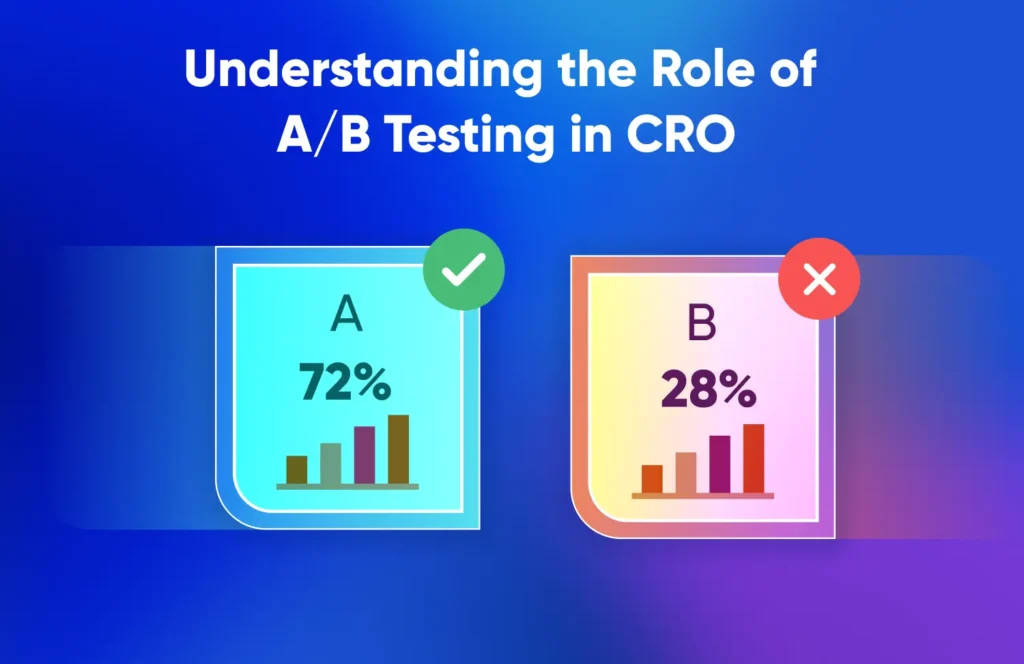
Understanding the Role of A/B Testing in CRO

Understanding the Role of AB Testing in CRO - Tatvic

Curious how A/B testing in CRO (Conversion Rate Optimization) helps turn everyday user actions into data-driven strategies that boost conversions?

Every Click, Form Submission or Sale on your site tells a story and A/B testing helps you translate those interactions into smarter decisions.

“You can’t improve what you don’t measure.”
~Peter Drucker

In a world where even a 1% lift in conversion can mean thousands of extra dollars, relying on guesswork just doesn’t cut it.

Instead, you need a systematic, repeatable approach to testing, backed by robust AB testing services and the right services partner to guide you.

Whether you’re a marketer, product manager, UX designer, or business owner, this guide will walk you through everything from the basics of ab testing to advanced statistical methods, real‑world case studies, and a step‑by‑step playbook for running your own high‑impact experiments.

Let’s dive in - >>

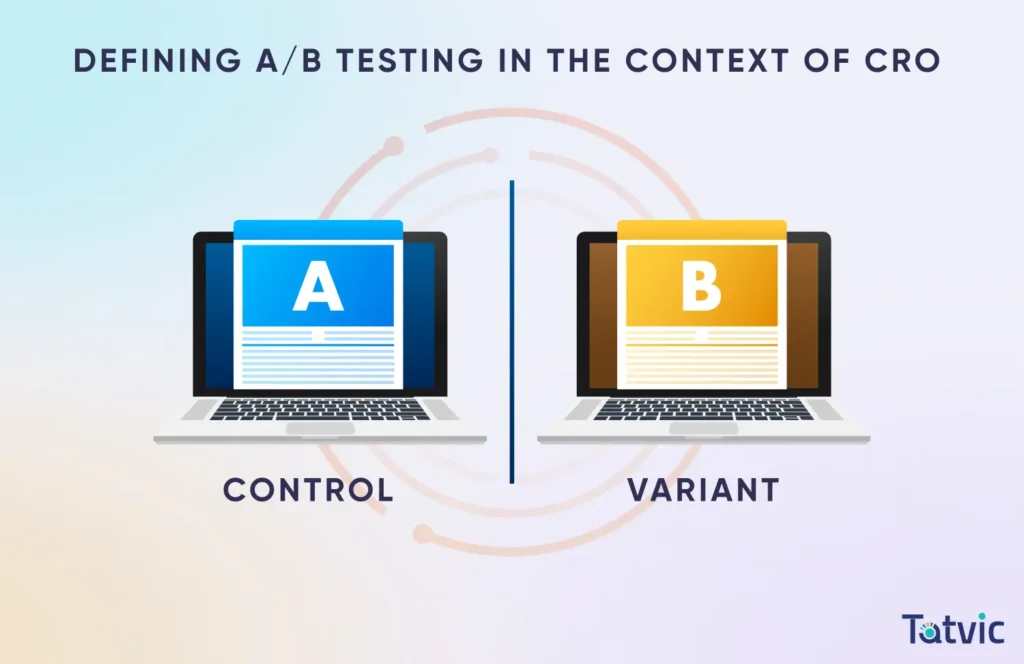
Defining AB Testing in the Context of CRO - Tatvic

Defining A/B Testing in the Context of CRO (Conversion Rate Optimization)

AB testing, also known as split testing, refers to the process of testing multiple variations of a web page to find higher-performing variations and improve the page’s overall conversion rate.

It is a continuous process that allows you to assess and check the variation that works better for your target audience based on strategic statistical analysis.

At its heart, A/B testing in CRO is a controlled experiment:

  1. You show Version A (the control) to some users and
  2. Version B (the variant) to others,
  3. Then measure which one performs better against your key metric be it Click‑Through Rate (CTR), Form Completion or Purchase Rate.

This isn’t hokey magic; it’s a rigorous approach that turns user behavior into a roadmap for improving your site.

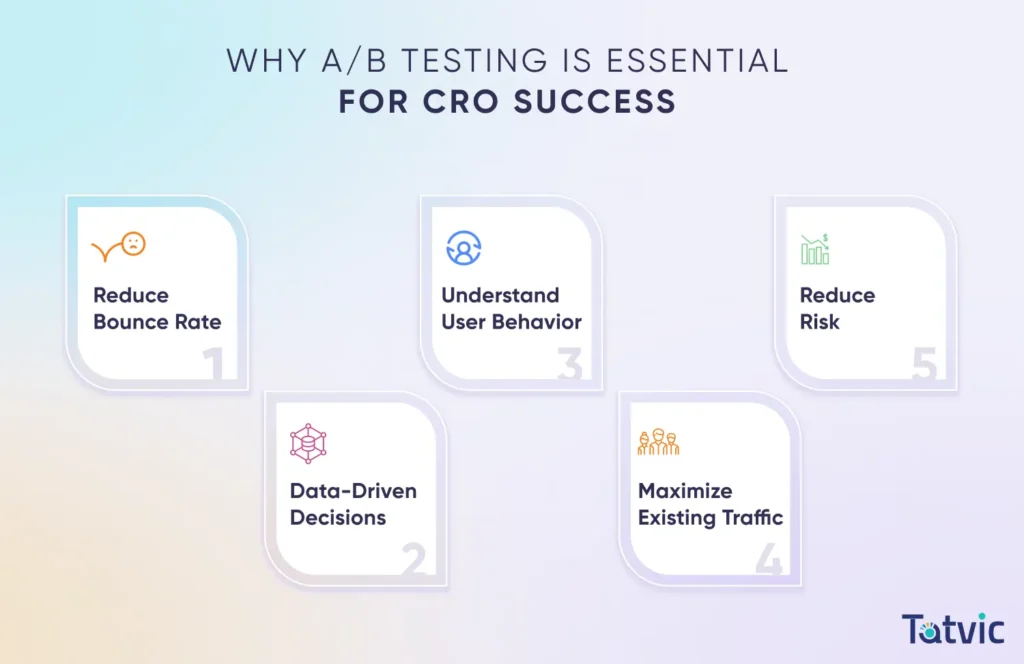
Why A/B Testing Is Essential for CRO Success

A/B testing allows you to experiment with different versions of a webpage to see what resonates most with your audience. It takes the guesswork out of optimization by relying on actual user behavior and performance metrics.

By continuously testing and refining elements like headlines, CTAs, and layouts, you can steadily improve conversion rates.

Ultimately, A/B testing empowers data-backed decision-making that leads to measurable growth in your CRO efforts.

Why invest time and budget in AB testing services??

Because it’s the only way to reliably improve conversions without guesswork.

Why AB Testing Is Essential for CRO Success - Tatvic

Here’s How Structured A/B Testing in CRO Fuels Growth:

  • Reduce Bounce Rate:

    By experimenting with different headlines, imagery, and calls‑to‑action, you give visitors exactly what they want keeping them on your site longer and reducing bounce.

  • Data-Driven Decisions:

    Move beyond gut feelings. Test hypotheses and let real user data guide you. Every test result informs your next move.

  • Understand User Behavior:

    Watch how different segments respond. Maybe desktop users love your long‑form copy, but mobile visitors prefer bullet points. AB testing services reveals these nuances.

  • Maximize Existing Traffic:

    Instead of pouring more money into ad spend, get more value from the visitors you already have. Even a 5% lift in conversion from AB testing services often outperforms a new ad campaign.

  • Reduce Risk:

    Rolling out a site‑wide redesign can backfire. With A/B tests, you can roll out incremental changes, validate them, then apply them broadly minimizing the risk of unexpected drops.

Did you know?

Companies that rigorously use A/B testing grow their revenues 1.5 to 2x faster than those that don’t.

Further, monitoring these changes allows you to have statistically significant and reliable data.

Apart from these, A/B testing also helps in:
  • Experimenting with various elements of an app, website, or landing page to boost conversion
  • Encouraging continuous improvement in user experience 
  • Improving user engagement and user navigation 
  • Improving the checkout experience
  • Getting a higher ROI (Return On Investment) without spending
Case Snippet: Titan Eye+

Through A/B testing, Tatvic boosted page views and purchases for Titan Eye+, enhancing their online revenue share. A/B and multivariate testing acted as core pillars of a winning CRO strategy.

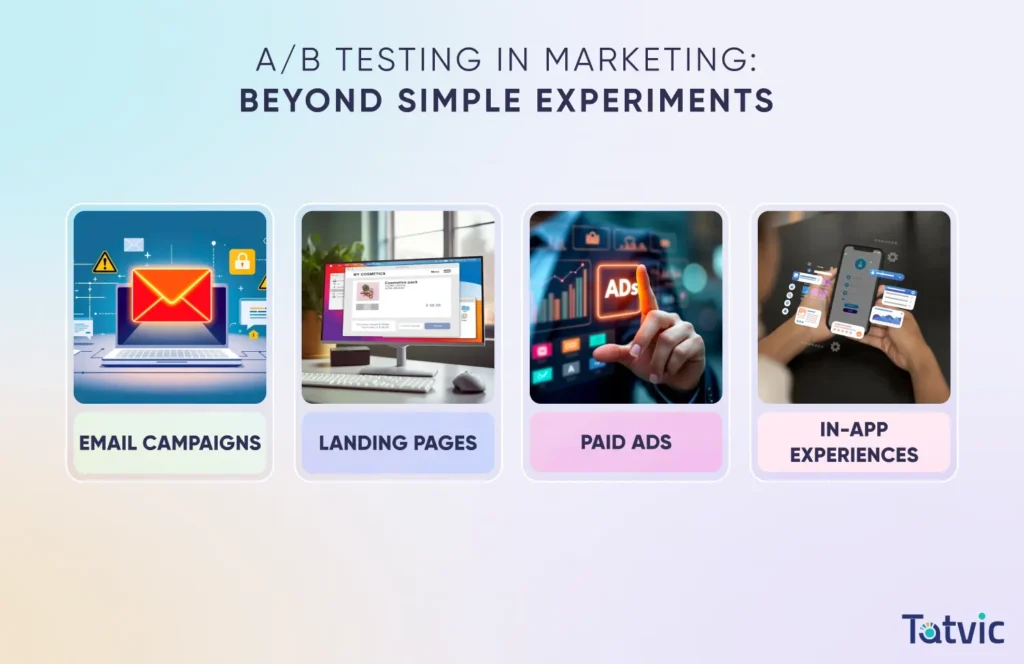
A/B Testing in Marketing: Beyond Simple Experiments

A/B testing isn’t just for websites, it’s a universal tool in any digital marketer’s toolbox.

It helps marketers make informed decisions by testing variations in emails, ads, and landing pages to see what performs best.

Whether it’s optimizing subject lines or experimenting with ad creatives, A/B testing brings clarity to campaign performance.

This method reduces assumptions and highlights what truly engages your audience.

When used consistently, it drives smarter strategies and better ROI across all channels.

AB Testing in Marketing Beyond Simple Experiments - Tatvic

Here’s how A/B Testing powers different channels:

1. Email Campaigns

  • Subject Lines: “20% off today only!” v/s “Your exclusive 20% savings inside.”
  • Preview Text: Changing the first line can boost open rates by 5-10%.
  • CTA Buttons: Shape, phrasing (“Start Now” v/s “Get Started”), and placement.

2. Landing Pages

  • Headline Positioning: Above the fold v/s further down.
  • Lead Magnet Format: PDF download v/s video series.
  • Form Length: Two fields v/s five fields.

3. Paid Advertisements

  • Ad Copy: Highlighting features v/s benefits.
  • Creative: Static images v/s short GIFs.
  • Ad Format: Carousel v/s single image.
4. In-App Experiences

  • Onboarding Flow: Step‑by‑step tutorial vs. “skip” option.
  • Feature Prompts: Modal window v/s inline tooltip.
  • Pricing Upsells: Hard sell v/s gentle reminder.

A testing tool that supports multi‑channel experiments web, email, ads  and in‑app becomes a force multiplier for your overall marketing ROI.

AB testing services become crucial for results that drive business growth. 

Types of A/B Tests in CRO (Conversion Rate Optimization) & When to Use Them

Different A/B testing methods serve unique goals in the CRO journey, from simple button color changes to complex multi-page experiments.

Knowing which type to use be it split testing, multivariate, or multi-page testing can greatly influence your outcomes.

Each test provides distinct insights into user behavior and interaction patterns.

By aligning the test type with your specific objective, you can optimize user experience and boost conversions more effectively.

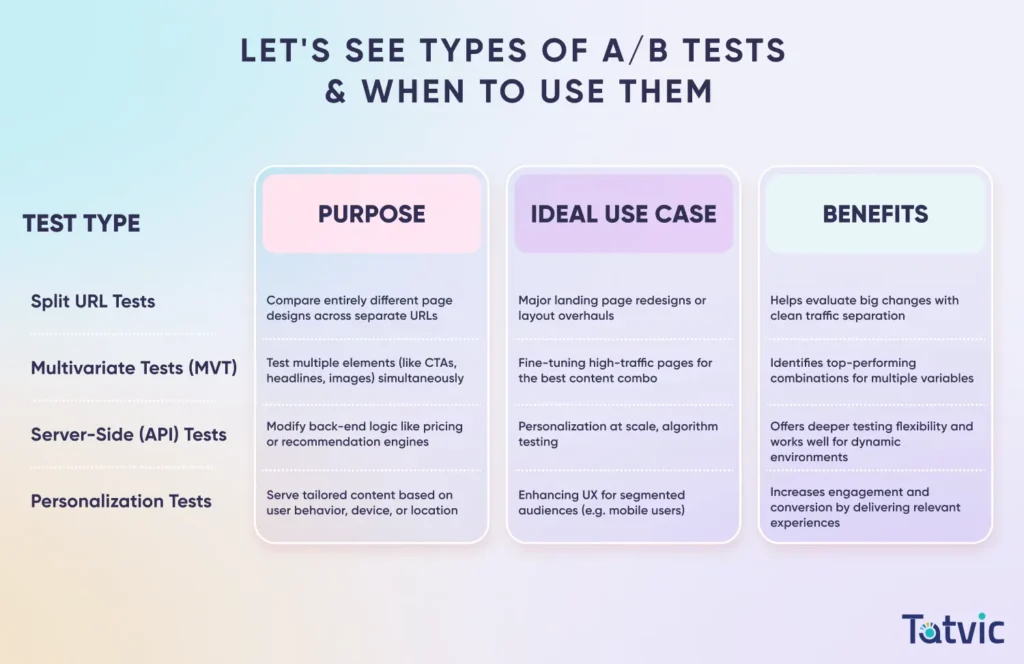
Types of AB Tests and When to Use Them-Tatvic

A Deep Dive into the Different Types of A/B Tests Used in CRO

  • Split URL Tests:

    Compare entirely different page designs on separate URLs ideal for landing‑page overhauls and commonly run via AB testing services. These tests are perfect for evaluating drastic design changes or entirely new page concepts. By directing traffic to two or more different URLs, businesses can gather clear performance insights. This method reduces bias from minor tweaks and reveals which page structure truly resonates with users. It’s especially effective for landing pages or campaign microsites.

  • Multivariate Tests (MVT):

    Test multiple elements (headlines, images, CTAs) at once on a single page to pinpoint the best combination. MVT is ideal when you’re optimizing several page elements simultaneously to see which combinations perform best. It provides deeper insights than simple A/B tests by showing interaction effects between variables. However, it requires a larger traffic volume to generate statistically significant results. Use it when you want fine-tuned control over user experience.

  • Server-Side (API) Tests:

    Experiment on backend logic (pricing engines or recommendation modules) for precise control and technical flexibility. These tests go beyond visual changes by focusing on back-end functionalities like algorithmic recommendations or dynamic pricing. Since they run at the server level, they offer faster load times and broader testing capabilities. They’re ideal for more technical teams aiming for deep customization. Server-side testing is great for scaling personalized user journeys.

  • Personalization Tests:

    Deliver tailored content to specific user segments (by behavior, device, or source) to boost relevance and conversions. With these, you serve content tailored to unique user attributes-like geography, browsing history, or referral channel. They help deliver a more relevant experience that increases engagement and conversion. Personalization tests are particularly useful for eCommerce and content-heavy platforms. Over time, they help build loyalty by making users feel understood.

Let’s See Types of A/B Tests & When to Use Them:


Types of A/B Tests & When to Use Them:

Note: Multivariate tests require at least 5× the traffic of split tests to reach statistical significance, so plan accordingly.

In practice, you’ll often run multiple test types in parallel using AB testing services that let you manage Split, MVT  and Server‑Side Tests from one dashboard.

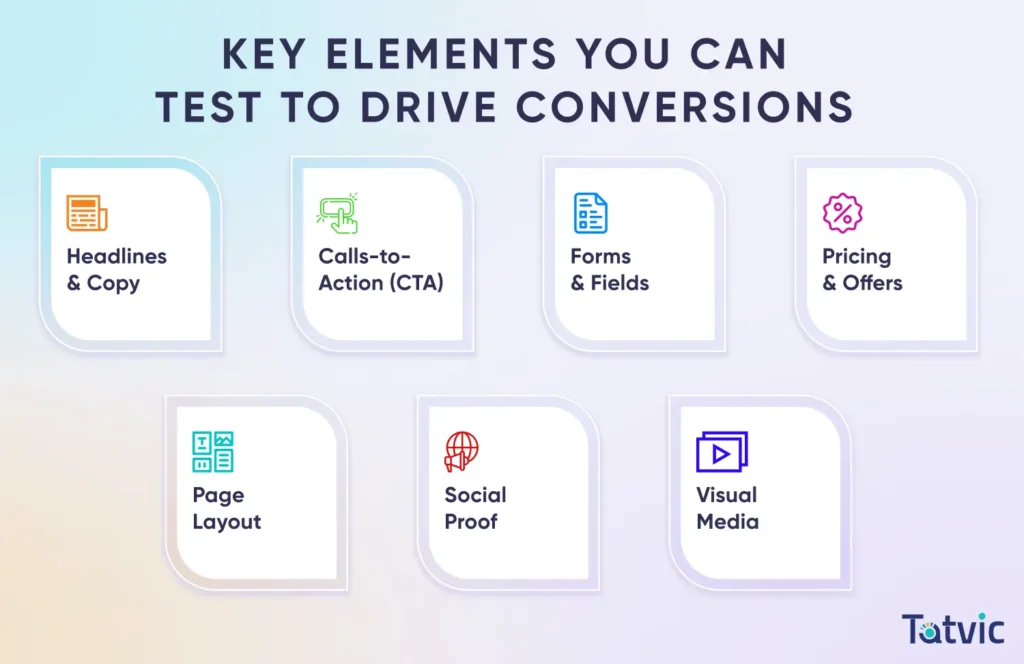
Key Elements You Can Test to Drive Conversions

There are many elements on your website that directly influence a visitor’s decision to convert and A/B testing helps you find which ones matter most.

From headlines and call-to-actions to forms and page layouts, each component plays a role in user experience.

By systematically testing these elements, you can uncover what truly resonates with your audience.

This data-driven approach helps turn insights into higher conversions over time.

Key Elements You Can Test to Drive Conversions- Tatvic Analytics

Let’s See Few of the Key Elements:

  • Headlines & Copy:

    Your headline is the first impression-make sure it clearly states what you offer and why it matters. Testing different tones, lengths, or emotional triggers helps you discover which messaging hooks your audience most effectively.

  • Calls-to-Action (CTA):

    A CTA button’s wording, size, and placement guide users toward the next step in their journey. By experimenting with phrasing (“Get Started” vs. “Try for Free”), button styles, and positioning, you’ll learn how to drive more clicks and conversions.

  • Forms & Fields:

    Every extra field you ask users to fill feels like friction-fewer inputs usually mean higher completion rates. Test variations in field count, label style (inline vs. above), and real‑time validation to find the sweet spot between data collection and user convenience.

  • Page Layout:

    How you arrange text, images, and CTAs can make or break the user flow. Try different column structures, whitespace levels, and navigation placements to see which layout keeps visitors engaged and moving toward your goal.

  • Social Proof:

    Trust badges, testimonials, and star ratings reassure visitors that they’re making the right choice. A/B test formats (short quotes vs. full case studies) and placement (inline vs. sidebar) to discover which social proof drives the biggest uplift.

  • Visual Media:

    Images, icons, and videos can boost engagement-but only if they’re relevant and high‑quality. Compare static imagery vs. short looping videos or custom illustrations vs. stock photos to learn what best resonates with your audience.

  • Pricing & Offers:

    How you present pricing-discount labels, “Most Popular” badges, or countdown timers-can create urgency and clarity. Test different offer structures (percentage off vs. dollar savings) and time‑limited messages to maximize perceived value and drive more purchases. As you incorporate each tweak, your testing backlog grows-fueling future hypotheses and making your CRO program self-sustaining. Leveraging AB testing services ensures that every test is set up correctly, analyzed properly, and iterated on for long-term performance gains.

Statistical Significance: When to Trust Your Results

Statistical significance tells you whether your A/B test in CRO results are likely due to actual changes or just random chance.

It helps ensure that the improvements you see are reliable and repeatable.

Without it, you might make decisions based on misleading data.

Reaching statistical significance gives you confidence to act on your findings and scale what works.

Gathering data is one thing. Knowing when your results are reliable is another.

Key Statistical Tests Used in CRO Are As Follows:

1. Frequentist Tests

  • Long‑Term Observation: Wait until your sample size is large enough (often tens of thousands of views).
  • P‑Value Threshold: Commonly 0.05 (95% confidence).
  • Pros: Well‑understood, widely supported.
  • Cons: Doesn’t let you peek early without risking false positives.

2. Bayesian Tests

  • Credible Intervals: Gives the probability one variant outperforms another.
  • Flexibility: You can check results mid‑test.
  • Pros: Faster insights; easier to interpret probability statements.
  • Cons: Requires more statistical sophistication and careful priors.

Quick Checklist for Reliable Tests

  • Minimum sample size achieved?
  • Run time covers full business cycles (weekends, weekdays)?
  • No major traffic source changes (like a viral tweet)?
  • One variable changed at a time?

Note: Most AB testing services include built‑in significance calculators. Use them but always double‑check with your own traffic numbers and business context.

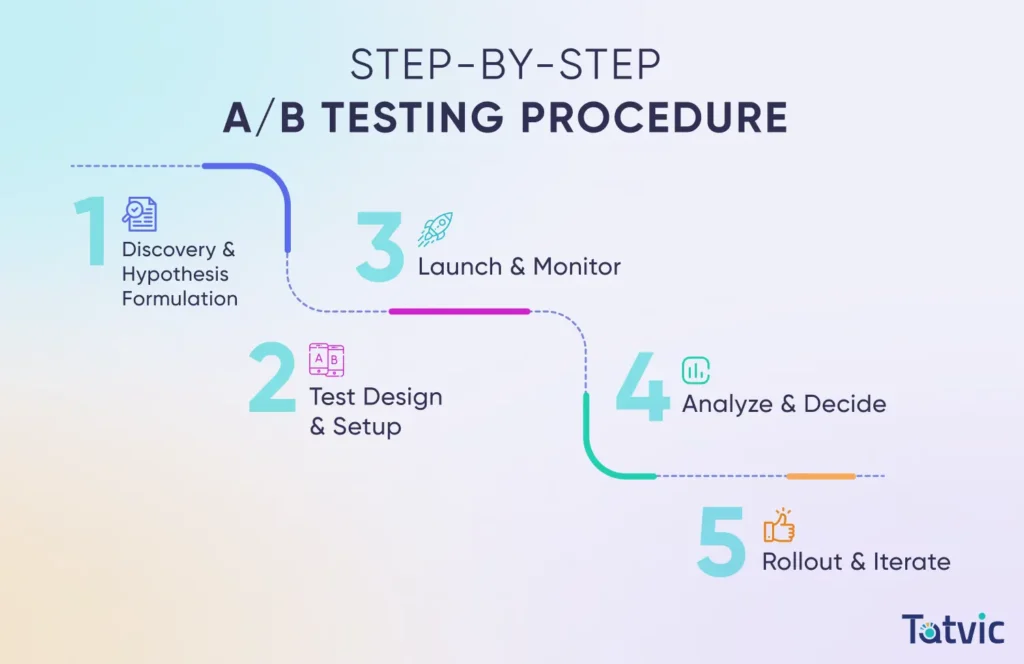
Step-by-Step A/B Testing Procedure To Be Used In CRO

A/B testing in CRO starts with identifying a goal, like boosting sign-ups or clicks, followed by forming a clear hypothesis.

Next, you create two versions of the element you’re testing and split your traffic between them.

After running the test for a set period, analyze the results to determine which version performs better.

Finally, implement the winning variation and continue testing to refine further.

A robust testing workflow keeps you organized and ensures each experiment moves you closer to better conversions.

Step-by-Step A/B Testing Procedure To Be Used In CRO

Simplified 5 Steps Process to Do A/B Tests in CRO like a pro:

Step 1: Discovery & Hypothesis Formulation 

  • Audit your analytics: Where are you leaking conversions?
  • Gather qualitative inputs: Heatmaps, session recordings, on‑site surveys.
  • Craft a clear hypothesis: “If we change the hero image to user‑generated photos, conversions will increase by 10%.”

Step 2: Test Design & Setup 

  • Choose your test type: split, MVT, or server‑side.
  • Build your variants in the testing tool (or ask your AB testing services provider to set it up).
  • Define your primary metric (e.g., “add to cart clicks”) and any secondary metrics (time on page, scroll depth).

Step 3: Launch & Monitor 

  • Start the experiment, directing an equal traffic split to each variant.
  • Monitor for technical issues: broken elements, mis‑fires on certain browsers.
  • Keep an eye on sample size projections to know when you’ll reach significance.

Step 4: Analyze & Decide

  • Let the data settle-avoid early peeking.
  • Check overall lift and segment performance (device, geography, traffic channel).
  • Decide: implement the winner, declare a tie, or scrap and learn.

Step 5: Rollout & Iterate 

  • Roll out the winning version sitewide.
  • Document results and lessons learned in your test repository.
  • Ideate the next test based on these insights-rinse and repeat.

Using professional AB testing services means you get templates, QA scripts, and reporting dashboards that streamline this entire process.

CTA: Book a Free CRO consultation today

Real-World Examples: Case Studies of A/B Testing Driving CRO

Theory is great, but real businesses need real results.

Here are three case studies showing how Tatvic’s AB testing services, powered by best‑in‑class testing tools, turned hypotheses into dollars:

1. A Travel Website saw 30% Uplift  in Conversion

Scenario: A leading travel portal faced high drop‑offs on its hotel listing page where users browsed rooms but rarely booked. Analytics and feature‑attribution analysis revealed a lack of urgency as the key barrier.

Approach: Working with Tatvic’s CRO Expert Team , they hypothesized that real‑time scarcity cues would drive bookings. In Variant B set up in our preferred testing tool, they displayed live viewer counts (“X people viewing this hotel”) and a rooms‑remaining indicator. Traffic was split 50/50 to measure impact on booking completions.

Result: The urgency‑driven variant delivered a 30% uplift in completed bookings, directly boosting revenue without any additional ad spend.

2. Online Marketplace Appointment Simplification: 70% More Lead Generation

Scenario: A large used‑car marketplace struggled to convert homepage visitors into appointment bookings. Multi‑stage navigation was causing friction, and only a small fraction of users completed the form.

Approach: Using Tatvic’s AB testing services and comprehensive Google Analytics tracking, they identified the cumbersome navigation as the culprit. Variant B replaced it with a single‐page lead‑gen form headlined “Sell Your Used Car in 30 Minutes,” and swapped out fields (city, date, time, mobile number) for previously under‑utilized inputs. The experiment ran via our testing tool with an equal traffic split.

Result: After two weeks, the desktop variant generated 66% more leads, and the mobile variant saw a 70% increase in leads, validating the simplified workflow.

3. “Book A Test Ride” Form Redesign: 93% increase in leads

Scenario: An Indian multinational motorcycle manufacturer wanted to boost submissions on its “Book Test Ride” form but saw low engagement despite healthy traffic.

Approach: Leveraging Tatvic’s AB testing services and form‑analytics data, they redesigned the form for Variant B, adding a floating CTA on the homepage and reducing the number of fields while reinforcing the call‑to‑action. The new design was implemented in their testing tool and tested across desktop and mobile.

Result: Over 27 days, the desktop variant drove a 93% increase in leads, and the mobile variant delivered a 44% lift, turning the Test Ride form into a top‑performing conversion funnel.

Key Takeaway: In each scenario, targeted experiments backed by Tatvic’s AB testing services and advanced testing tool setups, transformed user insights into significant conversion gains. Continuous testing and iteration are the engines of sustainable growth.

A/B Testing as Part of a Holistic CRO (Conversion Rate Optimization) Strategy

A/B tests are powerful, but they shouldn’t operate in a vacuum. The most successful programs integrate AB testing services into a broader CRO ecosystem to ensure your experiments are meaningful and aligned with larger goals.

To truly maximize conversion rates, A/B testing must be rooted in a deep understanding of the user journey and business objectives. When integrated with research, UX insights and real-time feedback, tests become strategic rather than tactical.

This holistic approach ensures that each experiment moves the needle in a meaningful way.

Ultimately, A/B testing becomes a continuous, cross-functional process not a one-time fix.

AB Testing as Part of a Holistic CRO (Conversion Rate Optimization) Strategy

Few things to always keep in mind:

  • User Research & Personas: Develop empathy for your users. Surveys, interviews, and analytics paint the “who” behind the clicks. AB testing services often use these insights to guide what to test and why.
  • UX Audits & Heuristic Reviews: Experts identify friction points and your test hypotheses often come from these reviews.
  • Qualitative Feedback: On‑site polls, chat transcripts, and session replays reveal why users behave the way they do.
  • Cross-Functional Collaboration: Marketing, design, analytics and development must align around your test roadmap and share ownership of results.

By embedding testing within continuous user research and cross-team workflows, you ensure each experiment builds on the last-creating a virtuous cycle of insights and optimizations.

AB testing services that align with your team structure and user data can accelerate your path to impactful, sustained conversion gains.

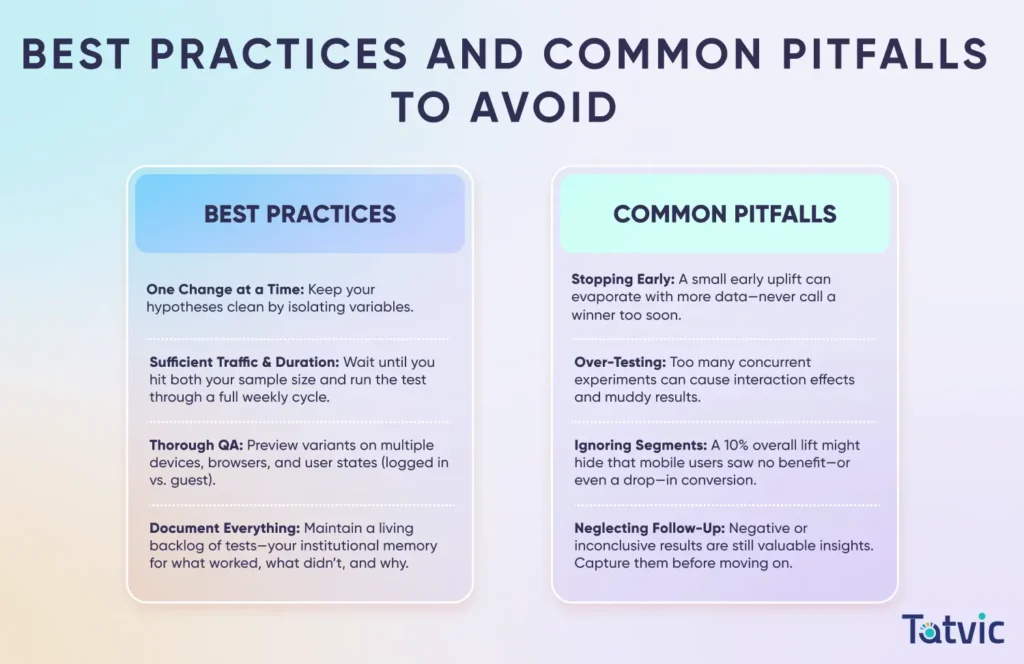
Best Practices and Common Pitfalls to Avoid

All too often, teams launch A/B testing services only to see disappointing results, these are usually because they skipped some fundamentals.

Best Practices to be followed while implementing A/B Tests in CRO

  • One Change at a Time: Keep your hypotheses clean by isolating variables.
  • Sufficient Traffic & Duration: Wait until you hit both your sample size and run the test through a full weekly cycle.
  • Thorough QA: Preview variants on multiple devices, browsers, and user states (logged in v/s guest).
  • Document Everything: Maintain a living backlog of tests your institutional memory for what worked, what didn’t and why.

Avoiding Common Pitfalls in A/B Tests for CRO Success

  • Stopping Early: A small early uplift can evaporate with more data-never call a winner too soon.
  • Over-Testing: Too many concurrent experiments can cause interaction effects and muddy results.
  • Ignoring Segments: A 10% overall lift might hide that mobile users saw no benefit or even a drop-in conversion.
  • Neglecting Follow-Up: Negative or inconclusive results are still valuable insights. Capture them before moving on.

Warning: Skipping proper QA and statistical checks can turn every experiment into a potential liability rather than a learning opportunity.

Best Practices and Common Pitfalls to Avoid - AB Testing in CRO

Conclusion: Making A/B Testing in CRO Your Growth Engine

A/B testing is more than just a tool in your CRO toolbox, it’s the very engine that powers continuous, data‑driven growth.

When you pair strategic testing with specialized AB testing services, you:

  • Reduce Risks: Incremental rollouts vs. big‑bang redesigns.
  • Uncover Deep Insights: Understand what truly moves the needle for your users.
  • Iterate Quickly: Establish a cadence of rapid experiments and quick wins.
  • Scale Sustainably: Embed testing within a culture of experimentation and cross‑team collaboration.

Conclusion Making AB Testing Your Growth Engine

At Tatvic, our AB testing services blend technical expertise, behavioral science, and hands-on support to guide you every step of the way from hypothesis generation to test setup, analysis, and rollout.

We tailor our services to your business objectives, ensuring every experiment aligns with your brand voice and long‑term goals.

Ready to put your CRO on autopilot?

Contact us today to kick off your first experiment and discover the true power of data-driven optimization.

The Role of Generative AI in Enhancing Predictive Analytics

The Role of Generative AI in Enhancing Predictive Analytics- Tatvic

Can Generative AI Revolutionize Predictive Analytics for Smarter Business Decisions??

53% of marketing leaders already use or intend to use AI for predictive analytics to get customer insights.

~Forrester survey

Discover how combining Generative AI (GenAI) with Predictive Analytics drives smarter decisions and transforms your digital strategy.

Why Combine Generative AI and Predictive Analytics 

Your company’s capacity to make better, quicker decisions in today’s data-driven economy depends on the way that you utilize data. Picture not only having the ability to accurately forecast your future trends but also the capacity to create new ideas and possibilities beyond what the data of the past can show. 

When you integrate Gen AI with predictive analytics into your business strategy, you not only unlock deeper insights but also automate processes in new, unexpected ways. Leading enterprises are leveraging Gen AI data analytics to simulate scenarios that traditional methods simply cannot match.

Why Combine Generative AI and Predictive Analytics - Tatvic

Together, Gen AI and Predictive Analytics provide you with competitive advantages, like:

  • Better Insights: By using Gen AI predictive analytics in tandem, you’re layering a creative element that releases buried insights. While predictive models predict trends based on history, Gen AI adds synthetic data and simulations to those models that capture what could be.
  • Automation & Foresight: Sophisticated predictive analytics employ statistical models and machine learning to tell you what is going to happen next. Gen AI enhances this by systematically creating possible outcomes, scenarios, or ideas for content assisting you to foresee opportunities as well as traps.
  • A Smooth Innovation Loop: With Gen AI generating new data points and predictive analytics validating these through intense testing, you establish a continuous cycle of innovation and validation. This collaboration turns your data into a living strategic asset, allowing proactive planning rather than reactive actions.
  • Real-World Impact: From creating customized marketing campaigns to streamlining supply chain operations, bringing the power of Gen AI predictive analytics together empowers you to act with assurance. Businesses employing this combination of technologies show dramatic gains in decision-making and revenue growth.

Book a Call to get Generative AI Services - >> 

What is Generative AI (Gen AI)?

Generative AI or Gen AI, is an area of artificial intelligence designed to produce novel content from raw material. Different from standard AI based only on pattern recognition, Gen AI leverages models such as neural networks and generative adversarial networks (GANs) to produce novel text, images, even music. It’s the wizardry behind generative chatbots, auto design, and others.

Key Features of Gen AI:

  • Content Creation:
    Gen AI can generate synthetic datasets, craft realistic images or simulate complete scenarios without human intervention.
  • Learning from Data:
    Gen AI digests massive amounts of data, learns from it, and produces outputs that echo human creativity. Think of Gen AI data analytics as a creative partner that can simulate ideas you’ve never considered.
  • Enhanced Innovation:
    When integrated with analytics, Gen AI can suggest innovative solutions, simulate alternative strategies, and provide creative narratives that generate potential outcomes with Gen AI predictive analytics.

What is Predictive Analytics? 

Predictive analytics is the process of applying past data, statistical models, and machine learning methods to determine the probability of future events. In other words, predictive models take what you know today and extrapolate what could occur tomorrow. Predictive models are essential for applications such as predicting sales, supply chain optimization, and risk management.

Core Elements of Predictive Analytics:

  • Data Analysis:
    It begins with collecting data from diverse sources-sales, web traffic, user behavior, etc.-and identifying patterns where Gen AI data analytics adds depth. Together, Gen AI predictive analytics delivers forecasts with rich context for smarter planning.
  • Model Building:
    Statistical and machine learning models are then trained to understand these patterns and predict future outcomes.
  • Actionable Insights:
    The end result is a set of actionable recommendations. For example, a predictive model might forecast a sales dip or a surge, enabling you to adjust your strategy accordingly.

Key Differences Between Generative AI and Predictive Analytics

While both Gen AI and predictive analytics are part of the larger AI ecosystem, their primary purposes differ considerably.

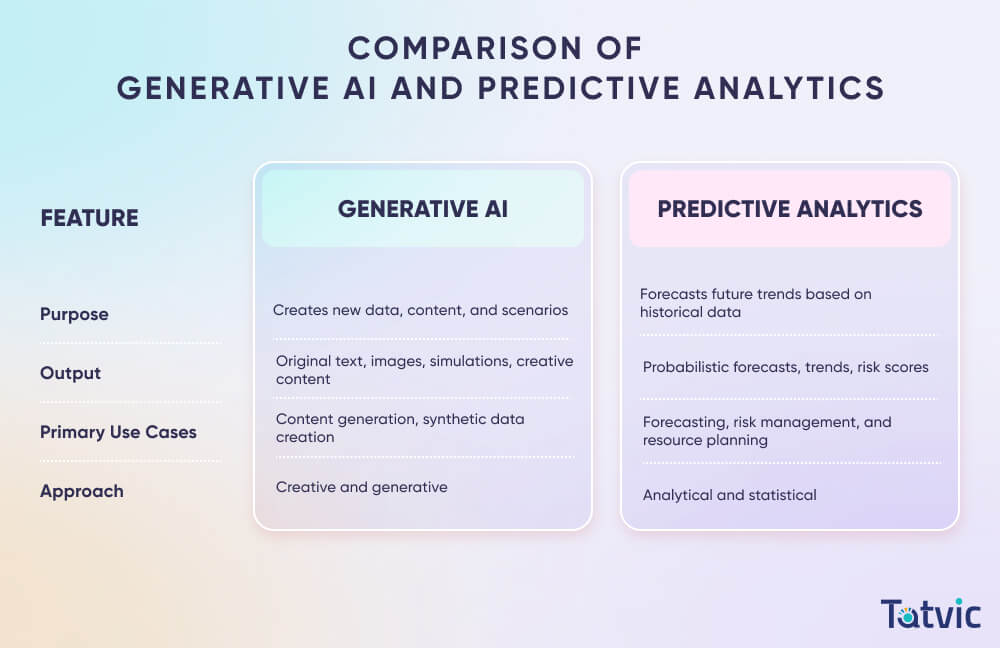
A comparative look at these technologies reveals the following:

Key Differences Between Generative AI and Predictive Analytics - Tatvic

This table highlights why integrating Gen AI with predictive analytics can result in improved overall analytics.

While Gen AI data analytics focuses on creative generation and enriching datasets, predictive analytics aims to project future outcomes reliably.

When unified, Gen AI data analytics empowers predictive frameworks with broader data sets and innovative simulation strategies enabling a more robust Gen AI predictive analytics system. This integration represents an evolution in analytics where generative capabilities boost the effectiveness of predictive insights. The synergy here transforms static data into dynamic, decision-ready intelligence.

You may also like to read 👉 Agentic AI vs Generative AI


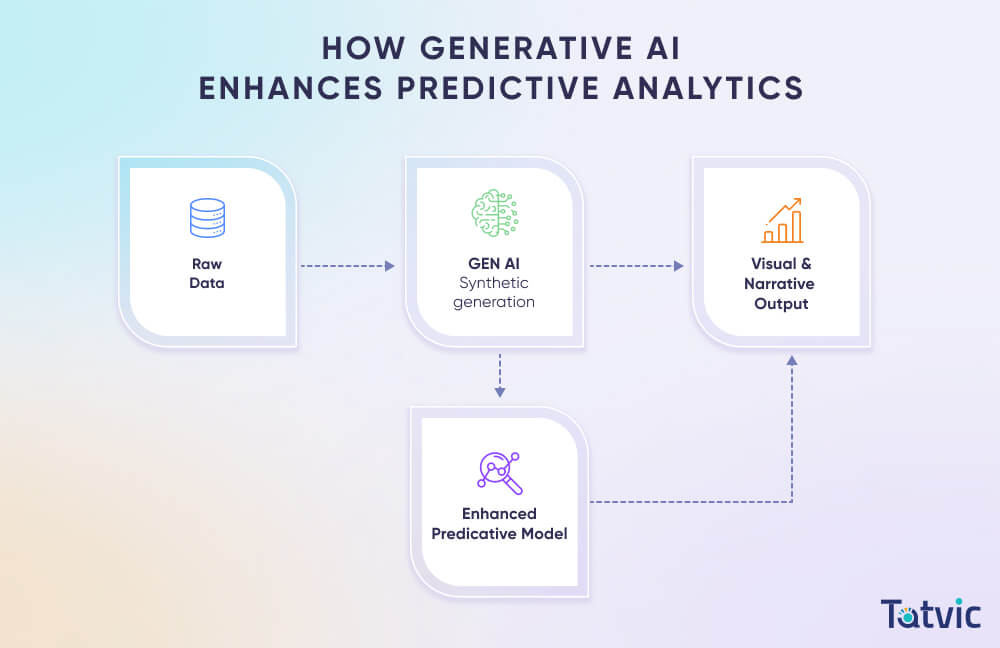
How Generative AI (Gen AI) Enhances Predictive Analytics 

Integrating Generative AI with predictive analytics offers several crucial enhancements. This is where Gen AI predictive analytics shines: it can generate artificial yet realistic data that fills gaps, making predictive analytics models more robust and less biased by limited historical data.

How Generative AI Enhances Predictive Analytics - Tatvic

Let’s Deep Dive:

1. Augmenting Datasets with Synthetic Data

  • Richer Training Data: 
    Gen AI generates synthetic data to supplement your real-world datasets. This enrichment allows predictive models to learn more robust patterns with Gen AI predictive analytics simulating rare events that might not occur frequently in historical data.
  • Improved Accuracy: 
    With a more complete dataset, predictive models can achieve higher accuracy, reducing biases and variances that stem from limited data resulting in more reliable predictive analytics outcomes.

2. Scenario Simulation

  • Dynamic Forecasting:
    Through Gen AI predictive analytics simulations, you can model thousands of potential scenarios from market downturns to sudden demand spikes. This capability of predictive tools prepares your models to handle a variety of outcomes.
  • Decision-Making Support:
    Instead of relying on static historical data, decision-makers can see a range of possibilities by a blend of Gen AI data analytics and predictive methods, empowering them to craft more resilient strategies.

3. Narrative Generation

  • Data Storytelling:
    Gen AI leverages Natural Language Generation (NLG) to transform complex data sets into clear, engaging narratives. Gen AI predictive analytics creates automated reports that explain predictive insights in plain language to help leaders grasp key findings quickly.
  • Actionable Insights:
    By coupling quantitative data with qualitative narratives, teams can better understand the “why” behind the numbers and act more decisively by leveraging predictive analytics.

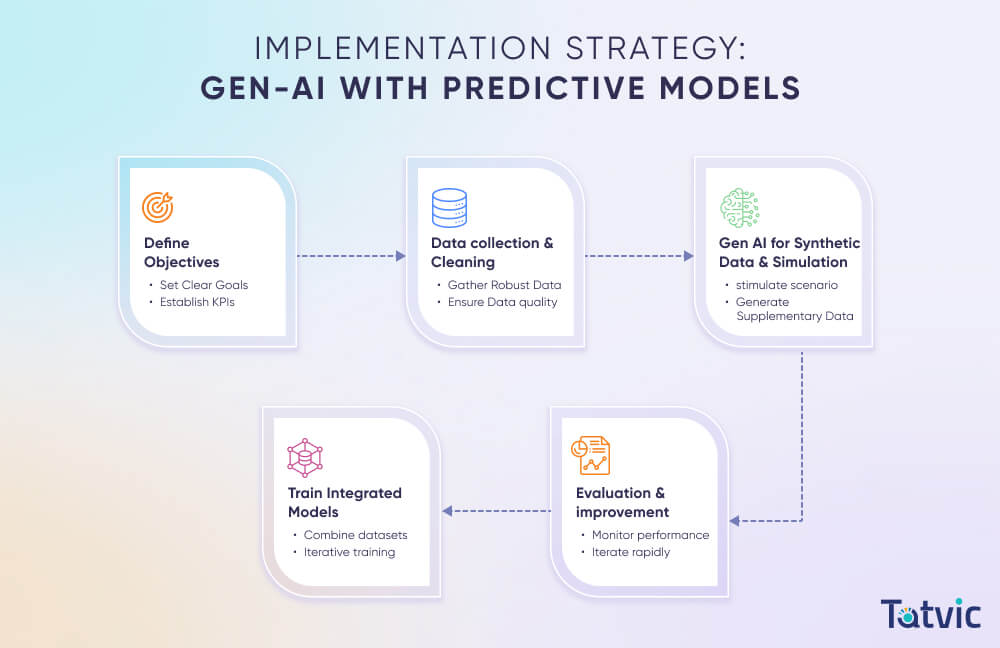
Implementation Strategy: Integrating  Generative (GenAI) with Predictive Models

Successfully combining these technologies necessitates a well-thought-out approach. It involves aligning data infrastructure, refining model training, and ensuring outcome interpretability. With the right strategy, businesses can unlock powerful insights and make faster, smarter decisions.

Implementation Strategy Integrating  Generative (GenAI) with Predictive Models

Follow these strategic steps to integrate Gen AI with your predictive analytics models:

1. Define Objectives

  • Set Clear Goals:
    Determine what you expect to achieve-whether it’s improved forecasting accuracy, personalized content generation, or enhanced customer engagement.
  • Establish KPIs:
    Identify key performance indicators that measure both the creative outputs from GenAI and the forecasting accuracy of predictive models.

2. Data Collection & Cleaning

  • Gather Robust Data:
    Collect comprehensive datasets from various internal and external sources.
  • Ensure Data Quality:
    Cleanse and validate your data to create a solid foundation. High-quality data is the cornerstone of both Gen AI and predictive modeling.

3. Leverage GenAI for Synthetic Data & Simulation

  • Generate Supplementary Data:
    Use Gen AI to produce synthetic data that fills in the gaps. This not only enhances your dataset but also mitigates issues of data scarcity.
  • Simulate Scenarios:
    Run simulations for rare or complex scenarios that can influence business outcomes. These “what-if” analyses boost the resilience of your predictive models.

4. Train Integrated Models

  • Combine Datasets:
    Merge your enhanced datasets-real and synthetic-into your predictive analytics framework.
  • Iterative Training:
    Employ an iterative training process where models are continuously updated based on new, incoming data, ensuring adaptability and accuracy.

5. Evaluation & Continuous Improvement

  • Monitor Performance:
    Regularly track performance metrics and adjust your models accordingly.
  • Iterate Rapidly:
    Use iterative feedback loops to refine both Gen AI and predictive components, ensuring that the integrated system evolves with your business needs.

Real-World Use Cases of Integrating Generative AI with Predictive Analytics

Integrating GenAI with predictive analytics is not just a theoretical exercise, it’s driving measurable success across various industries.

Here are some real-world examples where Gen AI Predictive Analytics is transforming industries:

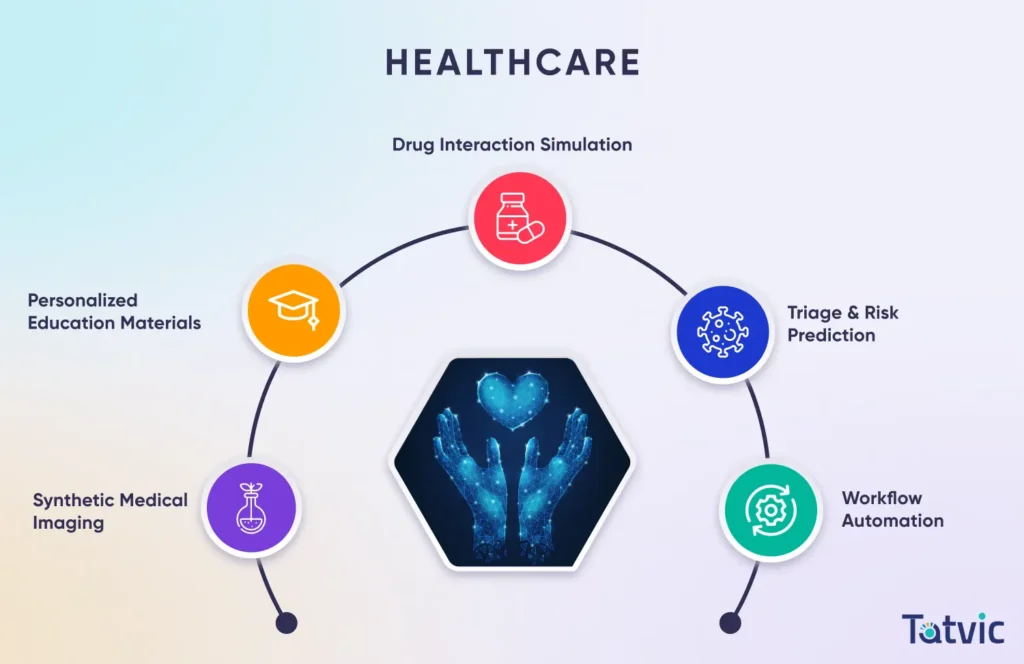
1. Healthcare

  • Enhanced Diagnostics:
    Hospitals use synthetic patient data generated by Gen AI to augment real-world datasets, resulting in more accurate diagnostic models and personalized treatment plans.
  • Simulated Scenarios:
    Gen AI data analytics framework results in enhanced patient care. Medical centers simulate treatment responses to identify the most effective interventions for diverse patient profiles.

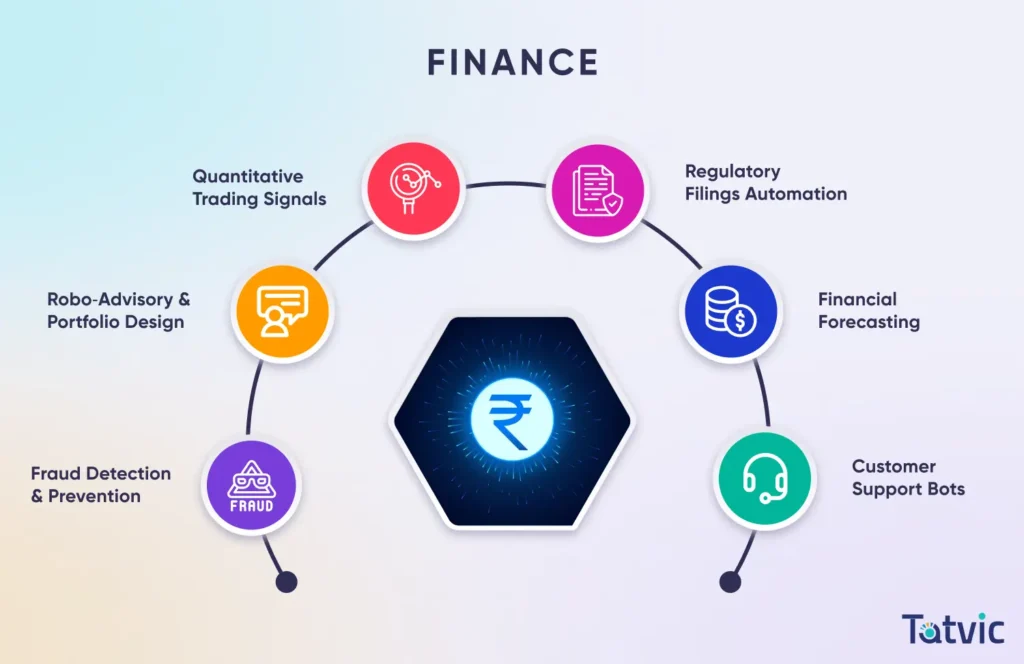
2. Finance

  • Risk Management:
    Financial institutions integrate Gen AI predictive analytics-generated data to simulate market scenarios, improving risk assessment models.
  • Fraud Detection:
    By enriching transaction datasets with synthetic data using Gen AI data analytics, banks enhance predictive models that detect and prevent fraudulent activities. This improves the model using Gen AI predictive analytics with enriched datasets.

Real-World Use Cases of Integrating Generative AI with Predictive Analytics - Tatvic

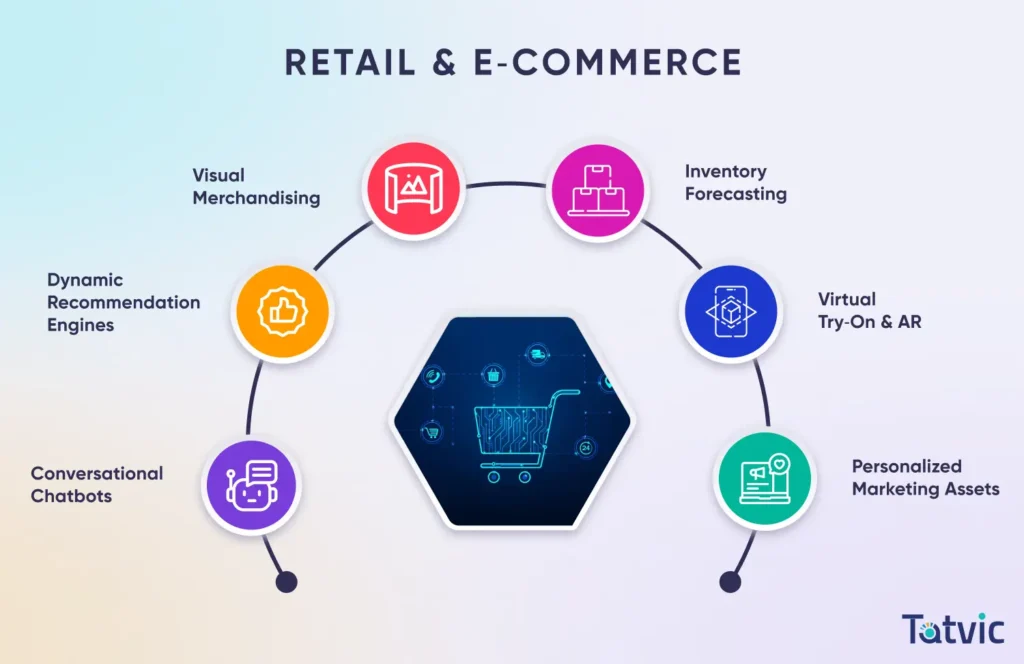
3. Retail

  • Personalized Marketing:
    Retailers utilize Gen AI to craft unique promotional content, while predictive analytics forecast product trends and consumer behaviors. Gen AI predictive analytics helps brands not only predict what products will be popular but also design compelling campaigns.
  • Inventory Optimization:
    Synthetic data supplementation helps anticipate demand spikes, enabling better inventory management and pricing strategies.

4. Manufacturing & Supply Chain

  • Process Optimization:
    Manufacturers simulate production environments using Gen AI-generated scenarios, leading to improved efficiency and reduced downtime.
  • Demand Forecasting:
    Combining real-world and Gen AI data analytics enables more accurate demand forecasts, ensuring optimal resource allocation.

Benefits of Using Generative AI (Gen AI) in Predictive Analytics

Blending Gen AI with predictive analytics isn’t just innovative, it’s transformational. It empowers businesses to move from reactive decisions to proactive strategies. With AI-generated insights, teams can identify trends earlier and respond with precision. This integration enhances forecasting accuracy and boosts operational efficiency. Ultimately, it helps deliver more personalized, data-driven customer experiences.

Here are some prominent benefits you can expect:

1. Accuracy Boost

  • Richer Data, Better Insights:
    Gen AI data analytics filling in the gaps, your predictive models benefit from a more comprehensive training set of synthetic data. This directly translates to more accurate forecasts and reduced prediction errors.
  • Reliable Scenario Simulation:
    Detailed simulations allow you to prepare for rare events, making your risk assessments more thorough.

2. Faster Speed to Insight

  • Accelerated Report Generation:
    Automated narrative generation powered by Gen AI transforms raw data into actionable insights rapidly.
  • Reduced Decision Cycle:
    With continuous testing and iteration, businesses can respond to market changes more swiftly, thereby gaining an edge over competitors.

3. Personalization at Scale

  • Tailored Experiences:
    Combine creative content generation from Gen AI with precise predictive models to deliver personalized recommendations that resonate with each customer.
  • Enhanced Engagement:
    Data-driven personalization not only boosts conversions but also nurtures long-term customer loyalty.

4. Cost Efficiency

  • Optimized Marketing Spend:
    Improved conversion rates mean that every marketing dollar works harder, reducing the overall cost per acquisition.
  • Maximized ROI:
    Better forecasting and scenario planning ensure that resources are allocated optimally, driving sustainable revenue growth.

Let’s see How Gen AI Enhances Traditional Analytics:

Benefits of Using Generative AI (Gen AI) in Predictive Analytics

The evolution from static analytics to dynamic Gen AI predictive analytics significantly redefines how quickly and effectively businesses can respond to market changes.

Schedule your FREE Consultation Today and take the first step toward smarter strategies and higher business growth.

Challenges and Ethical Considerations

These challenges include data privacy concerns, model transparency, and the risk of algorithmic bias. Ensuring ethical use of AI requires strong governance and clear accountability. Businesses must also navigate the complexities of integrating AI with legacy systems. Addressing these hurdles is essential to unlock AI’s full potential responsibly.

Challenges and Ethical Considerations of using Gen AI in Predictive Anlaytics

Despite the transformative benefits, integrating Gen AI with predictive analytics comes with its share of challenges:

1. Data Authenticity and Model Transparency

  • Ensuring Synthetic Data Reliability:
    One critical challenge is to make certain that synthetic data generated by Gen AI data analytics aligns closely with real-world scenarios. Rigorous validation processes must be in place to ensure that the enhanced dataset is authentic and unbiased.
  • Model Explanability:
    Transparency in how predictions are generated is essential. Stakeholders need to trust that the model’s outputs are valid. Investing in explainable AI with predictive outcomes can help bridge this gap.

2. Regulatory and Privacy Concerns

  • Compliance with GDPR, HIPAA, etc.:
    In sectors like healthcare and finance, using synthetic data must comply with strict regulatory standards when applying Gen AI. Data privacy remains a paramount concern; therefore, robust data governance practices are essential.
  • Data Security:
    Safeguarding both real and synthetic data against breaches and misuse is vital to protect your organization’s reputation and maintain regulatory compliance.

3. Avoiding Data Hallucinations

  • Mitigating Inaccurate Outputs:
    A known risk with Gen AI predictive analytics is the generation of “hallucinated” data-outputs that are inaccurate or misleading. Continuous monitoring, quality assurance, and feedback loops are necessary to minimize these risks and validate all insights within your analytics framework. .
  • Balancing Innovation with Caution:
    While Gen AI opens innovative possibilities, tempering creativity with a realistic evaluation of outputs is essential to avoid misinterpretation of data. 

Future Outlook of Using Generative AI in Predictive Analytics

The integration of Gen AI and predictive analytics is not a passing trend, it’s poised to be a cornerstone of future business strategy.

Here are several emerging trends that promise to further reshape the analytics landscape:

1. Hybrid AI Models

  • Evolution to Hybrid Solutions:
    Future systems will merge the creative capabilities of GenAI with the analytical rigor of predictive algorithms. These hybrid models will offer even more nuanced insights and dynamic forecasting, setting new standards in analytics.

2. Explainable AI

  • Greater Transparency:
    As the demand for accountability grows, advancements in explainable AI will ensure that the outputs of Gen AI predictive analytics systems are not only accurate but also understandable. This increased transparency will drive trust across organizational levels.

3. Domain-Specific Tools

  • Tailored Applications:
    Expect to see specialized Gen AI data analytics platforms designed for specific industries such as healthcare, finance, and retail. Customized solutions will address unique sector challenges and deliver finely tuned insights.
  • Deep Integration:
    Industries will further integrate these tools with existing systems, ensuring a seamless workflow that incorporates real-time data into next-gen analytics systems that empower the decision making process.

4. Increased Investment and Innovation

  • Rapid R&D Growth:
    With strong market demand, investments in research and development will accelerate. This means new algorithms, more comprehensive datasets, and continuously improving integration techniques.
  • Global Competitive Advantage:
    Businesses that embrace Gen AI predictive analytics early will not only streamline their operations but also gain a significant competitive edge in fast-evolving markets.

GEN AI in Predictive Analytics - Future Outlook - Tatvic

Conclusion

In summary, the fusion of Gen AI and predictive analytics is revolutionizing how businesses make decisions.

This integration drives:

  • Deeper Insights:
    With Gen AI data analytics enriching data inputs, predictive models become more robust and nuanced.
  • Faster Decision-Making:
    Automated insights and rapid scenario simulation mean your business can act swiftly in a competitive marketplace.
  • Personalized Customer Experiences:
    Tailor your strategies to individual customer needs at scale, leading to better engagement and loyalty.
  • Reduced Uncertainty:
    By predicting trends more accurately, you can plan proactively rather than reactively.

Every missed conversion is a lost opportunity. By partnering with a forward-thinking Conversion Rate Optimization agency and incorporating Gen AI predictive analytics, your business sets the stage for sustained growth. This dynamic combination empowers you to forecast potential challenges, adapt quickly to market shifts, and realize new opportunities-all while optimizing your overall operational efficiency.

Ready to transform your business through innovative AI-driven analytics?

Book Your Free Consultation Today and start your journey toward smarter, more profitable decision-making.

By following this comprehensive roadmap, you not only embrace the next evolution of predictive analytics and Gen AI but also ensure that every decision is informed by data, enriched with creative insights, and executed with precision. Stay ahead of the curve and transform your website’s potential into measurable revenue growth by harnessing the power of Gen AI predictive analytics.

The Rise of Generative AI Services: Trends, Innovations and Future

The Rise of Generative AI Services Trends, Innovations and Future - Tatvic

What do you think the Rise of Generative AI Services is a Revolutionary Disruption or Just Another Tech Bubble Waiting to Burst?

Let’s deep dive…

 The global Generative AI market is projected to reach $109.37 billion by 2030, growing at a CAGR of 35.6%

~Grand View Research, 2024

Why Generative AI Services Matter in Today’s World?

Generative AI has rapidly evolved from academic curiosities into mission‑critical engines of creativity, automation, and strategic growth.

What once began as niche research in neural networks now powers marketing campaigns that adapt in real time, fuels biotech discoveries of novel compounds, and transforms how teams ideate and execute.

A New Frontier of Collaboration
Think of Generative AI as an intelligent collaborator, one that can imagine, prototype, and optimize alongside human teams.

From generating hyper‑realistic product visuals to drafting personalized outreach emails or surfacing scientific insights from massive datasets, Gen AI services are reshaping workflows and expanding what’s possible.

In this space, we’ll discuss Gen AI’s evolution, examine today’s hottest trends & breakthroughs and peer into the innovations and challenges ahead.

Let’s Deep Dive into Generative AI ->>

What Is Generative AI (GenAI)?

Generative AI refers to models and subset of AI services designed to create new content whether that’s text, images, audio or structured data by learning patterns from existing examples. Unlike traditional AI systems that classify or predict, Gen AI generate fresh outputs in response to prompts.

To function effectively, Generative AI relies on foundational models that power its capabilities across different domains.

What Is Generative AI - Tatvic

Here are the core building blocks that make it all possible:

1. Large Language Models (LLMs)

These are powerful AI systems trained on enormous volumes of text to understand and generate language that feels natural.

  • What they do: They can write articles, summarize content, answer complex questions, or even generate computer code.
  • Real-world use: Tools like GPT-4 help power AI chatbots, writing assistants, coding helpers, and more.

2. Diffusion Models

These models create images from text by starting with random noise and gradually refining it into something meaningful.

  • What they do: Give them a description like “a sunset over the mountains in watercolor style,” and they’ll generate a matching image.
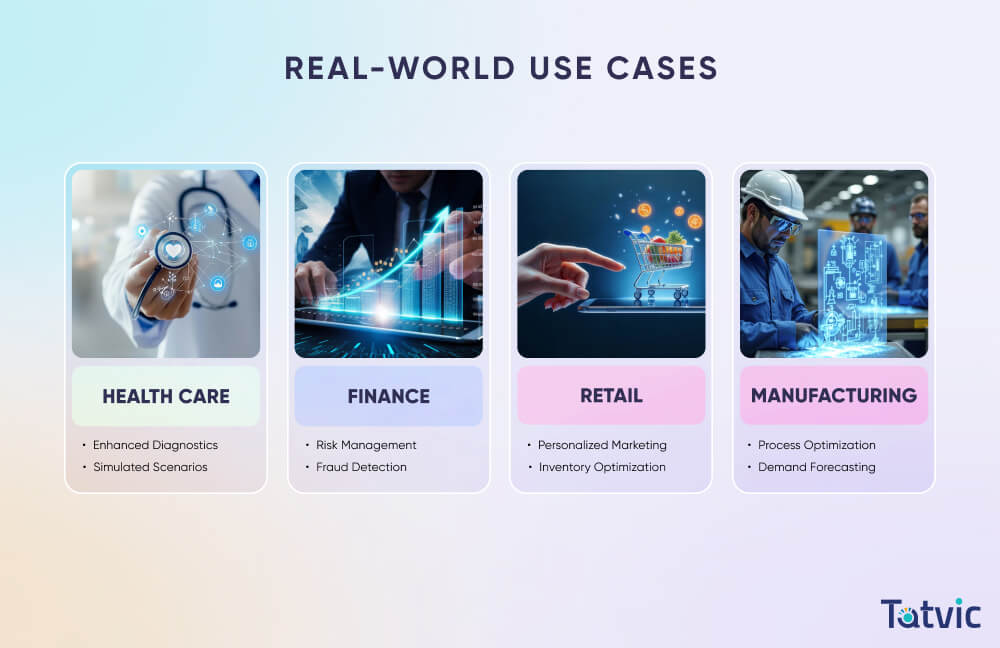
  • Real-world use: Used for creative tasks such as designing visuals, generating digital art, and building content for marketing or entertainment.

3. Reinforcement Learning (RL)

This training technique teaches AI by rewarding good decisions and learning from mistakes over time kind of like how humans learn new skills.

  • What they do: The model keeps improving its behavior by experimenting, getting feedback, and adjusting.
  • Real-world use: It’s used in areas like robotics, game development, and improving the quality of AI responses in conversational tools.

Understanding how Generative AI works helps decode their capabilities: you feed a prompt or dataset into the model, and it returns novel content that reflects learned patterns. This contrasts with more “narrow” AI services like recommendation engines that focus on selecting from existing items. Generative AI services imagine rather than just analyze, it opens the door to applications that were previously out of reach.

Current Trends in Generative AI Services

Generative AI services are evolving rapidly, with innovations driving content creation, personalization and automation across industries.

These trends are shaping how businesses engage users and streamline creative processes.

Current Trends in Generative AI Services - Tatvic

Let’s explore few of the Key Trends:

1. Multimodal AI Systems

Modern Gen AI services are multimodal, handling text, images, and audio in one go. Platforms like GPT‑4 and Gemini let you upload a product photo and instantly receive ad copy, video scripts, and hashtags. This convergence streamlines creative workflows across teams.

Key Benefits:
  • Unified Inputs & Outputs: Process multiple data types in one request.
  • Cross‑Functional Efficiency: Designers, writers, and developers work from the same AI‑driven brief.
  • Rapid Prototyping: Turn a single asset into text, video, and more without switching tools.

2. AI‑Powered Code Generation

Developers use services like GitHub, Copilot and Code Whisperer to auto-complete code, catch errors, and scaffold modules. By handling repetitive tasks and adhering to team conventions, these tools let engineers focus on critical problem-solving.

Workflow Improvements:
  • Starter Code Generation: Replace manual boilerplate with AI‑scaffolded templates.
  • Instant Code Review: Get on‑the‑fly feedback and style suggestions within your IDE.
  • AI‑Driven Debugging: Spot errors and edge cases faster than traditional tracing.

3. Hyper‑Personalized Marketing

Generative AI enables marketers to craft personalized emails, landing pages, and chatbot replies at scale. By analyzing user behavior in real time, it boosts engagement and conversions without manual effort.
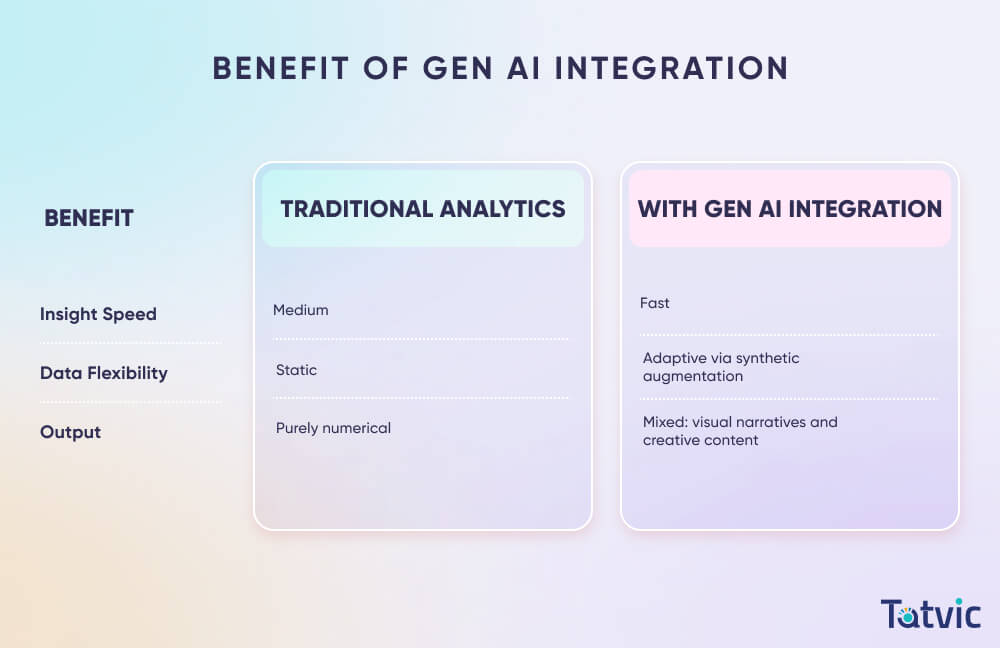
Capabilities at a Glance:
  • Dynamic Email Content: Personalized subject lines and body copy per recipient.
  • Segmented Landing Pages: Auto‑assembled layouts and offers for each audience cohort.
  • Live Chatbot Scripting: Context‑aware responses that adapt mid‑conversation.

4. AI in Scientific Discovery

R&D teams leverage Generative AI to mine scientific literature, design experiments, and propose novel molecules or hypotheses. These tools accelerate breakthroughs so researchers can focus on validation and real‑world impact.

Applications in Research:
  • Literature Mining: Summarize thousands of papers to surface key insights.
  • Hypothesis Generation: Propose new molecular structures or material compositions.
  • Experiment Design: Auto‑draft protocols and workflows for lab testing.

How Generative AI (GenAI) Transforms Traditional Workflows: A Side-by-Side Comparison

How Generative AI (GenAI) Transforms Traditional Workflows A Side-by-Side Comparison

5. Market Growth & Ecosystem

Generative AI is no longer just a buzzword, it’s a booming business.

In just a few years, investments have skyrocketed from pilot projects to multi-billion-dollar commitments.

By 2027, global spending on cloud-based Gen AI services is expected to surpass $20 billion, which is reflecting a compound annual growth rate of 85.9% from 2023 to 2027.

~ SDN Tech Solutions

Companies of all sizes, from enterprise giants to growing startups are jumping in, building teams dedicated to AI strategy, governance, and integration.

What’s driving this wave?

It’s never been easier to get started!

Thanks to pre-trained models, plug-and-play APIs, and “AI as a Service” platforms, even small businesses can launch custom AI workflows in days, not months. Barriers to entry are falling fast.

Current Trends in Generative AI Services - Market Growth & Ecosystem

Meanwhile, a dynamic ecosystem of vendors is expanding the playing field. You’ve got:

  • Tech giants offering end-to-end AI platforms,
  • Agile startups solving niche use cases, and
  • Specialist consultancies fine-tuning models for specific industries.

Whether you’re just beginning or scaling Gen AI across teams, there’s a service partner ready to meet your needs while keeping compliance and governance top of mind.

And it’s not just tools that are evolving the talent landscape is too. Universities, online platforms, and bootcamps are training the next wave of Gen AI talent. Companies are investing in employee upskilling and running internal innovation challenges to build real-world expertise.

Bottom line: the ecosystem is growing rapidly and the winners will be those who not only deploy Gen AI but scale it strategically, responsibly, and with people at the center.

Gen AI Innovations Shaping the Future

Generative AI services are leaping forward, fueled by smart specialization, ethical guardrails and tools that put creative superpowers in everyone’s hands.

Here’s what’s turning heads right now:

1. Specialized AI Models

No more one‑size‑fits‑all!

Today’s Gen AI services include domain‑specific models pre‑trained on niche datasets like medical journals or legal briefs. You get outputs that are accurate, compliant, and ready to use without endless fine‑tuning.

These models are:

  • Trained on industry data (healthcare, finance, engineering)
  • Reduces manual review and post‑processing
  • Ensures sector‑appropriate terminology and style

2. Ethical & Explainable AI

As AI moves into high‑stakes workflows, trust is non‑negotiable.

Ethical Gen AI services bake in bias checks, privacy safeguards, and clear reasoning so you can see exactly how a suggestion was generated.

These AI Agents can:

  • Bias mitigation layers to flag unfair outputs
  • Data‑privacy protocols aligned with GDPR, HIPAA, etc.
  • Self-explanatory dashboards that trace decision path

3. AI‑Native Creative Tools

Designers and marketers rejoice platforms like Adobe Firefly, Runway, and Canva now embed Gen AI services for instant, on‑brand variations. They can think banner ads in seconds, video cuts on demand, and automated brand‑compliant layouts.

These tools can also help in:

  • One‑click generation of color palettes, layouts and copy
  • In‑app controls to tweak style, tone and format
  • Accessibility for non‑technical users; no coding required

These innovations aren’t just cool, they’re reshaping workflows, boosting productivity, and making Generative AI services indispensable across every industry.

Industry Applications of Generative AI Services

Generative AI services are no longer confined to labs. They’re delivering real value in sectors as diverse as healthcare, finance, and retail.

By automating complex tasks, personalizing experiences and accelerating decision‑making, these AI services help organizations stay agile and customer focused.

Let’s see How Generative AI Services Are Revolutionizing Key Industries:

1. Gen AI Services in Healthcare Industry

Generative AI services are transforming patient care from diagnosis to discharge. By creating realistic synthetic data, automating content, and predicting treatment outcomes, they help providers deliver faster, more accurate, and more empathetic care.

Industry Applications of Generative AI Services in Healthcare Industry

Let’s See Few More Use Cases:

  • Synthetic Medical Imaging: Generate diverse, anonymized scans for radiologist training and AI model calibration.
  • Personalized Education Materials: Auto‑draft tailored guides, discharge instructions, and medication reminders.
  • Drug Interaction Simulation: Use specialized models to propose molecular structures and predict efficacy, cutting R&D cycles.
  • Triage & Risk Prediction: Analyze symptoms and vitals to flag high‑risk cases and prioritize interventions.
  • Workflow Automation: Populate EMRs, schedule appointments, and streamline billing with AI‑generated summaries.

2. Gen AI Services in Finance Industry

In a sector where milliseconds and compliance matter, Generative AI services drive speed, accuracy, and transparency. From detecting fraud patterns to generating regulatory reports, these AI tools help financial institutions stay competitive under volatile conditions.

Industry Applications of Generative AI Services in Finance Industry

Let’s See Few More Use Cases:

  • Fraud Detection & Prevention: Identify anomalous transactions in real time using generative anomaly‑detection models.
  • Robo‑Advisory & Portfolio Design: Craft personalized investment strategies and dynamically rebalance portfolios.
  • Quantitative Trading Signals: Generate algorithmic trading ideas by synthesizing market, news, and social‑media data.
  • Regulatory Filings Automation: Auto‑draft compliance documents, risk disclosures, and audit reports.
  • Financial Forecasting: Produce scenario‑based revenue and expense projections to guide strategic planning.
  • Customer Support Bots: Power natural‑language assistants to answer account queries and guide users through transactions.

3. Gen AI Services in Retail & E‑commerce Industry

From first site visit to final checkout, Generative AI services elevate every step of the customer journey. By personalizing product discovery, optimizing inventory, and automating content, they help retailers capture attention and drive conversion.

Industry Applications of Generative AI Services in Retail & Ecommerce

Let’s See Few More Use Cases:

  • Conversational Chatbots: Engage shoppers with context‑aware recommendations and real‑time support.
  • Dynamic Recommendation Engines: Suggest products based on user behavior, mood, or visual similarity.
  • Visual Merchandising: Auto‑generate banners, carousels, and style guides tailored to seasonal trends.
  • Inventory Forecasting: Analyze sales history, social buzz, and market signals to optimize stock levels.
  • Virtual Try‑On & AR: Create AI‑generated overlays for apparel, accessories, or cosmetics directly in‑browser.
  • Personalized Marketing Assets: Auto‑draft email campaigns, SMS offers, and social posts that reflect user preferences.

By embedding Generative AI services across these industries, organizations not only streamline operations but also unlock new avenues for innovation and customer delight.

Challenges and Considerations of Using Generative AI Services

Generative AI services unlock new possibilities, but they also introduce risks that impact trust, compliance, and user skills.

Below are the top challenges with a concise overview and practical pointers:

1. Data Privacy & Security

Generative models train on massive datasets sometimes including sensitive or proprietary information raising concerns about unauthorized data use and leaks.

Key Considerations to keep in mind:

  • Ensure GDPR/HIPAA/DPDP compliance with clear opt‑in policies
  • Anonymize or pseudonymize training data before use
  • Implement strict access controls and audit logs

2. AI Hallucinations & Misinformation

Since these models predict text based on patterns rather than facts, they can “hallucinate” plausible-sounding but incorrect outputs.

Key Considerations while facing such issue:

  • Require human review for high‑stakes content (health, finance, legal)
  • Use models with built‑in fact‑checking or citation features
  • Establish a validation process before publishing AI‑generated material

3. Intellectual Property & Ownership

AI-generated outputs often draw on copyrighted source material, creating uncertainty around who owns and can monetize the results.

Key Considerations to tackle the same:

  • Clarify licensing terms with your AI provider
  • Train models on properly licensed or public‑domain datasets
  • Monitor evolving AI/IP case law to stay compliant

4. Bias, Fairness & Ethics

Models inherit biases from their training data, which can perpetuate stereotypes or unfair treatment of certain groups.

Mitigation Strategies which you can follow:

  • Use diverse, representative datasets during training
  • Conduct regular bias audits and impact assessments
  • Leverage explainable AI tools to trace and justify outputs

Challenges and Considerations of Using Generative AI Services

5. Regulatory Uncertainty & Global Disparities

AI policies are patchy: some regions prioritize privacy, others focus on innovation, leaving gaps that can enable misuse or create unequal access.

Navigating Regulations:

  • Track major frameworks (EU AI Act, U.S. guidance, India’s DPDP)
  • Build flexible compliance processes that adapt to new rules
  • Partner with local experts to understand regional nuances

6. User Dependency & Skill Degradation

Over‑reliance on AI can lead to deskilling of writers, designers and analysts may lose core competencies if they defer too much to automated outputs.

Best Practices which you can follow to avoid Skill Degradation in the Generative AI Era:

  • Encourage human‑in‑the‑loop workflows with periodic manual checks
  • Provide training on when and how to override AI suggestions
  • Balance AI usage with projects that build critical thinking and creativity

What’s Next: Future of Generative AI (Gen AI)

We’re only scratching the surface of what Generative AI services can do!

As research accelerates and adoption expands, the next decade promises advances that will feel both dazzling and daunting.

What’s Next Future of Generative AI (Gen AI) - Tatvic

Here’s a closer look at the big‑picture trends set the future of Gen AI services:

  • The Quantum Leap: AI Meets Quantum Computing:

    Quantum computing has long been the holy grail of tech, and pairing it with Generative AI could be transformative. Quantum processors will handle exponentially larger datasets in parallel, slashing training times for complex models. Imagine real‑time drug discovery simulations, ultra‑personalized medicine tailored to your genome, or AI‑generated films rendered in seconds rather than hours.

  • AI Copilots in Every SaaS Tool:

    We’ve already met Copilots in Microsoft 365 and Notion AI, but the trend is just beginning. Soon, every business application-from CRMs to HR platforms will feature an embedded AI assistant that drafts emails, automates reporting, and even formulates strategic recommendations. These copilots will blur the line between user and tool, making Generative AI feel like a natural extension of daily workflows.

  • The Open‑Source Renaissance:

    While big tech still leads the charge, open‑source communities are democratizing access to powerful Gen AI models such as Mistral, LLaMA, and Falcon. Organizations can finetune these transparent, cost‑effective models on their own data, reducing reliance on proprietary platforms. This shift will empower startups, governments, and nonprofits to innovate without surrendering control of sensitive information.

  • Mature and Adaptive Regulation:

    After years of lagging behind innovation, policy is catching up. Expect unified frameworks for ethical AI use, data protection, and IP rules anchored by the EU’s AI Act and pilot programs in the U.K., Canada, and Singapore. We may even see certification programs that validate whether an AI service is explainable, biased or both.

  • Emotionally Intelligent AI Systems:

    Current Gen AI can mimic tone but doesn’t truly “feel.” Advances in affective computing aim to change that, enabling AI to detect sentiment, stress, and mood in real time. Future applications could include emotion‑aware customer service bots, virtual therapists, and interactive learning companions that adapt to your emotional state.

  • Self‑Learning and Continuous Improvement:

    The next generation of Gen AI services will learn continuously from user feedback, refining their outputs without requiring costly retraining cycles. Picture a writing assistant that adapts to your voice over months or a design tool that evolves based on how customers engage with your layouts always improving, always relevant.

Gen AI Innovations Shaping the Future - Tatvic

In a Nutshell

Generative AI has come a long way, from proof‑of‑concept demos to indispensable tools that drive innovation across sectors. By understanding current trends, evaluating pioneering innovations, and preparing for upcoming challenges, your organization can unlock the full potential of Gen AI services. Whether you’re aiming to boost productivity, personalize customer experiences, or accelerate R&D, Generative AI services offer a versatile, scalable solution.

Embrace responsible adoption, invest in ethical frameworks, and partner with experts so you can stay ahead in the Gen AI services revolution and turn tomorrow’s possibilities into today’s reality.

AI Analytics: Unlocking the Future of Data-Driven Business Insights

AI Analytics Unlocking the Future of Data-Driven Business Insights- Tatvic Analytics

Do you think AI Analytics will act as the New Frontier for Unlocking Advanced Data Insights for Businesses?

AI Analytics is experiencing rapid growth, with the global market projected to reach $1.339 trillion by 2030
~ Forbes

Are You Really Using Your Data to Its Full Potential?

There must be chances that your business is collecting a massive amount of data every single day, like: website visits, user clicks, customer preferences, transaction logs, and more.

But here’s the catch: having data doesn’t mean much unless you’re leveraging it the smart way.

That’s where AI analytics steps in.

The combination of Advanced Data Analytics and Artificial Intelligence (AI) results in AI analytics, which goes beyond simple number crunching.

It helps you to forecast trends, to tailor experiences and ultimately to make faster, better, and more informed decisions.

If you’re still stuck in manual reporting or traditional dashboards, you’re already behind.

Let’s dive into how AI analytics is revolutionizing how businesses think about data analytics and why it’s becoming the new baseline for digital growth.

What Is AI Analytics? 

AI analytics pairs artificial intelligence with conventional analytics operations to mechanize data analysis, uncover concealed patterns, and foresee future trends.

Imagine data analytics on steroids driven by machine learning, natural language processing (NLP), and deep learning algorithms.

Instead of just processing numbers, it interprets complex data in a way that’s faster and more intuitive than traditional methods.

With machine learning and predictive modeling at its core, AI analytics can even anticipate future trends.

It helps businesses make smarter decisions in real time. Simply put, it turns raw data into meaningful, forward-looking strategies.

Traditional Analytics vs AI Analytics: A Walkthrough

Traditional analytics relies on historical data and manual interpretation, often limiting how quickly insights can be drawn.

AI analytics, on the other hand, uses machine learning to process large data sets, learn from them, and deliver deeper, faster insights.

It can adapt to new patterns in real time and even predict outcomes.

This makes AI-powered analysis more dynamic and future-ready than traditional approaches.

Major Differences between Traditional Analytics vs AI Analytics:

Major Differences between Traditional Analytics vs AI Analytics - Tatvic Analytics

It’s not just about numbers, it’s about real-time insight and decision-making before your competition even knows the trend is on its way. AI brings advanced data analytics within reach and at scale for organizations of any size.

Why AI Is the Secret Sauce in Advanced Analytics

AI is the game-changer that takes advanced analytics to the next level. By automating data processing and uncovering hidden patterns, it helps businesses make smarter, faster decisions.

Unlike traditional methods, AI can adapt in real time and predict future trends with high accuracy. It’s the secret sauce behind truly intelligent, data-driven strategies.

Why AI Is the Secret Sauce in Advanced Analytics - Tatvic Analytics

Still curious about all the hype??

Let’s Demystify What Makes AI-powered Analytics a Strategic Advantage:

  1. Predictive Power:

    AI analytics does not simply study the past but forecasts the future. Sales forecasts to planning of inventory, AI-powered data analytics can make advanced warnings and foresighted suggestions.

  2. Automated Decision-Making:

    AI mechanizes boring work, such as arranging information or preparing reports. This allows your teams to focus on strategy rather than operations.

  3. Hyper-Personalization:

    AI segments customer data to deliver ultra-specific experiences. In marketing, this can translate into higher engagement and conversion rates.

  4. Real-Time Analytics:

    With AI, you’re not waiting days for reports. Get insights in real-time as your data streams in.

  5. Scalable Intelligence:

    Whether you’re a startup or an enterprise, AI analytics grows with your needs-adapting and learning as your data expands.

The Pillars of Advance AI Analytics

The Pillars of  Advance AI Analytics form the foundation for smarter, faster decision-making in today’s data-driven world.

From real-time data processing to predictive modeling and automation, these core elements help businesses uncover insights that traditional methods often miss.

AI analytics doesn’t just analyze data, it learns and adapts. This makes it a powerful tool for staying ahead in a constantly evolving market.

The Pillars of Advance AI Analytics - Tatvic Analytics

Let’s break down the key components that make AI analytics works like a pro:

  • Machine Learning (ML):

    ML algorithms identify complex patterns and refine results over time. From customer behavior predictions to fraud detection, machine learning fuels actionable insights.

  • Natural Language Processing (NLP):

    Ever wanted to just ask your system a question like “Why are my conversions dropping in the Midwest?” NLP enables conversational business intelligence, making analytics accessible to non-tech users.

  • Computer Vision:

    In industries like retail or manufacturing, AI can visually analyze product quality, store layouts, or inventory using image data.

  • Big Data Integration:

    Advanced analytics is only so good as the information it draws from. AI combines vast, varied data sets sourced from IoT sensors, social media, CRM, and more-into integrated models.

  • Advanced Data Visualization:

    Artificial intelligence-driven tools such as Power BI, Tableau, and Looker have introduced smart visualizations that suggest the most appropriate chart types from data.

Where AI Analytics Shines: Real Business Use Cases

AI analytics is not a buzzword, it’s already revolutionizing whole industries.

Real Business Use Cases of AI Analytics - Tatvic Analytics

From more intelligent pricing to predictive diagnostics, here’s how major industries are leveraging AI-powered analytics to drive tangible results.

1. Retail Industry

AI analytics enables retailers to foretell customer demand and simplify operations, making shopping more personalized and lucrative.

  • Personalized product recommendations: 
    AI scans browsing and purchasing behavior to recommend products that are personalized to individual consumers.
  • Dynamic pricing based on demand trends: 
    Real-time analytics adjusts prices based on supply, demand, and competitor strategies.
  • Inventory forecasting
    Predictive models ensure optimal stock levels, minimizing overstock and stockouts.

2. Healthcare Industry

In healthcare, AI analytics supports better diagnostics, treatments, and operational efficiency all while improving patient outcomes.

  • Disease diagnosis via pattern detection: 
    Machine learning detects subtle patterns in scans and test results to aid early diagnosis.
  • Patient journey mapping: 
    Analyzing treatment data reveals bottlenecks and opportunities to improve care pathways.
  • Clinical decision support: 
    AI recommends evidence-based treatment options by processing complex patient data.

3. Finance Industry

AI analytics is transforming financial services by offering sharper insights, stronger security, and better decision-making.

  • Real-time fraud detection: 
    AI flags suspicious transactions instantly, reducing losses and enhancing trust.
  • Risk modeling and scoring: 
    AI-powered risk engines assess borrower credibility with greater precision.
  • Portfolio optimization: 
    Smart algorithms balance risk and return across investment portfolios.

4. Marketing Industry

Marketers use AI analytics to unlock deep customer insights, improve campaign ROI, and craft laser-focused strategies.

  • Customer segmentation: 
    AI identifies meaningful audience segments based on behavior and demographics.
  • Campaign optimization: 
    Real-time feedback helps marketers tweak campaigns for better performance.
  • Sentiment analysis: 
    NLP tools scan social media and reviews to gauge public sentiment instantly.

5. Manufacturing Industry

In factories, AI analytics brings efficiency, precision, and foresight-cutting costs and boosting uptime.

  • Predictive maintenance: 
    AI predicts equipment failures before they happen, reducing downtime.
  • Quality control via computer vision: 
    Smart cameras catch defects on the line faster than human inspectors.
  • Demand forecasting: 
    AI enables manufacturers to keep up with fluctuating customer demand.

AI analytics is no longer a vision for the future now it’s a competitive imperative. From maximizing efficiency to uncovering better decisions, its value touches every industry. As data keeps expanding, adopting AI-based analytics is the secret to being ahead of the curve.

How to Get Started with AI Analytics?

It feels overwhelming to transition from simple and traditional dashboards to AI powered insights driven advanced dashboards, but you don’t have to reinvent everything in one night.

The trick is to marry AI analytics with advanced data analytics in a manner that is appropriate for your existing maturity and strategic objectives.

5 Steps Roadmap to guide you through in your journey to integrate Advance AI Analytics

Here’s A Simple 5 Steps Roadmap to Guide You Through in Your Journey to Integrate Advance AI Analytics:

Step 1: Audit Your Data Maturity:

Before you get into AI, ensure your data is clean, available, and purpose-driven to your business. Clean, organized data powers both AI analytics and next-generation advanced data analytics they just can’t perform without a rock-solid base.

Step 2: Define Objectives:

Jumping in without clear goals can result in noise rather than insights. Begin by defining the most important business issues you wish AI to address-such as enhancing conversions or decreasing churn.

Step 3: Start with a Pilot:

Don’t try to boil the ocean test AI’s potential in a focused area. A single project, like forecasting demand or automating reports, can show quick wins and build confidence.

Step 4: Integrate AI into Your Analytics Stack:

Once you’ve validated the benefits, plug AI into your existing tools. Leading cloud platforms make it easier than ever to scale without reinventing your architecture.

Step 5: Build a Culture of Data Curiosity:

AI analytics works best in teams that question, explore, and iterate. Encourage experimentation and make data literacy part of your organization’s DNA. AI analytics isn’t a magic switch it’s a mindset shift. By focusing on data readiness, business alignment, and continuous learning, organizations can unlock transformative value. Start small, stay curious, and let AI and advanced data analytics elevate your decision-making to new heights.

Difference Between Advanced Data Analytics & Business Intelligence

You’ve probably heard the terms business intelligence (BI) and advanced data analytics tossed around a lot and maybe even interchangeably.

While they’re definitely related, they’re not the same.

Think of them as two stages in the data evolution timeline, each serving a distinct purpose in how organizations use data.

Difference Between Advanced Data Analytics & Business Intelligence - Tatvic Analytics

Let’s break it down the differences : 

Business Intelligence (BI): Backward Looking to Move Forward

BI is all about understanding the past. It is about gathering, structuring, and graphing historical information what, when, and how. Dashboards, reports, and scorecards are its staples. BI provides decision-makers with a snapshot of performance and a view of KPIs across time.

Key traits of Business Intelligence:

  • Works primarily with historical data
  • Presents clean, structured dashboards
  • Generates static or real-time reports
  • Answers “What happened?”

So if your CEO wants to know how Q1 sales compared to last year, BI has the answer.

Advanced Data Analytics: Looking Ahead with Intelligence

Advanced data analytics goes several steps further. Instead of just analyzing what already happened, it uses techniques like predictive modeling, machine learning, and real-time processing to figure out why it happened and more importantly, what’s likely to happen next.

This approach helps businesses anticipate trends, detect anomalies, and simulate scenarios. It’s not just analysis it’s foresight.

Key traits of advanced data analytics:

  • Predictive and prescriptive in nature
  • Uses AI/ML, NLP, and automation
  • Analyzes data in real time
  • Answers “What might happen?” and “What should we do about it?”

So if you’re trying to predict which customers are likely to churn next month or how demand will shift during peak season, advanced analytics is your go-to.

Aspect Business Intelligence (BI) Advanced Data Analytics
Primary Focus Understanding what happened in the past Predicting what will happen and prescribing actions
Data Type Historical and structured data Real-time, historical, and unstructured data
Key Technologies Dashboards, reports, scorecards AI, ML, NLP, automation
Insights Provided Descriptive insights (“What happened?”) Predictive and prescriptive insights (“What might happen?”)
Use Case Example Comparing Q1 sales year-over-year Forecasting customer churn or peak season demand
Output Format Static or real-time dashboards Dynamic simulations, forecasts, and action recommendations

Where AI Analytics exactly Fits In?

It is where the magic happens it fills the gap between BI and advanced analytics. It injects AI into the analytical process to reveal deeper insights, automate results, and make your data work smarter for you.

Business Intelligence (BI) Backward Looking to Move Forward

In simple terms:

  • Business Intelligence helps you understand the past.
  • Advanced Data Analytics helps you forecast the future.
  • AI Analytics brings the best of both worlds, using real-time AI-powered analysis to deliver forward-looking insights at scale.

Debunking Common AI Analytics Myths

Let’s be real, AI still sort of feels like something out of science fiction to a few people.

That’s why myths abound that serve as a barrier for companies to jump into AI analytics.

But here’s the reality: most of these myths are either old or simply incorrect.

Let’s debunk a few of the biggest AI Analytics Myths:

“AI will replace analysts.”

Not even close.

This one’s a classic. In the real world, AI isn’t replacing analysts, it’s making them more powerful. Consider AI as the super-assistant that handles time-consuming boring tasks such as data cleansing, anomaly identification, and report creation. That way, analysts can concentrate on higher-level strategy, storytelling, and decision-making.

AI does the heavy lifting, but humans still pilot the ship.

“You need tons of data to use AI.”

Wrong again.

Yes, information is valuable but it doesn’t require terabytes of it to begin. Most contemporary AI models are surprisingly good with smaller, structured data sets, particularly when those data sets are clean and targeted. Tools now are smarter, more efficient, and designed to function even with modest data environments.

It’s not the size of the data set, it’s how you apply it.

“AI is too expensive for most companies.”

Not anymore.


Sure, AI used to be expensive when it required massive on-prem infrastructure and a team of data scientists. But today? Cloud-based platforms like Google Cloud, AWS, and Azure offer scalable AI solutions that fit in every budget, including startups and SMEs. Additionally, with pay-as-you-go pricing, you only pay for what you use.


AI isn’t a luxury anymore, it’s a smart investment.

“AI is only for tech companies.”

Think again.


AI is industry-agnostic. Whether you’re running a fashion label, a healthcare clinic, or a local coffee shop, AI analytics can help you personalize customer experiences, optimize inventory, or forecast demand. In fact, non-tech industries often see the biggest leaps because they’re tapping into data in ways they never could before.

If you’ve got data, AI can add value simple as that.

So, if you’ve been hesitant about exploring it because of these myths, it’s time to let them go. The tools are more accessible than ever, the use cases are everywhere, and the value?

Well, it just keeps growing.

Let’s map it out together.

Choosing the Right AI Analytics Partner

If your in-house team isn’t yet ready to tackle AI analytics on their own, partnering with a seasoned partner can be a good idea.

Choosing the Right AI Analytics Partner - Tatvic Analytics

But not all partners are equal here’s what to seek out when selecting the right one:

  • Proven Success Stories Within Your Industry:

    Don’t rely on tech jargons alone-request actual business case studies demonstrating outcomes in your field. A partner who understands your industry can implement AI applications to address your exact business needs.

  • Scalable Secure Solutions:

    As your business expands, your data solutions must expand with you-without sacrificing security. The right partner provides AI tools that scale seamlessly while securing and keeping your data compliant.

  • Easy-to-Use Dashboards:

    No one wants to deal with clunky interfaces or confusing data outputs. Choose a provider that delivers intuitive dashboards your team can actually use and understand.

  • Strong Customer Support:

    AI analytics isn’t a plug-and-play deal-you’ll need guidance as you scale. Look for partners who offer responsive, expert support every step of the way-not just during onboarding.
    The right AI analytics partner can be the difference between a project that stalls and one that drives real, measurable impact. Choose wisely-and make sure it’s someone who speaks the language of your business, not just the language of data.

The Future of AI in Advance Data Analytics

We have only started to unlock the full potential of AI in advanced data analytics.

As these technologies evolve, so does the way businesses make decisions.

Here’s a peek at where things are heading next:

  • Augmented Analytics:

    This goes beyond surfacing data-it interprets it and recommends what to do next. Think of it as having an AI-powered analyst that not only identifies trends but takes intelligent action on your behalf. It’s the future of advanced data analytics, blending automation with strategic insight.

  • Explainable AI (XAI):

    With AI driving critical decisions, transparency is the key. XAI helps users understand why an AI model made a recommendation, building trust and accountability into every insight.

  • Edge AI Analytics

    Rather than sending information to the cloud, AI processes it in the place where it’s created-such as on IoT devices or factory sensors. That implies near-instantaneous decisions in situations where seconds matter, such as autonomous driving or smart manufacturing.

  • Generative AI + Analytics:

    Imagine simply typing a question-“What caused our revenue dip last month?”-and getting a smart, visual, and accurate response. Gen AI will revolutionize data interaction, making analytics accessible to everyone, not just analysts.
    The next wave of AI in analytics is about speed, intelligence, and usability. And it’s closer than you think. Companies that embrace advanced data analytics now will be the ones turning data into action faster, smarter, and with more confidence than ever before.

The Future of AI in Advance Data Analytics - Tatvic Analytics

Real-World Results from AI Analytics

Let’s talk about the impact!

When businesses combine AI analytics with advanced data analytics, they don’t just get more data they get results that matter.

  • Revenue Uplift:

    Brands leveraging AI analytics with advanced data analytics for personalized offers have reported 15-30% increases in average order value.

  • Cost Savings:

    Whether it’s streamlining delivery routes or automating customer service tickets, advanced data analytics enabled by AI assists businesses in reducing operational expenses considerably-with no sacrifice to quality.

  • Customer Experience:

    Improved insights equal more timely, relevant, and personalized customer experience. With advanced data analytics driven by AI, companies can foretell needs, prevent problems, and surprise and delight customers at each touch point.

Final Thoughts: Is AI Analytics Right for your Business?

If your company is drowning in excess data, still holding on to spreadsheets, or relying on gut decisions rather than cold hard facts, AI analytics might be the wake-up call.

Embedding advanced data analytics into your process isn’t about keeping pace anymore; it’s about staying in business in today’s rapid-fire, data-driven economy.

By adopting AI-driven data analysis, you’re not simply bettering your technology you’re bettering your decision-making altogether.

With intelligent automation, predictive vision, and real-time intelligence, your company can transition from reactionary to revolutionary.

Whether you are starting out or expanding rapidly, now is the perfect time to add AI analytics to your expansion strategy.

It’s about uncovering what is happening, predicting what is yet to come, and making choices with confidence.

Ready to Activate the Full Potential of Your Data?

AI analytics doesn’t just show you the past it reveals the future.

Let’s turn your data into your strongest business asset.

Book a Free AI Analytics Consultation Today


The Role of Generative AI in Marketing Automation

The Role of Generative AI in Marketing Automation - Tatvic

Did you know that studies now show companies utilizing Generative AI in Marketing Automation outperform their competitors by a significant margin?

Over 74% of forward‐thinking organizations have embraced these transformative technologies, and when discussing Gen AI for marketing, many experts agree that the future of customer engagement will increasingly rely on intelligent automation.

The global market for Generative Artificial Intelligence (AI) in Marketing was valued at US$4.3 Billion in 2024 and is projected to reach US$26.6 Billion by 2030, growing at a CAGR of 35.4% from 2024 to 2030

~ Globe News Wire

Every success story shines a light on the power of Generative AI, and businesses are finding that integrating GenAI for marketing is no longer optional, it’s essential.

In this article, we explore how GenAI is revolutionizing the world of marketing by combining advanced generative strategies with state‐of‐the‐art Artificial Intelligence - AI

Need of Generative AI in Marketing Automation?

In today’s fast-paced business landscape, adopting cutting-edge automation is not a luxury, it’s a necessity.

The dynamic world of marketing now demands the blend of efficiency and personalization that only advanced Gen AI tools can provide. Companies that embrace Gen AI for marketing often see quick improvements in campaign performance and customer engagement.

Key advantages include improved operational efficiency, as decision-makers who integrate GenAI witness a significant productivity boost through automation of routine tasks. Personalized communication is achieved by delivering messages that resonate on a personal level, while competitive differentiation is secured through the adaptability of GenAI, making it an indispensable tool for modern companies.

Industry leaders frequently credit rising success rates to the strategic use of Gen AI for marketing techniques, proving that a generative approach redefines how brands plan and execute their campaigns.

Understanding Generative AI in Depth!

At its foundation, Generative AI for marketing automation equips businesses to produce targeted content, messages, and even entire campaigns without having to start from scratch each time.

GenAI systems utilize advanced algorithms and deep learning to analyze vast amounts of data, generating content, ideas, and tactics that mimic human ingenuity.

  • Machine Learning at Work:

    Generative AI leverages machine learning models to understand and mimic data patterns. In marketing, GenAI crafts personalized messaging that mirrors a human writer’s tone and style whether drafting emails, creating blog posts, or developing social media content.

  • Impact on Efficiency:

    With Generative AI for marketing emerging as a powerful tool, the process of content creation becomes considerably faster and more effective.

93% of marketers use AI to generate content faster

~ Survey Monkey

  • Innovative and Data-Driven:

    This technology is a combination of data-driven decision making and innovative strategy to make sure that campaigns do not only reach the audience fast but also in a manner that appears personal and real.

81% of Marketer use Generative AI it to uncover insights & 90% of  use it for quicker decision-making.
~ Survey Monkey

How Generative AI in Marketing Works - Tatvic

You may also like to read 👉 Agentic AI vs Generative AI

How Generative AI Really Works? 

Let’s break down the Gen AI workflow in 4 simple steps:

  1. Pattern Recognition with Deep Neural Networks: GenAI employs sophisticated neural networks to process structured and unstructured information, detecting patterns and connections.
  2. Training on Massive Datasets: These models are trained on millions of data points, allowing them to generate contextually relevant and engaging content.
  3. Real-Time Content Generation: Once trained, GenAI can produce personalized marketing messages instantly tailored to individual customer preferences and behavior.
  4. Seamless Integration into Marketing Operations: With the help of Generative AI consulting services, businesses can embed these models into existing workflows for efficient, scalable use.

Steps to Implement Generative AI in Marketing Automation

Implementing Generative AI for marketing automation strategy might sound challenging at first, but breaking it down into manageable steps makes the process accessible even for those without a technical background.

Numerous platforms now offer user-friendly interfaces designed with Gen AI for marketing in mind.

Steps to Implementing Generative AI in Marketing - Tatvic

Step-by-Step Implementation Guide for Gen AI in Marketing Automation:

  • Define Your Objectives:

    Start by outlining what you wish to achieve with GenAI, be it boosting conversion rates or personalizing customer interactions. Clear goals direct the use of a generative approach.

  • Choose the Right Platform:

    Research for the best and appropriate Generative AI Marketing Platforms or Tools and consider consulting Generative AI Experts to assess your needs. Most importantly select tools that integrate smoothly with your existing marketing systems.

  • Data Collection and Integration:

    Consolidate customer databases, website analytics, and social media insights into your GenAI system. High-quality data is critical for the success of any generative tool.

  • Pilot Campaigns:

    Test the solution on a small scale to refine your approach. Monitor performance closely and adjust as needed, ensuring that GenAI delivers consistent efficiency improvements.

  • Scale and Optimize:

    Gradually expand your operations once the tool’s benefits are proven. Integrate GenAI into broader strategies and use expert Generative AI consulting services to continually refine and enhance your campaigns.

Following these steps, along with maintaining open communication with your team and consultants, paves the way for a smooth transition to a more agile and effective marketing approach.

Evolution of Marketing Automation

Evolution of Marketing Automation

From Simple to Smart:
The evolution from simple email subject line automation to complex & personalized campaigns powered by GenAI highlights a significant shift in strategy.

Early Days of Automation:

  • Repetitive chores like sending mass emails
  • Scheduling social media posts
  • Tracking consumer data

Enter GenAI in the Game:
With the introduction of Generative AI:

  • Systems now use machine learning
  • Tailored experiences can be delivered at scale
  • The transition to generative techniques is transformational

Why It Matters

  • Tasks that once took hours are now completed in seconds
  • Campaigns are more dynamic, data-driven, and human-like
  • Every customer touchpoint feels tailored and timely

Businesses are increasingly turning to Generative AI consulting services to navigate the complexities of adopting this transformative technology. These experts guide organizations through each stage of implementation, ensuring every step is optimized for success. Companies that have embraced GenAI consistently report significant improvements, including increased efficiency, greater creative freedom, and enhanced campaign performance.

Bottom Line:
The future of automation isn’t just fast, it’s smart, adaptive, and incredibly personal. And you know what it’s already here!

👉 Agentic AI for Marketing: Driving Results with Intelligent Automation


Use Cases of Generative AI in Marketing Automation

Real-world examples provide clear evidence of the profound impact of GenAI on modern marketing.

Examples of GenAI Use Cases in Marketing Automation - Tatvic

Across various industries, Gen AI for marketing has redefined how brands interact with audiences, manage content, and drive engagement.

  • Content Creation:

    Traditional content generation demanded significant time and resources. With Gen AI, companies are now able to create articles, social media, and email newsletters with stunning pace and precision. The creative skills of Gen AI are usually even better than that of human writers by creating informative and compelling content day in and day out.

  • Customer Engagement:

    By monitoring customer behavior in real-time, Gen AI assists brands in personalizing messaging to specific customer interests. For example, a brand can use Gen AI to dynamically refresh product recommendations, and AI-powered personalized email campaigns return higher open and conversion rates.

  • Case Studies and Broader Examples:

    Many global brands have integrated GenAI into their workflows with notable success-experiencing dramatic improvements in customer retention and brand loyalty. Additionally, expert Generative AI consulting has transformed static campaigns into adaptive, dynamic content streams. Use cases also include the implementation of automated customer service chats and personalized landing pages, all driven by the capabilities of GenAI.

The widespread adoption of Generative AI for marketing demonstrates its potential to push creative boundaries and enhance every customer interaction.

Benefits of Generative AI in Marketing

Integrating GenAI into your marketing campaigns brings a multitude of benefits by automating everyday tasks and meeting strategic goals with a personalized touch.

Benefits of Generative AI in Marketing - Tatvic

Key Benefits are as follow:

  • Efficiency Gains: GenAI streamlines content production, campaign management, and data analysis. Rapid idea generation and refined strategies result in shorter turnaround times, providing companies a measurable competitive edge.
  • Enhanced Personalization: By analyzing real-time user behavior, GenAI crafts personalized messaging, product recommendations, and follow-up communications uniquely tailored to individual customer needs. This approach fosters deeper engagement and long-term loyalty. Moreover, expert Generative AI consulting can optimize these personalized experiences.
  • Superior Scalability: Whether handling vast amounts of data or generating multiple creative outputs simultaneously, GenAI scales effortlessly to meet your business needs. This adaptability allows even small teams to execute complex, multi-channel strategies that once demanded massive resources.

Comparison of Traditional V/S AI-Driven Marketing Automation

AI-Driven Marketing Automation not just fast but also efficient, Let’s see key differences:

Comparison of Traditional VS AI-Driven Marketing Automation

By integrating GenAI into your systems, you unlock creative potential that not only drives revenue growth but also builds a more connected brand identity.

With support from specialized Generative AI consulting services, companies can transition from conventional practices to forward-thinking, fully generative strategies.

Challenges of Using GenAI in Marketing

Although the benefits of GenAI are tremendous, there are some potential challenges that must be comprehended in order to make informed choices when implementing cutting-edge Generative AI for marketing solutions.

Acknowledging these challenges can assist companies in using best practices and effective controls.

Challenges of using GenAI in Marketing

Some of the Key Challenges are as follows:

1. Data Privacy:

Data privacy is a significant concern since Gen AI systems need to access large stores of customer data in order to generate targeted content. To combat these issues, companies need to have strict controls and comply with regulatory standards.

Points of significance are:

  • Stringent Controls:
    Have strong security measures in place to protect personal information.
  • Compliance:
    Practice best practices and comply with privacy laws to balance the use of GenAI while ensuring marketing efficacy.

2. Quality Control:

Another significant consideration is having quality control over the output of Gen AI. While automated content creation is very efficient, there is a risk that the output might not always be consistent with a brand’s unique voice or tone.

This challenge can be mitigated through:

  • Ongoing Supervision:
    Engage professional Generative AI consulting to continuously monitor and tweak outputs.
  • Consistency:
    Ensure that automated content consistently meets high-quality standards and truly represents the brand.

3. Ethical Considerations:

Ethical considerations are essential when using GenAI technologies. Transparent practices regarding the use of automated content generation help build trust with audiences and set industry standards.

Important aspects include:

  • Transparency:
    Clearly disclose when content is generated by AI to maintain audience trust.
  • Ethical Standards:
    Establish guidelines to prevent misuse and ensure that GenAI complements human creativity rather than replacing it.
  • Expert Consultation:
    Utilize insights from Generative AI consulting services to adopt a balanced and responsible approach.

By partnering with seasoned consultants and following established best practices, businesses can overcome these challenges and leverage GenAI to achieve revolutionary outcomes in marketing.

Future Trends of GenAI in Marketing Automation

Ahead lies a future where the landscape of Gen AI and marketing can be expected to become even more innovative as new technologies introduce new innovations that can further advance the capabilities of Generative AI in marketing, delivering both efficiency and creativity breakthroughs that were previously unimaginable.

Future Trends of GenAI in Marketing - Tatvic

Few of the Key Trends are as follows:

Emerging Technologies

The integration of Gen AI with other cutting-edge technologies is already in its nascent stage, and it can revolutionize the way customers interact with brands. For instance, Gen AI-driven interactive campaigns can enable consumers to engage with customized content in dynamic and interactive manners. As these integrations mature, Generative AI for marketing will be more and more interconnected with other groundbreaking technologies. Key developments include:

  • Augmented Reality:
    Enhancing immersive experiences that blend digital content with the real world.
  • Virtual Experiences:
    Creating fully interactive environments where users can engage with brands in a simulated setting.
  • Blockchain Integration:
    Enabling secure, transparent transactions and data sharing, which could revolutionize how consumer data is managed and utilized.

These technological advancements are not only redefining customer interactions but are also setting new benchmarks for what modern marketing systems can achieve.

Expert Predictions

Marketing experts unanimously predict that GenAI will become central to nearly every large marketing campaign in the coming years. The direction is clear: companies that invest in Generative AI for marketing today are likely to emerge as the market leaders of tomorrow. According to expert insights:

  • Market Leadership:
    Companies that integrate GenAI now will have a distinct competitive advantage as digital ecosystems continue to evolve.
  • Advances in Algorithms:
    Continuous improvements in generative algorithms and more intelligent AI systems will further blur the lines between human creativity and machine efficiency.
  • Consulting Value:
    Expert Generative AI consulting will become increasingly vital in helping companies navigate these rapid changes, ensuring they remain competitive amid a continuously developing digital world.

👉 How AI Is Reshaping Marketing in 2025: Trends, Tools & Tactics

Over the next few years, you can expect from GenAI in Marketing Automation:

  • Greater Integration:
    An increasing convergence of data, creative endeavors, and real-time refinements. Marketing systems will become more interconnected, allowing seamless collaboration between analytics, design, and automation tools. This will result in more agile campaigns, faster decision-making, and enhanced responsiveness to consumer behavior in real time.
  • Enhanced Content Creation:
    A shift toward more sophisticated customer journey mapping and personalization. GenAI will enable brands to produce hyper-relevant content at scale, aligned with individual user preferences, behaviors, and timing. From adaptive messaging to dynamic visuals, content will be smarter, faster, and more context-aware than ever before.
  • Increased User Interaction:
    A transformation in engagement levels across all channels, driven by data-driven insights and creative innovation. Expect richer, two-way experiences-interactive content, conversational AI, and personalized touchpoints that evolve with the user. The result: stronger connections, higher retention, and a more immersive brand experience across platforms.

The outlook for GenAI is extremely favorable as it continues to reshape the marketing landscape with innovations that promise even more dynamic and effective customer engagement.

Gen AI in Marketing Automation: In a Nutshell

In conclusion, it’s safe to say that GenAI is more than a passing trend but a foundation of contemporary marketing. We’ve witnessed how Gen AI for marketing and Generative AI consulting services are revolutionizing campaign strategies and driving businesses into a new age of efficiency and creativity. 

The embrace of GenAI from its genesis in generative algorithms to its advanced AI applications is a signifying paradigm shift that will keep impacting the industry.

As you progress to incorporate GenAI into marketing efforts, never forget that it is in blending technological advancement with a human element that success truly lies. Soak up expertise, pilot and refine your strategy, and most importantly, have your audience firmly in mind as you do it. In the process, you become part of an increasing movement of forward-thinking brands using Gen AI for marketing to achieve unmatched outcomes.

For those who are willing to rethink their marketing endeavors, today is the best day to explore the possibilities. Reflect on calling in for Generative AI consulting solutions to obtain more information, and above all else, unlock the potential of GenAI to revamp your campaign strategies. As always, each successful marketing path today begins with one step toward intelligent automation and innovation.

A Quick Recap

Throughout this article, we’ve examined how Gen AI is revolutionizing marketing today from its history and advantages to the setbacks and future possibilities. Regardless of whether you’re leveraging Gen AI for more intelligent campaigns or need professional Generative AI consulting, it’s one thing that’s certain: success in today’s time necessitates a well-balanced, data-driven, and imaginative strategy.

Why It Matters to Your Business

By putting these strategies into action, you’re not just following trends you’re shaping the future of AI in marketing. You’re making your brand more agile, more personal, and more impactful.

Implementing Gen AI is not a technology update it’s a shift in mindset. Suddenly, as you equip your teams with the intelligence and capabilities Gen AI brings, you liberate new heights of innovation, participation, and performance.

This is your time to advance, make better choices, and lead with certainty.

GenAI is not only the future of marketing, it’s your path to a smarter, brighter digital approach.


👉 Talk to an Expert | | Explore ROI Calculator for FREE 


Is Digital Marketing Analytics the Backbone of Modern Marketing?

Is Digital Marketing Analytics the Backbone of Modern Marketing - Tatvic Marketing Analytics

Do You Think Digital Marketing Analytics is the Backbone of Modern Marketing?

64% of marketing executives “strongly agree” that data-driven marketing is crucial for any business
~Forbes 

Envision having a dashboard that illuminates every interaction with your brand like:

  • Revealing exactly how users behave,
  • What drives them to convert, and
  • Where they disengage

This isn’t science-fiction; it’s the real power behind today’s Digital Marketing Analytics Solutions.

Gone are the days when gut instinct drove marketing decisions.

Now, every advertisement, every email, and every click is backed by robust data.

When you choose leading marketing analytics services, you’re not only capturing the entire picture but also making informed, timely decisions that foster growth.

Marketing Analytics Helps In: 

  • Getting Data-Driven Insights:
    Digital marketing analytics transform raw data into precise insights about user behavior.
  • Real-Time Updates:
    A vibrant dashboard displaying multiple marketing KPIs acts as the nerve center of your online strategy, keeping you up to date and ahead of the competition.
  • Enhanced Decision-Making:
    With marketing analytics services, every campaign becomes more accurate, targeted, and ultimately more effective-allowing you to optimize strategies quickly.

Turn Data into Actionable Marketing Outcomes

Discuss your strategy with Tatvic’s Marketing Analytics Experts to experience how an analytics-first approach can empower your business. By relying on top-tier online marketing analytics services, you not only track interactions but also translate data into actionable insights that drive success.

A robust, dynamic dashboard is more than just a visual, it’s the cornerstone of a proactive, agile marketing strategy.

With digital marketing analytics as the backbone of your marketing efforts, you’re set to boost:

  • Efficiency of  your marketing campaigns, 
  • Drive conversions and increase ROI, and
  • Secure a competitive edge in today’s ever-evolving digital landscape

Is Digital Marketing Analytics A Game-Changer in Martech Strategy

Do you ever wonder how certain brands manage to know exactly when to shift their marketing approach or what campaign will generate the most revenue?

The answer is obvious: With the help of Data -Driven Digital Marketing Analytics Approach, which sets them apart from the competition.

What is Digital Marketing Analytics A Game-Changer in Martech Strategy - Tatvic Digital Marketing Analytics

These Marketing Analytics Services enable businesses to track, manage, and maximize all aspects of their marketing performance.

In this article, we’re going to dive into what exactly:

  • Digital Marketing Analytics means?
  • Learn about its development from instinct-based instincts to fact-based decisions,
  • Contrast various analytics types,
  • Dissect the building blocks of an enterprise-level analytics stack, and
  • At the end of it all, we’ll illustrate how this innovative methodology is converting data into meaningful insights and why it’s the foundation of today’s marketing

What is Digital Marketing Analytics?

Digital marketing analytics is the practice of using data from your website, social media, email, and other channels to improve marketing performance.

It helps you understand user behavior, measure campaign impact, and make smarter, data-driven decisions.

At a basic level, digital marketing analytics services help you:

  • Track how users interact with your digital content.
  • Measure campaign effectiveness across channels.
  • Discover strengths, weaknesses, and opportunities in your marketing mix.
  • Budget more effectively.
  • Maximize customer journeys for increased ROI.

Think about the power of having this data at your fingertips.

When your marketing choices are informed by data, your messaging is more focused, your creativity is more relevant, and your campaigns outperform those driven by intuition every time.

Essentially, following a digital marketing analytics strategy is not merely a matter of following numbers, they enable companies to learn the “Why” behind every customer’s action, turning mere data into a strategic resource.

The Evolution of Marketing Automation From Gut Feel to Data-Driven Decisions - Tatvic Analytics

The Evolution of Marketing: From Gut Feel to Data-Driven Decisions

Marketing in the past was more of an art based on intuition and sheer creativity.

Brands used consumer surveys, anecdotal data, and occasionally even luck to guide their campaigns.

Over time, as the digital landscape grew, there was a need for more accurate measurements growing exponentially.

This has been marked by three main eras:

  • Traditional Era

Marketing used to be mostly dependent on creative intuition. TV, radio, and print were the dominant media, but there was minimal solid data to measure performance. With no feedback, creative concepts were launched on a best-guess basis, with no real understanding of their effect.

  • Early Digital Era

With the introduction of the Internet, marketing analytics services did come into the picture, but in a small way initially. Basic tools started being used by marketers to measure website traffic and email open rates. Though useful, these solutions gave only on-surface views and often remained unable to answer the key questions.

  • Data-Driven Era

With tools like GA4, Adobe Analytics, and CDPs, we’ve entered a new era of actionable data.

Modern digital marketing analytics goes beyond tracking, it predicts and personalizes, giving brands real-time insights into every customer interaction.

80% of customers are more likely to purchase a product or service from a brand that provides personalized experiences.

ERAs of Marketing Automation - Tatvic Analytics

This transformation from gut instinct to a data-driven strategy has revolutionized the marketing landscape. Through the use of advanced analytics services, brands are now shifting from guesswork to a strategic, targeted, and optimized strategy that delivers consistent success.

Traditional Analytics vs Real-Time Predictive Analytics

One of the intriguing elements of marketing analytics is the way that it has evolved from simply chronicling what occurred in the past to actually influencing what will occur in the future.

Look at the difference between Traditional Analytics vs Real-Time Predictive Analytics:

Traditional Analytics vs Real-Time, Predictive Analytics

The days of marketing analytics services are long gone when counting impressions and clicks was all that mattered.

Now, enterprises leverage digital marketing analytics services to receive insights in real-time, forecast upcoming trends, and even be given prescriptive directions on how to best connect with their audiences; altogether building a strategic agile marketing strategy.

Core Components of a Digital Marketing Analytics Stack

In order to fully leverage the value of digital marketing analytics approach, it is essential to have a solid analytics stack.

It consists of some key components working in tandem with each other in order to guarantee smooth data movement and timely actionable insights.

Data Collection & Integration

The cornerstone of any strong analysis system is trustable data gathering. This happens through:

  • First-party data gathering: Collecting data directly from your own properties.
  • Customer Data Platforms (CDPs): Merging data from several sources into a single customer view.
  • Tag management systems: Google Tag Manager and other tools simplify the process of data collection across your digital properties.
  • APIs and integration tools: Making sure data from numerous systems (CRM, social media, email platforms) is integrated and consistent.

When you invest in high-quality digital analytics consulting to implement these processes, you’re ensuring that your digital marketing analytics services are well-established. Clean, combined data is the foundation for actionable insights.

Performance Tracking

Implementing real-time dashboards is another critical piece. Performance tracking encompasses:

  • Campaign tracking: Tracking metrics such as conversion rates, click-through rates, and bounce rates across all channels.
  • Channel performance analysis: Understanding how each marketing channel-from social media to email-contributes to your overall performance.
  • Custom KPIs: Depending on your business, tailored KPIs can provide a more nuanced view of success.

By continuously monitoring performance, businesses using marketing analytics services can quickly adapt and optimize strategies to maximize ROI.

Core Components of a Digital Marketing Analytics Stack - Tatvic

Customer Journey Analysis

Understanding the customer journey is key to personalizing experiences and boosting engagement. This component involves:

  • Mapping touchpoints: Plotting all the points of interaction a customer has with your brand.
  • Finding friction points: Where customers lose interest or hit roadblocks.
  • Personalization strategies: Leveraging insights to personalize messages and offers to unique customers.

Proper digital marketing analytics services not only monitor the customer journey but assist you in optimizing it so that each interaction is a step closer to conversion.

Attribution Modeling

Attribution modeling puts a dollar value on the various touchpoints that drive a customer to decide.

The disparity between a last-click model and multi-touch attribution can’t be overemphasized:

  • Single-Touch Attribution: Gives all credit to one interaction, potentially simplifying nuanced customer paths too much.
  • Multi-Touch Attribution: Spreads credit across a series of interactions, giving each channel a clearer value.

Using advanced digital analytics consulting can assist in choosing and tailoring the ideal attribution model for your digital marketing analytics services so that you’ll have precise knowledge of which efforts are producing results.

What Are the Benefits of Marketing Analytics?

The power of analytics is much more than tallying up numbers, it fuels real business change.

Let’s take a look at some of the most significant benefits of Marketing Analytics in real world: 

Improved Targeting & Personalization

As you take advantage of advanced analytics services, you’re able to target your audience with more precision than ever.
The finer granularity creates:

  • Personalized offers and content that speak directly to specific segments
  • Increased engagement by addressing your customers’ actual needs and interests
  • Optimized campaigns where every message is designed to have maximum impact

GlobalDMA found that 49% of marketers use data to enhance customer experience

Continuous Campaign Optimization

Digital marketing analytics capabilities give you the power to track and tweak campaigns in real-time.
With early detection of underperforming areas, you can:

  • Pivot quickly on strategies
  • Maximize ad placements and bids
  • Make sure your budget is being used where it is needed most

Lowered Customer Acquisition Costs

With better targeting and streamlined campaign optimization, companies can significantly reduce the costs of acquiring new customers by:

  • Improved marketing budget usage
  • Increased total return on investment
  • More effective alignment between spend and performance results

What Are the Benefits of Marketing Analytics - Tatvic

Improved Channel Performance Awareness

Having one view of performance across all digital channels allows you to:

  • See which channels yield the best results
  • Prioritize efforts and investment in those with the highest ROI
  • Develop an integrated cross-channel marketing strategy that takes advantage of the strengths of each platform

Holistic Customer Behavior Insights

Those days of piecemeal data are over. Today’s analytics services enable you to view your customers’ journeys end-to-end.
With this wide view, you can:

  • Gain insight into the complete range of customer interactions.
  • Discover trends and opportunities that may be overlooked in reports siloed by channel.
  • Drive wiser strategic decisions with a 360-degree view of your audience.

In a nutshell, companies that invest in premium digital marketing analytics solutions experience better marketing performance, as well as greater efficiency and profitability.

What Are the Most Significant Use Cases of Marketing Analytics in 2025?

The potential of digital marketing analytics solutions isn’t theoretical, it’s already influencing the future of marketing in every industry.

Looking ahead to 2025 and beyond, here are some of the most significant use cases:

Funnel Drop-Off Analysis

  • Knowing where potential buyers drop off the process is essential. Using analytics services:
  • Determine where users actually drop off.
  • Make targeted adjustments to minimize drop-offs.
  • Boost conversion rates by making the customer journey smoother.

Advanced Campaign Segmentation

  • Segmentation puts marketing accuracy on steroids:
  • Split your audience into valuable groups based on behavior, demographics, and interests.
  • Target creative and offer to each group specifically.
  • Serve content extremely relevant, driving engagement and conversions.

A/B Testing Insights

  • Testing is still one of the pillars of digital optimization:
  • Employ analytics to evaluate the performance of different creative or message versions.
  • See which one performs better.
  • Refine campaigns in real time through data-led insights.

LTV & Churn Prediction

  • Predictive models revolutionize everything:
  • Predict various segments’ lifetime value (LTV).
  • Model expected churn and apply retention action before it’s too late.
  • Drive smarter investment through predictive insight.

What Are the Most Significant Use Cases of Digital Marketing Analytics in 2025 - Tatvic

Personalized Retargeting Strategies

  • High-performance digital marketing analytics services clear the way for ultra-personalized targeting:
  • Show dynamic, contextually targeted ads based on actual behavior in real time.
  • Re-engage customers who have expressed interest but have not converted.
  • Drive overall marketing ROI by keeping future customers top-of-mind.

By using comprehensive analytics services and the skills of digital analytics consulting, companies can unlock these strong use cases and drive historic growth.

Innovative Applications of Marketing Analytics Across Industries

Regardless of the industry, digital marketing analytics services provide customized advantages that solve specific problems.

Let’s see how various industries are utilizing these Marketing Analytics Solutions to scale their businesses:

Retail

  • Personalized Recommendation Engines: Through the analysis of user behavior, retailers can recommend products that exactly align with personal preferences, increasing average order values.
  • Inventory Optimization: With real-time sales data, retailers can dynamically manage inventory so that best-selling items are never out of stock.

EdTech

  • Cohort Analysis: Monitor student engagement and performance longitudinally to refine course material and retention processes.
  • Personalized Learning Paths: Personalize learning content based on extensive analytics of student progress and learning patterns.

BFSI (Banking, Financial Services, and Insurance)

  • Fraud Detection: Leverage predictive analytics to detect anomalous patterns indicating likely fraud.
  • Lead Scoring: Analyze customers’ behavior in order to score leads so that sales efforts target the most likely prospects.
  • Customer Segmentation: Create targeted retention and cross-sell initiatives based on accurate customer segmentation.

Healthcare

  • Patient Engagement: Analyzing patient interaction data allows healthcare providers to enhance patient outreach and engagement.
  • Behavior Modeling: Gain insight into patient behaviors to forecast future trends and enhance overall care delivery.
  • Personalized Campaigns: Leverage analytics services to personalize patient education and wellness programs, enhancing effectiveness.

Every industry gains tremendous results from unique applications of customized digital marketing analytics services which offer the bespoke solutions demanded by today’s dynamic companies. 

Navigating Main Marketing Analytics Adoption Challenges

Building a strong marketing analytics strategy isn’t always easy.

Even the best digital analytics efforts can face a few key challenges, such as:

  • Data Silos & Inconsistent Tracking

When information is fragmented across different systems, it can be extremely difficult to draw a full picture. Fragmented information tends to create inconsistent insights and prevents effective decision-making.

  • Poor Integration Across Tools

An effortless marketing strategy relies on integrations between different platforms-CRM, analytics, social media, and ad servers. Without an integrated approach, analytics services can provide incomplete or misleading insights.

Navigating Marketing Analytics Adoption Challenges - Tatvic

  • Lack of Skilled Talent

Rolling out and interpreting holistic digital marketing analytics services involves specialized skills. Locating experts who are familiar with the technical aspects as well as the strategic implications of analytics is still a major challenge for most organizations.

  • Privacy Regulations

Thanks to regulations like GDPR, CCPA, and others, maintaining compliance with legal requirements for data collection and processing is not negotiable. Such regulations bring complications to deploying analytics services but are unavoidable for protecting businesses as well as consumers.

Though these challenges may be intimidating, collaboration with experienced digital analytics consulting professionals has the potential to overcome and traverse them. A reliable agency guarantees that your digital marketing analytics services are not just effective but also compliant and scalable.

The Future of Digital Marketing is Data-Driven

There’s no question about it, the future is theirs who tap the power of data. The age of data-driven digital marketing analytics approach has finally arrived, and companies that catch the wave are poised to succeed in an increasingly competitive market with right digital analytics consulting.

In an era in which real-time insights, predictive models, and AI-powered recommendations are the expectation, brands that rely most aggressively on marketing analytics services will become the benchmark.

The Future of Digital Marketing is Data-Driven - Tatvic

You’re an industry newcomer or a veteran, the message is plain: to dominate future marketing, you need to be data-informed.

Moving forward, we’ll see even more integration of analytics with machine learning and automation. These advancements will not only further optimize marketing campaigns but also help predict emerging trends providing a competitive edge that is impossible to ignore.

Voices from the Field

“I’m not interested in Analytics, I’m interested in Applied Analytics. Intelligence not as an intellectual pursuit. Intelligence as an agent of change.”
- Avinash Kaushik, Digital Marketing Evangelist and Author of Occam’s Razor

“Digital technology is the most malleable resource at the world’s disposal to overcome constraints and reimagine everyday work and life.”
- Tanuj Bhojwani, Former Head, People+ai

“Have a vision for what you are trying to do. Use data to validate and help you navigate that vision, and map it down into small enough pieces where you can begin to execute in a data-informed way.”
- Meenal Balar, Former VP of Marketing, Remind

Unlock the Power of Digital Marketing Analytics in Modern Marketing with Tatvic

If you’re ready to tap into the full potential of data-driven decision-making, it’s time to harness the power of digital marketing analytics services. Whether you’re looking to optimize current campaigns, understand your customer journey more deeply, or transform your entire marketing strategy, the future is clear: a robust, analytics-powered approach is key.

Book a Free Consultation with a Tatvic Martech Expert ->

Ready to make data your greatest marketing asset?

Let’s discuss and revolutionize your marketing strategy with our innovative digital marketing analytics services.

Wrapping It All Up - Tatvic Analytics

Wrapping It All Up

Marketing has evolved from gut instinct to data-driven precision. Today, success lies in understanding the stories behind the numbers.

Digital marketing analytics helps uncover hidden trends, predict outcomes, and drive smarter decisions.

With the right digital analytics consulting and services, your business becomes more agile, innovative, and competitive.

It’s no longer a choice, data is the backbone of modern marketing.

From startups to established brands, those who embrace analytics unlock new growth opportunities and stay ahead of the curve.

Ready to make smarter marketing moves?

Let’s talk about integrating analytics into your strategy and turning data into real results.


Why Conversion Rate Optimization (CRO) Agency Is Crucial in 2025 and Beyond?

Why Conversion Rate Optimization (CRO) Agency Is Crucial in 2025 and beyond - Tatvic CRO

Do you know Why Conversion Rate Optimization (CRO) Agency Matters More Than Ever in 2025 and beyond?

Brands using Conversion Rate Optimization (CRO) tools and services have reported an average ROI increase of 223%.

~VentureBeat

But here’s the catch traffic doesn’t equal conversions.

The Problem:

Let’s Suppose,

You’re bringing in traffic and attracting visitors to your website. 

You’ve invested time and resources in building an appealing site.

Yet the conversion numbers simply do not reflect the effort you’ve poured in!

Visitors may engage with your content, but when it comes time to take action, whether it’s signing up, making a purchase, or requesting more information.
They don’t follow through. 

What’s going wrong?

The Solution:

That’s where an effective conversion rate optimization services comes in, and why your chosen Conversion rate optimization agency must be on deck to drive better conversion rate results.

In today’s market, having a proactive Conversion Rate Optimization (CRO) Agency is non-negotiable if you are serious about landing page conversion optimization.

In the modern digital economy, driving traffic is one problem; converting that traffic into real business outcomes is another. A dedicated Conversion rate optimization agency transforms your site into a high-performing machine that not only improves the conversion rate but also creates a seamless journey for every visitor. Top Conversion rate optimization companies are experts at making every conversion count, ensuring your rate of success climbs steadily over time.

In this ultimate guide, we expose why CRO is a must-have, walk you through its essential principles, and demonstrate how it turns your website’s potential into quantifiable revenue growth.

What is Conversion Rate Optimization (CRO) - Tatvic CRO Agency

What Exactly Is Conversion Rate Optimization (CRO) in 2025?

Conversion Rate Optimization (CRO) is the strategic and data-backed process of enhancing a website or digital experience to increase the percentage of users who take a desired action, be it making a purchase, submitting a lead form, subscribing to a newsletter or any other goal-specific conversion.

In 2025 digital landscape, where customer journeys are fragmented and attention spans are fleeting, CRO has evolved into a mission-critical growth strategy.

In today’s fragmented digital landscape, CRO is a mission-critical growth strategy, combining:

  • User behavior analysis
  • UX design & user psychology
  • AI & machine learning
  • Real-time personalization
  • Advanced analytics

At its core, Conversion Rate Optimization (CRO) is the systematic process of enhancing your website to increase the conversion rate i.e., the percentage of visitors who complete a desired conversion action and Conversion Rate Optimization Agency helps you to do it more effectively.

Whether your aim is to generate more leads, boost sales, or grow your subscriber base, the right Conversion rate optimization agency can make these goals achievable.

Why Is Conversion Optimization (CRO) Important in 2025?

With rising acquisition costs, ever-evolving consumer expectations, and fierce competition across digital platforms, driving more value from existing traffic is no longer optional, it’s essential. CRO helps businesses do exactly that by improving what already exists, instead of spending more on ads or traffic generation.

Partnering with a specialized CROAgency ensures your brand stays ahead by leveraging:

  • Real-time user behavior insights
  • Personalization powered by AI and machine learning
  • Rapid experimentation through A/B and multivariate testing
  • Cross-device and omnichannel conversion optimization
  • Full-funnel performance tracking and ROI alignment

How Leading Conversion Rate Optimization Agencies Drive Measurable Results?

Top Conversion Rate Optimization Agencies don’t guess, they test, measure and iterate.

They leverage advanced analytics, behavioral insights and user psychology to uncover what truly drives user action.

They remove guesswork from your funnel and rely on real-time data to inform every optimization decision.

With relentless A/B testing, heatmap analysis, and UX audits, they fine-tune each element of the customer journey to maximize ROI.

These agencies act as growth partners not just service providers constantly evolving strategies to align with business KPIs and market dynamics.

Here’s how leading CRO agencies consistently deliver measurable results:

1. Understanding User Behavior: Data-First Strategy

  • They start by analyzing vast amounts of user data-click paths, session recordings, heatmaps to uncover where users drop off or hesitate.
  • AI-powered behavior segmentation helps tailor the experience to different user personas.

2. Identifying Friction Points

  • Experts audit every touchpoint in your conversion funnel: landing pages, checkout flows, CTAs, forms-to find bottlenecks or usability issues.
  • Voice of Customer (VoC) analysis from surveys, feedback, and chat logs helps decode customer intent.

3. Data-Driven Hypotheses & A/B Testing

  • Hypotheses are created based on real insights, not assumptions.
  • Controlled A/B or multivariate tests are launched to measure the impact of changes in real-world conditions.

4. Implementation & Iteration

  • Winning variations are implemented permanently, and learnings feed into the next optimization cycle.
  • CRO is never one-and-done continuous iteration is key to compounding gains over time.

5. Personalization at Scale:

  • Using AI and machine learning, they tailor experiences based on audience segments, behaviors, geolocation, and device usage.

6. Cross-Functional Expertise:

  • Their teams blend UX/UI design, content strategy, behavioral psychology, and analytics to create a unified optimization approach

7. ROI-Driven Focus

  • Every optimization is tied back to key business metrics be it lead quality, conversion value, or customer lifetime value not just vanity metrics like bounce rate.

The result?

Sustainable growth through continuous improvements that compound over time, not short-term hacks.

When you work with a Top CRO Agency, you’re partnering with professionals who know that every detail matters in optimization.

Remember, a great agency consistently refines conversion optimization strategies to yield a higher conversion rate.

What Is a Conversion Rate Optimization (CRO) Agency ?

A Conversion Rate Optimization (CRO) agency is a specialized digital partner that helps businesses increase the percentage of website visitors who take desired actions, whether that’s making a purchase, signing up for a service, booking a demo or filling out a lead form.

Unlike general marketing or web design firms, a CRO agency is laser-focused on turning traffic into conversions. In 2025, where every click counts and acquisition costs are rising, working with a seasoned Conversion Rate Optimization agency is no longer a luxury, it’s a strategic necessity.

In 2025, a Conversion Rate Optimization (CRO) Agency is more than just a digital consultant, it’s a strategic growth partner that helps businesses unlock the full revenue potential of their digital presence. By optimizing the user experience across your website or app, these agencies help convert more visitors into paying customers, qualified leads, or engaged subscribers.

Whether your goal is to boost sales, generate high-quality leads, or increase user engagement, a specialized Conversion Rate Optimization agency leverages data, behavioral insights, and experimentation to make it happen without increasing your advertising spend.

How a Conversion Rate Optimization (CRO) Agency Adds Value in 2025

Today’s digital ecosystem is more competitive and data-driven than ever. Ad costs are rising, customer attention spans are shrinking, and user expectations are sky-high. In this environment, simply driving traffic isn’t enough. You need a strategy to convert that traffic into measurable business outcomes.

In an era of:

  • Rising customer acquisition costs
  • Shorter attention spans
  • Increasing competition

…CRO gives you a way to optimize existing traffic for greater ROI, and

A Conversion Rate Optimization (CRO) Agency Helps You:

  • Discover friction points across your funnel
  • Analyze behavior through heatmaps, scroll maps & recordings
  • Launch A/B & multivariate tests that drive data-backed improvements
  • Optimize for cross-device, mobile, and omnichannel journeys
  • Align performance with business KPIs in real time

A Top Conversion Rate Optimization Agency delivers laser-focused strategies that include:

  • User behavior analysis using heatmaps, session replays, and funnel tracking
  • A/B testing and multivariate experiments to validate what actually works
  • UX/UI enhancements rooted in behavioral psychology
  • Data-driven personalization that adapts the user journey in real time
  • Ongoing performance tracking and iterative improvement

These Conversion Rate Optimization services are designed to maximize your website’s performance, ensuring every visit has the highest possible chance of converting.

Why You Can’t Afford to Ignore Conversion Rate Optimization (CRO) Agency in & after 2025?

Even a small bump in your conversion rate can lead to massive returns.

With ads getting more expensive and competition growing, making the most of your existing traffic is more important than ever.

A Conversion Rate Optimization agency helps find what’s stopping visitors from converting and fixes it to boost your sales or leads.

In 2025 and beyond, if you’re not doing CRO, you’re losing customers.

Why You Can't Afford to Ignore Conversion Rate Optimization (CRO) Agency in & after 2025

Here’s Why Every Business Should Consider Hiring a Conversion Rate Optimization Agency Immediately:

  • Use Existing Traffic:

    Each visitor on your site equals a potential conversion. Instead of constantly spending to bring in additional visitors, CRO agency helps you get the highest value out of your existing traffic.

  • Reduced Customer Acquisition Costs:

    A modest boost in conversion rates translates to each visitor being worth more. By optimizing the conversion process and making each interaction matter, you reduce waste spend and boost profitability.

  • Enhance User Experience:

    An optimized site provides a smooth, intuitive experience. Easy navigation, easy-to-read content, and a compelling layout provide a smooth path from interest to action. This enhanced user experience lowers bounce rates, increases session lengths, and produces better-quality leads.

  • Enable Data-Driven Decisions:

    Transitioning from intuition to evidence-based decision-making is critical. With the help of A/B testing and strong analytics, each choice is supported by actual user behavior. Each improvement is quantifiable and meaningful with this disciplined methodology.

  • Gain a Competitive Advantage:

    As competitors continue to perfect their online strategies, dedication to conversion rate optimization companies enables you not just to keep up, but to get ahead. Ongoing optimization gives your business the ability to react swiftly to trends and maximize every chance to bring visitors in as customers.

Each conversion missed is revenue lost!

CRO Agency taps into the potential of your site that you’re not even aware exists

Case Snippets of how CRO helped Companies to direct increase in Quality Leads and Sales

  • The importance of data-driven decisions and the integration of advanced technologies in CRO.

 ICICI Prudential Life : Leveraging Google Marketing Platforms and machine learning models, Tatvic helped ICICI Prudential Life increase sales by 22% and session duration by 122%. 

  • The benefits of using existing traffic more effectively through CRO.

HDFC Life Insurance: By implementing Conversion Rate Optimization - CRO techniques, Tatvic achieved a 169% surge in lead form submissions for HDFC Life Insurance.

  • Message optimization and the importance of clear communication in CRO.

UNext Learning: Tatvic revamped UNext Learning’s online course pages, leading to a 15% improvement in lead form submissions.

Tatvic revamped UNext Learning’s online course pages, leading to a 15% improvement in lead form submissions

  • The significance of Mobile Optimization in CRO strategies.

Ferns N Petals (FNP): Tatvic’s CRO techniques improved FNP’s mobile conversion rate, leading to a 13% increase in the purchase funnel and a 4% uplift in overall purchases.

  • UX and UI enhancements and the impact on user engagement

TVS Motor: Landing page optimization by Tatvic brought a 31% uplift in the number of leads.

  • Addressing common conversion challenges and the importance of optimizing calls-to-action.


Royal Enfield: Tatvic redesigned the ‘Book a Test Ride’ form for Royal Enfield, resulting in a 50% increase in conversion rates.

What Businesses Often Miss About Conversion Rate Optimization (CRO)?


Many businesses mistakenly believe that conversion rate optimization is just about making minor tweaks like changing button colors. However, effective conversion runs much deeper.

Recognizing the true potential of conversion rate improvement requires a robust process implemented by a seasoned Conversion rate optimization agency.

What Leading CRO Agencies Know (That Most Brands Miss)

  • User Intent Is King:

    Successful conversion begins with a thorough understanding of your visitors’ needs. The key is to align your messaging and design with the specific intent behind each visit. When every part of your site speaks directly to what your audience is seeking, conversion potential skyrockets.

  • Every Page is a Funnel:

    Paying attention to the homepage only is a usual mistake. Each page is a potential funnel that should lead the users towards the conversion. If each page is optimized for the purpose, the user experience turns into a seamless one. This is where a professional conversion rate optimization agency steps in.

  • Design Is Not the Same as User Experience (UX):

    While a beautiful design can grab attention, it’s the underlying user experience that converts. The right conversion rate optimization company brings together beauty and functionality so that each design decision makes the site more usable and encourages users to move forward.

  • Testing Without Strategy Is Just Guessing:

    Inconsistent results result from random A/B tests without definitive hypotheses. Effective conversion depends on a formal, systematic test process that separates variables and provides definite insights into user behavior. The scientific process ensures that every change is measurable and meaningful.

  • Speed and Mobile Matter A Lot:

    In a time when the majority of users anticipate pages to load within three seconds or less, slow sites greatly hamper conversion efforts. Additionally, the growing use of mobile browsing necessitates having a responsive, fast-loading mobile experience. Efficiency and speed are key elements of any effective conversion rate optimization strategy.

The Core Pillars of a Winning Conversion Rate Optimization (CRO) Strategy

A comprehensive approach to conversion optimization by a reliable Conversion rate optimization agency hinges on several key pillars:

  • Behavior Analysis:

    Knowing how your users behave is the beginning of conversion optimization.
    To understand where users are getting stuck, dropping off, or getting engaged, use tools like to track and analyze:

      • Heatmaps
      • Session replays
      • Bounce Rate
      • Funnel Analytics 

These insights shows concealed roadblocks in the conversion process that aren’t always obvious.

Top Conversion rate optimization companies make this analysis a priority.

  • A/B & Multivariate Testing:

    Testing lies at the center for any conversion rate optimization company. Rather than making assumptions, test one element at a time systematically, whether it is a headline, image, or call-to-action button. When relevant, multivariate testing (modifying several elements simultaneously) can determine the ideal combinations. Roll out small tests, measure effect, and roll out successful modifications broadly.

  • Message Optimization:

    Your copy is your value proposition. Every headline, subheading, and call-to-action must clearly communicate the benefits of your offer. Continuously test and refine your messaging until it resonates powerfully with your audience, making the next step an obvious choice.

The Core Pillars of a Winning Conversion Rate Optimization (CRO) Strategy

  • UX & UI Enhancements:

    User interface (UI) and user experience (UX) design have to be harmonious. Simplify navigation, establish clear directions, and enhance page layouts to minimize friction. A simple, intuitive design will allow visitors to navigate the site easily and be more likely to convert.

  • Mobile Optimization:

    With more and more people visiting sites on the move, it is crucial that your website is properly optimized for compact screens. A responsive design, high-speed loading, and touch-enabled interfaces are crucial to getting and keeping mobile visitors. Leading Conversion rate optimization companies prioritize mobile optimization as a must-have.

  • Personalization & Segmentation:

    Each visitor is different. User behavior, demographic, or device-based segmentation enables you to build customized experiences that address specific needs. Customized landing pages, dynamic content, and segmented promotions can boost your conversion rates dramatically by making each visitor feel special. Trust experienced Conversion rate optimization companies to leverage every opportunity

When Should You Begin Considering a Conversion Rate Optimization (CRO) Agency?

The answer is NOW!

Every moment without a strategic Conversion Rate Optimization agency working on your site is a missed conversion opportunity.

Here are key moments when to consider an Conversion Rate Optimization (CRO) Agency:

  • Prior to a Website Redesign: Leverage existing data to drive a new design that solves past conversion issues.
  • After Launching a New Product: Make sure your messaging and landing pages are optimized for the new product.
  • When Scaling Your Advertisements: As you spend more on digital ads, an optimized website drives the highest return on each click.
  • When Conversions Fall Off: If your traffic is high but conversion rates are down, it indicates underlying problems that a trusted conversion rate optimization agency can solve.

CRO needs to be considered an ongoing process, not a one-time solution.

Leading Conversion Rate Optimization Companies consistently show that the sooner you work with an experienced agency, the faster your conversion rate rebounds.

[Book Your Free CRO Consultation Today and Find Hidden Opportunities]


Busting Common Conversion Rate Optimization (CRO) Misconceptions

There are widespread myths about conversion optimization and a smart Conversion rate optimization agency is ready to set the record straight:

Myth:1 CRO Is Only for E-Commerce

Though CRO is crucial for online businesses, its advantages apply to any site with a goal whether lead gen, contact capture, or engagement. A dedicated Conversion rate optimization agency can help any business improve their conversion rate.

Myth:2 It’s Just About Changing Button Colors

Surface level tweaks, such as changing button colors, are just a tiny part of conversion rate optimization. Real optimization is founded on deep analytics, knowledge of user psychology, and making strategic adjustments that affect the overall user experience.

Myth:3 I Can Optimize My Site Myself

While in-house improvements are possible, expert guidance from a seasoned Conversion rate optimization agency ensures a systematic approach that consistently drives conversion gains. A disciplined approach to testing, and continuous data analysis. Many businesses find that partnering with specialists leads to more sustainable results.

Myth:4 I’ve Tried CRO and It Didn’t Work

Failed past attempts at conversion optimization tend to result from a failure to have a systematic process or appropriate testing methodologies. A specialized conversion rate optimization agency adopts an approach of continuous learning and adaptation so that each experiment learns from past successes.

5 Steps CRO Process for Transformation

There are 5 Steps followed by Top Conversion Rate Optimization Agencies which business can follow to streamline their CRO Strategy for Transformation: 
  1. Discovery & Audit: We begin by getting to know your website and its traffic patterns to identify the key areas that need improvement.
  2. Developing a strategy: Based on your website’s needs, create a customized strategy to address specific objectives and achieve tangible results
  3. Implementation: Refine landing pages, redesign call to action (CTA) buttons, and optimize every element to boost conversion rates.
  4. Continuous testing and optimization: Constantly test and learn to perfect your optimization method and keep your website ahead of the curve. 
  5. Clear reporting: Stay informed about your website’s progress through frequent updates and detailed reports.

The Process of CRO 5 Steps to Transformation

By embracing these five transformative steps, you create a robust, data-driven conversion optimization process that not only improves current conversion rates but also builds a solid foundation for ongoing growth and innovation.

Conquering Common Conversion Challenges with Conversion Rate Optimization (CRO) Agency

Even the best websites face challenges.

Visitors drop off without explanation, forms go unfilled, and product pages see traffic but no sales.

A CRO agency dives deep into these friction points, using data and testing to turn confusion into clarity and missed opportunities into measurable growth.

Here’s How a Leading Conversion Rate Optimization Agencies and Companies Tackle Challenges:

  • High Bounce Rates:

    When people leave your site in a hurry, it means that something is wrong-whether deceptive advertising, too slow to load, or incompatible content. Conversion rate optimization agency finds the problem pages and experiments with design, messaging, and layout enhancements to lower bounce rates and retain visitors.

  • Weak Calls-to-Action (CTAs):

    A weak or misplaced CTA can suppress an otherwise great user experience. By systematic testing of CTA design, copy, and position, you can identify what inspires action, so all your buttons and links propel engagement.

  • Poor User Experience (UX):

    Messy pages and convoluted navigation interrupt the user experience. A thorough conversion rate optimization audit points out zones of friction, enabling you to declutter page designs and make navigation more straightforward-making it simpler for users to take desired actions.

  • Insufficient Personalization:

    One-size-fits-all, generic experiences can make visitors feel unimportant. With the right conversion rate optimization agency, you can segment your audience and provide personalized content that specifically addresses their individual needs, thus making them more likely to convert.

Building a Long-Term CRO Partnership - Tatvic Best CRO Agency

Building a Long-Term CRO Partnership

Conversion optimization is not a one-off tweak. It’s an ongoing commitment to improving the conversion rate.

Working with a reputable conversion rate optimization agency has several long-term benefits:

  • Collaboration with Experts:

    An experienced conversion rate optimization company can provide knowledge and technical skills that may be overlooked internally.
    Their fastidious testing procedures and data analysis enable them to develop strategies specifically tailored to your goals.

  • Transparency and Communication:

    Effective conversion optimization is based on transparent, honest reporting and open communication.
    Frequent updates and comprehensive analytics keep everyone on the same page, and every adjustment is motivated by your business objectives.

  • Flexibility and Adaptability:

    The online marketplace is constantly evolving. Your conversion optimization strategy needs to be flexible capable of responding to new trends, seasonal fluctuations and technological innovations to provide long-term sustained optimization.

Unlocking Growth: The Real Impact of a Conversion Optimization (CRO) Agency

An effective Conversion rate optimization agency yields quantifiable business results.

From increasing lead submissions and sales to lowering customer acquisition costs, the impact is direct and scalable.

With continuous testing and improvement, a CRO agency ensures your website becomes a high-performing growth engine.

Real-World Impact What CRO Can Do for Your Business

Here’s what you can expect when you invest in true conversion optimization agency:

  • Increased Revenue:

    A slight increase in conversion rate makes a big difference in your revenue without extra ad spend. All gains equal your traffic becoming more valuable with the right conversion rate optimization agency.

  • Improved Brand Perception:

    A smooth, optimized user experience boosts your brand. Happy users will be more inclined to perceive your company as legitimate and professional, resulting in better loyalty and repeat business.

  • Maximized Marketing Spend:

    Better conversions means your investment in traffic generation returns a higher value. This efficiency helps you lower ad budgets or reinvest in additional marketing for long-term expansion.

  • Data-Backed Decisions:

    With continuous testing and real analytics, a seasoned Conversion rate optimization agency shifts your focus from guesswork to facts. This data-driven approach streamlines your overall marketing strategy and keeps you one step ahead of competition.

Conclusion: CRO Is a Growth Engine, Not a Quick Fix!

Your website is much more than an online placeholder. It’s your number one tool for driving conversion. A professional Conversion rate optimization agency continually optimizes your website’s optimization plan, making sure that each visitor has the potential to be a conversion. This ongoing collaboration with leading Conversion rate optimization agencies and a professional conversion rate optimization company keeps your conversion rate increasing steadily while your agency of choice keeps you ahead of the digital curve.

If you desire an uplift in your conversion rate and to view an evident effect on revenue, engaging with an expert Conversion rate optimization agency is the initial step towards making your conversion optimization process a thundering triumph. Allow a top-notch Conversion rate optimization agency to propel you into the next tier of conversion excellence.

Maximize your Revenue with the Best Conversion Rate Optimization (CRO) Agency

Every click, every scroll, every second a user spends on your website is an opportunity waiting to be realized.

With the right Conversion Rate Optimization agency by your side, you can transform uncertainty into insight, visitors into customers, and traffic into real, measurable revenue. If you’re ready to stop guessing and start growing, now is the time to invest in strategic, data-backed CRO.

Let’s unlock the true power of your website, one optimized conversion at a time.


Book Your Free CRO Consultation Today →


Bot Icon
Bot Icon

Tatvic Bot

Explore About Tatvic and Services