Why Marketing AI Depends on Measurement Data
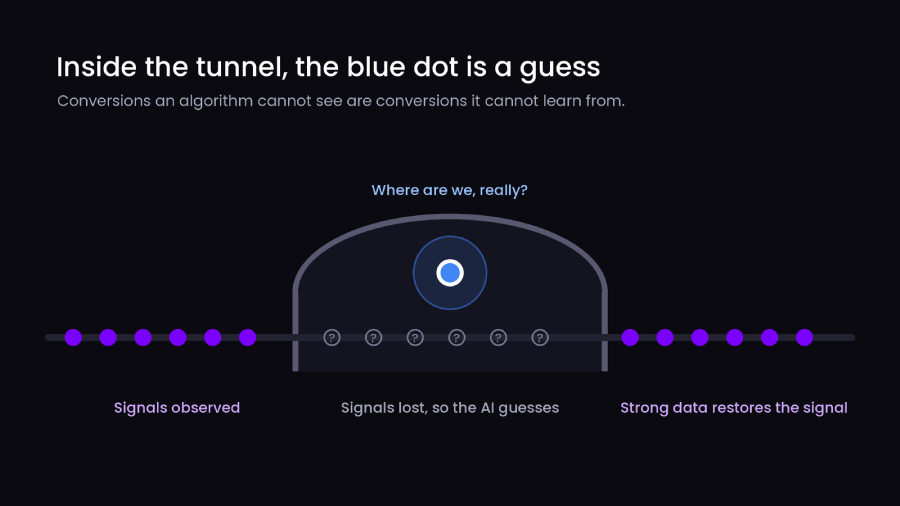
Picture a satnav driving into a tunnel. The car keeps moving and the map keeps redrawing. But the blue dot is now a guess.
Many ad accounts run the same way today. Bidding algorithms keep optimizing while a share of conversions never reaches them. Data strength is how you close that gap. It describes how complete, connected and trustworthy the signals behind your marketing AI really are.
This post explains what data strength means, where signals leak, and the four layers that rebuild them. You will also get a six-question self-check to run on your own setup.
What Is Data Strength?
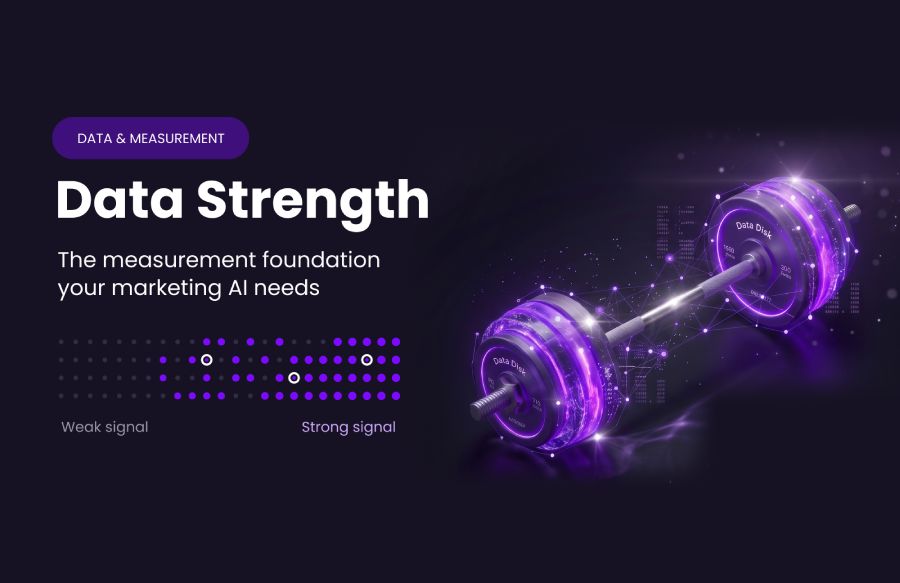
Data strength is the foundation of reliable, AI-powered marketing measurement. Google describes it in terms of building a trusted decision system with first-party data by connecting information across sources such as websites, apps and CRM systems.
For marketers, the practical question is whether the data feeding measurement and optimization tools is complete, consistent, relevant and responsibly collected.
- Can you connect a website enquiry to the right conversion event?
- Can you reconcile that event with the lead recorded in your CRM?
- Are the signals being shared with the appropriate permissions?
These are the questions that determine how useful your data is for decision-making. Better-connected, higher-quality signals can give marketing systems a more complete picture of performance - but they cannot compensate for poorly defined conversion goals or flawed business processes.
Strong data gives automated bidding more signals to learn from. Weak data hands it a partial picture.
How Tatvic reads data strength
Tools are only half the story. We treat data strength as a discipline: making every number your team acts on complete, consistent and explainable.
That gives you three tests for any metric:
- Complete: does it capture every real outcome, or only the ones that were easy to track?
- Consistent: do your analytics, ad and CRM platforms define the same event the same way?
- Explainable: can you say why two systems disagree, and by how much?
How Weak Data Quietly Costs You Growth
Automated bidding learns from outcomes. Every conversion it sees teaches it which clicks, audiences and creatives deserve more budget. Every conversion it misses teaches it nothing.
Weak data strength is easy to overlook because missing data never shows up in a dashboard. Signals usually leak in three places:
- At the browser. Privacy settings and ad blockers can restrict scripts served from third-party domains, so a tag may never fire.
- At the identity gap. A conversion happens, but nothing links it back to the ad that earned it.
- At the handoff. A form fill is recorded, yet the qualified lead and the closed sale stay locked in the CRM.
A hypothetical example
Say a lead-generation brand sees 100 enquiries from paid search in its CRM. Its ad platform records 78. The algorithm learns from those 78 and treats the other 22 as if they never happened.
There is a second risk. If the 78 include duplicates or mislabeled events, the AI optimizes with confidence towards the wrong goal. We explored this in our post on why bad data gets worse when AI gets involved.
Four Layers That Build Data Strength
Think of data strength as four layers of conversion tracking and first-party data. Each one closes a different gap, and they work best together.
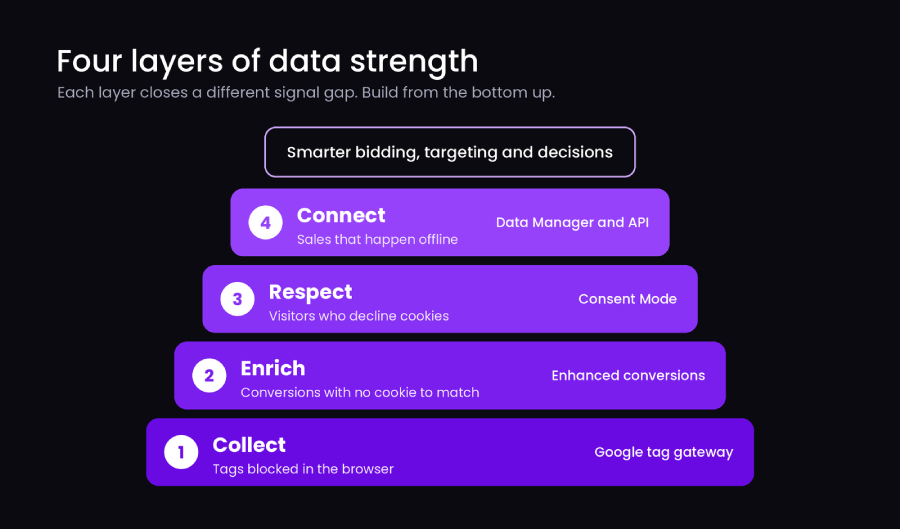
| Layer | Gap it closes | Google tool | Question to ask |
|---|---|---|---|
| 1. Collect | Tags blocked in the browser | Google tag gateway | Do our tags load from our own domain? |
| 2. Enrich | Conversions with no cookie to match | Enhanced conversions | Does each conversion carry hashed first-party data? |
| 3. Respect | Visitors who decline cookies | Consent Mode | Is consent captured and passed to Google tags correctly? |
| 4. Connect | Sales that happen offline | Data Manager and its API | Do CRM outcomes flow back to the ad platform? |
Layer 1: Collect signals reliably
Google tag gateway lets a site serve Google tags from its own domain instead of a third-party one. In its launch announcement, Google reported an 11% uplift in signals for advertisers who configured it. That figure comes from early 2025 data, so treat it as a benchmark rather than a promise. Measure your own baseline first.
Layer 2: Enrich every conversion
Enhanced conversions add hashed first-party data, such as an email address, to a conversion. The data is hashed with SHA256 before it is sent. Google then matches it to signed-in accounts that engaged with an ad. A leads version applies the same idea to imported offline conversions.
Layer 3: Respect consent and model the gaps
Consent Mode adjusts tag behavior based on each visitor’s consent choice. Where consent is declined and eligibility rules are met, Google can model conversions it cannot observe. Modeled conversions are estimates, so record your go-live date. Otherwise, before-and-after comparisons will mislead you.
Not sure which layer is your weakest?
Tatvic’s measurement and attribution solutions begin with a diagnosis, then move to a plan.
Layer 4: Connect online and offline outcomes
A form fill is the midpoint of a lead journey. The sale is the outcome. Google’s Data Manager API supports sending offline conversions and enhanced conversions for leads back to Google Ads.
Many teams join GA4 and CRM data in BigQuery to see which channels produce customers, not just form fills. If you want a hand connecting those sources, our GA4 and analytics services are a good place to start.
Data Strength Is Also a Data Quality Problem
A pipeline can be technically perfect and still deliver messy data. Duplicate events, “not set” values and blind spots inside app WebViews all weaken the signal. None of them adds a visitor. They only make the visitors you already have harder to count and interpret.
Three habits keep data trustworthy over time:
- Consistent naming: one event taxonomy, documented and shared across teams.
- Clear ownership: a named person who approves every tracking change.
- Scheduled audits: checks after each release, not once a year.
A small example. Because event names are case sensitive, GA4 treats form_submit and Form Submit as two different events. One form can quietly split its conversions across two rows.
Our post on what happens to GA4 data between collection and reporting is a useful follow-up.
A Quick Data Strength Self-Check
Answer these six questions for your most important conversion to gauge your data strength. Count the “not sure” answers as a no.
- Do your Google tags load from your own domain?
- Does each conversion send hashed first-party data, and does Google report it as working?
- Is consent captured, tested and passed to every tag?
- Do qualified leads and closed sales flow back to your ad platform?
- Can you explain the gap between your ad, analytics and CRM numbers?
- Does one person own the measurement plan and review it on a schedule?
Every no marks a place where your AI may be learning from a partial picture. Start with the first one you hit. The layers build on each other, so collection comes before enrichment, and enrichment comes before connection.
Key Takeaways: Build the Signal Before You Scale the Spend
- Data strength is how complete, connected and trustworthy the signals behind your marketing AI are.
- Missing conversions teach bidding systems nothing, and dashboards rarely show what is absent.
- Four layers rebuild the signal: collect, enrich, respect consent and connect offline outcomes.
- Modeled conversions help fill gaps, but they remain estimates.
- Data quality and governance matter as much as the tools.
More budget cannot fix weak data strength. It only pays the algorithm to learn faster from an incomplete picture. Brands that treat measurement as a foundation give their AI a fair chance to perform.
Is Your Marketing AI Learning From Reliable Data?
More budget cannot fix weak data strength. It can simply give an optimization system more room to act on incomplete or inconsistent signals.
Start by identifying where your measurement breaks down - from website tagging and conversion tracking to consent configuration and CRM reconciliation.
Want to understand where your measurement needs attention?
Explore Tatvic’s measurement services to assess your tracking setup, identify signal-quality gaps and prioritize improvements based on your marketing objectives.