Introduction
In our last blog, we highlighted a crucial principle: data integrity is not a checkpoint. It is an ongoing discipline, protecting every analytics journey from bad data and unreliable insights. Treating data integrity in analytics as a one-time task no longer works - websites evolve daily, campaigns get more complex, and customer interactions are constantly shifting.
Yet, many organizations still depend on manual tag audits. These audits once served as a safety net, but today they are slow, resource-heavy, and prone to error. Even a single implementation mistake like a missing GA4 purchase event or incorrectly mapped parameter can cause dashboards to break, reporting to misalign, and confidence to collapse.
Once leadership loses trust in data, decisions stall, campaigns underperform, and revenue potential slips away. This is precisely why businesses need an AI-powered Tag Auditor to transform their approach to automated GA4 tag audits.
The Current State: Manual Tag Audits
At first glance, manual tag audits look methodical. The typical process involves:
- Preparing the event schema
- Mapping events across customer journeys
- Observing requests through browser DevTools
- Recording findings in spreadsheets
But this approach shows cracks almost immediately:
- Time-intensive → audits can drag on for days or weeks
- Human error → testers miss small but critical payload mismatches
- Inconsistent documentation → one tester’s notes rarely match another’s
- Scalability issues → large sites or apps overwhelm teams
Instead of strengthening data integrity, the process creates fragility. Every new website feature or marketing campaign triggers another lengthy cycle. Teams repeat the same checks again and again, but errors still creep in through this outdated automated tag testing approach.
Meanwhile, analysts spend hours buried in logs rather than driving strategic insights. Stakeholders are left with inconsistent dashboards, questioning whether the numbers in GA4 are even accurate.
Put simply, manual tag audits are no longer built for the speed and scale of modern digital ecosystems. This is where tag auditing automation becomes essential for business success.
The Bottlenecks That Hurt
The true pain of manual auditing isn’t just inefficiency - it’s the bottlenecks it creates across the business.
- Signals not firing correctly → A checkout click or lead form submission may never appear in GA4.
- Inconsistent classifications → One tester marks an event “valid,” another flags it as “fail.”
- Repetitive cycles → Every product release or campaign update resets the audit process.
- Resource drain → Analysts spend hours firefighting instead of optimizing campaigns.
- Lost trust → Once executives see gaps in dashboards, they doubt the data altogether.
These challenges ripple across the organization. Marketing teams hesitate to scale campaigns. Product teams delay launches, waiting for “clean data.” Leadership grows skeptical of reporting, slowing decision-making.
In short, manual tag audits don’t just cost time. They erode the data trust that every business relies on to compete. An effective event validation tool can eliminate these bottlenecks entirely.
Why GA4 Needs Automated Audits More Than Ever
For most organizations, GA4 has become the source of truth for performance measurement. Campaign budgets, product roadmaps, and leadership dashboards depend on it. The GA4 migration has introduced higher complexity in events, schema drift, and more parameters that can break.
But when tags misfire even slightly - the downstream impact is massive:
- Missed conversions → Paid media ROI appears lower than it is.
- Faulty attribution → Campaigns that work get underfunded.
- Skewed user journeys → Drop-offs or repeat purchases go untracked.
- Eroded credibility → Executives question whether to act on analytics reports.
Real-world GA4 tracking failures happen more frequently than teams realize. Consider this scenario: an e-commerce site launches a flash sale, but the purchase completion event stops firing on mobile devices due to a recent site update.
Manual audits won’t catch this until the campaign ends - by then, thousands of conversions go untracked, skewing campaign performance data and wasting ad spend.
This is why ensuring GA4 data accuracy is not just a technical exercise - it’s a business necessity. Accurate tags power sharper insights, more efficient spend, and faster decisions. And that’s exactly where automated GA4 tag audits change the game.
Manual vs Automated Tag Audits: A Side-by-Side Comparison
Let’s put it side by side to understand why tag auditing automation is crucial:
| Manual Tag Audits | Automated GA4 Tag Audits |
| Relies on human testers | Runs schema-based validation automatically |
| Prone to missed errors | Eliminates human oversight gaps |
| Takes days or weeks per cycle | Completes audits in hours |
| Documentation inconsistent | Produces standardized, repeatable reports |
| Breaks down at scale | Scales effortlessly across sites/apps |
| Resource-intensive | Minimal human intervention required |
| Reactive approach | Proactive continuous monitoring |
The difference is not just speed. Automated tag testing guarantees precision, consistency, and confidence-qualities manual audits simply cannot sustain at enterprise scale.
Enter the AI-Powered Tag Auditor
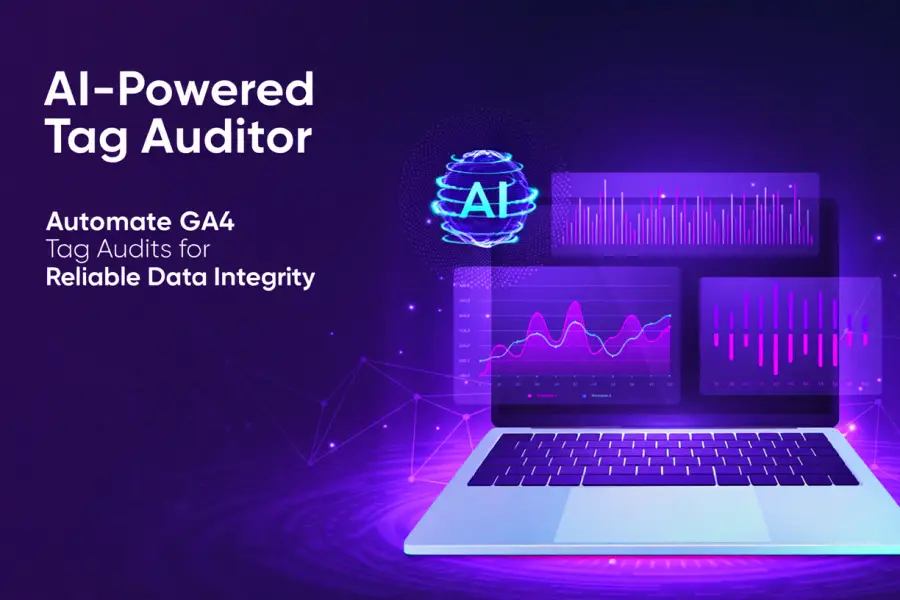
This is where Tatvic’s AI-powered Tag Auditor enters the picture - purpose-built to solve the limitations of manual auditing. This advanced event validation tool represents the next evolution in tag auditing automation.
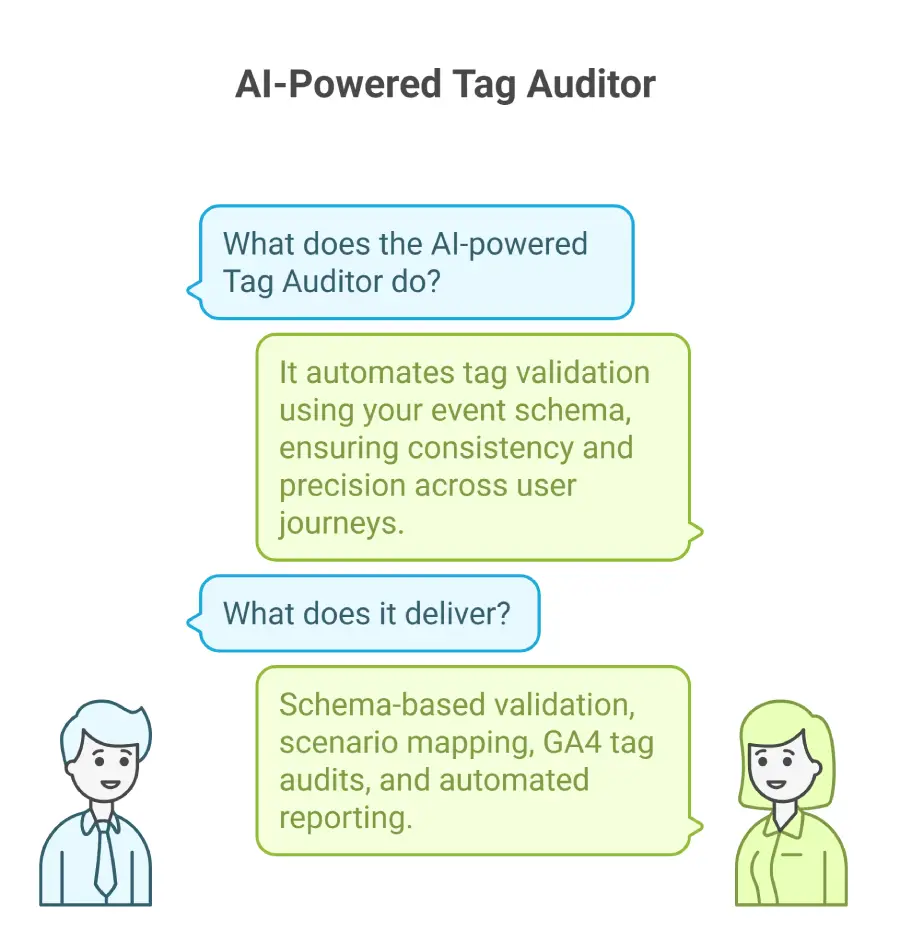
The tool automates every step of tag validation, using your event schema as its north star. Instead of analysts manually observing DevTools logs, the AI-powered Tag Auditor validates tags systematically, across journeys, with consistency and precision.
Here’s what it delivers:
- Schema-based validation → every event checked against your blueprint
- Scenario mapping → full user journeys tested end-to-end
- GA4 tag audits → requests validated in real time
- Automated reporting → results clean, structured, and bias-free
The outcomes are immediate:
- Faster deployments → audits no longer block go-live
- Continuous monitoring → auditing becomes ongoing, not one-off
- Error-free validation → no oversights or inconsistencies
- Protected data integrity → safeguarded across all properties
The biggest win is confidence. Teams no longer waste energy debating whether GA4 numbers are accurate. Leaders no longer second-guess dashboards. Campaigns launch faster because validation is built in.
How Continuous Tag Monitoring Protects Campaign ROI
Traditional manual audits operate on a “test once, deploy forever” mentality. But modern digital environments are dynamic - tags can break between audits due to site updates, third-party integrations, or code deployments.
This is where continuous tag monitoring tools become invaluable. Consider this scenario: if checkout clicks break on Day 2 of a high-spend campaign, manual audits won’t catch it in time. By the time the next scheduled audit occurs, thousands of dollars in ad spend could be wasted on seemingly “non-converting” traffic.
The AI-powered Tag Auditor positions itself as not just QA but ongoing insurance for your analytics investment. It continuously validates that:
- Purchase events fire correctly across all devices
- Lead form submissions reach GA4 without data loss
- Campaign parameters track properly throughout the customer journey
- Custom events maintain proper schema compliance
This continuous validation approach protects campaign ROI by catching issues before they impact business decisions. Marketing teams can confidently scale campaigns knowing their event tracking QA tool is monitoring performance 24/7.
In Action: How It Works
What makes the AI-powered Tag Auditor powerful is its simplicity:
- Upload your event schema
- Select the events you want to validate
- Let AI run the audit across journeys
- Receive instant, actionable reports
Unlike manual audits, this automated tag testing tool checks multiple events simultaneously. It produces standardized reports every time. And it requires no additional team bandwidth.
Once the schema is uploaded, automated GA4 tag audits can be repeated anytime without starting over. That means QA cycles are shorter, release timelines are faster, and campaign launches move at the pace of business.
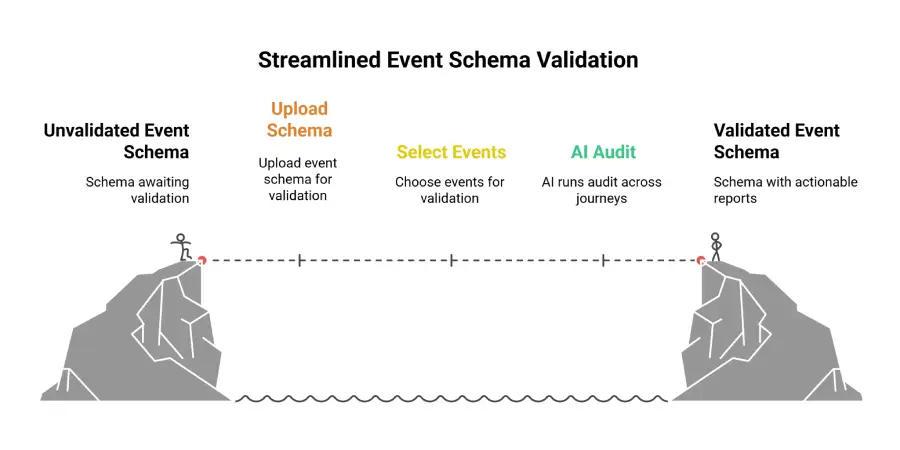
Organizations using the AI-powered Tag Auditor report audits completed ~70% faster than manual processes. What used to consume days now takes hours - a true transformation in tag auditing automation efficiency.
And it’s not just about speed, it’s about trust. The tool gives stakeholders confidence that their GA4 dashboards reflect reality. That every conversion, every lead, every signal is firing as intended.
How AI-Powered Tag Auditor Enhances Data Trust
Trust in data is fragile. Once lost, it takes months to rebuild. Data integrity in analytics becomes the foundation upon which all business decisions rest.
The AI-powered Tag Auditor prevents this cycle by ensuring:
- Accuracy & reliability → Every tag validated against schema, free from human bias.
- Scalability → Audits run across multiple sites and apps, no extra resources needed.
- Smarter insights → Reports flag missing events, highlight mismatches, and recommend fixes.
- Executive confidence → Dashboards remain consistent, unlocking faster business decisions.
Instead of data being questioned, it becomes the trusted foundation for scaling campaigns, testing new strategies, and driving ROI. This event validation tool ensures that data integrity in analytics is maintained consistently across all touchpoints.
Benefits & Business Value
The value of Tatvic’s AI-powered Tag Auditor lies in its ability to transform auditing into a business advantage through comprehensive tag auditing automation.
- Accuracy & reliability → Human error eliminated. Validation becomes consistent and repeatable.
- Efficiency & scalability → One property or dozens, the tag monitoring tool scales seamlessly.
- Smarter insights → Analysts move from firefighting to optimizing strategy.
- Confidence in decisions → Leadership moves faster when dashboards are trusted.
- Cost reduction → Fewer resources needed for ongoing automated tag testing.
- Risk mitigation → Continuous monitoring prevents data integrity issues before they impact business.
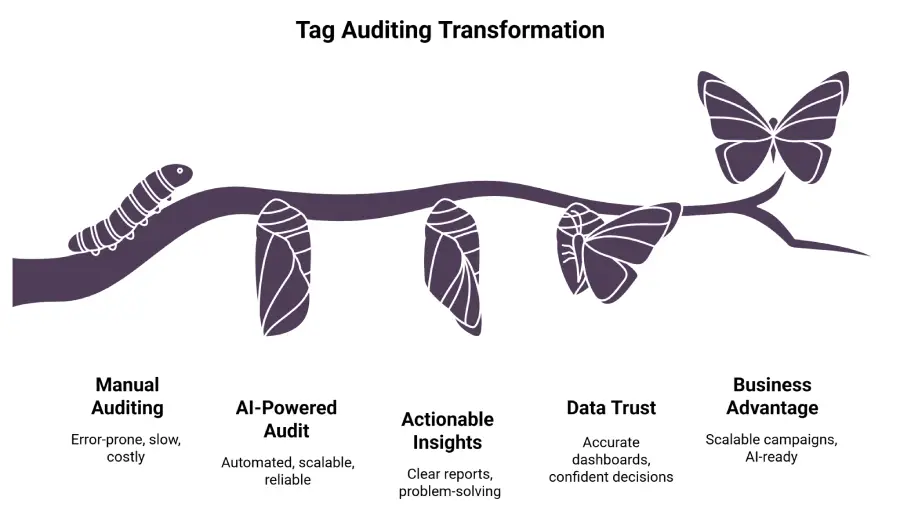
Taken together, these benefits shift auditing from a drain on resources to a competitive edge. Instead of worrying about broken tags, teams focus on optimizing campaigns, driving ROI, and growing the business with reliable automated GA4 tag audits.
Closing Takeaway
Auditing doesn’t need to be slow or painful. With Tatvic’s AI-powered Tag Auditor, it becomes a source of speed, trust, and scale through advanced tag auditing automation.
- No more broken tags disrupting dashboards.
- No more wasted days on manual checks.
- No more doubt in GA4 reports.
Instead, businesses gain reliable data integrity in analytics, faster releases, and insights they can act on with confidence. Our automated GA4 tag audits ensure that your analytics foundation remains solid while your business scales.
In today’s digital world, the winners aren’t just those who collect data - they are the ones who protect it at scale with intelligent event validation tools and continuous tag monitoring.
Schedule a call with Tatvic experts today and see how AI-powered Tag Auditor can transform your analytics with reliable automated tag testing and seamless GA4 data accuracy.
Stay tuned for the next blog in this series: Data Sanity - The Autonomous Agent That Ensures Your Analytics Pipelines Never Go Off Track.