Hello There!

Lorem ipsum dolor sit amet, consectetur adipiscing elit,

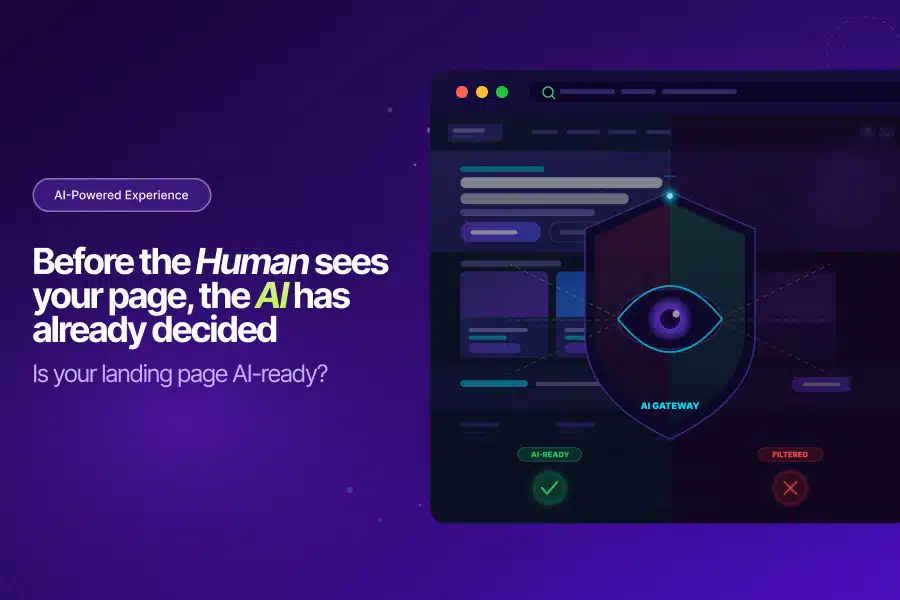
Landing Page Optimization in 2026 Has Two Audiences. Most Brands Are Only Optimizing for One.

Right now, a shopper is asking ChatGPT to find the best running shoes under $120. Another is asking Perplexity to compare skincare serums for sensitive skin. A third is asking Google’s AI Mode to build a sustainable gift set under $80.

Your brand either shows up in those answers or it doesn’t.

This is the new reality of landing page optimization. And most e-commerce teams are only solving half the problem. They’re building pages for humans who arrive. They’re not building pages for the AI systems that decide whether to send those humans in the first place.

That gap is where revenue is being lost right now.

The Funnel Has a New Front Door

For two decades, e-commerce started with Google. You optimized keywords, earned backlinks, bought ads, and drove traffic to your pages. The playbook was consistent, well-understood, and it worked.

That formula is breaking down faster than most teams realize.

McKinsey‘s AI Discovery Survey found that 50% of consumers now use AI when searching online. Among those who’ve tried it:

  • 44% say AI has become their primary way to search
  • Only 31% still prefer traditional search

This isn’t a slow, gradual shift. It’s already the majority behavior among high-intent, high-spending shoppers, exactly the audience ecommerce brands work hardest to reach. These are people with purchase intent who are actively looking for product recommendations, comparisons, and trusted sources.

Gartner‘s forecast: Traditional search engine volume will drop 25% by 2026 as AI chatbots take over queries that once ran through Google and Bing. Their analyst put it plainly: companies will need to rethink their entire marketing channel strategy as generative AI becomes embedded across every aspect of commerce.

Organic Traffic Is Already Sliding

BCG‘s research adds an uncomfortable reality check for brands still focused entirely on traditional SEO:

  • Nearly 10% of businesses are already seeing year-over-year organic traffic decline
  • Traditional organic search traffic in the US is falling at roughly 10% annually
  • Traffic to retail sites from generative AI sources grew 4,700% year over year in July 2025 alone

That last number isn’t a trend to watch. It’s a signal that landing page optimization now means something fundamentally different than it did 12 months ago. The channel driving the fastest growth in qualified e-commerce traffic is AI.

Brands still treating landing page optimization as a purely human-facing discipline are optimizing for a shrinking pool of traffic while the fastest-growing pool passes them by.

Your Landing Page Now Serves Two Audiences

Here’s what most ecommerce teams haven’t fully processed yet.

When a consumer asks an AI assistant to recommend a product, the AI doesn’t just Google it. It pulls together information from your product pages, your reviews, your structured data, third-party citations, forums, and comparison sites. It evaluates credibility, consistency, and clarity.

Then it decides whether your brand belongs in the answer.

That decision happens before any human ever lands on your page.

As McKinsey puts it: “In an agentic world, your customer may no longer be a human with a browser; it is just as likely to be an autonomous agent, acting on that customer’s behalf.”

This means landing page optimization in 2026 has two distinct jobs:

Job What It Means
Job 1 Convert the human who arrives
Job 2 Be clear, trustworthy, and recommendable to the AI that decides to send them

Most brands are doing Job 1 reasonably well. Job 2 is almost entirely ignored, which means the AI gatekeeping the recommendation never sends the human in the first place.

What the Second Job Actually Requires

Deloitte’s 2025 Digital Media Trends puts it plainly:

“We are moving away from optimising for clicks and toward optimising for understanding. When an AI system generates a response, it draws on content it can interpret and trust.”

Effective landing page optimization for AI audiences requires a specific set of structural changes most brands haven’t made yet:

  • Rich product schema and clean metadata
  • Descriptive content that language models can actually parse
  • Consistent, current information across all channels
  • FAQ content that answers real shopper questions
  • Pricing, delivery windows, and return policies in machine-readable formats
  • Third-party citations and review signals that establish credibility

Deloitte is specific about why this matters: metadata, taxonomy, and signals of expertise now play a significant role in whether a brand’s content gets surfaced accurately by AI systems. This isn’t optional polish; it’s the foundation of landing page optimization for the current environment.

Brands that skip this work don’t just miss an optimization opportunity. They become invisible to the fastest-growing discovery channel in ecommerce history.

What AI Agents Look for When Comparing Products

When AI agents compare products on a shopper’s behalf, BCG’s research shows they rely on a narrow and specific set of signals:

  1. Price - Is it clearly visible and machine-readable?
  2. Reviews - Are aggregated scores structured and prominently surfaced?
  3. Delivery speed - Is the fulfilment window stated explicitly?
  4. Return policy - Is it clear, accessible, and easy to parse?

Brands whose landing page optimization surfaces all four signals in structured, machine-readable formats have a clear structural advantage over brands presenting the same information in ways only humans can interpret.

This is not a one-time technical fix. It’s an ongoing discipline. Every product page, FAQ section, and comparison document needs to be structured for AI comprehension, not just human readability. As your inventory, pricing, and policies change, those updates need to flow consistently across every channel where AI systems might pull your information.

Why This Matters for Your Revenue

The commercial case for better landing page optimization is now impossible to ignore.

Adobe Analytics studied over a trillion visits to US retail sites during the 2025 holiday season. Shoppers arriving from generative AI assistants significantly outperformed every other traffic source:

Metric AI-Referred Shoppers
Conversion rate +31% vs all other traffic
Thanksgiving conversion +54%
Black Friday conversion +38%
Bounce rate 33% lower
Time on site 45% more
Pages viewed per visit +13%

Revenue per visit from AI-referred shoppers increased 254% year over year during the 2025 holiday season. That’s not a rounding error. That’s a different category of visitor entirely, one that only arrives if your landing page optimization has done the work of earning the AI recommendation upstream.

The Highest-Intent Traffic on the Internet

Salesforce data reinforces the same story from a different angle.

In the first six months of 2025, conversion rates from AI channels were 700% higher than traffic referred from social media. That puts AI-referred traffic in its own category, more intent-loaded than paid search, more purchase-ready than any other digital acquisition channel currently available.

These visitors didn’t stumble onto your site. They arrived because an AI system evaluated your brand, found it credible and relevant, and recommended it by name. They came pre-qualified.

Proper landing page optimization is what earns that recommendation in the first place. Without it, the pre-qualification never happens, and the high-intent visitor never arrives.

The Stakes Are $5 Trillion

McKinsey’s agentic commerce report, published in October 2025, laid out what’s commercially at stake globally:

  • AI agents could mediate $3-5 trillion in global consumer commerce by 2030
  • US B2C retail alone could see up to $1 trillion in AI-orchestrated revenue

Their framing was deliberate: “This is not just an evolution of e-commerce. It’s a rethinking of shopping itself.” They compare this transition to the web and mobile revolutions and project that it will move faster than either one did.

How Much Time Do You Actually Have?

Deloitte’s Agentic Commerce research puts a concrete deadline on the urgency:

  • 63% of global retailers believe companies without an AI strategy will fall behind within two years
  • By 2030, 55% of digital consumers will start product research on LLM platforms
  • 25% of global e-commerce sales will be enabled by AI agents by 2030

Brands investing in landing page optimization for AI audiences now are locking in positions in the recommendation layer that will be hard for slower competitors to displace.

BCG’s research makes the compounding effect explicit: once a brand becomes an established, authoritative source that AI systems trust and cite, it tends to get cited more often, creating a visibility advantage that grows over time. Brands waiting for this to be “fully proven” before acting will find those positions already taken.

One Page. Two Audiences. One Strategy.

Here’s the good news: optimizing for AI agents and optimizing for human visitors are not competing priorities. They reinforce each other.

The same qualities that make a page convert real people are the qualities that earn AI recommendations:

  • Clear, well-structured product information
  • Honest reviews surfaced prominently
  • Transparent delivery and return policies
  • FAQ content that answers real questions shoppers actually ask

Effective landing page optimization in 2026 doesn’t mean choosing between SEO and AIO. It means treating both as one coherent strategy: get found before the visit, convert after it.

Your Quick Action Checklist

Before your next product launch, run your landing page against these questions:

[ ] Is pricing visible in a machine-readable format?

[ ] Does the page include FAQ schema for common shopper questions?

[ ] Is the delivery window and return policy explicitly stated?

[ ] Is product metadata consistent across all channels?

[ ] Are credible third-party sources citing or reviewing this page?

If you answered no to two or more, your landing page optimization is only serving one of your two audiences and leaving the highest-converting traffic source on the table.

Ready to Close the Gap?

The brands winning in 2026 aren’t choosing between old and new. They’re doing both with infrastructure built for both audiences from the ground up.

Tatvic works with e-commerce brands to close the gap between traffic and revenue through agentic AI-powered landing page optimization and customer experience strategy.

Curious what your current pages are leaving on the table? Let’s find out.

AI Analytics: Why Most Teams Discover Problems Too Late

Marketing analytics has evolved significantly over the past decade. Today, teams have access to detailed dashboards, multi-channel attribution models, and near real-time reporting capabilities. Campaign performance, user journeys, and conversion metrics are no longer hidden behind fragmented systems-they are visible, measurable, and accessible at scale.

Yet despite this progress, one persistent problem continues to impact marketing performance.

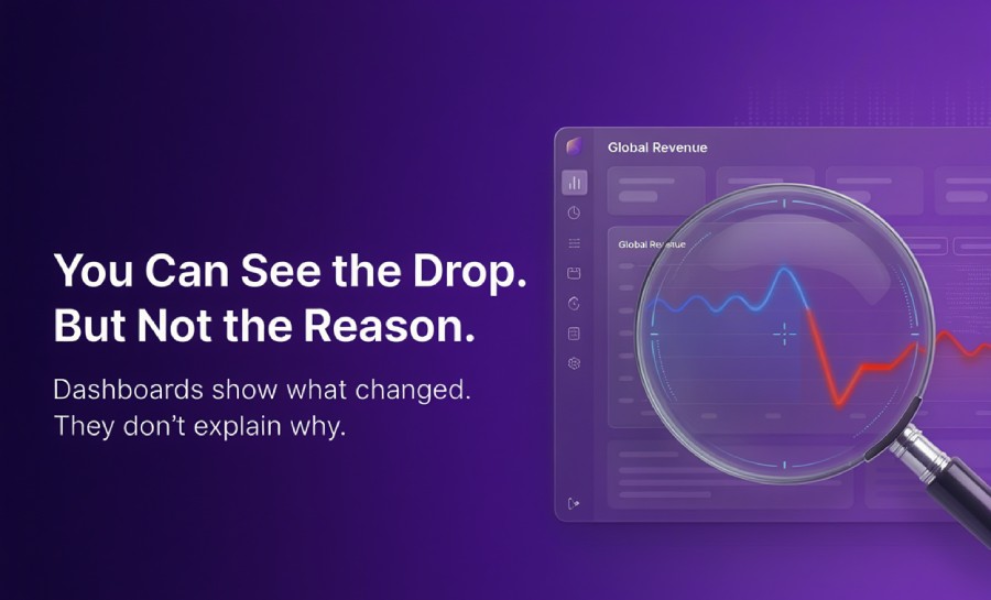
Teams can see what is happening.
But they often realize what changed far too late to act effectively.

This gap between data visibility and timely awareness is where most inefficiencies in modern analytics systems originate. And in performance-driven environments, this delay does not just affect reporting-it directly affects revenue outcomes.

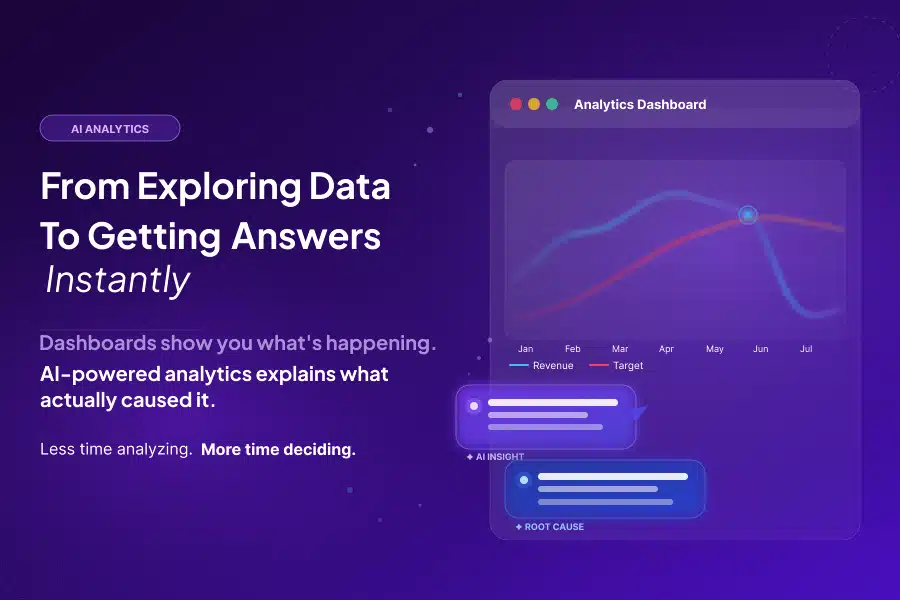
This is precisely where AI analytics is beginning to redefine how analytics systems operate. Instead of simply enabling access to data, AI analytics focuses on detecting meaningful changes as they happen and enabling faster decision-making.

Analytics Today Is Built for Investigation, Not Detection

Most analytics platforms in use today-whether it is Google Analytics 4, Adobe Analytics, or similar tools-are fundamentally designed for exploration. They are highly effective at organizing data, enabling segmentation, and allowing teams to analyze performance across multiple dimensions.

However, they are not designed to proactively identify what matters most.

In practice, this means that analytics systems function more like repositories of information rather than active intelligence layers. They store and present data, but they do not interpret it in a way that prioritizes immediate action.

As a result, teams rely heavily on manual workflows.

A marketer logs into a dashboard, reviews key metrics, compares trends, and tries to identify whether something has changed. This process is repeated daily or weekly, depending on the team’s operating rhythm.

The limitation here is subtle but critical.

Performance changes do not occur when dashboards are checked.
They occur continuously.

And this disconnect creates a delay between when an issue arises and when it is discovered.

This limitation is explored further in: What if you didn’t have to explore the data?

The Real Problem: Detection Lag

To understand the impact of this gap, it is important to look at how detection typically happens in real-world workflows.

Consider a common scenario. A campaign begins to underperform due to a change in bidding strategy, audience targeting, or external market conditions. The decline is not immediately obvious-it happens gradually over a few hours or a day.

Since no alert is triggered, the issue remains unnoticed.

It is only during a routine dashboard check-often one or two days later-that someone notices a dip in performance. At this point, the team begins investigating the issue, analyzing trends, and validating whether the change is significant.

By the time corrective action is taken, the impact has already occurred.

Budget has been spent inefficiently.
Conversions have declined.
Opportunities for early optimization have been missed.

This is what is referred to as detection lag.

And it is one of the most overlooked sources of inefficiency in marketing analytics.

Detection lag is not just a delay in awareness. It is a delay in action-and that delay has compounding consequences.

This is the core problem that AI analytics is designed to address.

Why Traditional Analytics Workflows Break at Scale

As marketing systems grow more complex, the limitations of manual analytics workflows become more pronounced.

Modern marketing environments involve multiple channels, campaigns, audience segments, and data streams. Each of these variables introduces additional layers of complexity, making it increasingly difficult to identify meaningful changes quickly.

In such environments, manual analysis does not scale effectively.

Teams are required to:

  • review multiple dashboards
  • segment data across dimensions
  • identify patterns manually
  • validate findings across tools

This process is not only time-consuming but also prone to inconsistency. Different team members may interpret the same data differently, leading to delays in decision-making.

More data does not simplify decision-making. Without the right systems, it increases the effort required to reach clarity.

This is where the role of AI analytics becomes critical.

The Hidden Metric Most Teams Ignore: Time-to-Detection

While marketing teams are highly focused on performance metrics such as conversion rate, return on ad spend (ROAS), and customer acquisition cost (CAC), very few track a metric that directly influences all of them.

That metric is time-to-detection.

Time-to-detection refers to the duration between when a performance change occurs and when it is identified.

This metric is critical because it determines how quickly corrective action can begin.

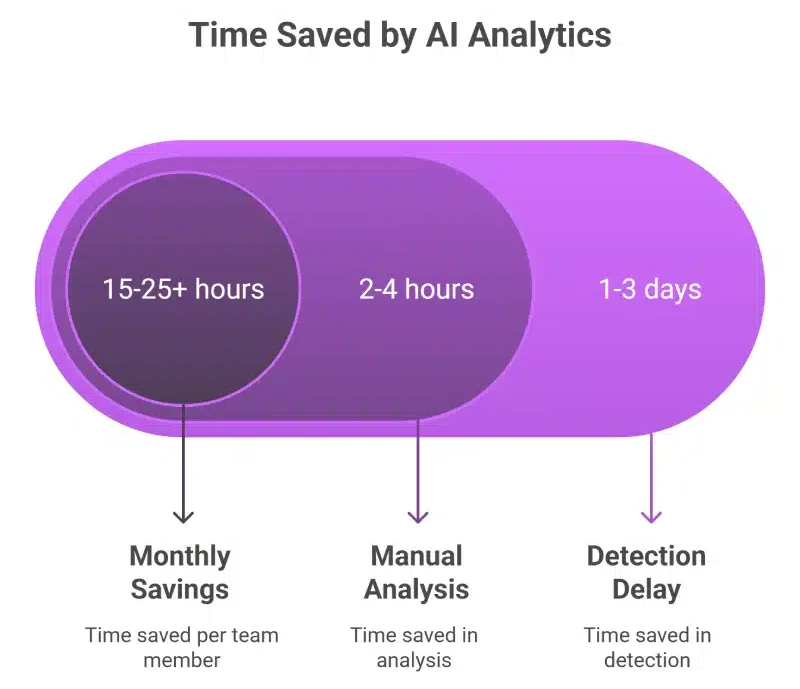
A delay of even 24-48 hours can significantly impact performance, especially in high-spend environments. During this time, underperforming campaigns continue to consume budget, and high-performing opportunities remain under-optimized.

According to Gartner, organizations often fail to fully leverage their analytics investments due to delays in insight generation and inefficient data utilization.

This highlights an important reality.

The challenge is not a lack of data.
It is the inability to act on data at the right time.

AI Analytics: Shifting from Passive Data to Active Intelligence

AI analytics introduces a fundamental shift in how analytics systems operate.

Instead of relying on users to explore data and identify issues, AI analytics continuously monitors performance metrics and detects anomalies automatically. It evaluates data in real time, compares it against historical patterns, and identifies deviations that require attention.

This transforms analytics from a passive system into an active intelligence layer.

With AI analytics, teams are no longer dependent on manual checks. Instead, they receive timely insights that highlight what has changed, where the change has occurred, and why it matters.

This shift significantly reduces the time required to move from data observation to decision-making.

What AI-Powered Analytics Looks Like in Practice

To understand the practical impact of AI analytics, it is helpful to compare how workflows operate with and without it.

Without AI Analytics

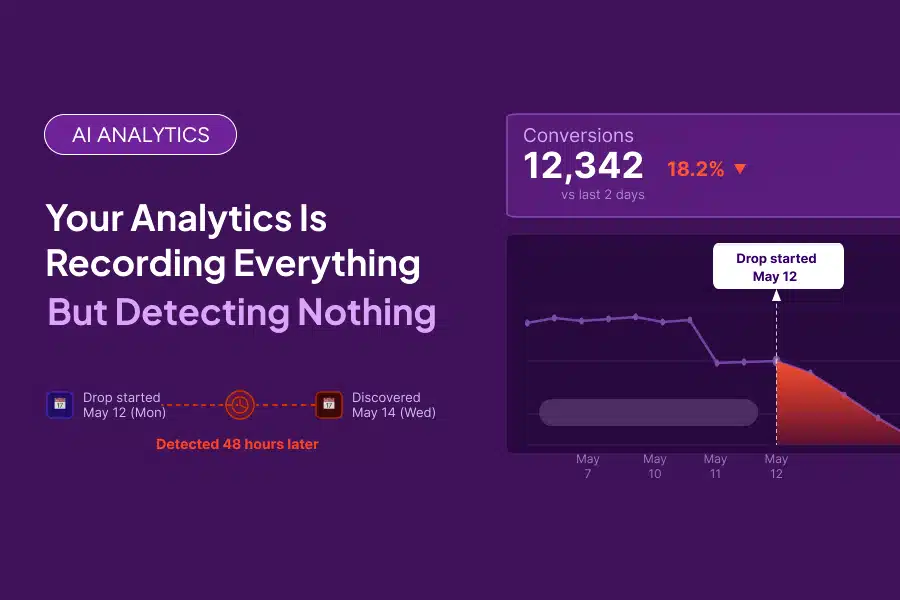
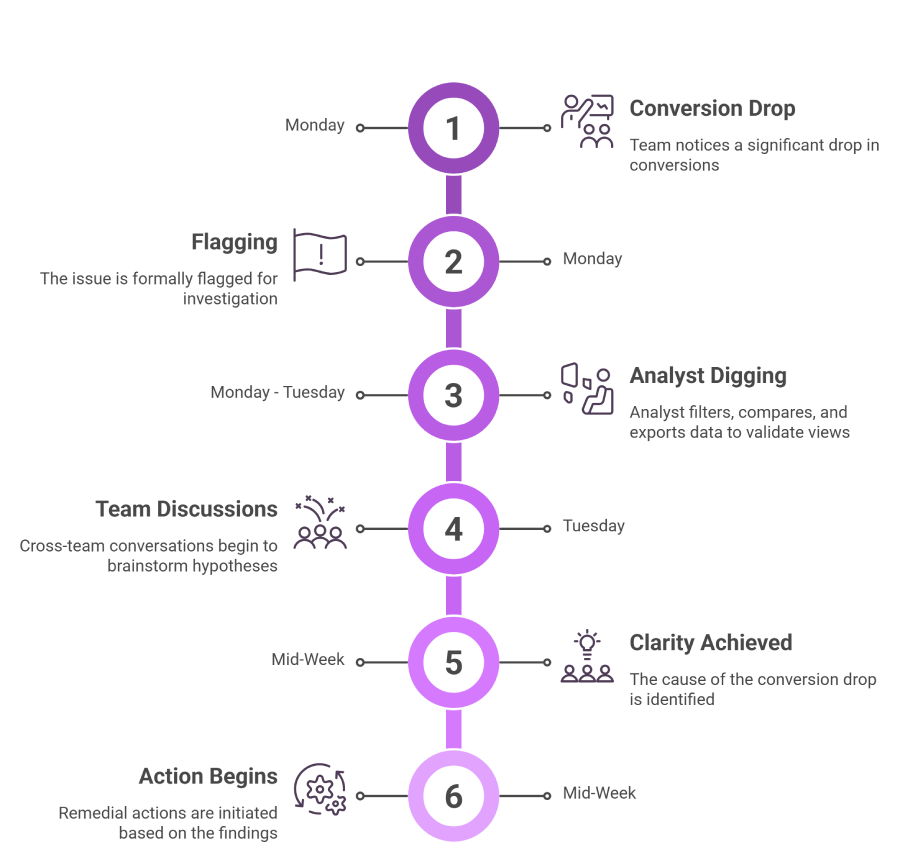
A retail brand running multiple campaigns experiences a gradual decline in conversions due to a change in bidding strategy. The decline begins on a Monday but goes unnoticed because there are no alerts.

By Wednesday, the team notices a drop during a routine dashboard review.

They begin analyzing:

  • campaign performance
  • channel-level data
  • device segmentation
  • geographic trends

After spending considerable time exploring the data, they identify the root cause and take corrective action.

By this time, two to three days of inefficient spend have already occurred.

With AI Analytics

In the same scenario, AI analytics detects the anomaly on Monday itself.

The system identifies that the performance deviation is outside expected patterns and surfaces an insight such as:

“Conversions have dropped by 15%, primarily driven by Paid Search. The decline is linked to recent changes in bidding strategy and exceeds expected variance.”

The team receives this insight immediately and can act within hours.

The difference is not just operational efficiency-it is financial impact.

Pain Points vs Outcomes: A Clear Contrast

Without AI analytics, teams experience:

  • delayed awareness of performance issues
  • significant time spent on manual analysis
  • reactive decision-making
  • increased risk of wasted budget

With AI analytics, teams benefit from:

  • near real-time detection of anomalies
  • reduced dependency on manual workflows
  • faster and more confident decision-making
  • improved campaign stability and efficiency

This contrast highlights why AI analytics is not just an enhancement but a necessity for modern marketing systems.

The Measurable Business Impact of AI Analytics

The impact of AI analytics can be quantified across multiple dimensions.

Research from McKinsey & Company indicates that organizations using AI in marketing can achieve improvements of up to 20-30% in ROI.

Similarly, Deloitte highlights that AI-driven organizations are able to respond more quickly to market changes and operate with greater efficiency.

These improvements are driven by:

  • reduced detection delays
  • faster decision-making cycles
  • more efficient allocation of resources

Over time, these benefits compound, leading to sustained improvements in marketing performance.

Why This Gap Is Becoming More Expensive

As marketing systems become more dynamic, the cost of delayed detection continues to increase.

Automation, real-time bidding, and multi-channel strategies amplify the impact of even small inefficiencies. If a system reacts late, it continues to execute outdated strategies, leading to further performance decline.

This makes AI analytics a foundational capability rather than an optional enhancement.

Organizations that adopt it early gain a significant advantage in terms of speed, efficiency, and performance consistency.

AI Analytics and the Evolution Toward Agentic AI

AI analytics plays a critical role in enabling more advanced systems such as Agentic AI.

While AI analytics focuses on detecting and interpreting changes, Agentic AI extends this capability by enabling automated actions based on those insights.

Together, they create a continuous loop:

  • detection
  • interpretation
  • execution

This evolution is explored further in: Marketing decision speed with AI Analytics

The Cost of Waiting

One of the most overlooked aspects of analytics transformation is the cost of inaction.

Organizations often delay adopting new approaches because existing systems appear to function adequately. However, this delay results in repeated inefficiencies over time.

Each campaign cycle without AI analytics introduces:

  • avoidable performance losses
  • repeated manual effort
  • missed optimization opportunities

These costs are not always visible in a single report, but they accumulate over time.

The real cost is not the problem itself. It is how long it continues before being addressed.

Moving from Insight to Action

Recognizing the gap is only the first step.

The next step is quantifying its impact and identifying where improvements can be made.

Tools such as:

can help organizations evaluate the potential benefits of adopting AI analytics and determine their readiness for implementation.

This shifts the conversation from theoretical value to measurable impact.

Conclusion

The evolution of analytics is no longer about improving visibility.

It is about improving responsiveness.

The ability to detect and act on changes quickly is becoming a key differentiator in marketing performance.

AI analytics enables this shift by transforming analytics systems from passive reporting tools into active intelligence layers.

And as marketing environments continue to evolve, this capability will become essential for organizations looking to maintain a competitive edge.

AI Analytics in Marketing: What If You Didn’t Have to Explore Data to Understand It?

AI Analytics in Marketing: The Missing Layer Between Data and Action

AI analytics in marketing is no longer just about reporting performance - it’s about reducing the time it takes to understand and act on it.

Over the past decade, marketing analytics has evolved significantly. Tools like Google Analytics 4 have made data more accessible, structured, and reliable. Most organizations today have invested heavily in dashboards, tracking, and reporting layers to strengthen their analytics setup.

But even with this progress, something still feels slower than it should.

Teams can see what’s happening almost instantly. Yet understanding what the data actually means - and deciding what to do next - still takes time.

This shift from data access to data interpretation is something we explored in detail in our earlier piece on how AI Analytics: Marketing Decision-Making Speed blog impacts decision speed.

This is exactly where AI analytics is beginning to redefine how modern marketing teams operate.

What is AI Analytics in Marketing?

AI analytics refers to the use of artificial intelligence to analyze marketing data, identify patterns, and generate actionable insights that improve marketing decision making.

Unlike traditional marketing analytics, AI analytics helps teams move beyond reporting by answering:

  • Why performance changes are happening
  • What factors are driving those changes
  • What actions should be taken next

This shift is what makes AI powered analytics a critical layer in modern analytics workflows.

The Evolution of Marketing Analytics: What Changed, and What Didn’t

To understand why this problem exists, it helps to look at how marketing analytics has evolved.

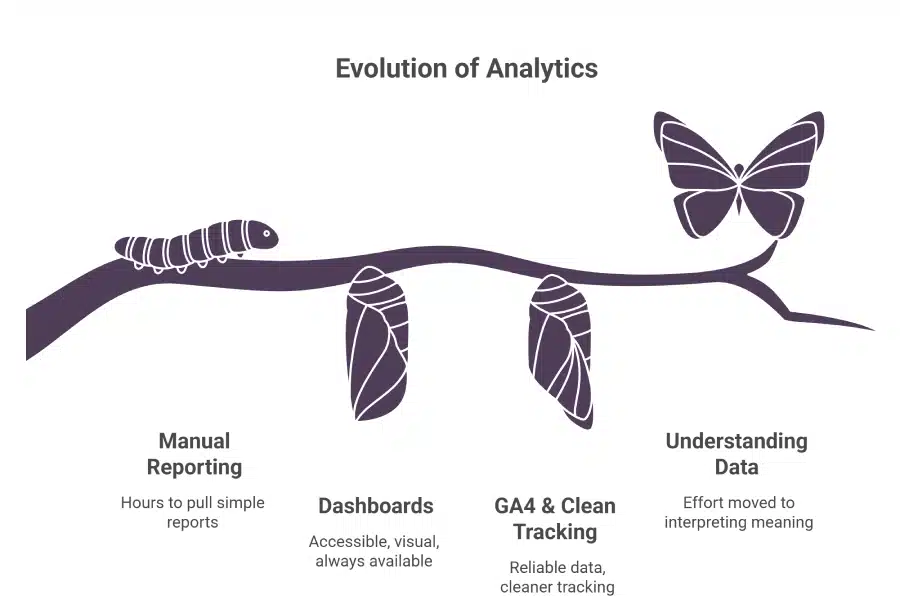
Earlier, analytics was heavily manual. Teams depended on multiple tools, spreadsheets, and delayed reporting cycles. Pulling even a basic campaign report required time, coordination, and validation. Data existed - but accessing it was difficult.

Then came structured platforms like Google Analytics 4, which transformed how teams interacted with data.

These platforms made analytics:

  • Centralized across channels
  • Available in near real time
  • Easier to visualize through dashboards

This was a major leap forward for marketing analytics. However, while access improved, interpretation did not evolve at the same pace.

Even today, most analytics systems are designed to show data - not explain it. Teams still rely on manual workflows to understand why something happened and what actions should follow. This is where AI analytics begins to play a critical role.

The Real Bottleneck in Marketing Analytics

Most organizations today have a mature marketing analytics setup. They have:

  • Clean event tracking
  • Structured dashboards
  • Defined KPIs
  • Cross-channel visibility

On the surface, this looks like a fully optimized analytics system. But when performance changes occur, decision-making still slows down.

The issue is no longer data quality or reporting accuracy.
The issue is how long it takes to interpret the data.

Without AI analytics, teams still rely on manual workflows to connect data points, validate assumptions, and derive insights. This is where time gets consumed, and where decision speed breaks down.

What Happens After a Performance Drop (In Reality)

Consider a typical scenario.

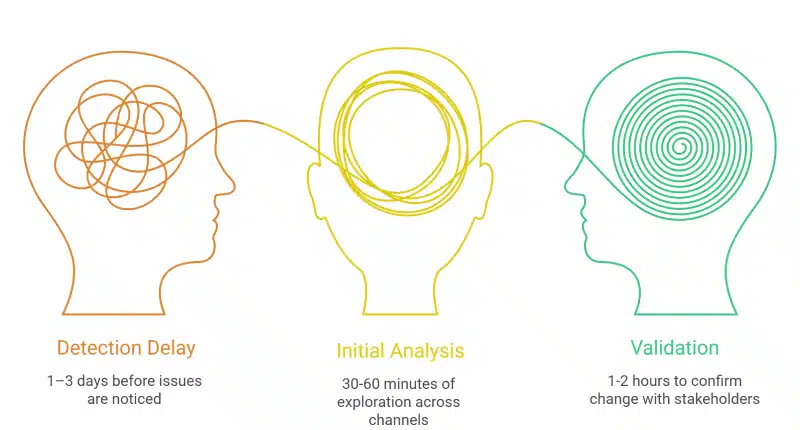
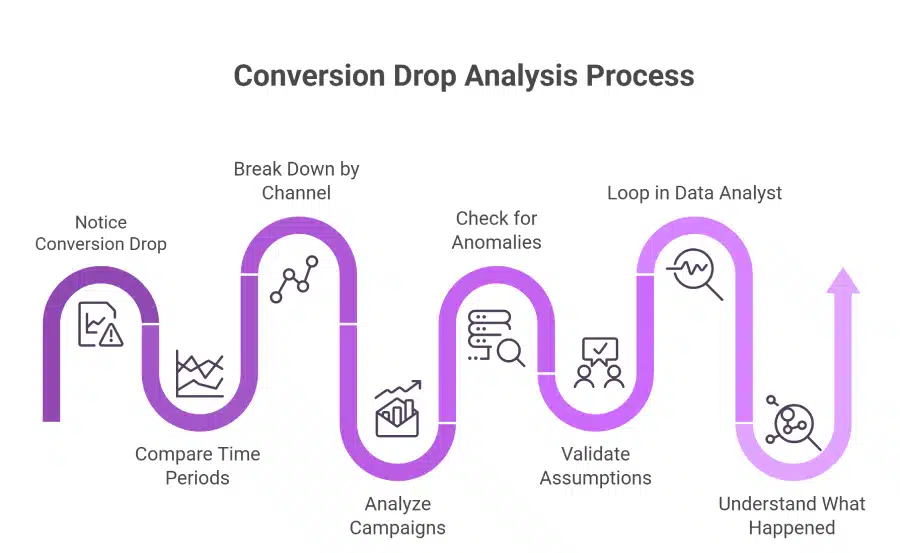
A drop in conversions is detected in your dashboard. The signal is clear, and the data is reliable. But that’s only the starting point.

From there, the team begins a structured investigation process:

  • Comparing performance across time periods
  • Breaking down results by channel
  • Analyzing campaign-level changes
  • Segmenting by audience, device, or geography
  • Validating whether the trend is real or an anomaly

In many cases, a data analyst is involved to conduct deeper analysis.

At this stage, the team is not making decisions yet.
It is still trying to answer a basic question:

“What exactly is happening here?”

This is where time gets consumed. And without AI analytics, this process repeats every time a new question arisesTraditional analytics process that slows marketing decision making speed.

Why This Process Persists Across Teams

The reason this workflow continues is not because teams are inefficient. It’s because traditional analytics tools are designed for exploration.

They are built to answer descriptive questions such as:

  • What changed?
  • Where did it change?
  • How significant is the change?

But they do not directly answer:

  • Why did it change?
  • What caused it?
  • What should we do next?

That gap creates a dependency on manual interpretation.

Even in sophisticated google data analytics setups, teams rely on human judgment to connect data points, validate hypotheses, and derive insights. This makes marketing decision making slower than it should be.

The Hidden Cost of Manual Interpretation

This interpretation gap has a measurable impact on performance. Without AI analytics, teams continue to rely on repetitive manual analysis to bridge this gap.

A significant portion of marketing analytics effort is spent on:

  • Repeating similar analyses for recurring questions
  • Validating insights across multiple stakeholders
  • Explaining findings in different contexts

Over time, this leads to:

  • Delayed decisions
  • Slower optimization cycles
  • Missed opportunities

These are not visible issues in dashboards, but they directly affect outcomes. If you want to quantify what this delay is costing your team, you can estimate the impact using the AI ROI Forecaster.

This is precisely where AI analytics creates value - not by improving visibility, but by improving understanding.

The Shift Toward AI Analytics

The shift toward AI analytics is not just conceptual - it is already delivering measurable impact.

According to research by McKinsey & Company, organizations adopting AI in marketing and sales are seeing significant improvements in performance, efficiency, and ROI.

AI analytics introduces a new way of interacting with data. Instead of starting with dashboards and exploring multiple dimensions manually, teams can start with insights that are already contextualized. This reduces the effort required to interpret data and accelerates decision-making.

At a practical level, AI analytics enables:

  • Automatic detection of anomalies
  • Pattern recognition across large datasets
  • Identification of likely causes
  • Generation of actionable insights

This is what differentiates AI analytics from traditional marketing analytics.

It is not about replacing existing tools.
It is about enhancing them with an interpretation layer.

What AI Powered Analytics Looks Like in Practice

With AI powered analytics, workflows change in a meaningful way.

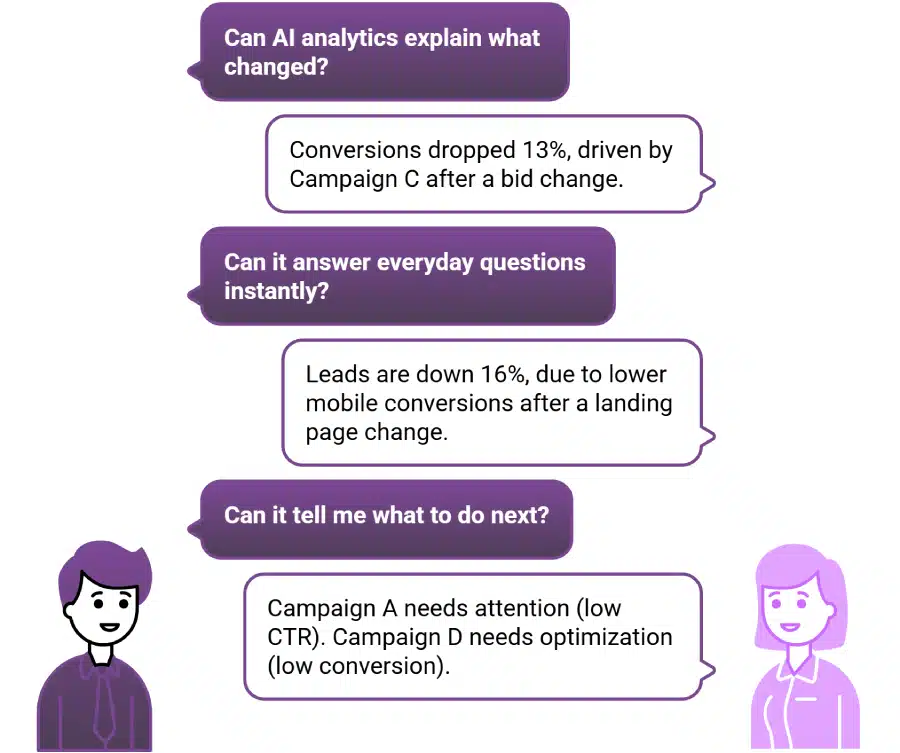
Instead of manually investigating a drop in performance, teams receive insights such as:

  • “Conversions declined by 14% due to reduced engagement in mobile traffic from Campaign A.”
  • “Lead volume dropped due to lower conversion rates on landing page X after a recent update.”

These insights provide immediate context.

The team no longer needs to start from scratch. Instead, it can:

  • Validate the insight
  • Assess business impact
  • Decide on the next step

This shift reduces the time between data and action. That is the real promise of AI analytics.

In fact, we recently broke down a few real-world scenarios - from “simple questions” that take hours to answer, to situations where teams struggle to decide what to do next - in a more conversational format.

The Role of Agentic AI in Analytics

As AI analytics continues to evolve, agentic AI is emerging as a key enabler of continuous intelligence.

Unlike traditional automation, which executes predefined tasks, agentic AI systems can operate more independently. They continuously monitor data, identify changes, and surface insights without requiring manual input.

In the context of marketing analytics, this means:

  • Insights are generated proactively
  • Patterns are identified continuously
  • Teams are alerted to meaningful changes in real time

This transforms analytics from a passive system into an active decision-support layer. Explore how Agentic AI Services for Marketing Transformation can introduce a continuous intelligence layer into your analytics workflows

This is also where modern ai solutions are heading - toward systems that assist not just in reporting, but in understanding and action.

How AI Analytics Improves Marketing Decision Making

The impact of AI analytics on marketing decision making is significant.

Faster Time to Insight

Teams no longer spend hours or days interpreting data. Insights are available much earlier in the process.

Reduced Dependency on Manual Workflows

Routine questions can be answered without repeated analysis, reducing the burden on analysts.

More Consistent Interpretation

Standardized insights reduce variability in how different stakeholders interpret data.

Better Resource Allocation

Teams spend less time analyzing and more time optimizing and experimenting.

Together, these improvements lead to more efficient and effective marketing operations.

AI Analytics Use Cases in Marketing

To understand how this works in practice, AI analytics use cases in marketing highlight where teams gain the most value. Some common AI analytics use cases include:

  1. Campaign Performance Monitoring
    AI analytics identifies underperforming campaigns and highlights the root cause before significant budget is wasted.
  2. Conversion Drop Analysis
    Instead of manual investigation, AI analytics pinpoints the exact drivers behind performance changes.
  3. Cross-Channel Insights
    AI analytics connects performance trends across platforms, providing a unified view of what’s happening.
  4. Opportunity Identification
    AI analytics highlights areas that require attention, enabling teams to act faster.

These use cases demonstrate how AI analytics moves beyond reporting into actionable intelligence.

Evaluating Your Current Analytics Setup

Most organizations evaluate their analytics maturity based on:

  • Data quality
  • Tracking accuracy
  • Reporting capabilities

While these are important, they do not fully capture effectiveness.

A more relevant question is: How much effort does it take to get an answer?

If answering a simple question requires multiple steps, coordination, or extended analysis, it indicates that the analytics setup is incomplete. This is where AI analytics can create the most impact.

From Dashboards to an Analytics Intelligence Layer

Modern marketing analytics is evolving into a layered system.

Foundation Layer:

  • Data collection
  • Tracking (Google Analytics 4)
  • Reporting dashboards

Intelligence Layer:

  • AI analytics
  • AI powered analytics
  • Agentic AI

The intelligence layer focuses on interpretation.

It continuously analyzes data, connects signals to causes, and surfaces insights without requiring repeated manual effort. This is what defines an analytics intelligence layer.

The Strategic Advantage of AI Analytics

The real value of AI analytics lies in speed.

In competitive environments, the ability to understand data quickly leads to faster decisions. Faster decisions lead to better outcomes.

Organizations that adopt AI analytics gain:

  • Faster optimization cycles
  • Reduced wasted spend
  • Improved campaign performance

This is not just an operational improvement.
It is a competitive advantage.

Where Most Organizations Get It Wrong

Many organizations assume that improving dashboards will solve their analytics challenges.

In reality:

  • More dashboards increase complexity
  • More data does not equal better decisions

Another common mistake is treating AI analytics as a standalone tool.

It is not just a tool.
It is a shift in how analytics workflows operate.

Without aligning workflows, even the best AI analytics solutions will not deliver full value.

Closing Perspective

Analytics has always evolved to reduce effort.

First, it reduced the effort of collecting data.
Then, it reduced the effort of accessing it.

Now, it is reducing the effort of understanding it. This is where AI analytics is making the biggest impact.

By transforming how insights are generated and consumed, AI analytics enables teams to move faster from data to decision. It reduces manual effort, improves clarity, and supports better marketing decision making.

The advantage today is no longer about having more data. It is about understanding it faster - and acting on it sooner.

→ Explore how Agentic AI Services for Marketing Transformation can introduce a continuous intelligence layer into your analytics workflows

Tatvic | Automate your marketing with Agentic AI

AI Powered Analytics | Why Marketing Decision-Making Is Still Slow - and How to Fix It

AI Analytics: From Dashboards to Decisions

Where Marketing Decision-Making Slows Down

For years, marketing teams were solving for one core problem: They couldn’t trust their analytics.

Different dashboards showed different numbers.
Attribution didn’t add up.
Teams spent more time validating marketing analytics than using it.

So naturally, the focus shifted:

  • Better tracking
  • Cleaner Google Analytics 4 implementations
  • Standardized dashboards
  • Stronger reporting layers

And to be fair - this worked.

Today, many organizations finally have reliable analytics. They trust their data. But something unexpected happened next: Decision-making didn’t speed up. This is exactly where AI analytics is changing how modern marketing teams operate.

What Is AI Analytics in Marketing?

AI analytics in marketing refers to the use of artificial intelligence to analyze data, identify patterns, and generate actionable insights that improve marketing decision making.

Unlike traditional marketing analytics, which focuses on dashboards and reporting, AI analytics goes a step further. It helps teams understand:

  • Why performance changes are happening
  • What factors are driving those changes
  • What actions should be taken next

This is what makes AI powered analytics fundamentally different. Instead of relying entirely on a data analyst, teams can use intelligent systems to:

  • Detect anomalies in real time
  • Analyze cross-channel performance
  • Surface insights proactively
  • Recommend next best actions

In practice, this means your analytics evolves from:
‘Reporting what happened‘ to ‘Explaining what’s happening - and guiding what to do next‘

This shift is central to modern ai solutions and is increasingly powered by advancements like agentic AI, which enables continuous monitoring and decision support. This is why AI analytics is becoming a critical layer in modern marketing systems.

If Data Isn’t the Problem, What Is?

Most teams assume that once data is fixed, decisions should become faster. But in reality, the bottleneck hasn’t disappeared. It has moved.

From: “Can we trust this data?”

To: “What does this data actually mean - and what should we do next?”

And that second question is where things slow down again. Because while data collection and reporting have matured, data interpretation is still manual. This is where modern AI analytics enters the conversation.

The Hidden Bottleneck in Marketing Analytics

Let’s look at how this plays out in a typical marketing analytics workflow.

A team today has:

  • Clean analytics implementation
  • Accurate tracking
  • Structured dashboards
  • Cross-channel visibility

Everything looks right. But when performance drops:

What looks like a simple performance drop turns into a multi-day process - not because the data is wrong, but because understanding it takes time. This is where marketing decision-making speed breaks down. Every delay between signal and clarity slows action, extends impact, and reduces the ability to respond in real time. Without AI analytics, this interpretation gap continues to slow down decision-making.

Nothing Is Broken. But It’s Still Slow.

This is the reality of modern analytics. The issue is no longer:

  • Data quality
  • Reporting accuracy

The issue is: Time taken to interpret data

And that’s exactly the gap AI powered analytics is designed to solve. If you want to understand the real impact on your business, you can evaluate the potential ROI of faster decisions with the AI ROI Forecaster

The Core Limitation of Dashboards

Most marketing dashboards are designed to answer one question:

“What changed?”

They can show:

  • Drop in conversions
  • Channel-level performance
  • Campaign-level trends

But they don’t explain:

  • Why the change happened
  • Whether it’s temporary or systemic
  • What action should be taken

The biggest limitation impacting marketing decision-making speed is lack of automated interpretation. This creates a gap. And that gap is filled manually - every single time.

Why AI Analytics Is Becoming Essential

The shift toward AI analytics isn’t theoretical - it’s already delivering measurable impact.

Research compiled from firms including McKinsey Digital (2026) shows that AI in marketing can drive an average ROI improvement of around 35%.

At the same time, broader studies indicate that organizations using AI in marketing and sales are already seeing tangible gains in performance and efficiency.

This reinforces a clear shift: The competitive advantage is moving from access to data → speed of understanding.

Instead of just showing data, it helps teams:

  • Detect anomalies automatically
  • Analyze patterns across dimensions
  • Identify likely causes
  • Recommend next steps

This is where AI powered analytics transforms marketing decision making.

Why Marketing Analytics Still Feels Slow

Even with AI analytics capabilities emerging, most teams are still operating with manual interpretation layers where teams face the following challenges: 

1. Analysis Is Reactive

Teams analyze data after something goes wrong.

This means:

  • Insights come late
  • Impact has already occurred
  • Opportunities are missed

2. Analysts Become a Bottleneck

As data complexity increases, so does reliance on analysts.

They handle:

  • Ad-hoc queries
  • Deep dives
  • Reporting requests
  • Data validation

When multiple stakeholders ask questions, everything slows down.

3. Interpretation Isn’t Standardized

Two people can look at the same dashboard and reach different conclusions.

Why?

Because interpretation depends on:

  • Context
  • Experience
  • Assumptions

This leads to:

  • More discussions
  • Delayed decisions
  • Lack of consistency

4. Decision Latency Impacts Performance

This is the hidden cost.

In marketing:

Timing matters as much as the decision itself.

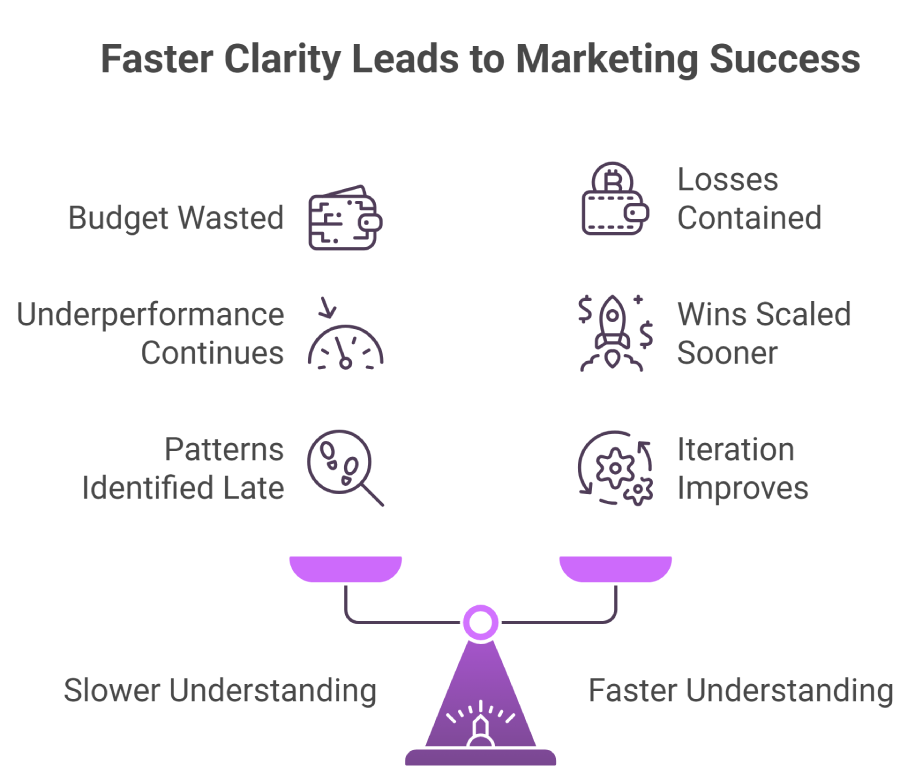
If understanding is delayed:

  • Budgets are wasted before correction
  • Underperformance continues longer
  • Winning strategies are identified late

Decision latency directly reduces marketing decision-making speed across teams.

The Real Shift: From Data Accuracy to Decision Speed

Over the last few years, organizations have optimized for: Data accuracy, tracking reliability, and reporting consistency but the next evolution isn’t better dashboards. It’s analytics intelligence powered by ai solutions.

It’s about: How fast your team can move from data → insight → action

This is where most organizations still struggle.

Introducing Analytics Intelligence

This is where AI analytics evolves into a true intelligence layer.

An Analytics Intelligence Layer

This sits on top of your existing analytics setup and focuses on:

  • Continuous performance monitoring
  • Automated analysis of changes
  • Contextual explanation of trends
  • Identification of likely causes

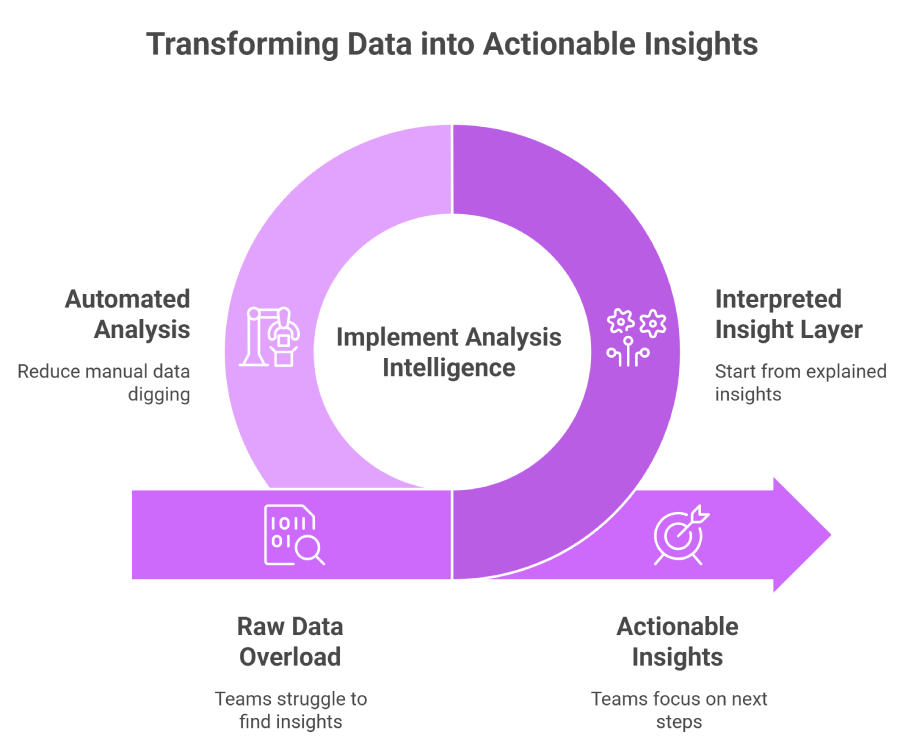
Instead of starting with raw data,
teams start with interpreted insights.

Is Your Current Process Ready for This Shift?

Not every analytics workflow is ready for an intelligence layer. The key question is: Where is your team still dependent on manual analysis? This is where evaluating your internal workflows becomes critical.

→ Use the AI Process Eligibility Calculator to identify where AI analytics can create the most impact

From Manual Analysis to AI-Powered Clarity

Let’s revisit the earlier scenario. Instead of spending 2-5 days analyzing data, the team receives:

“Conversions dropped 18% yesterday, primarily from paid search.
The decline is concentrated in Campaign X after a recent bid adjustment.”

Now the conversation changes.

From: “What happened?”

To: “What should we do next?”

This shift reduces:

  • Time spent analyzing
  • Back-and-forth discussions
  • Dependency on manual workflows

And compresses decision cycles from days to hours. With AI analytics, teams no longer start from raw data - they start from insight.

Does This Replace Analysts or Teams?

No, and it shouldn’t.

The role of AI Analytics Intelligence is not to replace human expertise. It’s to enhance it.

Teams still:

  • Validate insights
  • Apply business context
  • Make final decisions

But they start from a position of clarity, not confusion.

Why This Matters More Than Ever

Marketing environments today are more complex than ever.

  • More channels
  • More campaigns
  • More segmentation
  • More data

At the same time:

  • Decision cycles are shorter
  • Expectations are higher
  • Teams are leaner

In this environment: AI use cases in analytics are no longer optional - they’re a competitive advantage.

How to Identify If You Have a Decision Speed Problem

Ask yourself:

  • How long does it take to understand a performance drop?
  • How many people are involved in analysis?
  • How often do decisions get delayed due to unclear insights?
  • How quickly can your team act on new opportunities?

If the answer is measured in days,
there’s a clear opportunity to improve.

From Reporting to Decision Intelligence

Most organizations have already invested in: Marketing analytics tools, data pipelines, reporting dashboards

But reporting only answers: “What happened?”

To improve performance, you need systems that answer: “Why did it happen - and what should we do next?”

That’s the shift from:     Reporting     to    Decision Intelligence

The Role of Agentic AI in Analytics

Agentic AI takes this further. Instead of just analyzing data, it can:

  • Continuously monitor performance
  • Trigger insights automatically
  • Assist in decision workflows

This creates a system where analytics is no longer passive - it becomes active.  Not just to inform decisions. But to support how marketing actually operates at scale.

Closing Thought

Fixing your data was a critical step. But it was never the final one. Because clean data doesn’t create clarity on its own. And in today’s environment:

The advantage doesn’t come from having more data.
It comes from understanding it faster - and acting on it sooner.

Improving marketing decision-making speed is no longer about fixing data. It is about reducing the time between insight and action. The faster teams interpret what is happening, the faster they can respond - and that is where competitive advantage now lies. This is the real promise of AI analytics - faster understanding, faster action, and better outcomes.

Explore what faster, more consistent decision-making could look like:

If your team is still spending days moving from data to action, it may be time to rethink how your AI analytics layer operates.

→ Start your Analytics Intelligence discussion
→ Evaluate your AI readiness

Agentic AI for Marketing: Driving Results with Intelligent Automation

Agentic AI for Marketing: Driving Results with Intelligent Automation - Tatvic

Do you Know?

Marketers Saw a 13.7% Average ROI from Agentic AI in 2026
~BCG

We’re at a turning point in how work gets done , not just faster, but fundamentally smarter.

The rise of Agentic AI for marketing is transforming how decisions are made, actions are taken and results are scaled in real time.

But what exactly is it and why is now the moment to care for Agentic AI for marketing automation?

Agentic AI refers to a new class of AI systems that go beyond traditional automation or even advanced machine learning.

AI for Marketing has long promised efficiency gains, but Agentic AI for Marketing systems are goal-seeking, context-aware and capable of autonomous decision-making across complex tasks  often with minimal human intervention.

While “AI” is a term that’s been hyped for years, Agentic AI is not about chatbots or basic scripts.

It’s about delegating entire jobs, not just tasks to intelligent agents that continuously learn, optimize and coordinate with other tools or systems.

Agentic AI for Marketing: Scaling Marketing Automation In A Smarter Way

Traditional Marketing Automation is built on predefined workflows and static rules.

While it helps streamline repetitive tasks, it often lacks the flexibility and intelligence needed to thrive in today’s dynamic digital landscape.

As customer behaviors shift in real time and campaign complexity grows, businesses need more than automation, they need autonomy.

Agentic AI introduces a new paradigm: autonomous and goal-driven agents that not only execute tasks but also plan, adapt, and optimize marketing actions intelligently.

These agents continuously learn from data, make context-aware decisions, and operate with minimal human intervention-enabling marketers to move faster, target smarter, and respond in real time.

By combining the power of machine learning, decision intelligence, and real-time feedback loops, Agentic AI allows marketing teams to scale their efforts more intelligently.

It unlocks smarter automation, driven not just by efficiency, but by adaptability and strategic outcomes.

In this guide, we explore how Agentic AI is redefining marketing automation and how organizations can leverage it to deliver greater performance, personalization and ROI at scale.

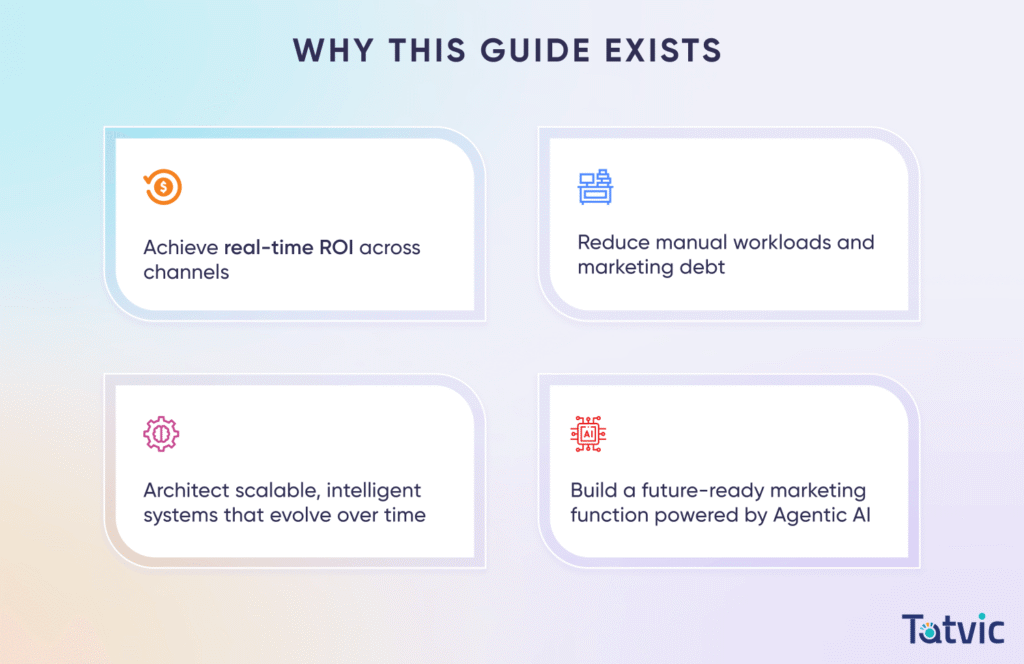
Why This Guide on Agentic AI For Marketing Automation Exists?

Despite its potential, Agentic AI for marketing automation can feel complex or out of reach for many teams. There’s a lot of noise, hype, and confusion around terms like “autonomous agents” or “multi-agent systems.” That’s why we created this guide - to make Agentic AI for marketing automation understandable, actionable, and above all, applicable to real-world marketing challenges.

Agentic AI for Marketing: Scaling Marketing Automation In A Smarter Way

This isn’t just a trendwatcher’s report. It’s a practical, strategic roadmap for marketers looking to:

  • Achieve real-time ROI across channels
  • Reduce manual workloads and marketing debt
  • Architect scalable, intelligent systems that evolve over time
  • Build a future-ready marketing function powered by Agentic AI
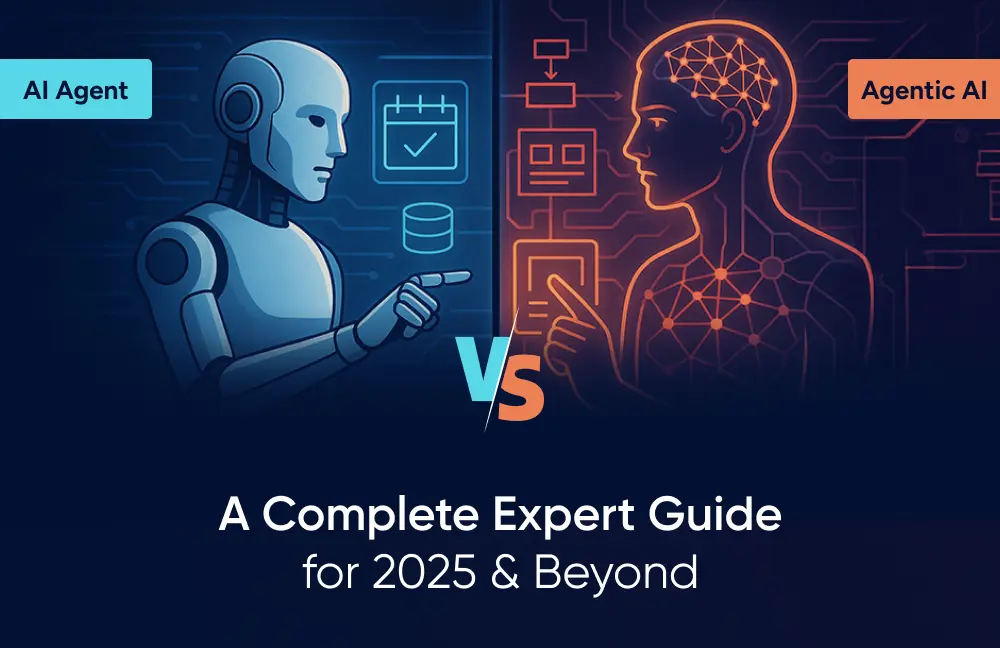
You may also like to read👉 Agentic AI vs AI Agents: A Complete Guide for 2026 & Beyond


What the Early Data Tells Us about the Role of Agentic AI in Marketing?

Early evidence across industries shows that Agentic AI for marketing automation is already delivering tangible value.

Here are three verified data points from leading research:

Revenue Uplift in Marketing & Sales

63% of companies surveyed by McKinsey report higher revenue in marketing and sales after scaling AI, making these functions the biggest beneficiaries of AI-driven growth.
Source: McKinsey Global AI Survey, 2023

Cost Reductions in Operations

44% of the same respondents say AI has cut costs by at least 10% in the units where it’s deployed, with marketing operations among the top areas realizing these savings.
Source: McKinsey Global AI Survey, 2023

Widespread AI-Powered Personalization

Over 50% of marketers have deployed AI-driven personalization tools to tailor customer experiences in real time-resulting in an average 20% boost in engagement metrics.
Source: Gartner Marketing Technology Survey, 2024

These figures underscore a clear trend: businesses embracing Agentic AI for marketing automation see faster execution, lower costs, and measurable revenue uplifts proving the technology is ready for prime time.

Why Agentic AI in Marketing Really Matters Now?

The pressure on marketers in 2026 has never been more intense.

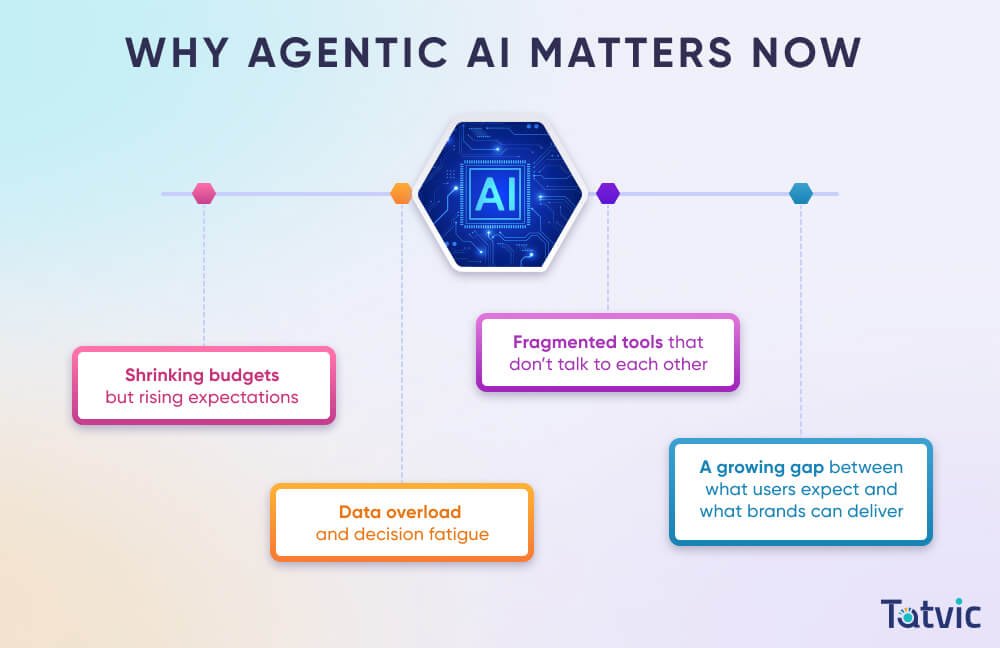
Marketing teams today are navigating a perfect storm of heightened expectations, constrained budgets, and an overwhelming explosion of data.

Agentic AI for marketing automation offers a real way forward. By using agents that are goal-driven, adaptive and self-improving, marketing teams can break the cycle of reactive execution and start operating proactively, intelligently and at scale.

Why Agentic AI in Marketing Really Matters Now - Tatvic

This moment is unique. Advances in real-time data infrastructure, scalable LLMs, and edge computing have converged, making Agentic AI truly autonomous. If you want AI Marketing that adapts on the fly, eliminates manual bottlenecks, and delivers real-time ROI, there’s never been a better time to embrace Agentic AI for marketing automation.

Despite access to advanced Martech stacks, many still face persistent challenges:

  • Shrinking budgets, rising KPIs: Marketing leaders are being asked to do more with less. Optimize performance, personalize experiences and scale campaigns, all while operating with reduced spend.
  • Data deluge and decision fatigue: With vast amounts of customer and campaign data pouring in across channels, marketers struggle to turn insights into timely action.
  • Disconnected tools and siloed systems: Legacy marketing automation platforms and fragmented data stacks don’t integrate seamlessly, leading to inefficiencies and lost opportunities.
  • Sky-high customer expectations: In 2026, consumers expect real-time relevance, hyper-personalization, and instant gratification-standards that outdated automation simply can’t meet.

Enter Agentic AI: The Future of Marketing Automation

Agentic AI isn’t just another upgrade in your Martech toolkit, it’s a fundamental shift.

This new wave of intelligent, autonomous agents redefines how marketing gets done.

Instead of relying on rigid workflows and static rules, Agentic AI empowers marketers with systems that are:

  • Goal-driven: Agents operate with clear business objectives in mind-whether it’s maximizing ROAS, improving engagement, or reducing churn.
  • Self-improving: These agents learn continuously from real-time data and past outcomes to refine strategies dynamically.
  • Context-aware: They understand the environment, customer signals, and business context, adjusting campaigns on the fly for optimal impact.
  • Proactive, not reactive: Instead of waiting for inputs or approvals, agents anticipate what’s needed and act autonomously to achieve it.

Why Agentic AI in Marketing Is Important Now?

The timing couldn’t be more critical or more promising.

In 2026, we’ve hit a powerful inflection point where technology finally enables true marketing autonomy:

  • Scalable LLMs (Large Language Models) are now fine-tuned for industry-specific marketing applications, enabling more precise, context-rich decision-making.
  • Real-time data infrastructure powered by event-driven architectures (e.g., Kafka, Snowpipe, and Apache Flink) allows instant feedback and action loops.
  • Edge computing and privacy-aware AI make it possible to deliver personalized experiences at speed while maintaining compliance with evolving data regulations like the Digital Markets Act and India’s DPDP Bill.
  • Agentic orchestration platforms are replacing clunky dashboards, automating campaign management, A/B testing, audience segmentation, and even creative optimization at scale.

It’s time to stop patching together workflows and start building self-directed marketing systems.

Agentic AI isn’t just the next step, it’s the leap toward marketing that’s faster, smarter, and more ROI-driven than ever before.

  • You don’t need more dashboards-you need decisions.
  • You don’t need more tools-you need outcomes.
  • You don’t need more rules-you need results.
  • You don’t need more Automation -you need Autonomy.

Agentic AI delivers all Four!

The Imperative for Real-Time ROI

The Imperative for Real-Time ROI

In 2026, marketers no longer have the luxury of time or guesswork.

Campaigns are no longer judged by monthly wrap-ups or post-mortem dashboards.

Every initiative is tethered to real-time performance metrics, tight budgets and high-stakes KPIs.

The question CMOs are asking isn’t just “Did this work?”, it’s:

“What’s working right now and what must change immediately?”

Traditional marketing automation tools simply can’t keep pace with the speed of decision-making required today.

That’s where Agentic AI for marketing automation steps in not as an enhancement, but as a game-changing necessity.

You may also like to read👉 Agentic AI vs Generative AI in 2026: Definitions, Use Cases and Key Differences


Why Real-Time Marketing Is No Longer Optional

In today’s high-velocity digital landscape, delayed insights cost money, attention, and conversion. Modern marketing needs to react not in hours or days but in seconds.

Agentic AI delivers real-time ROI by enabling autonomous decision loops across every marketing touchpoint. It’s not about analyzing last week’s campaign, it’s about optimizing this second’s results.

Imagine intelligent AI Agents that:

  • Pull live performance data from multiple platforms (Google Ads, Meta, DV360, CRM, etc.)
  • Analyze campaign signals across audiences, creatives, and channels in real time
  • Reallocate budget dynamically toward high-performing assets or underexposed audiences
  • Auto-generate and A/B test subject lines, CTAs, or creative elements on the fly
  • Trigger contextual next-best actions for users based on their real-time behaviors

The Tech Convergence That Made It Possible

The shift to real-time, agentic marketing is powered by a unique convergence of technologies now fully matured in 2026:

  • Streaming data pipelines (e.g., Snowflake Snowpipe, Apache Kafka, Confluent Cloud) now handle billions of real-time events with near-zero latency.
  • Next-gen LLMs, like GPT-5 and Claude 3.5, are now fine-tuned for marketing decision-making, generating not just content, but strategy and performance recommendations.
  • Edge computing and serverless architectures enable data processing at the point of interaction no more waiting for centralized batch jobs.
  • Autonomous agent frameworks are built to execute adaptive marketing strategies without requiring constant human oversight.

Marketers have long leaned on automation to scale execution.

But 2026 demands more than automation, it demands intelligent action at speed.

Agentic AI turns automation into autonomy, empowering systems that not only act but adapt.

That agility directly translates into:

  • Higher conversion rates
  • Smarter budget allocation
  • Increased marketing velocity
  • Immediate feedback loops for continuous improvement

Real-time ROI isn’t a buzzword, it’s a business imperative.

Every moment you wait to optimize is a moment lost in a hyper-competitive market.

  • With Agentic AI, you’re not just keeping up -> you’re staying ahead.
  • You’re not just automating -> you’re advancing.
  • You’re not just reporting ROI -> you’re accelerating it.

Welcome to the new standard in performance marketing.


You may also like to read👉 How AI Is Reshaping Marketing in 2026: Trends, Tools & Tactics


Why 2026 Is the Breakthrough Year for Instant ROI with Marketing Automation

2026 isn’t just another year of AI hype, it’s the inflection point where marketing automation and real-time ROI converge.

The pressure on marketing teams to do more with less has never been greater.

Budget scrutiny is at an all-time high, C-suite patience is at an all-time low, and delayed insights are no longer acceptable.

Yet, according to BCG’s October 2024 report, despite multi-year investments in AI, 74% of companies still struggle to scale meaningful value.

The culprit?

Most AI deployments remain siloed in pilots, dashboards or POCs failing to deliver measurable outcomes.

Only 1 in 4 enterprises have matured their AI strategy enough to drive cross-functional, ROI-generating impact.
- Source: BCG, “Where’s the Value in AI?”, 2024

The Leaders Have a Different Playbook

What sets the frontrunners apart isn’t just access to AI, but how they integrate it deeply into their revenue engines and cost-optimization workflows.

  • 45% of AI leaders deploy AI for enterprise-wide cost transformation (vs. just 10% of laggards)
  • Over 33% use AI directly to fuel top-line growth-boosting revenue through smarter decision-making and personalized automation
  • Leaders close the loop between insights and action with minimal human intervention

With real-time data pipelines and cloud-native LLMs now mainstream, Agentic AI for marketing automation is finally live. In a world of shrinking budgets and zero patience for lag, this is the year AI Marketing proves its ROI.

From ROI Lag -> ROI Live

In traditional marketing automation, results are often reactive. You launch a campaign, wait days for performance data, and only then make changes.

With Agentic AI, the game changes:

  • ROI insights surface in real time, not in post-campaign retrospectives.
  • Campaign performance is continuously optimized based on dynamic behavior and live feedback loops.
  • Budgets shift automatically toward what’s working, eliminating waste and maximizing impact without waiting for manual intervention.

In 2026, Agentic AI doesn’t just report ROI. It delivers it instantly.

Agentic AI Marketing Automation 101: From Predictive to Prescriptive to Fully Autonomous

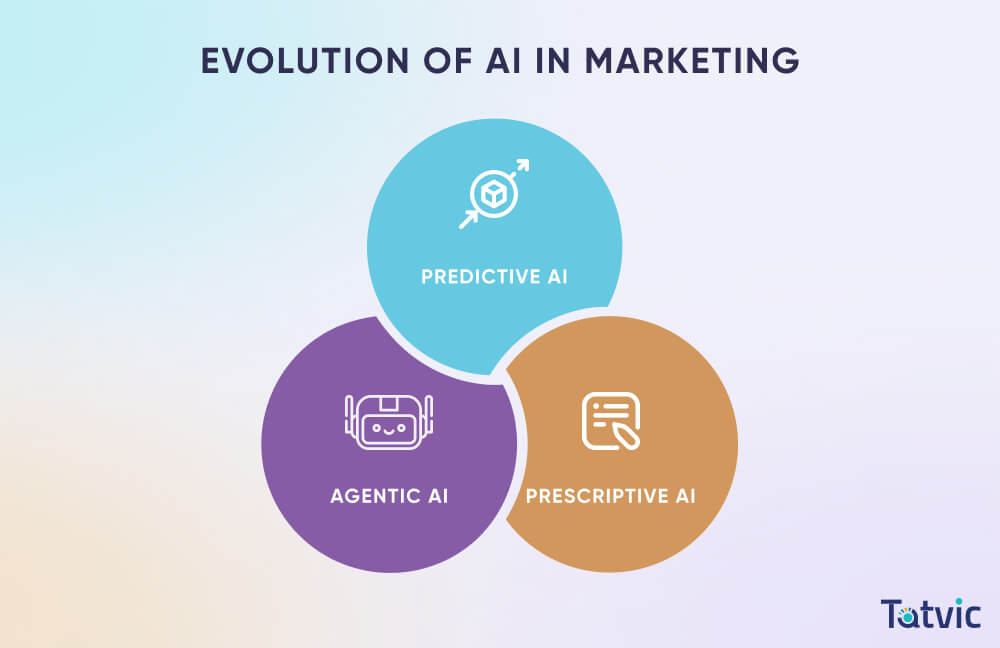
The Evolution of AI in Marketing Automation

The evolution of AI in marketing is a story of growing intelligence, autonomy, and business impact. What began as data-driven support tools has now matured into fully autonomous systems that not only recommend but execute.
Evolution of AI in Marketing

Stage 1: Predictive AI - Seeing What’s Likely to Happen

Predictive AI was the first major milestone. It helped marketers move from gut-feel decisions to data-backed forecasting.
These models:

  • Scored leads based on conversion potential
  • Predicted customer churn
  • Recommended best-next products or offers
  • Identified behavior trends across segments

While powerful, predictive AI still left the actioning to humans.

Stage 2: Prescriptive AI - Suggesting What to Do

Next came prescriptive AI tools that not only anticipated outcomes but suggested the optimal path forward.
These solutions would:

  • Recommend campaign budget reallocations
  • Suggest subject line improvements based on audience insights
  • Optimize bidding strategies for paid media
  • Guide content sequencing based on user journey modeling

However, execution still required human validation. Think of this phase as AI copilots, not commanders.

Stage 3: Agentic AI - Acting Autonomously in Real Time

Welcome to 2026: the age of Agentic AI for marketing automation.

Agentic AI systems represent a breakthrough leap. These aren’t just intelligent advisors, they’re autonomous agents with the ability to:

  • Ingest and analyze real-time cross-channel data
  • Make data-driven decisions with minimal latency
  • Dynamically execute changes across campaigns, budgets, creatives, and journeys
  • Learn continuously and self-improve with each interaction

There’s no need for human-in-the-loop delays. These agents think, act, and adapt at machine speed enabling fully self-driving marketing operations.

This evolution from predictive to prescriptive to autonomous is what sets Agentic AI apart in the marketing tech landscape.

It allows brands to:

  • Move from insights to impact instantly
  • Deliver hyper-personalization at scale
  • Eliminate manual bottlenecks across the marketing funnel
  • Continuously optimize based on real-world results-not assumptions

In 2026, with cloud-native LLMs, real-time data streams, and scalable edge computing,

You may also like to read👉 Agentic AI vs ChatGPT: What Marketers Need to Know in 2026


Agentic AI isn’t just an upgrade, it’s a redefinition of what’s possible in marketing.

Core Capabilities & Business Impacts

In 2026, the most transformative marketing automation systems are no longer just reactive-they’re agentic, proactive, and self-evolving. At the heart of Agentic AI lies a new class of intelligent systems defined by three breakthrough capabilities: goal-seeking behavior, collaborative agents, and real-time self-optimization.

Together, these elements enable marketing teams to unlock unprecedented efficiency, agility, and growth at scale.

1. Goal-Seeking Decision-Making Agents

Agentic AI systems are designed to pursue outcomes, not just execute tasks.

These intelligent AI Agents:

  • Continuously scan and interpret thousands of signals across campaigns, channels, and user touchpoints
  • Prioritize marketing actions aligned with predefined business objectives (e.g., ROAS, CAC, LTV)
  • Make high-frequency decisions without human bottlenecks

This allows for dynamic, autonomous marketing orchestration-with minimal manual intervention and maximal business alignment.

2. Real-Time Learning & Continuous Optimization

Unlike traditional automation that relies on static rules or pre-trained models, Agentic AI adapts in real time:

  • Refines strategies based on immediate performance feedback
  • Tests and evolves content, creatives, timing, and placement on the fly
  • Adjusts for shifting market signals, user behaviors, or budget thresholds instantly

The result?

A self-improving marketing engine that becomes smarter and more effective with every interaction.

3. Automated Activation Across the Full Funnel

Agentic AI doesn’t just suggest actions, it executes them.

These systems can:

  • Launch campaigns and deploy assets autonomously
  • Reallocate budgets from underperforming to high-performing channels in real time
  • Rewrite subject lines, CTAs, or product recommendations instantly to boost performance
  • Trigger multichannel journey updates based on live intent signals

This eliminates lag between insight and impact turning real-time intelligence into immediate business outcomes.

The result?

Marketers shift from firefighting to strategy elevating AI Marketing from static reporting to dynamic, ROI-driven action and turning Agentic AI for marketing automation into your most reliable growth engine.

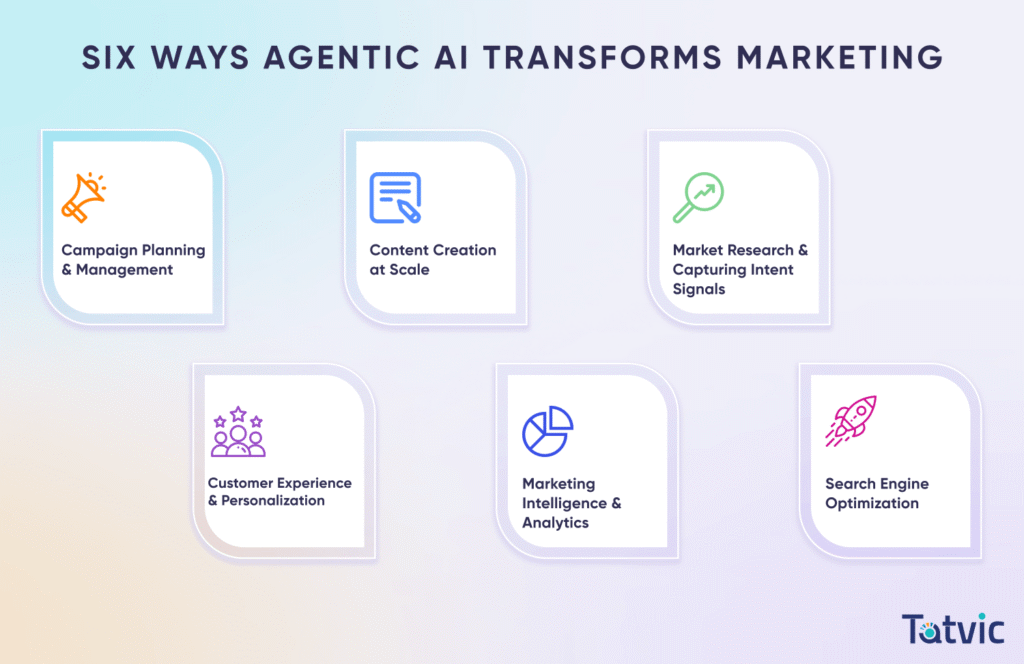
6 Ways How Agentic AI Is Transforming Marketing in 2026

As marketing complexity explodes in the era of hyper-personalization, shrinking attention spans, and real-time consumer expectations, Agentic AI emerges as the breakthrough force that doesn’t just automate but intelligently orchestrates marketing at scale.

These next-gen AI agents don’t wait for commands; they anticipate, act and adapt 24/7.

6 Ways How Agentic AI Is Transforming Marketing in 2025 - Tatvic

Here’s how Agentic AI is redefining what’s possible across the marketing value chain in 2026:

1. Campaign Planning & Management

Agentic AI independently plans, manages, and optimizes multi-channel campaigns from start to finish. With the right human-in-the-loop checkpoints, it ensures every marketing effort is both agile and effective.

  • Data-Driven Planning: AI agents scan real-time market signals-trending keywords, channel performance, and competitor moves-to draft ROI-ranked growth plans.
  • Scenario Forecasting: Run “what-if” models on budget, creative, and channel mix to predict campaign outcomes.
  • Live Optimization: Campaign blueprints refresh automatically as market conditions shift, keeping your strategy one step ahead.

2. Content Creation at Scale

Create compelling, tailored content across formats and platforms-intelligently crafted, iterated, and delivered by agents.

  • Smart Content Generation: Agents auto-write emails, ads, and landing pages based on real-time data and user behavior.
  • Multiformat Output: Instantly generate graphics, videos, and copy variants that adhere to brand standards.
  • Always-On Testing: Every creative element is tested and refined continuously to drive higher engagement.

3. Market Research & Capturing Intent Signals

Agentic AI captures a wide range of market signals and translates them into action-ready intelligence for sales and marketing.

  • Trend Monitoring: Track competitor launches, customer usage patterns, and industry shifts.
  • Intent Detection: Surface high-interest segments based on behavioral and contextual cues.
  • Actionable Inputs: Deliver timely recommendations to sales and marketing teams to act before opportunities or risks escalate.

4. Customer Experience & Personalization

Personalize digital journeys on the fly, using real-time signals to enhance engagement and improve customer experience.

  • Real-Time Journey Mapping: AI agents adjust user flows dynamically based on behavior, sentiment, and engagement.
  • Triggered Messaging: Deliver personalized emails, chat nudges, or app prompts exactly when needed.
  • Adaptive Personalization: Each customer’s path evolves as they interact-ensuring optimal relevance and conversion potential.

5. Marketing Intelligence & Analytics

Proactively surface insights, detect anomalies, and recommend the next best actions to steer marketing efforts in the right direction.

  • Predictive Forecasts: Access forward-looking projections on pipeline, revenue, and ROI.
  • Anomaly Detection: Flag dips, spikes, or unusual activity early-before they hurt performance.
  • Tactical Recommendations: Get guided advice on whether to scale, pause, or pivot-all within your dashboard.

6. Search Engine Optimization

Automate and scale your SEO strategy to stay ahead in search rankings-without manual lift.

  • Continuous Optimization: AI agents adjust keyword strategy, content structure, and internal linking in real-time.
  • SERP Intelligence: Monitor algorithm shifts and competitor positioning to protect your ranking.
  • Sustained Performance: Deliver long-term SEO results with adaptive, self-improving AI workflows.

Embedding these six intelligent capabilities into your marketing stack isn’t just future-proofing, it’s performance-proofing.

In 2026, Agentic AI for marketing automation isn’t just about working smarter; it’s about scaling faster, executing sharper, and connecting deeper than humanly possible.

How Agentic AI Marketing Automation Works Across Critical Jobs

Each marketing function from demand generation to sales enablement benefits uniquely from Agentic AI for marketing automation.

How Agentic Marketing Automation Works Across Critical Jobs

Below are role-based ‘Agent Recipes’ with key inputs and actions:

1. Demand Generation & Lead Nurturing

Inputs: Website behavior, firmographics, intent signals
Agent Actions:

  • Dynamically adjust offer thresholds based on visitor engagement
  • Send targeted drip-email sequences
  • Trigger retargeting ads when intent signals spike

2. Creative & Content Personalization

Inputs: Demographic profiles, past interactions, time of day
Agent Actions:

  • Generate personalized subject lines and headlines
  • Create hero banners and ad visuals tailored to audience segments
  • Rotate and test creative variants in real time

3. Marketing Analytics & Insights

Inputs: Cross-channel performance metrics, attribution models, spend data
Agent Actions:

  • Auto-generate consolidated dashboards
  • Flag anomalies or unexpected performance shifts
  • Recommend budget reallocations to maximize ROI

4. Sales Enablement & Handoff Automation

Inputs: CRM activity logs, lead scores, engagement triggers
Agent Actions:

  • Alert sales reps to high-intent leads instantly
  • Auto-populate relevant case studies or collateral in outreach emails
  • Schedule follow-up tasks and reminders within CRM

By aligning each agent’s inputs with precise actions, Agentic AI seamlessly automates and optimizes critical marketing jobs, so your teams can focus on strategy and growth.

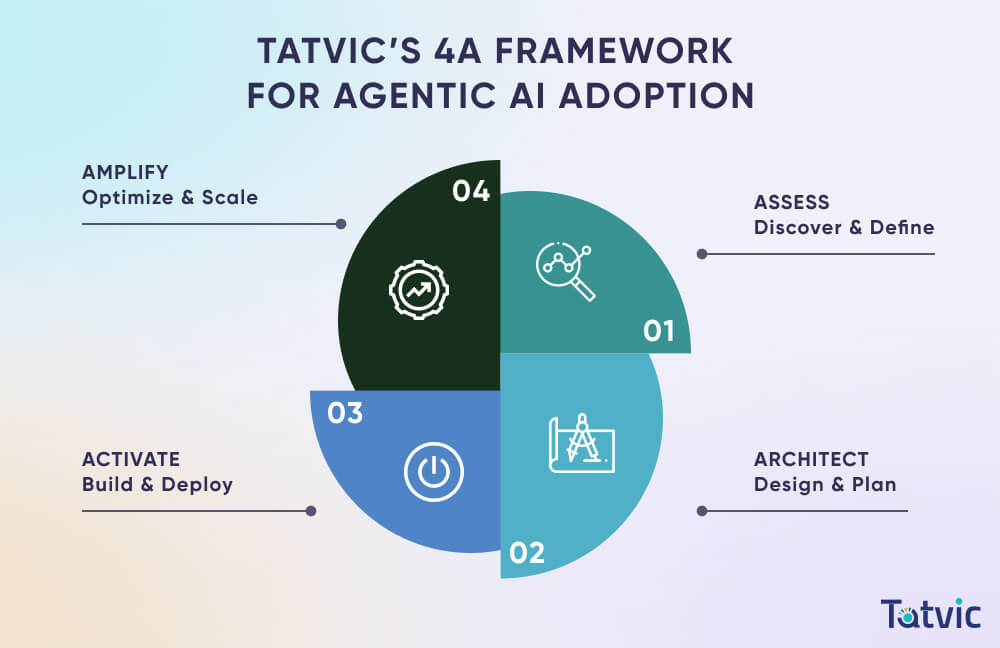
Tatvic’s 4A Framework for Agentic AI Adoption in Marketing

Tatvic’s 4A Framework provides a clear, step-by-step roadmap to adopt Agentic AI in your marketing stack from uncovering the highest-value opportunities to scaling proven pilots organization-wide.

It helps marketing leaders navigate technical readiness, prioritize quick wins, and align AI initiatives with business goals.

By systematically moving through each stage, organizations can reduce adoption risk, accelerate ROI, and build lasting competitive advantage in a rapidly evolving digital landscape.

Tatvic’s 4A Framework for Agentic AI Adoption in Marketing

1. ASSESS: Discover & Define

The journey starts by evaluating your current marketing capabilities and data landscape. This phase identifies where Agentic AI can make the most immediate impact.

  • Audit Existing Systems: Evaluate CRM, CDP, analytics, and ad platforms for data quality, coverage, and governance gaps.
  • Identify AI Opportunities: Pinpoint high-impact use cases where intelligent agents can drive efficiency or unlock new value.
  • Define KPIs & Roadmap: Set measurable goals (e.g., CPL, ROI, pipeline contribution) and outline a phased implementation plan.

2. ARCHITECT: Design & Plan

With opportunities identified, the next step is to build the architecture-defining the workflows, systems, and rules that your AI agents will operate within.

  • Design Agent Workflows: Map decision paths, triggers, and actions across your marketing ecosystem.
  • Plan Integrations: Align APIs, webhooks, and services for seamless interoperability with your current martech stack.
  • Set Guardrails: Establish governance policies and safeguards to ensure reliability, compliance, and trust.

3. ACTIVATE: Build & Deploy

Now it’s time to bring your agents to life. This phase involves configuring agents, integrating them into live systems, and training your team to work with the new model.

  • Deploy Pilot Agents: Launch AI agents in a controlled environment, aligned to specific use cases and KPIs.
  • Run Real-World Tests: Monitor performance in live conditions, with human-in-the-loop support to catch issues early.

Team Readiness: Train marketing teams on the new workflows, ensuring they’re equipped to manage and scale the solution.

4. AMPLIFY: Optimize & Scale

After validating success, it’s time to scale. This phase is about expanding agent coverage, optimizing based on real-world feedback, and embedding continuous learning.

  • Scale Across Campaigns: Extend AI adoption across regions, channels, and marketing functions.
  • Automate Optimization: Use feedback loops, automated alerts, and model retraining to keep agents sharp.
  • Track Value Over Time: Maintain dashboards and reporting cadences to ensure ROI, efficiency, and agility continue to improve.

Following these four steps ensures rapid pilots, seamless integration and sustained ROI unlocking autonomous marketing at scale.

Building Your Data & Technology Foundation for AI Marketing Automation

To unlock the full potential of Agentic AI for marketing automation, a strong data and tech foundation is essential.

Intelligent agents require more than just data they need a curated, governed, and interoperable system that delivers context and continuity across the customer journey. It starts with making sure your data is not only collected, but ready for real-time, autonomous action.

Building Your Data & Technology Foundation

1. Data Readiness

  • Completeness & Hygiene: Clean, de-duplicate, and normalize records to prevent decision errors.
  • Governance & Security: Implement data classification, encryption, and consent management in line with GDPR and CCPA.

2. Tech Stack Integration

  • CRM/CDP Connectivity: Native connectors for Salesforce, HubSpot, and major CDPs.
  • Ad Platform APIs: Seamless bid and budget control on Google Ads, LinkedIn, and programmatic platforms.
  • Analytics Streams: Real-time web behavior via Google Analytics, Adobe Analytics, or custom streams.

3. Scalable Infrastructure Readiness

  • Dynamic Resource Scaling: Utilize cloud-native platforms that automatically adjust compute and storage capacity to support AI agent training, testing, and real-time decision-making.
  • Performance Efficiency: Implement streamlined processing pipelines to ensure minimal delay for time-sensitive campaign execution.
  • Resilient & Future-Ready Systems: Build a flexible architecture that supports growing data volumes, evolving agent logic, and expanding use cases with ease.

Governance & Organizational Readiness for AI Marketing Automation

Integrating Agentic AI for marketing automation demands clear governance, ethical guardrails, and organizational readiness to assign accountability, uphold fairness, and drive user adoption.

These structures ensure autonomous decisions align with business objectives, comply with regulations, and maintain stakeholder trust.

1. AI Governance Framework

  • Define roles & responsibilities: AI Stewards, Data Owners, and an Ethics Board.
  • Establish approval workflows for high-impact agent decisions to maintain control and accountability.

2. Ethical & Compliance Guardrails

  • Privacy-by-Design: Consent management, data minimization, and encryption at every layer.
  • Bias Detection & Fairness Checks: Leverage explainable AI tools (e.g., SHAP dashboards) to ensure equitable decisioning.

3. Change Management & Center of Excellence

  • Launch an Agentic AI Center of Excellence (CoE) with executive sponsorship to drive adoption.
  • Develop training curricula and certification paths for marketers, analysts, and engineers.
  • Build an “AI Champions” network to share best practices, troubleshoot issues, and promote innovation.

4. Risk Monitoring & Audit Trails

  • Continuous drift detection, alerting, and automated retraining cadences.
  • Immutable logs capturing agent actions, human overrides, and compliance reports-essential for audits and regulatory reviews.

By embedding rigorous governance, continuous risk monitoring, and a dedicated Center of Excellence, you transform Agentic AI for marketing automation from a pilot into a trusted, enterprise-wide capability driving autonomous marketing safely, efficiently, and at scale.

Without a stable data foundation, even the smartest agents will deliver subpar results.

Next Steps & Interactive Tools ->

Instant ROI Calculator

Embed our Agentic AI for marketing automation ROI calculator to let prospects estimate their uplift in under five minutes turning passive readers into qualified leads.

➥ Schedule a Discovery Session with our Agentic AI Marketing experts & setting the stage for a rapid & low-risk rollout


Insight-to-Creative Automation - The New Engine Behind Viral, Insight-Led Marketing

Marketing Didn’t Break. It Just Started Moving Faster Than Our Systems.

Search still works.
People still look for products, answers, inspiration, and reassurance.

What’s changed is how and when they search.

Users no longer type short, transactional queries like “buy running shoes.”
They ask nuanced, context-heavy questions like:

  • “Best cushioned shoes for knee pain”
  • “Sneakers TikTok creators are wearing right now”

These queries are shaped by culture, creators, conversations, and real-time moments - not just intent to buy.

For marketers, this creates a quiet but growing problem.

By the time keyword research is completed, reviewed, clustered, and approved, the moment that triggered the search behavior has often already passed.

Keyword research still tells you what people searched for.
It does not tell you what to create, when to create it, or how to act before competitors flood the same space.

This is where most modern marketing teams lose momentum - not because they lack insight, but because they can’t translate insight into action fast enough.

The Growing Gap Between Insight and Execution

Traditional keyword research was never designed for this environment.

It is inherently backward-looking. It analyzes historical volume, competition, and trends that have already stabilized. That worked when search behavior changed slowly. It doesn’t work when culture, platforms, and intent shift week by week.

What marketers experience today is a persistent execution gap.

Insights live in dashboards, spreadsheets, and reports. Creative teams work on fixed calendars. Campaigns launch after approvals, iterations, and revisions. And by the time everything goes live, the opportunity window has narrowed - or closed.

The result is familiar:

  • Brands enter trends late and pay a premium for attention
  • Creative feels generic because it’s built for scale, not momentum
  • Teams spend more time coordinating than experimenting
  • Competitors who moved faster dominate visibility

This isn’t a failure of creativity or strategy. It’s a system problem.

Why “Faster Execution” Alone Isn’t the Answer

Many teams try to solve this by asking for faster turnaround.

They push agencies harder.
>
They shorten approval cycles.
>
They add more tools.

But speed alone doesn’t fix the core issue.

The real challenge is translation - turning raw signals into brand-relevant creative decisions without losing context, consistency, or quality.

You don’t just need to know what is trending.
You need to know:

  • Whether the trend actually aligns with your brand
  • How it connects to your audience’s intent
  • What creative angle makes sense for you
  • And how to act while momentum is still building

This is where Insight-to-Creative Automation enters the picture.

What Is Insight-to-Creative Automation?

Insight-to-Creative Automation is a marketing system that continuously identifies emerging search and cultural signals, evaluates their relevance to a brand, and automatically translates them into brand-aligned creative across channels - before trends reach saturation.

Unlike traditional keyword research or static automation, it connects insight discovery, decision-making, and creative execution into a single, autonomous workflow powered by Agentic AI and governed by brand and business guardrails.

At Tatvic, this isn’t positioned as a tool you plug in.
It’s implemented as a custom operating system for modern marketing teams, designed around your data, your brand voice, and your growth priorities.

How the System Actually Works: Beyond the Buzzwords


  • From Passive Monitoring to Active Trend Discovery

The system continuously monitors search behavior, identifying emerging trends before they hit mainstream saturation. It understands semantic relationships and builds topic clusters that reflect how people actually search - without human supervision.

No spreadsheets. No manual sorting. No guesswork.

  • From Generic Trends to Brand-Relevant Signals

Here’s the critical difference: the system doesn’t just find any trending keyword.

It identifies trends that align with your brand positioning, audience, and messaging. It evaluates which emerging topics create authentic connections with your brand story.

You don’t get noise. You get signal.

  • From Insight to Creative: Without Manual Translation

This is where the biggest transformation happens.

Once a relevant trend is identified, the system doesn’t stop at insight delivery. It orchestrates creative execution. That includes generating:

  • Campaign messaging aligned to the trend’s intent
  • Content themes tailored to your audience segments
  • Ad copy and social narratives consistent with your brand voice
  • Landing page messaging that connects curiosity to conversion

Instead of handing insights to creative teams and hoping for alignment, the system ensures continuity from discovery to deployment.

  • From One-Time Setup to Continuous Learning

Unlike static tools, the system learns from every campaign outcome and brand interaction. It gets smarter about your brand’s unique voice, your audience preferences, and your competitive positioning - continuously refining its creative orchestration.

The more you use it, the better it gets.

This is what makes Agentic AI fundamentally different from rule-based automation.

If your team is sitting on insights that rarely make it to market in time, it may be a system issue - not a talent one.

Explore how Tatvic helps brands operationalize Insight-to-Creative Automation. Speak with a Tatvic Strategy Expert

A Real-World Scenario: Why Timing Beats Volume

Consider a performance marketer launching a Q4 campaign around “sustainable fashion.”

The keyword data looks strong. Search volume is healthy. The campaign goes live.

But results disappoint.

Digging deeper reveals the problem: the term is already saturated. Competitors entered months earlier. Costs are high, and differentiation is low.

Meanwhile, a parallel trend -“thrifted capsule wardrobe” - was gaining momentum quietly. Lower competition. Higher cultural relevance. Stronger emotional resonance.

The insight existed.
The timing didn’t.

Insight-to-Creative Automation is designed to catch that parallel momentum early, validate its relevance, and launch while the opportunity is still open.

What Changes When Teams Operate This Way

When insight and execution are connected through an autonomous system, several things shift:

  1. Marketing teams stop chasing trends and start riding them early.
  2. Creative teams focus more on ideation and less on rework.
  3. Campaigns feel timely, contextual, and culturally aligned.
  4. Learning cycles shorten dramatically.

Most importantly, brands move at the speed of culture - without losing consistency.

Why Insight-Led Marketing Wins Virality

We’re entering an era where virality is engineered, not accidental.

The brands that win won’t just react to trends - they’ll anticipate them, ride them early, and pivot faster than competitors can keep up. But they’ll do it while maintaining brand consistency and authentic voice.

That’s why automation isn’t a luxury - it’s becoming essential infrastructure.

Insight-to-Creative Automation represents a true end-to-end system that autonomously discovers trending keywords and transforms them into brand-relevant creative campaigns.

If you’re still relying on static keyword lists and disconnected creative workflows, you’re already behind.

The Real Competitive Advantage Is Time

The difference between knowing a trend and acting on it used to be weeks.

Now it can be minutes.

That shift isn’t incremental.
It’s structural.

Brands that adopt Insight-to-Creative Automation gain a lasting advantage - because speed, relevance, and brand alignment compound over time.

What’s Coming in This Series

This is just the beginning.

Throughout this series, we’ll take you deep into the world of viral, insight-led marketing powered by agentic AI.

Next up: We’ll show you exactly how to identify trending keywords and generate brand-aligned creatives - complete with practical use cases and real campaign wins that demonstrate the power of agentic AI-driven creative generation at scale.

Then: We’ll explore the evolution of search itself - moving beyond traditional SEO into the new frontiers of Generative Engine Optimization (GEO) and AI Engine Optimization (AEO). You’ll learn step-by-step how to optimize your content and campaigns for these emerging search paradigms.

After that: We’ll dive into real-time trend hijacking - the art and science of surfacing cultural moments before your competitors even know they exist. You’ll discover how to align emerging trends with precise audience personas and intent signals.

Finally: We’ll demonstrate the ultimate content multiplication strategy - taking a single keyword insight and exploding it into dozens of multi-format assets across channels, audiences, and content types.

You’ll walk away with a complete viral marketing playbook and execution framework.

Each piece will give you tactical workflows, real examples, and strategic frameworks you can apply immediately.

Where Tatvic Comes In

Tatvic works with enterprise and growth-stage teams to design and deploy Agentic AI systems that connect insight directly to execution.

Not as experiments. Not as one-off pilots.
But as scalable marketing infrastructure.

This is the right moment to have that conversation, if you’re exploring how to move beyond reactive keyword research and fragmented creative workflows.

See What Insight-to-Creative Automation Looks Like for Your Brand

If you want to understand how this approach can apply to your search, content, or paid media strategy, connect with Tatvic’s experts for a working session.

Schedule a Strategy Call with Tatvic

Because when trends move this fast, execution can’t wait.


What Is Agentic AI? A Complete Guide to the Future of Marketing in 2025

What Is Agentic AI A Complete Guide to the Future of Marketing in 2025 - Tatvic

Introduction: Why Agentic AI Is the Future of Marketing

In 2025, Agentic AI is rapidly emerging as the defining force behind intelligent, scalable marketing transformation. Unlike traditional AI agents that execute singular, predefined tasks, Agentic AI systems operate with autonomy, memory, and long-term goal orientation planning, adapting, and coordinating entire marketing ecosystems in real-time.

Rather than merely responding to prompts, Agentic AI mimics human-like decision-making. It dynamically orchestrates multiple specialized AI agents-copywriters, media buyers, A/B testers, CRM automators, and analytics modules-into cohesive, self-optimizing workflows that deliver measurable business outcomes.

For marketers, this marks a seismic shift: from fragmented automation to truly intelligent, agent-led orchestration that evolves with changing business goals, audience signals, and data inputs.

If you’re exploring “What is Agentic AI?”, how it compares to traditional AI agents, or how it can drive automated, outcome-driven marketing-this complete guide breaks it all down. You’ll discover the architecture, core capabilities, use cases, and how Tatvic’s Agentic AI services are helping global brands stay ahead with autonomous marketing engines designed for performance, not just productivity.

What Is Agentic AI?

Agentic AI is a next-generation form of artificial intelligence that goes beyond reactive tasks to become a proactive, goal-driven orchestrator of complex operations. Unlike conventional AI agents that execute isolated commands or workflows, Agentic AI operates with agency, memory, and strategic reasoning-taking high-level goals and autonomously managing the steps to achieve them from start to finish.

For example, instead of waiting for human prompts like “create an ad copy” or “send a newsletter,” an Agentic AI system understands an overarching goal like “launch the holiday campaign.” From there, it independently:

  • Breaks down the goal into subtasks
  • Assigns those subtasks to specialized AI agents (e.g., content generation, media planning, email automation)
  • Sequences and supervises task execution
  • Monitors performance through real-time analytics
  • Continuously optimizes based on feedback loops and changing conditions

In essence, Agentic AI acts as the “executive brain” behind your marketing tech stack, dynamically orchestrating agents across tools like CRMs, ad platforms, analytics dashboards, and creative suites.

Agentic AI vs. Traditional AI Agents: What Sets Them Apart in 2025?

As businesses increasingly integrate artificial intelligence into core workflows, understanding the distinction between Agentic AI and traditional AI agents becomes mission-critical. While both leverage machine intelligence, their roles, architecture, and business impact differ significantly.

Feature

Traditional AI Agents (e.g., ChatGPT, Jasper)

Agentic AI Systems (e.g., AutoGPT, LangGraph)

Scope Task-specific and prompt-driven End-to-end goal-based automation across functions
Autonomy Reactive - requires manual prompts Proactive - initiates actions based on objectives and context
Coordination Executes in isolation Coordinates multiple agents, APIs, and platforms simultaneously
Memory Stateless or limited session memory Persistent memory with contextual understanding and long-term reasoning
Adaptability Limited adaptability to multi-step goals Dynamically adapts, reprioritizes, and self-corrects workflows in real-time
Examples (2025) Chatbots, image generators, content writing tools Multi-agent orchestrators, marketing AI platforms, autonomous campaign systems

AI agents are the specialized building blocks, great at executing single tasks like writing emails, analyzing sentiment or responding to questions. In contrast, Agentic AI acts as the strategic conductor: it connects these capabilities under a unified goal, enabling autonomous execution of entire workflows like “Launch a multi-channel campaign” or “Optimize our Q3 performance strategy.”

This shift marks a transformational leap from automation to intelligence.

With this, businesses unlock a new era of productivity, personalization, and speed powered by AI that thinks, coordinates, and delivers outcomes autonomously.

What Makes AI “Agentic”? Key Capabilities Explained

Unlike conventional AI tools that merely react to inputs, Agentic AI systems proactively pursue high-level business goals through coordinated, intelligent, and self-correcting actions.

Here’s a breakdown of what makes AI truly “agentic” in 2025:

  • Autonomy & Goal‑Driven Workflow Execution

    At the heart of Agentic AI is autonomy. Rather than waiting for human prompts, agentic systems understand overarching objectives-like “launch a B2B email campaign for Q3”-and autonomously translate them into a sequence of tasks. These tasks may include drafting emails, segmenting the audience, scheduling deliveries, allocating ad budgets, and analyzing real-time performance. The key difference? Agentic AI initiates, executes, and optimizes these tasks with little to no human intervention.

  • Long-Term Memory & Contextual Learning

    Traditional AI tools often operate in a stateless environment-forgetting the context once a session ends. In contrast, Agentic AI systems are designed with persistent memory and contextual awareness. They remember your brand guidelines, audience preferences, past campaign performance, and even which messaging resonated with which segment. This enables them to deliver consistent and ever-improving outputs over time.

  • Multi‑Agent Collaboration Under Central Orchestration

    Agentic AI doesn’t work alone-it functions like a marketing command center. A central orchestration layer coordinates multiple specialized agents, each skilled in different domains like content writing, ad targeting, A/B testing, CRM updates, or analytics. Together, they function as a synchronized digital team that works toward a common goal.

  • Self‑Correction & Continuous Feedback Loops

    A defining feature of Agentic AI is its ability to monitor, evaluate, and improve its own performance. Through real-time feedback loops, these systems identify bottlenecks, detect underperforming content or campaigns, and apply changes autonomously. This cycle of continuous learning and self-correction is what makes Agentic AI scalable and sustainable for long-term business impact.

  • Planning & Reasoning vs Predictive Output

    Most generative AI tools provide responses based on predictions-but lack intentionality. Agentic AI blends strategic planning with predictive intelligence. It can reason through multi-step dependencies, plan around constraints (budgets, timelines, targeting), and make trade-offs to maximize overall business value. This strategic orientation transforms AI from a reactive assistant into a proactive growth driver.

Agentic AI is not just intelligent, it’s intentional.

By combining autonomy, long-term memory, multi-agent orchestration, and continuous learning, it elevates AI from a tool to a full-fledged digital operator capable of executing complex, multi-channel marketing strategies without micromanagement.

How Agentic AI Works: Core Concepts

Understanding how Agentic AI works means grasping how it combines autonomy, orchestration, and adaptive intelligence to transform static automation into intelligent, goal-focused execution. While traditional AI tools rely on manual prompts or rigid rule-based flows, Agentic AI operates as a dynamic system that plans, acts, learns, and optimizes on its own.

Here’s a breakdown of the key components of Agentic AI that make this possible:

1. Orchestration Layer - The Strategic Conductor

At the heart of every Agentic AI system lies an orchestration layer-a centralized intelligence engine that coordinates multiple specialized AI agents, tools, and APIs. Think of it as the conductor of a symphony, ensuring that each agent (for tasks like writing, analytics, scheduling, or CRM updates) works in harmony toward a unified business goal.

2. Persistent Memory & Adaptive Learning Engine

Agentic AI systems leverage long-term memory and contextual intelligence-a sharp contrast to stateless AI agents. This enables them to recall past campaigns, brand preferences, customer journeys, and even historical mistakes to improve future actions. It’s like having an AI that learns your brand’s DNA over time.

Example: If your Black Friday campaign underperformed last year, Agentic AI will factor that in while planning this year’s strategy without being told.

3. Autonomous Workflow Initiation

Instead of waiting for human instructions or trigger-based logic, Agentic AI autonomously initiates workflows based on defined objectives and real-time context. You set the goal-like “boost conversions in Q3”-and the system designs, launches, and optimizes a multi-touch campaign across platforms.

4. Outcome-Focused Execution, Not Just Task Completion

What sets Agentic AI apart is its relentless focus on outcomes, not just task delivery. It constantly asks, “Is this moving us closer to the goal?” and reconfigures its approach if the answer is no.

  • Instead of just sending emails, it measures engagement and pivots to better-performing channels mid-campaign.
  • Instead of just generating ad creatives, it tests and iterates based on real-time performance.

5. Real-Time Feedback Loops & Self-Optimization

Agentic AI is inherently self-correcting. It doesn’t just execute and forget-it learns. By embedding real-time feedback loops, it evaluates the impact of every action, adjusts campaign elements, and fine-tunes strategies autonomously.

TL;DR: What Powers Agentic AI?

Component

Description

Orchestration Layer Aligns tasks and agents to achieve strategic goals
Memory & Learning Module Remembers, adapts, and improves over time
Autonomous Initiation Starts workflows based on context, not manual prompts
Outcome-Focused Logic Executes with a goal-first, impact-driven mindset
Self-Correcting Feedback Continuously learns and adjusts in real time

In 2025, Agentic AI represents the next evolution of enterprise intelligence-one that replaces human micromanagement with machine-led orchestration. From marketing automation to operations, it’s not just about doing tasks faster-it’s about achieving results smarter.

If you’re still prompting tools to act, you’re not leveraging Agentic AI. You’re just using AI agents.
The future is agentic and it’s already here.

Real‑World Use Cases: Agentic AI in Marketing (2025)

As Agentic AI systems evolve in sophistication, their impact on marketing workflows is nothing short of transformative. Unlike traditional AI tools that perform isolated tasks, it orchestrates entire strategies making marketing more autonomous, personalized, and results-driven.

Key real-world applications where Agentic AI is redefining how marketers operate in 2025:

1. Automated End-to-End Campaign Deployment

How it works:
Agentic AI platforms initiate and manage the entire lifecycle of a campaign starting from strategic planning to execution and performance tracking without constant human intervention.

  • Agent A analyzes historical campaign data and audience behavior to suggest high-performing content formats.
  • Agent B generates copy, visuals, and creative assets aligned with brand tone and audience preference.
  • Agent C schedules and deploys content across multiple platforms (Google Ads, Meta, LinkedIn, Email, etc.).
  • Agent D monitors real-time performance and suggests mid-flight optimizations (e.g., budget reallocation or audience tweaks).

Outcome: Reduced time-to-launch, consistent brand messaging, and smarter resource allocation-all executed autonomously.

2. Hyper-Personalization Engines That Learn & Evolve

How it works:
Agentic AI moves beyond static segmentation. It dynamically personalizes content and experiences for individual users based on evolving data signals.

  • Agents run continuous A/B/n testing of messaging, creatives, and CTAs.
  • Results are fed into the memory layer, which adapts targeting rules and personalization strategies for each user cohort.
  • Systems also respond in real-time to behavioral triggers (e.g., cart abandonment, repeat visits, etc.) with tailored interventions.

Outcome: Campaigns that feel human-crafted but are powered by machine-driven learning-leading to higher engagement and conversions.

3. AI-Driven Marketing Operations Automation

How it works:
Agentic AI doesn’t just execute; it thinks like a marketing manager, performing operational tasks and strategic analysis at scale.

  • Reallocates budgets based on ROAS or CPM trends.
  • Performs competitive benchmarking by scanning live ad libraries and market trends.
  • Updates dashboards and reports autonomously-complete with insights, alerts, and recommended next steps.

Outcome: Time-consuming manual operations become intelligent, real-time processes-empowering marketing teams to focus on creativity and strategy, not grunt work.

In the fast-paced, multi-channel world of digital marketing, Agentic AI is not just a productivity tool, it’s a strategic enabler. By embedding goal-directed autonomy, contextual awareness, and orchestration into every facet of marketing, it ensures brands can scale intelligently, respond faster, and optimize continually.

Whether you’re a CMO planning a global product launch or a performance marketer optimizing for ROAS, Agentic AI ensures your tech stack thinks, learns, and executes like a high-performing team without burning out.

Here is the fully enhanced, enriched, and optimized content for the section “Architecture: Multi‑Agent Ecosystems in 2025” - written for maximum impact across SEO, AEO, voice search, Google’s EEAT standards, and optimized for LLMs like ChatGPT, Gemini, Claude, and Perplexity.

Architecture: Multi‑Agent Ecosystems in 2025

As we move deeper into the era of intelligent automation, the true power of Agentic AI lies in its ability to operate within multi-agent ecosystems-collaborative environments where specialized AI agents work together autonomously to achieve complex marketing goals.

These ecosystems are now at the core of AI-powered marketing infrastructure in 2025.

What is a Multi-Agent Ecosystem in Agentic AI?

A multi-agent ecosystem refers to a coordinated system of autonomous AI agents each with specific roles and capabilities working in unison through a central controller. These agents communicate, delegate, and learn from each other using a shared context or memory, enabling dynamic decision-making and goal-based execution at scale.

This is not hypothetical, it’s how modern marketing operations are being run today.

Core Components of a Modern Agentic AI Architecture

Here’s what a typical Agentic AI-powered marketing stack looks like in 2025:

1. Agentic Controller (Central Brain)

The Agentic Controller is the command center that governs task orchestration, memory sharing, and agent coordination. It ensures each agent is aligned with the broader marketing objective whether it’s a campaign launch, budget optimization, or lead nurturing workflow.

  • Maintains shared memory across agents for context continuity
  • Tracks progress toward the end goal, not just task execution
  • Coordinates task routing and delegation based on agent availability and expertise
  • Integrates with human feedback loops for explainability and governance

2. Copywriting & Creative Agent

This agent is responsible for generating content including ad copy, email subject lines, blog posts, and even social captions. Unlike generic text generators, it pulls from brand style guides, past high-performing creatives, and audience segmentation data.

  • Optimizes for tone, brand voice, and channel-specific formatting
  • Performs auto-A/B content generation
  • Learns from historical content performance to improve future outputs

3. Deployment Agent

The Deployment Agent handles omnichannel publishing and campaign configuration.

It autonomously:

  • Publishes content to Google Ads, Meta, LinkedIn, X (Twitter), and email platforms
  • Selects ideal publishing time slots based on engagement history
  • Adapts content dynamically for platform-specific variations

It ensures campaigns are not just created but deployed with intelligence.

4. Performance Analytics & Optimization Agent

This agent continuously monitors KPIs like CTR, ROAS, conversion rate, and bounce rate. But more than just tracking, it acts:

  • Flags underperforming campaigns and recommends corrective actions
  • Reallocates budgets and channel investments based on real-time data
  • Runs attribution modeling and ROI forecasting autonomously

5. Tooling & Integration Layer: LangChain, CrewAI & Beyond

In 2025, frameworks like LangChain, CrewAI, and AutoGen Studio have become foundational for building Agentic AI architectures. These tools enable:

  • Modular agent design with specialized skillsets
  • Memory and context management across long workflows
  • Seamless integration with APIs, CRMs, ad platforms, and BI tools
  • Secure multi-agent communication and reasoning pipelines

In today’s marketing ecosystem where agility, personalization and data-driven decisions are non-negotiable, Agentic AI provides a competitive edge by replacing rigid automation with goal-seeking intelligence.

With multi-agent ecosystems:

  • Campaigns get deployed faster
  • Messaging becomes hyper-relevant
  • Decisions improve with every data point

And most importantly, marketers can focus on strategy, storytelling, and innovation-while the agents handle execution, optimization, and iteration in real time.

Key Benefits of Agentic AI in 2025

Agentic AI is redefining the future of marketing operations by enabling systems that don’t just assist, but autonomously execute high-level strategies with minimal human intervention.

Below are the Most Transformative Benefits of Adopting Agentic AI in 2025:

1. Unified, Cross-Channel Execution

Agentic AI seamlessly integrates across platforms-Google Ads, Meta, LinkedIn, email, CRMs, and analytics dashboards-ensuring consistent messaging, synchronized campaigns, and effortless multi-channel scaling.

2. Radically Reduced Manual Oversight

With its ability to understand goals and initiate tasks independently, Agentic AI slashes the need for micromanagement. It replaces step-by-step instructions with high-level directives like “Increase ROAS by 20% this quarter.”

3. Accelerated Go-To-Market Speed

Whether it’s launching a new product line or reacting to competitor moves, Agentic AI dramatically compresses the time from strategy to execution by automating content creation, targeting, and deployment in real time.

4. Scalable Hyper-Personalization

Every agent in the system contributes to personalization-crafting tailored messages, testing variations, and learning what works best for each micro-segment, all at enterprise scale.

5. Real-Time Optimization & Decision-Making

Agentic AI doesn’t wait for manual reviews, it tracks campaign performance continuously, learns from user behavior, and auto-adjusts everything from budgets to creative assets in real time.

6. Significant Uplift in Marketing ROI

By combining intelligent planning, zero-latency execution, and always-on optimization, Agentic AI systems deliver outsized improvements in return on ad spend (ROAS), cost per lead (CPL), and customer lifetime value (CLV).

7. Transparent Decision Trail & Auditability

Every action taken by an agent is recorded and explainable. Stakeholders can easily trace decisions, view rationales, and ensure alignment with compliance or brand guidelines.

With Agentic AI, businesses shift from spending 80% of their time on execution to dedicating that time to strategy, creative thinking, innovation and customer experience while the agents handle the rest.

Why Forward-Thinking Businesses Are Shifting to Agentic AI in 2025

In 2025, Agentic AI has become a pivotal force in driving intelligent marketing transformation. As businesses navigate the dual pressures of efficiency and innovation, agent-based systems are no longer optional, they’re essential.

Here’s why organizations across sectors are transitioning toward Agentic AI:

1. Accelerated ROI Through Goal-Driven Intelligence

Agentic AI systems are designed to operate with autonomy and intent. Instead of following static rules, they interpret high-level business objectives and proactively orchestrate the right mix of channels, audiences, creatives, and strategies to meet them. This approach enables faster, more precise decision-making-ultimately resulting in significantly improved return on investment.

Unlike traditional AI or rule-based automation, Agentic AI continuously optimizes for outcomes like lead generation, conversions, or customer retention-automatically reallocating budgets, adjusting messaging, and identifying underperforming assets in real time.

2. Workload Consolidation Across the Marketing Stack

Most marketing teams operate in tool-heavy environments, with CRMs, ad platforms, analytics dashboards, and automation tools functioning in isolated silos. Agentic AI brings them together into a unified, intelligent ecosystem.

By breaking these silos, businesses eliminate operational friction, reduce manual work, and improve cross-functional collaboration. Marketers can spend less time managing platforms and more time refining strategy, while the agent executes the underlying workflows autonomously.

3. Competitive Edge in Saturated and Fast-Moving Markets

In crowded markets where speed is critical, Agentic AI provides businesses with a distinct competitive advantage. These systems can respond to real-time market changes-like competitor campaigns, seasonal shifts, or sudden demand spikes-by adapting messaging, channels, and bids automatically.

This enables brands to move from slow, reactive execution cycles to rapid, proactive strategy deployment. Companies leveraging Agentic AI often outperform their peers on key metrics like time-to-market, share of voice, and customer engagement.

4. Seamless Integration Across Marketing, Data and Tech

Agentic AI acts as an intelligent layer that connects disparate systems-ranging from large language models and analytics platforms to budget planning tools and sales CRMs. It unifies data flows, decision layers, and execution channels into a single operating framework.

As a result, teams gain a more consistent, transparent, and accurate view of campaign performance. This interconnectedness enables smarter forecasting, clearer reporting, and seamless transitions from insight to action.

5. Proactive Strategy Execution and Predictive Agility

Agentic AI doesn’t just execute it plans, tests, and iterates autonomously. It can simulate different campaign paths, analyze historical trends, predict outcomes, and trigger preventive actions based on early signals of underperformance.

This allows businesses to shift from reactive marketing to proactive growth strategy. With predictive feedback loops and autonomous course correction, Agentic AI minimizes human bottlenecks and enables always-on optimization.

The shift to Agentic AI is not just about automation-it’s about creating a new standard for intelligence, adaptability, and scale in marketing. Businesses that adopt this early will benefit from faster growth, leaner operations, and deeper market insights.

Tatvic’s Agentic AI Services help organizations harness this new wave of intelligent automation. From agent design to orchestration and deployment, we enable marketing teams to build systems that think, act, and optimize like expert strategists at scale.

Explore how Tatvic is helping businesses lead the next era of marketing transformation with Agentic AI.


Agentic AI: Challenges and 2025 Trends You Should Know

While Agentic AI is redefining the future of intelligent automation and autonomous decision-making, its adoption isn’t without challenges. As organizations scale these systems in 2025, several critical hurdles and emerging trends have come to the forefront particularly around data integrity, explainability, and hybrid orchestration.

Key Challenges of Agentic AI in 2025

1. High Dependency on Strong Data Foundations

Agentic AI relies on clean, contextual, and well-structured data to reason, plan, and act autonomously. Inconsistent or incomplete datasets can lead to flawed decisions, incorrect optimizations, or inaccurate campaign execution.

Organizations must invest in robust data pipelines, real-time analytics infrastructure, and governance frameworks to ensure the agents are drawing from trustworthy sources. Without high-quality data inputs, even the most advanced agent models can underperform.

2. Risk of Hallucinations and Cognitive Bias in Agents

Large Language Models (LLMs) that power Agentic AI can sometimes generate hallucinated outputs-responses that sound confident but are factually incorrect. When agents use these outputs to trigger real-world actions, the implications can be serious, ranging from wasted ad spend to reputational damage.

Mitigating these risks requires integrating fact-checking layers, agent guardrails, and feedback loops that detect and correct inconsistencies in real time. Alert systems and human-in-the-loop checkpoints are becoming standard in enterprise-grade deployments.

3. The Need for Human Auditability and Accountability

As Agentic AI takes on more autonomous decisions, regulatory bodies, stakeholders, and even end users are demanding greater transparency. It’s critical to maintain detailed audit logs of agent actions, decision paths, and model reasoning-especially in regulated industries like finance, healthcare, and public policy.

Businesses must ensure agents are explainable, traceable, and compliant with AI ethics guidelines such as GDPR, India’s Digital Personal Data Protection Act (DPDPA), and the EU AI Act.

2025 Trends Shaping the Future of Agentic AI

1. Emergence of Hybrid AI Stacks

Leading enterprises are moving toward hybrid stacks that combine multiple AI components-such as LLMs for reasoning, structured agents for planning, and orchestration engines for execution.

These stacks are often layered with reinforcement learning, APIs, and control interfaces to balance flexibility with safety. This modular design approach ensures scalability, better task delegation, and granular governance of each agent’s capabilities.

2. Rise of Internal AgentOps Teams and Low-Code Marketplaces

Just as DevOps transformed software delivery, AgentOps is becoming a new function in AI-first organizations. These cross-functional teams are responsible for designing, deploying, monitoring, and retraining autonomous agents across marketing, sales, support, and operations.

Simultaneously, 2025 has seen the growth of low-code/no-code agent marketplaces, enabling marketers and business users to deploy pre-configured agents without writing complex code-dramatically lowering the barrier to intelligent automation.

3. Demand for Explainability and Transparent Decision Logs

With Agentic AI systems making high-impact decisions across customer journeys, there’s a growing need for explainable AI (XAI). Enterprises are now standardizing AI explainability dashboards and real-time decision logs to ensure stakeholders can understand why agents made specific recommendations or took particular actions.

Whether it’s a campaign budget adjustment, creative swap, or targeting shift-every move by the agent must be traceable, auditable, and compliant with business rules.

Here’s the enriched, SEO-, GEO-, and AEO-optimized version of your section, written to align with 2025 standards, Google’s EEAT principles, and current best practices for language models like ChatGPT, Gemini, Claude, and Perplexity:

The Future of Agentic AI and Intelligent AI Agents (2025 & Beyond)

As the AI ecosystem matures rapidly in 2025, the evolution of Agentic AI is paving the way for more modular, intelligent, and self-directed automation across industries. Unlike conventional AI systems that require constant triggering or supervision, Agentic AI architectures are becoming increasingly autonomous, strategic and composable a critical shift for organizations aiming to stay ahead in dynamic, data-intensive markets.

1. Composable Agent Architectures: Plug-and-Play for Enterprise Scale

In modern enterprise environments, businesses no longer want monolithic AI systems. Composable Agent Architectures allow companies to design workflows using interchangeable agents-like task-specific modules for performance analytics, email copywriting, budget pacing, or CRM updates.

By adopting a plug-and-play model, organizations can adapt AI functionality quickly, swap in best-in-class modules, and customize agent behavior without rewriting the whole system. This flexibility is especially useful in marketing, customer support, and supply chain optimization.

2. Self-Coordinating Agent Networks with Shared Context

The next-generation of Agentic AI systems features self-coordinating multi-agent networks powered by shared memory and contextual alignment.

These networks:

  • Share goals, learnings, and constraints in real-time
  • Minimize redundancy by delegating subtasks autonomously
  • Ensure alignment with dynamic business KPIs

This shared intelligence across agents creates a cohesive AI brain-ideal for orchestrating multi-touch marketing campaigns, cross-functional automation, or business intelligence synthesis.

3. Enterprise AI Marketplaces: Low-Code Deployment at Scale

In 2025, low-code agent marketplaces are transforming how businesses onboard and deploy AI. These platforms allow teams to select from a wide array of pre-trained, security-compliant AI agents and integrate them into workflows using minimal code.

Whether it’s a budget optimizer trained on historical ad spend or a multilingual customer service agent, the rise of enterprise-grade agent marketplaces ensures rapid deployment and interoperability across platforms like Salesforce, Google Ads, HubSpot, and beyond.

4. Long-Term Learning & Optimization Ecosystems

Traditional AI models often struggle with long-term strategy. Agentic AI changes this by enabling continuous learning ecosystems where agents evolve over weeks or months based on contextual data, behavioral feedback, and strategic shifts.

This long-horizon optimization is critical for:

  • Long-term brand performance tracking
  • Multi-quarter marketing investments
  • Seasonality-based customer behavior analysis

Agentic systems equipped with memory and reasoning can now learn, adapt, and strategize like a human marketing strategist but at machine scale.

5. Real-Time, Dynamic KPI Alignment

One of the most compelling benefits of Agentic AI is its ability to dynamically re-prioritize KPIs in real-time. For example, if a product’s inventory is low, the system can automatically reduce ad spend, shift focus to other SKUs, or pause promotions-without requiring manual intervention.

These goal-aware, self-adjusting systems ensure alignment between campaign performance, business constraints, and strategic outcomes-all while providing full visibility and audit trails.

Key Takeaway: Orchestration > Replacement

The future of Agentic AI isn’t about replacing individual AI agents. It’s about orchestrating them intelligently, connecting capabilities, memory, intent, and feedback loops into a unified system that maximizes impact with minimal input.

Organizations adopting Agentic AI in 2025 are not merely automating tasks they’re redefining how strategy, execution, and optimization flow across the enterprise.

If you’re exploring how to transform your marketing, sales, or customer engagement with goal-driven intelligence, explore

Tatvic’s Agentic AI Services for Marketing Transformation 

Getting Started: Is Your Brand Ready for Agentic AI?

The shift to Agentic AI in marketing is not just a trend-it’s a strategic transformation. But before diving in, brands must evaluate their current systems, data maturity, and operational readiness to truly benefit from intelligent agent-based automation.

1. Readiness Indicators: Is Your Organization Signaling the Need?

If your marketing and operations are grappling with the following, it’s a sign you’re ready for Agentic AI:

  • Fragmented Tools and Channels: Teams use disconnected platforms without centralized coordination.
  • Siloed Automation: Multiple automations exist, but they don’t “talk” to each other.
  • Scaling Pressure: Manual workflows are limiting your ability to grow across channels or markets.
  • Lack of Real-Time Responsiveness: Your systems aren’t adapting to changing customer behavior in real-time.
  • Low Strategy-to-Execution Velocity: There’s a lag between insights, decisions, and action.

2. Team & Tech Fit: Do You Have the Foundations?

Implementing Agentic AI requires more than just interest-it needs a supportive ecosystem:

  • Data Infrastructure Readiness: Clean, unified, and accessible first-party and third-party data sources.
  • Integration Capabilities: Ability to connect CRMs, ad platforms, analytics, and LLM APIs.
  • Governance Maturity: Security, auditability, and control mechanisms to ensure safe AI deployment.
  • Cross-Functional Collaboration: Alignment between marketing, data, tech, and leadership teams.

3. Pilot Launch Strategy: Start Small, Scale Smart

The most successful implementations begin with focused pilots:

  • Define Clear Objectives: Choose one to two business goals-e.g., lead qualification, campaign optimization, or content production.
  • Scope the Agent Design: Identify which workflows an AI agent can execute autonomously (or semi-autonomously).
  • Measure ROI Rapidly: Use clear KPIs to track agent effectiveness in real-time.
  • Review and Iterate: Analyze performance, feedback loops, and system learnings to improve continuously.

4. Your Next Step: Build a Custom Roadmap with Tatvic

Ready to explore how Agentic AI can transform your marketing operations?

Tatvic’s Agentic AI specialists can help you:

  • Assess your readiness across data, tech, and talent.
  • Design pilot programs that align with your strategic goals.
  • Build a long-term roadmap for intelligent automation and agent orchestration.

Get a tailored consultation today and move from experimentation to transformation with Agentic AI.

Why Tatvic Is the Best Customized Agentic AI Service Provider in 2025

When it comes to implementing Agentic AI for marketing and business automation, enterprises need more than just a plug-and-play solution. They require a trusted, experienced, and strategic partner who understands their business goals, data landscape, and operational realities. That’s where Tatvic stands out.

1. Proven Track Record of Enterprise Success

As of 2025, Tatvic has successfully deployed over 120 customized Agentic AI systems across industries like retail, BFSI, SaaS, e-commerce, travel, and healthcare-delivering measurable value and long-term ROI.

Whether it’s a hyper-growth D2C brand in New York or a multinational conglomerate headquartered in Mumbai, Tatvic’s solutions are designed to adapt to localized challenges and global scalability needs.

2. The 4A Framework: From Assessment to Adaptation

Tatvic’s proprietary 4A Framework (Assess - Align - Automate - Adapt) provides a structured pathway for brands to adopt Agentic AI with clarity and confidence:

  • Assess: In-depth audit of your current marketing stack, data readiness, and automation maturity.
  • Align: Define use cases, goals, and stakeholder alignment across departments.
  • Automate: Deploy intelligent AI agents that autonomously execute repetitive tasks or high-volume processes.
  • Adapt: Continuously refine, govern, and scale AI agents as your business and market evolves.

This structured, consultative approach ensures Agentic AI adoption isn’t a one-time project, but a strategic capability embedded into the business.

3. Real Results: Tangible Efficiency Gains

Clients adopting Tatvic’s Agentic AI services in 2025 have reported:

  • Up to 60% reduction in manual operations and human hours
  • 2x faster go-to-market execution for multi-channel campaigns
  • Improved lead qualification accuracy and predictive segmentation
  • Better attribution and faster decision-making cycles

4. Built-In Compliance, Governance & Scalability

Agentic AI adoption must be secure, ethical, and enterprise-ready.

Tatvic ensures:

  • Full data compliance with global standards (e.g., GDPR, CCPA, India DPDP)
  • Role-based access, observability logs, and AI audit trails
  • Seamless integration with CRMs, CDPs, ad platforms, GA4, and internal BI systems
  • Scalable AI agent orchestration across business units and geographies

5. Global Reach, Local Relevance

Tatvic’s global delivery capabilities with active clients across India, USA & APAC regions make it one of the few Agentic AI partners that can balance hyper-local insights with enterprise-grade execution.

Ready to Build Custom Agentic AI Agents That Work for You?

Whether you’re asking “What is Agentic AI?”, exploring ways to integrate it into your marketing workflows, or seeking an experienced partner to lead your transformation, Tatvic delivers tailored, measurable, and future-ready AI automation.

Book your Agentic AI strategy call with Tatvic today and discover how your business can scale faster, smarter, and more efficiently in 2025.

Final Thoughts: Agentic AI Isn’t Just the Future, It’s the New Standard

As of 2025, the debate between AI Agents vs. Agentic AI is no longer academic - it’s a decisive factor in business transformation and competitive edge.

While traditional AI agents automate isolated tasks and improve operational productivity, Agentic AI systems go several steps further. They bring true autonomy, contextual coordination, adaptive decision-making, and continuous optimization redefining how marketing, sales, and operations scale in real time.

In a landscape defined by hyper-personalization, real-time intelligence, and pressure to do more with less, Agentic AI isn’t a luxury - it’s a strategic imperative.

So if you’re still asking, “What is Agentic AI and how is it different from AI agents?” now is the time to move from exploration to execution.

Step into the future of intelligent marketing automation.

Let Tatvic help your brand lead, not lag.

👉 Explore Agentic AI services by Tatvic

👉 Discover Your Potential ROI with ROI Calculator

The Marketing Consultant That Never Sleeps: Building Autonomous Agents for Continuous Campaign Optimization

The Marketing Consultant That Never Sleeps Building Autonomous Agents for Continuous Campaign Optimization

Imagine hiring the world’s most brilliant marketing strategist. Someone who understands your business inside and out, continuously monitors every aspect of your campaigns, learns from every customer interaction, and optimizes performance 24/7 without breaks, vacation days, or off-hours.

Now imagine this strategist never forgets a lesson learned, instantly adapts to market changes, and gets smarter with every campaign. They predict customer behavior before customers know it themselves, adjust budgets in real-time based on performance signals, and optimize messaging the moment they detect engagement patterns shifting.

This isn’t fantasy, it’s autonomous agents architecture. And it’s transforming marketing from reactive campaign management to predictive, self-improving systems that operate at the speed of digital business.

The “Always-On” Marketing Reality

Let’s start with what you’re actually dealing with.

According to recent research, 69.1% of marketers have integrated AI into their operations, and the AI marketing sector is projected to reach over $40 billion by 2024.

But here’s the challenge: traditional marketing automation still requires human intervention for optimization. You set up campaigns, monitor dashboards, analyze results, and make adjustments.

Meanwhile, 74% of marketers expect more than a quarter of their tasks to be AI-automated, and marketing automation increased using AI by 250% in 2023.

The gap?

Most automation is still rule-based, not learning-based. Your campaigns run on autopilot, but they’re not getting smarter.

While you sleep, your competitors’ campaigns are learning, adapting, and optimizing. That’s the autonomous agents advantage.

What Autonomous Agents Actually Mean for Marketing

Think about the difference between a traditional car and a Tesla with autopilot. Both get you from point A to point B, but only one is continuously learning from millions of miles driven by other Teslas, updating its navigation in real-time, and improving its performance without human intervention.

Autonomous agents architecture brings this same self-improving capability to marketing.

Instead of campaigns that follow pre-programmed rules, you deploy learning systems that:

  • Continuously analyze performance data, customer behavior, and market conditions
  • Autonomously optimize bidding, targeting, messaging, and timing based on real-time signals
  • Predict and adapt to trends before they become obvious to human marketers
  • Learn from every interaction to improve future performance
  • Operate 24/7 without human oversight while maintaining strategic alignment

The result?

Self-evolving marketing that gets smarter with every customer interaction, every campaign, and every market shift.

The “Set and Forget” Problem

Here’s what typically happens with traditional marketing automation:

  • Week 1: Launch campaign with carefully planned targeting and messaging
  • Week 2: Check performance, notice some underperforming segments
  • Week 3: Make manual adjustments based on last week’s data
  • Week 4: Realize market conditions shifted, but it’s too late to capitalize
  • Week 5: Discover competitors found a better approach while you were analyzing
  • Week 6: Plan next campaign based on outdated learnings

Meanwhile, 76% of marketers using marketing automation generate positive ROI within a year, but marketing automation can improve campaign performance by 44% when it includes continuous optimization.

The breakthrough?

Automated emails see 84% higher open rates, 341% higher click rates, and 2,270% increase in conversion rates compared to regular emails when they’re powered by learning algorithms rather than static rules.

How Autonomous Agents Transform Marketing Performance

Let’s explore what true marketing autonomy looks like in practice:

  • Predictive Performance Optimization

    Your autonomous agent doesn’t just respond to performance changes-it predicts them. By analyzing historical patterns, seasonal trends, and real-time signals, it adjusts campaigns before performance dips occur. Top-performing email workflows generate $16.96 per recipient, significantly higher than average workflows at $1.94, largely due to continuous learning algorithms.

  • Real-Time Market Adaptation

    When competitor activity, customer sentiment, or market conditions shift, autonomous agents adapt instantly. No waiting for weekly reports or monthly strategy meetings. The system learns from every interaction and adjusts targeting, messaging, and budget allocation in real-time.

  • Continuous A/B Testing

    Instead of manual A/B tests that take weeks to conclude, autonomous agents conduct micro-tests continuously, learning from every interaction to optimize performance incrementally. Each customer interaction provides data that improves the next interaction.

  • Intelligent Budget Allocation

    The agent monitors performance across all channels simultaneously and autonomously shifts budget to highest-performing opportunities. When it detects a surge in mobile engagement, it automatically increases mobile ad spend. When email performance peaks, it expands email frequency for responsive segments.

  • Predictive Customer Journey Optimization

    By analyzing customer behavior patterns, autonomous agents predict the next best action for each customer and automatically trigger the optimal touchpoint. They don’t just follow predefined customer journeys-they create personalized paths that adapt based on individual behavior.

The Business Case: Why Performance-Driven Leaders Choose Autonomy

Let’s examine the numbers that matter to revenue-focused executives.

Research shows that 58% of marketers whose companies use generative AI for content creation said increased performance is the top benefit, but autonomous agents extend this performance improvement across all marketing functions.

  • Continuous Optimization:

    91% of marketers reported increased demand for automation from business teams, but autonomous agents deliver optimization that never stops learning or improving.

  • Speed of Adaptation:

    While human teams need days or weeks to analyze data and implement changes, autonomous agents adapt in real-time. In fast-moving markets, this speed advantage often determines campaign success.

  • Scale of Learning:

    Human marketers learn from their own campaigns. Autonomous agents can learn from every campaign across your organization, creating compound intelligence that improves all marketing performance.

  • 24/7 Performance:

    Chatbots should take over 85% of customer service requests by 2024, but autonomous marketing agents extend this always-on capability to optimization, not just response.

Real-World Applications: Where Autonomous Agents Excel

  • E-commerce Optimization:

    Continuous price testing, inventory-based promotion timing, and personalized product recommendations that adapt based on browsing behavior, purchase history, and real-time inventory levels.

  • Media Buying:

    Autonomous bidding optimization across platforms that adjusts based on conversion probability, audience behavior, and competitive landscape changes throughout the day.

  • Content Performance:

    Self-optimizing content distribution that learns which topics, formats, and timing generate best engagement for different audience segments, continuously improving content strategy.

  • Customer Lifecycle Management:

    Predictive churn prevention that identifies at-risk customers and automatically triggers retention campaigns with personalized messaging and offers.

  • Cross-Channel Attribution:

    Intelligent attribution models that adapt based on customer journey patterns, giving credit to touchpoints that truly drive conversions rather than following static attribution rules.

When Autonomous Agents Aren’t the Right Choice

  • Strategic honesty:

    Autonomous agents aren’t appropriate for every marketing scenario.

  • Brand-New Businesses:

    Without historical data and established customer patterns, autonomous agents have limited learning foundation. Start with simpler architectures first.

  • Highly Creative, Brand-Focused Campaigns:

    When campaigns prioritize artistic vision, brand storytelling, or creative experimentation over performance optimization, human creativity should lead.

  • Regulated Industries:

    Some industries require human approval for all marketing communications, making fully autonomous optimization impractical.

  • Limited Technical Infrastructure:

    Autonomous agents require robust data infrastructure and integration capabilities that some organizations may not have.

Getting Started: Your First Autonomous Campaign

Ready to test autonomous agents?

Start with performance marketing where clear metrics enable effective learning:

  • Choose Data-Rich Campaigns:

    Start with email marketing, paid search, or social media where you have substantial performance data

  • Define Success Metrics:

    Establish clear KPIs that the autonomous agent can optimize toward (ROAS, conversion rate, LTV)

  • Set Learning Parameters:

    Define what the agent can optimize (targeting, timing, messaging) and what requires human approval (budget increases, new audiences)

  • Implement Feedback Loops:

    Ensure performance data feeds back to the learning algorithm continuously

  • Monitor and Refine:

    Track how the autonomous agent’s performance compares to human-managed campaigns

The Competitive Reality of Self-Improving Marketing

Here’s what’s happening while you’re planning next quarter’s campaigns: companies using autonomous agents are optimizing performance in real-time, 24/7.

They’re capturing market opportunities the moment they emerge, adapting to customer behavior changes instantly, and continuously improving based on every interaction.

While traditional marketing teams are stuck in monthly optimization cycles, autonomous agents are completing hundreds of micro-optimizations daily.

This isn’t just about efficiency, it’s about competing in markets where adaptation speed determines success.

The organizations that master autonomous agents first won’t just have better-performing campaigns-they’ll have marketing systems that get smarter faster than their competitors can keep up with.

The Future of Strategic Marketing

We’ve covered the full spectrum: sequential precision (prompt chaining), concurrent execution (parallel processing), strategic coordination (orchestrator-workers), and continuous optimization (autonomous agents). But which architecture should you choose for your specific situation?

Next week: We’ll conclude our series with “Choosing Your Marketing AI Architecture: The CFO’s Guide to ROI-Driven Implementation”, a comprehensive decision framework that helps you select the optimal architecture based on your business objectives, team structure, and growth stage.

Because while autonomous agents represent the most sophisticated approach, the best architecture is the one that aligns with your current needs and capabilities while providing a path to greater sophistication.


Ready to implement autonomous agents in your marketing operations?

Explore our Agentic AI services or calculate your potential continuous optimization gains with our ROI calculator.

Building up to autonomy?

Read “The Marketing Orchestra: Orchestrator-Workers Architecture and Why Your Campaigns Need a Conductor” to understand strategic coordination.


Agentic AI vs AI Agents: A Complete Guide for 2025 & Beyond

Agentic AI vs AI Agents A Complete Guide for 2025 & Beyond - Tatvic

What’s the real difference between Agentic AI and AI Agents and why does it matter for your marketing in 2025?
As automation takes center stage, understanding Agentic AI vs AI Agents isn’t just a technical distinction, it’s a strategic one.

While both promise efficiency, only one delivers end-to-end autonomy.

In this guide, we break down the differences, real-world use cases, and what businesses need to know to stay competitive.


TL;DR:

The rise of Agentic AI vs AI Agents debates in 2025 signals a critical evolution in how businesses especially marketers leverage automation. While AI agents perform isolated tasks using predefined logic, Agentic AI takes a step further. It drives autonomous, goal-driven execution across complex workflows using memory, decision-making, and orchestration logic. This guide unpacks everything marketers need to know to navigate this shift.

This article answers key questions like:

  • What’s the difference between Agentic AI and AI Agents?
  • When should you transition from AI Agents to Agentic AI?
  • How do these technologies compare in real-world marketing automation?
  • What does the future hold for intelligent automation?

What Are AI Agents?

AI Agents are intelligent, task-focused software programs built to execute specific functions autonomously. These agents operate within predefined parameters, relying on a combination of rules, machine learning, and triggers to perform actions often without real-time human intervention.

They are reactive systems: capable of completing tasks when prompted or activated, but limited in their ability to adapt, reason, or self-direct beyond their scope of instruction.

They excel at handling narrow, repetitive workflows, such as updating CRM records, generating weekly reports, or sending reminders. However, AI agents lack the goal orientation, decision-making autonomy, and cross-functional orchestration that Agentic AI systems provide.

How AI Agents Work in 2025

AI agents rely on a mix of:

  • Predefined logic (if-this-then-that workflows)
  • Narrow AI models (trained on limited task data)
  • Reactive mechanisms (triggered by events or prompts)

They’re excellent at handling repeatable, isolated functions across business systems.

Common Use Cases of AI Agents in Marketing (2025):

  • Content Generation: Creating email subject lines, blog outlines or social media posts
  • CRM Workflow Automation: Assigning leads, updating deal stages, triggering follow-ups
  • Campaign Reminders: Sending scheduled alerts or nudges based on user behavior
  • A/B Test Reporting: Automatically analyzing test variations and summarizing results

Despite their utility, AI agents work in silos. They excel at doing a task, not achieving a goal.

They don’t connect multiple actions across platforms unless integrated through human-led workflows or third-party automation tools.

Real-World Example of An AI Agent

Imagine a marketing AI agent integrated into a CRM system.

When a new lead fills out a form:

  • The agent automatically scores the lead based on predefined rules (e.g., company size, job title).
  • It routes the lead to the correct sales rep.
  • It sends a templated welcome email.

This sequence happens without human input but only within the logic it was trained or programmed for.

It won’t independently analyze lead quality trends, optimize email content based on open rates, or reassign leads based on rep performance.

That’s where Agentic AI steps in.

What Is Agentic AI?

Agentic AI is a next-generation form of artificial intelligence that shifts from isolated task execution to autonomous, goal-driven operations. Unlike traditional AI agents that require prompts or scripts to act, Agentic AI can independently interpret objectives, plan strategies, make decisions, and carry out end-to-end workflows across integrated systems.

Agentic AI doesn’t wait for step-by-step instructions it understands the end goal and charts the most efficient path to achieve it. This makes it particularly powerful for complex, dynamic marketing environments where decision-making, execution, and optimization need to happen simultaneously and at scale.

Definition (Tatvic, 2025)

Agentic AI is an intelligent, self-directed system capable of executing complex, multistep business workflows by leveraging reasoning, feedback loops and tool integration without continuous human intervention.
~Tatvic, 2025

This distinguishes Agentic AI from reactive AI agents by empowering the system to think, act, and improve on its own.

Modern Architecture of Agentic AI

Agentic AI systems are not monolithic they are modular, layered, and built for reasoning and adaptability.

Their key components include:

  • Core Foundation Model:

    At the heart of the system is a large language model like GPT-5, Claude 3.5, or a specialized domain model trained for marketing, finance  or operations.

  • Policy Engine:

    Determines strategic decision paths based on context and desired outcomes. Think of it as the “brain” that decides what happens next.

  • Memory & Context Store:

    Enables persistent learning from past executions. It recalls what worked, what didn’t, and applies that knowledge to improve future outcomes.

  • Tool Orchestration Layer:

    Allows seamless integration with third-party platforms-like CRMs (HubSpot, Salesforce), Ad Platforms (Google Ads, Meta), BI tools (Looker, Power BI)-to execute tasks autonomously.

  • Self-Monitoring & Feedback Loops:

    Constantly evaluates performance, detects errors or inefficiencies, and adapts strategy in real time without human correction.

This intelligent architecture is what makes Agentic AI goal-oriented, proactive and increasingly indispensable for modern enterprise automation.

Use Cases of Agentic AI in 2025

Agentic AI is transforming how businesses automate complex tasks across departments.

Key use cases of Agentic AI include:

  • Marketing Automation: Plan, launch, and optimize campaigns without manual input.
  • Ad Spend Optimization: Dynamically reallocate budgets across platforms based on real-time performance.
  • Sales Enablement: Trigger personalized outreach and follow-ups based on CRM behavior.
  • Customer Journey Orchestration: Manage multichannel lifecycle campaigns with precision.
  • Operational Workflows: Automate internal processes like report generation or ticket resolution.
  • Security Monitoring: Detect threats, trigger containment protocols, and escalate intelligently.

Real-World Example of Agentic AI: AI-Driven Campaign Management

A B2B SaaS company used an Agentic AI system to fully automate a product launch campaign:

  • The AI set campaign objectives, created email and ad content using an embedded LLM (like GPT-5), selected target segments from the CRM, and deployed assets across Google Ads, LinkedIn, and email.
  • Throughout the campaign, it monitored performance KPIs like CTR, conversions, and spend efficiency.
  • It paused underperforming ads, launched new creative variants, and shifted budgets across channels all without human intervention.
  • The result: a 28% higher ROI and 60+ hours saved in manual execution.

👉  Transform Your Marketing With Tatvic’s Agentic AI Services


Agentic AI vs AI Agents: Key Differences Explained

As organizations increasingly adopt intelligent automation, understanding the difference between Agentic AI and AI Agents is mission-critical. While both utilize artificial intelligence, their capabilities, scope, and business impact vary significantly.

In 2025, the choice between AI Agents and Agentic AI directly influences how efficiently businesses can scale, personalize, and optimize their operations. Grasping these differences helps teams move from isolated task automation to unified, outcome-driven intelligence.

Here’s a side-by-side comparison between Agentic AI vs AI Agents in 2025:

Feature

AI Agents

Agentic AI

Core Function Task automation based on predefined rules or scripts End-to-end, goal-driven execution with autonomous decision-making
Scope Narrow and limited to specific tasks Broad, cross-functional workflows involving multiple tools and actions
Initiation Triggered by user prompts or static workflows Initiates based on business objectives or contextual signals
Coordination Operates in isolation; minimal coordination Coordinates with multiple agents, tools, and platforms seamlessly
Learning & Feedback Basic pattern recognition; no long-term memory Continuous learning from past actions; adapts using persistent memory loops
Tool Integration Plugin-based or single-system integration Native orchestration across CRMs, ad platforms, analytics tools, and APIs
Adaptability Cannot deviate from scripted logic Dynamically adapts strategies and decisions in real-time
Ideal Use Case Drafting a report, generating content, or setting reminders Planning, launching, optimizing, and scaling multi-channel marketing campaigns

The primary difference between Agentic AI and AI Agents lies in autonomy and orchestration. AI agents are powerful assistants but they wait for instructions. Agentic AI, on the other hand, understands the goal, creates a plan, chooses tools, takes action, monitors outcomes and improves all without needing to be told every step.

In today’s high-velocity marketing landscape, where brands must react in real time and operate across fragmented platforms, Agentic AI is emerging as the core operating layer for performance marketing, revenue operations, and enterprise automation.

If AI agents are smart assistants, Agentic AI is your campaign strategist, media buyer, analyst, and optimizer all in one system.

You might also like to read👉 Agentic AI for Marketing: Driving Results with Intelligent Automation


Technical Architecture Comparison: Agentic AI vs AI Agents

A key difference between Agentic AI and AI Agents lies in how they are architected to think, decide and act.

In 2025, as businesses prioritize intelligent automation, the depth and flexibility of architecture becomes a deciding factor in what scales and what stalls.

Detailed architectural comparison between Agentic AI vs AI Agents

Component

AI Agents

Agentic AI

Core Architecture Rule-based logic or narrow AI models focused on single-use functions Modular, layered architecture combining foundation models, memory, and planning engines
Memory Stateless; no memory of past interactions or decisions Stateful; with embedded memory modules for contextual awareness and continuous learning
Tool Usage Limited use of APIs or basic script integration Full-scale tool orchestration with APIs, CRMs, ad platforms, analytics tools, and more
Decision Logic Hardcoded workflows or basic ML triggers Dynamic policy engine that adapts decisions based on changing inputs, priorities, and results
Scalability Requires manual setup and orchestration for each new task or workflow Built to scale; can run and optimize multiple marketing, sales, or ops workflows autonomously

AI Agents are still useful for singular, well-bounded tasks, but they lack flexibility when systems need to operate across multiple departments, platforms, and channels. Their architecture isn’t designed for evolution, it’s designed for execution.

Agentic AI, however, is built for adaptability. It uses feedback loops to self-correct, memory systems to retain context, and orchestration layers to manage everything from media buying to email sequencing. Think of it as the difference between a script and a strategist.

As enterprise workflows become increasingly nonlinear and data-driven, Agentic AI is positioned to become the autonomous nervous system of marketing, customer success, and business intelligence operations.

Why Move from AI Agents to Agentic AI?

While AI Agents have long been useful in automating individual tasks, they lack the depth, coordination, and adaptability required to run full-scale, outcome-driven operations.

As marketing and enterprise workflows grow more complex in 2025, businesses are shifting to Agentic AI to unify fragmented systems, reduce inefficiencies and deliver intelligent automation at scale.

This shift reflects a growing need for systems that not only perform tasks but understand goals, adapt in real-time, and drive continuous improvement.

Agentic AI fills this gap by acting as a strategic layer between data, decisions, and execution something AI agents alone cannot offer.

Key Reasons to Transition from AI Agents to Agentic AI:

  • Eliminate Workflow Fragmentation

    AI agents often operate in isolation managing specific functions like sending emails or processing leads but they don’t communicate or align with other systems. Agentic AI acts as the central decision-maker, orchestrating agents, APIs, and platforms around a common business goal.

  • Enable Real-Time Optimization

    AI agents execute based on predefined rules but typically lack feedback mechanisms. Agentic AI continuously learns from real-world results and user behavior, allowing it to refine its actions, adjust budgets, reallocate resources, and improve outcomes autonomously.

  • Reduce Manual Oversight

    Coordinating multiple AI agents still requires human input for supervision, sequencing, and troubleshooting. Agentic AI eliminates this overhead by independently managing multi-step workflows and making decisions based on policy engines and past performance.

  • Achieve Goal-Driven Automation

    AI agents respond to prompts; Agentic AI responds to objectives. You no longer need to tell it how to do something just what you want to achieve (e.g., maximize ROAS, increase sign-ups), and it handles the rest through strategic planning, execution, and iteration.

AI Agents automate actions.
Agentic AI automates outcomes.

For marketers, sales teams, and digital leaders in 2025, adopting Agentic AI is not just a technological shift, it’s a strategic evolution.

It allows organizations to move from task automation to intelligent orchestration that delivers measurable impact across the entire customer lifecycle.

Applications of AI Agents & Agentic AI in 2025

Applications of AI Agents

AI agents are widely used in 2025 to handle repetitive, narrow-scope tasks.

These tools are prompt-driven or workflow-based and typically support single-step automation.

  • Content generation including email drafts, ad copy, blogs, and social media captions
  • CRM task routing such as assigning leads, updating pipelines or sending follow-up reminders
  • Automated reporting and KPI summaries from campaign platforms like Meta, Google Ads or HubSpot

AI agents provide efficiency but often function in isolation. Their true impact depends on human oversight or integration within larger systems.

Applications of Agentic AI

Agentic AI systems, on the other hand, function as autonomous, goal-driven orchestrators.

They execute complex, multistep tasks across channels and platforms.

  • Managing full-funnel marketing campaigns from ideation to deployment and optimization
  • Dynamically reallocating budgets across platforms like Google, Meta, and LinkedIn based on real-time performance
  • Orchestrating customer lifecycle marketing across email, CRM, SMS, and paid media channels
  • Automating end-to-end event or webinar workflows, including asset creation, promotion, nurturing, and analytics

Agentic AI reduces manual intervention and delivers outcomes at scale by learning, adapting, and executing continuously.

AI Agents assist.
Agentic AI delivers.

2025 Real-World Use Cases: AI Agents vs Agentic AI

This side-by-side breakdown shows how businesses are using AI Agents and Agentic AI differently in real marketing environments:

Scenario

AI Agents

Agentic AI

Customer Support Responds to FAQs using predefined scripts Handles triage, escalation, and resolution with context-aware decision-making
Email Marketing Drafts email content or sends reminders Generates, schedules, tests, and optimizes full campaigns based on objectives
Reporting Creates scheduled dashboards or summaries Analyzes data trends, identifies anomalies, and triggers follow-up actions
Ad Campaigns Writes ad variants on request Manages campaign delivery, reallocates budgets, and optimizes creatives autonomously
Lead Nurturing Sends basic drip emails Executes personalized sequences based on CRM triggers and user behavior

These examples highlight the core difference between Agentic AI and AI Agents, task execution vs autonomous orchestration.

In 2025, leading marketing teams are increasingly integrating Agentic AI to unlock smarter, scalable and self-optimizing operations.

Limitations of Agentic AI & AI Agents

While both Agentic AI and AI Agents have brought significant advancements in marketing automation, each comes with its own set of limitations that businesses need to consider before scaling their adoption.

Limitations of AI Agents

AI agents, though highly effective for specific, repetitive tasks, remain constrained by their narrow design and lack of strategic intelligence.

  • Operate in Silos: AI agents often function independently, unable to coordinate with other systems or agents unless manually configured.
  • Rigid and Non-Adaptive: They rely on predefined logic or static prompts, making them ill-equipped to handle dynamic or evolving business needs.
  • Manual Orchestration Required: Most AI agents need human oversight or integration through external logic layers to tie tasks into business outcomes.

In essence, AI agents are reactive executors, not strategic thinkers. They can save time, but they don’t scale intelligence across workflows.

Limitations of Agentic AI

Agentic AI, while offering broader autonomy and smarter orchestration, comes with its own implementation and governance challenges, especially in complex or regulated environments.

  • High Setup Complexity: Deploying Agentic AI often requires strong architectural planning, custom tooling, and integration across multiple data sources.
  • Dependency on Data Quality: These systems learn and act based on available information. Poor-quality, siloed, or biased data can severely affect performance and decision accuracy.
  • Governance and Accountability: Without proper oversight, Agentic AI may drift from its intended goals posing reputational or compliance risks, especially in industries like healthcare, finance, or advertising.

Despite these challenges, Agentic AI remains a powerful solution when implemented responsibly, offering exponential gains in scalability and efficiency.

Takeaway: In the conversation around Agentic AI vs AI Agents, it’s not just about capabilities, it’s about trade-offs. AI agents are simple but limited. Agentic AI is powerful but demands thoughtful deployment, robust data pipelines, and ethical oversight to realize its full potential.

You might also like to read👉 Agentic AI vs Generative AI in 2025

When to Use When: Agentic AI vs AI Agents

Understanding when to deploy AI Agents vs Agentic AI is essential for building a high-performing marketing automation stack in 2025. While AI agents excel at tactical, single-step tasks, Agentic AI is built for strategic, multi-step execution.

Here’s a comparison to guide your decision-making:

Scenario

Use AI Agents

Use Agentic AI

Content writing ✅ Ideal for generating copy, subject lines, or first drafts ❌ Not built for isolated creative tasks
Campaign launch ⚠️ Can assist with content but needs manual orchestration ✅ Executes full campaign flows autonomously
Data summaries ✅ Great for pulling reports and surface-level insights ⚠️ Can do it, but overkill unless linked to action
Multichannel coordination ❌ Lacks capability to manage cross-platform logic ✅ Seamlessly orchestrates across email, ads, CRM, and more
Budget optimization ❌ Needs manual input or BI dashboards ✅ Dynamically reallocates spend based on performance in real-time
Lead nurturing ⚠️ Sends reminders or alerts ✅ Designs and executes entire sequences based on behavior and scoring

Use AI Agents for tactical, narrowly scoped jobs where speed and repetition matter and use Agentic AI when your goal is to scale intelligently across systems, channels, and performance metrics without constant human involvement.

In the debate of Agentic AI vs AI Agents, the choice isn’t binary, it’s strategic. Many high-performing organizations in 2025 are blending both: using AI agents for support roles and Agentic AI to lead execution.

Agentic AI with Multi-Agent Ecosystems

In 2025, Agentic AI has evolved beyond a standalone system. It now functions as the central intelligence layer within multi-agent ecosystems, where different AI agents specialize in discrete tasks. This model combines the precision of individual agents with the strategic oversight of Agentic AI, enabling seamless, end-to-end automation across marketing operations.

How It Works:

Imagine launching an email campaign:

  • One agent drafts the subject line and email body using a generative model like ChatGPT.
  • Another agent schedules and sends the email via your ESP (Email Service Provider).
  • A third agent tracks open rates, click-throughs, and engagement metrics in real time.
  • The Agentic AI layer acts as the orchestrator, coordinating the sequence, analyzing results, adjusting timing, and triggering follow-up actions based on performance insights.

This goal-driven coordination eliminates fragmented workflows and empowers marketing teams to:

  • Reduce manual handoffs
  • Accelerate campaign timelines
  • Drive smarter, data-backed decisions

As marketing ecosystems grow more complex, isolated AI agents quickly become inefficient and hard to manage at scale. Agentic AI provides the connective tissue, ensuring that all agents operate cohesively toward a shared business objective.

Whether it’s managing omnichannel campaigns, lead nurturing workflows, or performance optimization, Agentic AI with multi-agent orchestration represents the next evolution in enterprise automation.

Trends, Governance & Ethical Considerations (2025)

As the adoption of Agentic AI and AI Agents continues to surge in 2025, enterprises are moving beyond experimentation into full-scale deployment. But with rapid innovation comes an urgent need for clear governance, ethical alignment and risk mitigation.

Key Trends in 2025:

  • AI Orchestration Platforms Are Going Mainstream: Frameworks like LangChain, CrewAI and Autogen Studio are enabling plug-and-play coordination of specialized agents within agentic ecosystems.
  • In-House Agent Teams Are Emerging: Forward-looking marketing teams are building internal AI stacks complete with creative, ops, analytics, and optimization agents-coordinated by an Agentic AI layer.
  • Rise of Hybrid AI Stacks: Enterprises are combining large language models (LLMs) like ChatGPT or Claude with agent frameworks and Agentic controllers to build intelligent, autonomous marketing workflows.
  • Cross-Platform Interoperability: Multi-agent ecosystems are being designed to natively integrate with CRMs, analytics tools, ad platforms, and data lakes-removing silos across the tech stack.

You might also like to read👉 How AI Is Reshaping Marketing in 2025: Trends, Tools & Tactics


Governance & Risk Management:

  • Transparency & Auditability Are Non-Negotiable: Enterprises now demand that Agentic AI decisions like campaign budget shifts or content moderation be fully auditable and traceable to a logic path.
  • AI Accountability Regulations Are Taking Shape: Global regulatory bodies are introducing frameworks that mandate clear boundaries for decision-making, requiring human-in-the-loop checkpoints for critical workflows.
  • Agentic Security Measures in Focus:
      • Prompt Injection Defense: Safeguards are being implemented to prevent malicious manipulations of AI agents via inputs.
      • Drift Monitoring: AI controllers are now equipped with feedback and containment mechanisms to avoid agents straying from strategic goals.

Ethical Considerations:

  • Explainability and Consent: As Agentic AI increasingly automates user interactions (email, ads, chat), enterprises are prioritizing transparent user consent and explainable AI logic.
  • Bias Mitigation: Organizations are actively auditing agent behavior to minimize unintended biases in campaign decisions, content generation, and targeting strategies.
  • Sustainable AI Use: With growing concerns over energy consumption, many companies are shifting toward green AI strategies, optimizing agent execution cycles and model deployment environments.

The Future of Agentic AI and AI Agents for Automation

The next frontier of intelligent automation is not about choosing between Agentic AI and AI Agents-it’s about combining their strengths into dynamic, modular ecosystems that can adapt, learn, and scale.

What’s Coming in 2025 and Beyond:

  • Composable Agentic Architectures: Businesses are moving toward plug-and-play AI frameworks, where modular agents can be dynamically assembled to solve specific tasks. Agentic AI acts as the controller, delegating tasks to specialist agents (e.g., data analysis, content generation, campaign deployment) on demand.
  • Multi-Agent Collaboration via Shared Memory: Next-gen agent ecosystems will feature shared memory layers, allowing different AI agents to coordinate, share context, and learn from each other-drastically improving accuracy, personalization, and speed of execution.
  • Smarter, Persistent Memory Systems: Agents will go beyond short-term session data and instead retain historical knowledge, campaign outcomes, and brand-specific learning enabling them to refine strategies autonomously across time.
  • Low-Code AI Marketplaces: Companies will increasingly rely on pre-built, enterprise-grade AI agents available through secure marketplaces. With low-code interfaces, marketing and ops teams can launch advanced AI workflows without deep engineering support.

What This Means for Businesses

  • Agentic AI isn’t replacing AI Agents, it’s orchestrating them. In a hybrid model, AI agents perform specialized actions, while Agentic AI ensures these agents align with business goals, iterate based on feedback, and deliver measurable outcomes.
  • Enterprise Marketing Will Operate as a Cognitive System: The future points toward unified systems where Generative AI, analytical agents, predictive engines, and Agentic orchestrators work in tandem enabling real-time, end-to-end marketing automation.
  • From Automation to Autonomy: The shift is no longer about removing manual work. It’s about designing self-improving marketing engines that can act, adapt, and evolve like experienced strategists only faster.

Final Thoughts: Choosing the Right Intelligence for the Right Task

In the ongoing evolution of AI in marketing, the debate between Agentic AI vs AI Agents isn’t about one replacing the other, it’s about deploying the right level of intelligence for the right outcome.

AI agents are ideal for executing predefined, task-based functions quickly and efficiently. They’re the tactical engines behind productivity. But as modern marketing workflows become increasingly multi-channel, real-time, and outcome-driven, businesses need more than just automation-they need autonomy, orchestration, and adaptation.

That’s where Agentic AI leads the charge.

In 2025, forward-thinking organizations are adopting Agentic AI frameworks to unify siloed agents, optimize decision-making, and orchestrate marketing operations end-to-end without constant manual intervention. These systems aren’t just automating tasks they’re achieving goals.

From siloed effort to strategic orchestration, Agentic AI turns scattered execution into intelligent performance.

If your organization is ready to move beyond basic automation and into a future of goal-driven, autonomous marketing, Tatvic’s Agentic AI Services offer the perfect starting point. We help brands build, deploy and scale Agentic systems that drive measurable ROI, operational agility and full-funnel marketing transformation.

The Marketing Orchestra: Orchestrator-Workers Architecture and Why Your Campaigns Need a Conductor

The Marketing Orchestra Orchestrator-Workers Architecture and Why Your Campaigns Need a Conductor

Picture this:

You’re 48 hours away from your company’s biggest product launch of the year. Your parallel processing agents are working beautifully creative development, channel optimization, and competitive analysis are all happening simultaneously. But then the CEO walks in with “one small change” to the positioning strategy.

In a parallel processing world, you’d need to manually coordinate updates across five different agents, each working on different aspects of your campaign. By the time you communicate the change to everyone and ensure strategic alignment, you’ve lost precious hours and possibly introduced inconsistencies.

This is where orchestrator-workers architecture becomes your marketing salvation-imagine parallel processing with a brilliant conductor ensuring every agent works in perfect strategic harmony.

The Strategic Alignment Crisis

Let’s acknowledge what’s really happening in marketing organizations today.

According to recent research, only 16% of marketers say their marketing technology strategies are actually aligned with their business strategies. Meanwhile, just 9% of marketers can currently engage customers across channels on a consistent basis.

Here’s the sobering reality:

78% of marketers are satisfied with their ability to engage customers across channels, but this masks a huge divide-93% of high performers report satisfaction, while only 50% of underperformers feel the same.

The difference?

Strategic coordination.

While marketing campaign management software market is projected to grow from $25.17 billion in 2024 to $48.87 billion by 2032, most organizations are still struggling with what happens after they deploy all these tools: strategic orchestration.

What Orchestrator-Workers Architecture Actually Means

Think about the last time you watched a world-class symphony. The violinists, cellists, brass section, and percussion all have different sheet music, different instruments, and different technical requirements. Yet somehow, they create a unified, emotionally powerful experience.

That magic happens because of the conductor someone who understands the full composition, maintains strategic timing, and ensures every section contributes to the overall artistic vision.

Orchestrator-workers architecture brings this same principle to marketing AI. A central orchestrator agent understands your complete business strategy, campaign objectives, and market context. It dynamically breaks down complex marketing initiatives and assigns specialized worker agents to handle specific tasks while maintaining strategic alignment throughout execution.

The result?

Intelligent coordination with strategic oversight parallel execution that never loses sight of the bigger picture.

The “Coordination Chaos” Problem

Here’s what typically happens with complex marketing initiatives involving multiple teams and tools:

  • Monday: Strategy team defines campaign direction
  • Tuesday: Creative team interprets strategy (with their own creative lens)
  • Wednesday: Paid media team builds campaigns (based on their understanding of the brief)
  • Thursday: Content team creates assets (hoping everything aligns)
  • Friday: Social team develops content (trying to maintain brand consistency)
  • Following Monday: Leadership realizes messaging is inconsistent across channels
  • Following Tuesday: Emergency meetings to “get everyone on the same page”
  • Following Wednesday: Rushed fixes that compromise campaign quality

Sound painfully familiar?

Research shows that 87% of marketers see data as the most underutilized asset in their company, but the real issue isn’t data, it’s strategic coordination of all the moving pieces.

Meanwhile, by integrating marketing teams and channels, organizations see a 31% increase in campaign efficiency and using an integrated approach sees an average of 50% more ROI.

The orchestrator-workers architecture makes this integration seamless and intelligent.

How Orchestrator-Workers Transforms Strategic Execution

Let’s reimagine that complex product launch with orchestrator-workers architecture:

  • Strategic Intelligence Layer

    The orchestrator agent continuously monitors business objectives, market conditions, competitive landscape, and brand guidelines. When the CEO introduces that positioning change, the orchestrator immediately understands the strategic implications across all campaign elements.

  • Dynamic Task Delegation

    Based on the strategic shift, the orchestrator dynamically reassigns tasks: Worker Agent A updates messaging frameworks, Agent B revises creative concepts, Agent C adjusts media targeting, while Agent D modifies content calendars. All simultaneously, all strategically aligned.

  • Real-Time Strategic Alignment

    Unlike parallel processing where agents work independently, worker agents continuously receive strategic guidance from the orchestrator. If Agent B’s creative concepts start drifting from brand guidelines, the orchestrator intervenes immediately, not after the work is complete.

  • Intelligent Resource Allocation

    The orchestrator agent monitors campaign performance and worker agent capacity in real-time, dynamically shifting resources to high-priority elements. If competitive intelligence reveals an urgent threat, the orchestrator can reassign agents without disrupting overall campaign flow.

The result?

Strategic changes that used to require days of coordination now happen in hours, with perfect alignment maintained throughout execution.

The Business Case: Why Strategic Leaders Love This Architecture

Let’s talk numbers that resonate with executive teams.

Research shows that CEOs who excel at delegation generate 33% more revenue than those who do not, but traditional delegation lacks the strategic intelligence of orchestrator-workers architecture.

Here’s what makes this architecture compelling for business leaders:

Real-World Applications: Where Orchestrator-Workers Excels

  • Complex Product Launches:

    Multi-channel campaigns requiring perfect timing, message consistency, and strategic flexibility. The orchestrator ensures every element serves the overall launch strategy while workers handle specialized execution.

  • Market Entry Campaigns:

    When entering new markets with different regulatory requirements, cultural sensitivities, and competitive landscapes. The orchestrator maintains strategic coherence while workers adapt to local conditions.

  • Crisis Management:

    During PR challenges or competitive threats, the orchestrator rapidly deploys appropriate responses across channels while ensuring message consistency and strategic alignment.

  • Seasonal Mega-Campaigns:

    Holiday seasons or industry events where timing is everything and strategic coordination can make or break performance. The orchestrator manages complex timelines while workers execute specialized tasks.

  • Enterprise Rebrand Initiatives:

    When changing brand positioning, messaging, or visual identity across dozens of channels and hundreds of assets. Perfect coordination is essential for brand integrity.

When Orchestrator-Workers Isn’t the Right Choice

  • Strategic transparency:

    orchestrator-workers architecture isn’t always optimal.

  • Simple, Single-Objective Campaigns:

    If you’re just running basic email campaigns or simple social media promotions, the orchestration overhead isn’t justified.

  • Highly Creative, Experimental Work:

    When campaigns depend on creative exploration and artistic iteration, human creativity should lead rather than strategic automation.

  • Small, Resource-Constrained Teams:

    Organizations with fewer than 5 marketing team members might benefit more from prompt chaining or parallel processing before scaling to orchestration.

  • Well-Established, Repetitive Processes:

    If your marketing workflows are already highly standardized and rarely require strategic adjustments, simpler architectures may be more efficient.

Getting Started: Your First Orchestrated Campaign

Ready to test orchestrator-workers architecture?

Start with a medium-complexity, multi-channel initiative:

  1. Define Strategic Parameters:

    Clear campaign objectives, brand guidelines, target audiences, and success metrics that the orchestrator agent will maintain

  2. Map Worker Specializations:

    Identify distinct marketing functions (creative, media, content, analytics) that can operate as specialized worker agents

  3. Establish Coordination Protocols:

    Define how often worker agents should check in with the orchestrator for strategic guidance

  4. Choose Your Pilot Campaign:

    Select a campaign with moderate complexity where mistakes aren’t catastrophic

  5. Monitor Strategic Consistency:

     Track how well the orchestrator maintains alignment across all worker outputs

The Leadership Reality You Can’t Ignore

Here’s what’s happening in the C-suite while you’re reading this:

71% of employees do not trust their leaders’ capability to take their organization to the next level, largely because leaders struggle with strategic coordination at scale.

The companies mastering orchestrator-workers architecture aren’t just executing campaigns faster, they’re demonstrating strategic leadership that builds confidence across the organization. When marketing initiatives maintain perfect strategic alignment despite complexity and rapid changes, it signals sophisticated operational capability to investors, partners, and top talent.

While your competitors struggle with coordination chaos and strategic drift, orchestrator-workers architecture positions your marketing team as a strategic asset that scales with business complexity.

The Strategic Evolution Path

We’ve now covered sequential precision (prompt chaining), concurrent execution (parallel processing), and strategic coordination (orchestrator-workers). But what happens when you want your marketing AI to learn and improve autonomously?

Next Blog: We’ll explore autonomous agents architecture imagine orchestrator-workers that continuously learns from performance data, market changes, and customer behavior to optimize strategies without human intervention. Think of it as having a brilliant marketing strategist who never sleeps, never forgets lessons learned, and constantly improves campaign performance.

Because while orchestrator-workers architecture solves the coordination problem, autonomous agents solve the continuous optimization problem. And in today’s fast-moving markets, you need both strategic coordination and intelligent adaptation.

Keep updated to discover how the most advanced marketing organizations are building AI architectures that provide strategic advantage, not just operational efficiency. Your competitive differentiation increasingly depends on how intelligently you orchestrate complexity.

Ready to implement orchestrator-workers architecture in your marketing operations?

Explore our Agentic AI services or calculate your potential strategic alignment improvements with our ROI calculator.

Building on the foundation?

Read “The Marketing Dream Team: How Parallel Processing Turns Your AI into a Multi-Tasking Superhero” to understand concurrent AI execution.


Bot Icon
Bot Icon

Tatvic Bot

Explore About Tatvic and Services