Hello There!

Lorem ipsum dolor sit amet, consectetur adipiscing elit,

Choosing Your Marketing AI Architecture: The CFO’s Guide to ROI-Driven Implementation

Choosing Your Marketing AI Architecture The CFO’s Guide to ROI-Driven Implementation

When marketing leaders propose implementing AI, CFOs don’t ask “How cool is it?”
They ask, “What’s the ROI?”

And rightly so.

According to a 2024 Deloitte Insights study, only 27% of companies report significant financial benefits from their AI investments.

The rest?

They either chose the wrong architecture, underestimated data readiness, or fell into the trap of over-promising AI without a realistic execution plan.

This guide is built for decision-makers who want results, not just buzzwords.

It’s for CFOs, CMOs and digital transformation leads who need a clear, financially sound framework to select the right AI architecture based on:


1. Business Objectives

“What core outcomes are we trying to drive, and how measurable are they?”

Definition:

The strategic goals your organization aims to achieve through AI adoption in marketing - typically tied to growth, efficiency, or customer experience. These define the role AI will play: revenue acceleration, cost reduction, retention uplift, lead generation, or brand lift.

Examples:
  • Drive 20% uplift in ROAS in paid media
  • Reduce customer churn by 15%
  • Shorten sales cycle by 30%
  • Increase marketing productivity per dollar spent
Why It Matters:

Your AI architecture must align with the type and complexity of desired outcomes. Autonomous architectures are best for real-time optimization, while orchestrator models serve longer-cycle brand or B2B goals.

2. Team Structure

“Do we have the right roles, capacity, and collaboration model to support AI deployment?”

Definition:

The size, skill composition, and operational maturity of your internal marketing, data, and technology teams. Includes how well your teams collaborate cross-functionally (marketing + data science + engineering).

Examples:
  • Presence of marketing operations or growth teams
  • In-house data engineers or reliance on agency partners
  • Org readiness for AI ownership vs. outsourcing
Why It Matters:

Agentic architectures require high autonomy and continuous support. If your team lacks embedded data capabilities, a more guided or orchestrated system is safer.

3. Data Maturity

“Do we have the quality, granularity, and integration of data needed to fuel AI?”

Definition:

How advanced your organization is in collecting, unifying, and using data. Includes data cleanliness, real-time availability, attribution setup, and use of cloud infrastructure or CDPs.

Maturity Stages:
  • Basic: Disconnected tools, manual reports, no clear tracking
  • Intermediate: Tag management, some CRM integration, lagging dashboards
  • Advanced: Unified IDs, event-based tracking, real-time data warehouse
Why It Matters:

IBM research shows 89% of AI failures stem from data issues. Agentic and autonomous systems demand rich, structured, real-time data to learn and act effectively.

4. Execution Complexity

“What’s the scale and variability of the marketing operations we’re automating?”

Definition:

The volume, diversity, and dynamic nature of your marketing programs. This includes the number of campaigns, channels, markets, buyer journeys, personalization layers, and how frequently these shift.

Indicators of High Complexity:
  • 10+ audience segments
  • Cross-border localization
  • High-frequency testing and variant production
  • Multiple KPIs across funnel stages
Why It Matters:

Autonomous or hybrid orchestrator-worker architectures thrive in complex environments. Simpler or lower-variation businesses can do more with rule-based or prompt-chaining systems.

5. Time-to-Value

“How soon do we need results, and how much experimentation can we tolerate?”

Definition:

The acceptable timeline between AI implementation and measurable performance improvement. Also includes the organization’s risk appetite and willingness to invest in longer-term capability building.

Time Horizon Types:
  • Short-term (< 3 months): Fast pilot, tangible impact needed
  • Mid-term (3-6 months): Willing to experiment and course-correct
  • Long-term (> 6 months): Strategic shift, cultural and technical overhaul
Why It Matters:

According to Deloitte’s 2024 AI in Marketing Report, 63% of failed AI deployments underestimated change timelines. If you need quick wins, a modular or orchestrator-led setup works better than building full autonomy from scratch.

Why Choosing the Right AI Architecture Matters

AI isn’t a tool. It’s a system of systems.

Choose wrong, and you risk:

  • High upfront costs with minimal return
  • Siloed execution with no compounding advantage
  • Burned-out teams chasing overengineered solutions
  • Missed windows of opportunity due to slow optimization cycles

According to IBM’s Global AI Adoption Index (2023):

“One in four AI projects fails because the architecture is misaligned with organizational goals and deployment capacity.”

In simple terms: AI fails when strategy and structure don’t align.

“A successful AI initiative isn’t just about intelligence. It’s about architecture aligned to ROI.”
- Tatvic Agentic AI Team, 2025

The 4 Pillars of ROI-Driven Architecture Selection

1. Business Objective Fit

Your AI system must align to what drives your business’s P&L:

Business Goal

Best-fit Architecture

Why It Works

Lead Gen at Scale Orchestrator-Worker Model Automates 1:many personalization fast
Retention + LTV Growth Autonomous Agents Predictive behavior + continuous action
Operational Efficiency Prompt Chaining or Hybrid Streamlines repetitive decisions
Real-Time Media Optimization Parallel Agent Systems Executes decisions at speed + scale

Capgemini Research Institute finds:
“Companies aligning AI with clear business goals see 39% higher ROI in the first year.”

2. Data Maturity + Infrastructure

Not all architectures are data-agnostic. Some require rich data histories, while others can start small and learn over time.

Your Data Reality

Suitable AI Model

Large, clean, structured datasets Autonomous Agents
Some customer + campaign data Orchestrator-Worker
Fragmented or limited data Prompt Chaining or Rule-Based AI

According to Deloitte:
“68% of failed AI initiatives cite poor data quality as a top challenge.”
- Deloitte State of AI in the Enterprise, 5th Edition

3. Team + Execution Capability

AI is not plug-and-play.

You must assess operational bandwidth to maintain and evolve the system:

Team Capability

Architecture Fit

Strong ML/DevOps + Engineering Team Autonomous/Parallel Systems
Mid-sized team with ops bandwidth Orchestrator-Worker or Hybrid
Lean marketing-only team Prompt Chaining or Co-Pilot AI

IBM Research (2023) shows:

“Organizations with centralized AI Centers of Excellence outperform peers in scaling ROI by 43%.”

4. Time-to-Value

The architecture must align with how fast you need to see results:

Timeframe

Architecture

Remarks

Immediate (30-60 days) Prompt Chaining or Co-Pilot Low dev lift, fast to deploy
Medium (2-4 months) Orchestrator-Worker Requires setup, shows ROI soon
Long (6+ months) Autonomous/Parallel Agents Needs training + data; high payoff later

Real-World Implementation Examples

1. B2B SaaS Brand (Mid-size, $20M ARR)

  • Need: Reduce CAC by 20% through paid ad optimization
  • Architecture Chosen: Orchestrator + Ad Channel Agents
  • Results:

    • CAC reduced by 23%
    • 4x faster creative testing cycles
    • ROAS uplift by 36% in 90 days

2. Retail Enterprise (Global, $800M Revenue)

  • Need: Predict churn + trigger retention journeys
  • Architecture Chosen: Autonomous Agent System
  • Results:

    • Churn reduced by 18%
    • Retention emails personalized at 1:1 scale
    • $11M LTV growth in Year 1

Decision Matrix: Which Architecture Is Right for You?

Factor

Prompt Chaining

Orchestrator-Worker

Autonomous Agents

Parallel Agent Systems

Time-to-Market ✅✅✅ ✅✅ ❌ ❌
Engineering Requirement Low Medium High Very High
Data Maturity Needed Low Medium High Very High
Use Case Complexity Simple Moderate Advanced Complex
Long-term ROI Potential Medium High ✅✅✅ ✅✅✅✅

Final Thoughts: A CFO’s Checklist Before Investing in AI Architecture

  • Do we have a clear business KPI tied to this AI initiative?
  • Is our data mature enough for the architecture being proposed?
  • Do we have the engineering + ops muscle to maintain this?
  • What is our expected time-to-value and how will we measure it?
  • Is this scalable or will we need to rebuild in 12 months?

Ready to implement the perfect architecture in your marketing operations?

Explore our Agentic AI services or calculate your potential continuous optimization gains with our ROI calculator 
The Marketing Consultant That Never Sleeps: Building Autonomous Agents for Continuous Campaign Optimization

The Marketing Consultant That Never Sleeps Building Autonomous Agents for Continuous Campaign Optimization

Imagine hiring the world’s most brilliant marketing strategist. Someone who understands your business inside and out, continuously monitors every aspect of your campaigns, learns from every customer interaction, and optimizes performance 24/7 without breaks, vacation days, or off-hours.

Now imagine this strategist never forgets a lesson learned, instantly adapts to market changes, and gets smarter with every campaign. They predict customer behavior before customers know it themselves, adjust budgets in real-time based on performance signals, and optimize messaging the moment they detect engagement patterns shifting.

This isn’t fantasy, it’s autonomous agents architecture. And it’s transforming marketing from reactive campaign management to predictive, self-improving systems that operate at the speed of digital business.

The “Always-On” Marketing Reality

Let’s start with what you’re actually dealing with.

According to recent research, 69.1% of marketers have integrated AI into their operations, and the AI marketing sector is projected to reach over $40 billion by 2024.

But here’s the challenge: traditional marketing automation still requires human intervention for optimization. You set up campaigns, monitor dashboards, analyze results, and make adjustments.

Meanwhile, 74% of marketers expect more than a quarter of their tasks to be AI-automated, and marketing automation increased using AI by 250% in 2023.

The gap?

Most automation is still rule-based, not learning-based. Your campaigns run on autopilot, but they’re not getting smarter.

While you sleep, your competitors’ campaigns are learning, adapting, and optimizing. That’s the autonomous agents advantage.

What Autonomous Agents Actually Mean for Marketing

Think about the difference between a traditional car and a Tesla with autopilot. Both get you from point A to point B, but only one is continuously learning from millions of miles driven by other Teslas, updating its navigation in real-time, and improving its performance without human intervention.

Autonomous agents architecture brings this same self-improving capability to marketing.

Instead of campaigns that follow pre-programmed rules, you deploy learning systems that:

  • Continuously analyze performance data, customer behavior, and market conditions
  • Autonomously optimize bidding, targeting, messaging, and timing based on real-time signals
  • Predict and adapt to trends before they become obvious to human marketers
  • Learn from every interaction to improve future performance
  • Operate 24/7 without human oversight while maintaining strategic alignment

The result?

Self-evolving marketing that gets smarter with every customer interaction, every campaign, and every market shift.

The “Set and Forget” Problem

Here’s what typically happens with traditional marketing automation:

  • Week 1: Launch campaign with carefully planned targeting and messaging
  • Week 2: Check performance, notice some underperforming segments
  • Week 3: Make manual adjustments based on last week’s data
  • Week 4: Realize market conditions shifted, but it’s too late to capitalize
  • Week 5: Discover competitors found a better approach while you were analyzing
  • Week 6: Plan next campaign based on outdated learnings

Meanwhile, 76% of marketers using marketing automation generate positive ROI within a year, but marketing automation can improve campaign performance by 44% when it includes continuous optimization.

The breakthrough?

Automated emails see 84% higher open rates, 341% higher click rates, and 2,270% increase in conversion rates compared to regular emails when they’re powered by learning algorithms rather than static rules.

How Autonomous Agents Transform Marketing Performance

Let’s explore what true marketing autonomy looks like in practice:

  • Predictive Performance Optimization

    Your autonomous agent doesn’t just respond to performance changes-it predicts them. By analyzing historical patterns, seasonal trends, and real-time signals, it adjusts campaigns before performance dips occur. Top-performing email workflows generate $16.96 per recipient, significantly higher than average workflows at $1.94, largely due to continuous learning algorithms.

  • Real-Time Market Adaptation

    When competitor activity, customer sentiment, or market conditions shift, autonomous agents adapt instantly. No waiting for weekly reports or monthly strategy meetings. The system learns from every interaction and adjusts targeting, messaging, and budget allocation in real-time.

  • Continuous A/B Testing

    Instead of manual A/B tests that take weeks to conclude, autonomous agents conduct micro-tests continuously, learning from every interaction to optimize performance incrementally. Each customer interaction provides data that improves the next interaction.

  • Intelligent Budget Allocation

    The agent monitors performance across all channels simultaneously and autonomously shifts budget to highest-performing opportunities. When it detects a surge in mobile engagement, it automatically increases mobile ad spend. When email performance peaks, it expands email frequency for responsive segments.

  • Predictive Customer Journey Optimization

    By analyzing customer behavior patterns, autonomous agents predict the next best action for each customer and automatically trigger the optimal touchpoint. They don’t just follow predefined customer journeys-they create personalized paths that adapt based on individual behavior.

The Business Case: Why Performance-Driven Leaders Choose Autonomy

Let’s examine the numbers that matter to revenue-focused executives.

Research shows that 58% of marketers whose companies use generative AI for content creation said increased performance is the top benefit, but autonomous agents extend this performance improvement across all marketing functions.

  • Continuous Optimization:

    91% of marketers reported increased demand for automation from business teams, but autonomous agents deliver optimization that never stops learning or improving.

  • Speed of Adaptation:

    While human teams need days or weeks to analyze data and implement changes, autonomous agents adapt in real-time. In fast-moving markets, this speed advantage often determines campaign success.

  • Scale of Learning:

    Human marketers learn from their own campaigns. Autonomous agents can learn from every campaign across your organization, creating compound intelligence that improves all marketing performance.

  • 24/7 Performance:

    Chatbots should take over 85% of customer service requests by 2024, but autonomous marketing agents extend this always-on capability to optimization, not just response.

Real-World Applications: Where Autonomous Agents Excel

  • E-commerce Optimization:

    Continuous price testing, inventory-based promotion timing, and personalized product recommendations that adapt based on browsing behavior, purchase history, and real-time inventory levels.

  • Media Buying:

    Autonomous bidding optimization across platforms that adjusts based on conversion probability, audience behavior, and competitive landscape changes throughout the day.

  • Content Performance:

    Self-optimizing content distribution that learns which topics, formats, and timing generate best engagement for different audience segments, continuously improving content strategy.

  • Customer Lifecycle Management:

    Predictive churn prevention that identifies at-risk customers and automatically triggers retention campaigns with personalized messaging and offers.

  • Cross-Channel Attribution:

    Intelligent attribution models that adapt based on customer journey patterns, giving credit to touchpoints that truly drive conversions rather than following static attribution rules.

When Autonomous Agents Aren’t the Right Choice

  • Strategic honesty:

    Autonomous agents aren’t appropriate for every marketing scenario.

  • Brand-New Businesses:

    Without historical data and established customer patterns, autonomous agents have limited learning foundation. Start with simpler architectures first.

  • Highly Creative, Brand-Focused Campaigns:

    When campaigns prioritize artistic vision, brand storytelling, or creative experimentation over performance optimization, human creativity should lead.

  • Regulated Industries:

    Some industries require human approval for all marketing communications, making fully autonomous optimization impractical.

  • Limited Technical Infrastructure:

    Autonomous agents require robust data infrastructure and integration capabilities that some organizations may not have.

Getting Started: Your First Autonomous Campaign

Ready to test autonomous agents?

Start with performance marketing where clear metrics enable effective learning:

  • Choose Data-Rich Campaigns:

    Start with email marketing, paid search, or social media where you have substantial performance data

  • Define Success Metrics:

    Establish clear KPIs that the autonomous agent can optimize toward (ROAS, conversion rate, LTV)

  • Set Learning Parameters:

    Define what the agent can optimize (targeting, timing, messaging) and what requires human approval (budget increases, new audiences)

  • Implement Feedback Loops:

    Ensure performance data feeds back to the learning algorithm continuously

  • Monitor and Refine:

    Track how the autonomous agent’s performance compares to human-managed campaigns

The Competitive Reality of Self-Improving Marketing

Here’s what’s happening while you’re planning next quarter’s campaigns: companies using autonomous agents are optimizing performance in real-time, 24/7.

They’re capturing market opportunities the moment they emerge, adapting to customer behavior changes instantly, and continuously improving based on every interaction.

While traditional marketing teams are stuck in monthly optimization cycles, autonomous agents are completing hundreds of micro-optimizations daily.

This isn’t just about efficiency, it’s about competing in markets where adaptation speed determines success.

The organizations that master autonomous agents first won’t just have better-performing campaigns-they’ll have marketing systems that get smarter faster than their competitors can keep up with.

The Future of Strategic Marketing

We’ve covered the full spectrum: sequential precision (prompt chaining), concurrent execution (parallel processing), strategic coordination (orchestrator-workers), and continuous optimization (autonomous agents). But which architecture should you choose for your specific situation?

Next week: We’ll conclude our series with “Choosing Your Marketing AI Architecture: The CFO’s Guide to ROI-Driven Implementation”, a comprehensive decision framework that helps you select the optimal architecture based on your business objectives, team structure, and growth stage.

Because while autonomous agents represent the most sophisticated approach, the best architecture is the one that aligns with your current needs and capabilities while providing a path to greater sophistication.


Ready to implement autonomous agents in your marketing operations?

Explore our Agentic AI services or calculate your potential continuous optimization gains with our ROI calculator.

Building up to autonomy?

Read “The Marketing Orchestra: Orchestrator-Workers Architecture and Why Your Campaigns Need a Conductor” to understand strategic coordination.


The Marketing Orchestra: Orchestrator-Workers Architecture and Why Your Campaigns Need a Conductor

The Marketing Orchestra Orchestrator-Workers Architecture and Why Your Campaigns Need a Conductor

Picture this:

You’re 48 hours away from your company’s biggest product launch of the year. Your parallel processing agents are working beautifully creative development, channel optimization, and competitive analysis are all happening simultaneously. But then the CEO walks in with “one small change” to the positioning strategy.

In a parallel processing world, you’d need to manually coordinate updates across five different agents, each working on different aspects of your campaign. By the time you communicate the change to everyone and ensure strategic alignment, you’ve lost precious hours and possibly introduced inconsistencies.

This is where orchestrator-workers architecture becomes your marketing salvation-imagine parallel processing with a brilliant conductor ensuring every agent works in perfect strategic harmony.

The Strategic Alignment Crisis

Let’s acknowledge what’s really happening in marketing organizations today.

According to recent research, only 16% of marketers say their marketing technology strategies are actually aligned with their business strategies. Meanwhile, just 9% of marketers can currently engage customers across channels on a consistent basis.

Here’s the sobering reality:

78% of marketers are satisfied with their ability to engage customers across channels, but this masks a huge divide-93% of high performers report satisfaction, while only 50% of underperformers feel the same.

The difference?

Strategic coordination.

While marketing campaign management software market is projected to grow from $25.17 billion in 2024 to $48.87 billion by 2032, most organizations are still struggling with what happens after they deploy all these tools: strategic orchestration.

What Orchestrator-Workers Architecture Actually Means

Think about the last time you watched a world-class symphony. The violinists, cellists, brass section, and percussion all have different sheet music, different instruments, and different technical requirements. Yet somehow, they create a unified, emotionally powerful experience.

That magic happens because of the conductor someone who understands the full composition, maintains strategic timing, and ensures every section contributes to the overall artistic vision.

Orchestrator-workers architecture brings this same principle to marketing AI. A central orchestrator agent understands your complete business strategy, campaign objectives, and market context. It dynamically breaks down complex marketing initiatives and assigns specialized worker agents to handle specific tasks while maintaining strategic alignment throughout execution.

The result?

Intelligent coordination with strategic oversight parallel execution that never loses sight of the bigger picture.

The “Coordination Chaos” Problem

Here’s what typically happens with complex marketing initiatives involving multiple teams and tools:

  • Monday: Strategy team defines campaign direction
  • Tuesday: Creative team interprets strategy (with their own creative lens)
  • Wednesday: Paid media team builds campaigns (based on their understanding of the brief)
  • Thursday: Content team creates assets (hoping everything aligns)
  • Friday: Social team develops content (trying to maintain brand consistency)
  • Following Monday: Leadership realizes messaging is inconsistent across channels
  • Following Tuesday: Emergency meetings to “get everyone on the same page”
  • Following Wednesday: Rushed fixes that compromise campaign quality

Sound painfully familiar?

Research shows that 87% of marketers see data as the most underutilized asset in their company, but the real issue isn’t data, it’s strategic coordination of all the moving pieces.

Meanwhile, by integrating marketing teams and channels, organizations see a 31% increase in campaign efficiency and using an integrated approach sees an average of 50% more ROI.

The orchestrator-workers architecture makes this integration seamless and intelligent.

How Orchestrator-Workers Transforms Strategic Execution

Let’s reimagine that complex product launch with orchestrator-workers architecture:

  • Strategic Intelligence Layer

    The orchestrator agent continuously monitors business objectives, market conditions, competitive landscape, and brand guidelines. When the CEO introduces that positioning change, the orchestrator immediately understands the strategic implications across all campaign elements.

  • Dynamic Task Delegation

    Based on the strategic shift, the orchestrator dynamically reassigns tasks: Worker Agent A updates messaging frameworks, Agent B revises creative concepts, Agent C adjusts media targeting, while Agent D modifies content calendars. All simultaneously, all strategically aligned.

  • Real-Time Strategic Alignment

    Unlike parallel processing where agents work independently, worker agents continuously receive strategic guidance from the orchestrator. If Agent B’s creative concepts start drifting from brand guidelines, the orchestrator intervenes immediately, not after the work is complete.

  • Intelligent Resource Allocation

    The orchestrator agent monitors campaign performance and worker agent capacity in real-time, dynamically shifting resources to high-priority elements. If competitive intelligence reveals an urgent threat, the orchestrator can reassign agents without disrupting overall campaign flow.

The result?

Strategic changes that used to require days of coordination now happen in hours, with perfect alignment maintained throughout execution.

The Business Case: Why Strategic Leaders Love This Architecture

Let’s talk numbers that resonate with executive teams.

Research shows that CEOs who excel at delegation generate 33% more revenue than those who do not, but traditional delegation lacks the strategic intelligence of orchestrator-workers architecture.

Here’s what makes this architecture compelling for business leaders:

Real-World Applications: Where Orchestrator-Workers Excels

  • Complex Product Launches:

    Multi-channel campaigns requiring perfect timing, message consistency, and strategic flexibility. The orchestrator ensures every element serves the overall launch strategy while workers handle specialized execution.

  • Market Entry Campaigns:

    When entering new markets with different regulatory requirements, cultural sensitivities, and competitive landscapes. The orchestrator maintains strategic coherence while workers adapt to local conditions.

  • Crisis Management:

    During PR challenges or competitive threats, the orchestrator rapidly deploys appropriate responses across channels while ensuring message consistency and strategic alignment.

  • Seasonal Mega-Campaigns:

    Holiday seasons or industry events where timing is everything and strategic coordination can make or break performance. The orchestrator manages complex timelines while workers execute specialized tasks.

  • Enterprise Rebrand Initiatives:

    When changing brand positioning, messaging, or visual identity across dozens of channels and hundreds of assets. Perfect coordination is essential for brand integrity.

When Orchestrator-Workers Isn’t the Right Choice

  • Strategic transparency:

    orchestrator-workers architecture isn’t always optimal.

  • Simple, Single-Objective Campaigns:

    If you’re just running basic email campaigns or simple social media promotions, the orchestration overhead isn’t justified.

  • Highly Creative, Experimental Work:

    When campaigns depend on creative exploration and artistic iteration, human creativity should lead rather than strategic automation.

  • Small, Resource-Constrained Teams:

    Organizations with fewer than 5 marketing team members might benefit more from prompt chaining or parallel processing before scaling to orchestration.

  • Well-Established, Repetitive Processes:

    If your marketing workflows are already highly standardized and rarely require strategic adjustments, simpler architectures may be more efficient.

Getting Started: Your First Orchestrated Campaign

Ready to test orchestrator-workers architecture?

Start with a medium-complexity, multi-channel initiative:

  1. Define Strategic Parameters:

    Clear campaign objectives, brand guidelines, target audiences, and success metrics that the orchestrator agent will maintain

  2. Map Worker Specializations:

    Identify distinct marketing functions (creative, media, content, analytics) that can operate as specialized worker agents

  3. Establish Coordination Protocols:

    Define how often worker agents should check in with the orchestrator for strategic guidance

  4. Choose Your Pilot Campaign:

    Select a campaign with moderate complexity where mistakes aren’t catastrophic

  5. Monitor Strategic Consistency:

     Track how well the orchestrator maintains alignment across all worker outputs

The Leadership Reality You Can’t Ignore

Here’s what’s happening in the C-suite while you’re reading this:

71% of employees do not trust their leaders’ capability to take their organization to the next level, largely because leaders struggle with strategic coordination at scale.

The companies mastering orchestrator-workers architecture aren’t just executing campaigns faster, they’re demonstrating strategic leadership that builds confidence across the organization. When marketing initiatives maintain perfect strategic alignment despite complexity and rapid changes, it signals sophisticated operational capability to investors, partners, and top talent.

While your competitors struggle with coordination chaos and strategic drift, orchestrator-workers architecture positions your marketing team as a strategic asset that scales with business complexity.

The Strategic Evolution Path

We’ve now covered sequential precision (prompt chaining), concurrent execution (parallel processing), and strategic coordination (orchestrator-workers). But what happens when you want your marketing AI to learn and improve autonomously?

Next Blog: We’ll explore autonomous agents architecture imagine orchestrator-workers that continuously learns from performance data, market changes, and customer behavior to optimize strategies without human intervention. Think of it as having a brilliant marketing strategist who never sleeps, never forgets lessons learned, and constantly improves campaign performance.

Because while orchestrator-workers architecture solves the coordination problem, autonomous agents solve the continuous optimization problem. And in today’s fast-moving markets, you need both strategic coordination and intelligent adaptation.

Keep updated to discover how the most advanced marketing organizations are building AI architectures that provide strategic advantage, not just operational efficiency. Your competitive differentiation increasingly depends on how intelligently you orchestrate complexity.

Ready to implement orchestrator-workers architecture in your marketing operations?

Explore our Agentic AI services or calculate your potential strategic alignment improvements with our ROI calculator.

Building on the foundation?

Read “The Marketing Dream Team: How Parallel Processing Turns Your AI into a Multi-Tasking Superhero” to understand concurrent AI execution.


The Marketing Dream Team: How Parallel Processing Turns Your AI into a Multi-Tasking Superhero

The Marketing Dream Team How Parallel Processing Turns Your AI into a Multi-Tasking Superhero

Picture this scenario:

Your biggest client just called. They want to launch a new product across five channels in two weeks. While you’re still recovering from that phone call, your boss drops by with “just a quick request” they need competitive analysis, creative concepts, and budget projections by tomorrow morning for the board meeting.

In the old world, this meant one frantic all-nighter or disappointing someone important. But what if I told you there’s an architecture that makes your AI work like a perfectly coordinated pit crew, where multiple tasks happen simultaneously without chaos or compromise?

Welcome to parallel processing the architecture that transforms marketing AI from a helpful assistant into a multi-tasking superhero.

The Multi-Channel Reality Check

Before we dive into the solution, let’s acknowledge what you’re already dealing with

According to recent research, 73% of consumers prefer shopping through more than one channel, and 72% of consumers prefer connecting with brands through multiple channels. Meanwhile, 87% of retailers agree that a multi-channel strategy is critical to their success.

The pressure is real: your customers expect seamless experiences across every touchpoint, but your team is drowning in the complexity of managing them all.

Here’s where it gets interesting:

Multi-channel shoppers spend three times more than single-channel shoppers and companies with strong multi-channel marketing see a 9.5% increase in annual revenue.

The opportunity is massive, but most teams are stuck in sequential thinking when they need parallel execution.

What Parallel Processing Actually Means for Marketing

Think about the last Marvel movie you watched. Remember that epic battle scene where multiple heroes are fighting simultaneously across different fronts, each using their unique superpowers, but all working toward the same objective?

That’s parallel processing for marketing.

Instead of waiting for your copywriter to finish before your designer can start, or completing your Facebook ads before moving to Google Ads, parallel processing architecture deploys multiple AI agents simultaneously, each handling different aspects of your campaign while maintaining perfect coordination.

Here’s the magic: concurrent execution with intelligent coordination. Like having a dream team where everyone knows exactly what they’re supposed to do, when to do it, and how their work fits with everyone else’s-except this team never gets tired, never misses deadlines, and never has creative differences.

The “Sequential Bottleneck” Problem

Let’s be honest about what typically happens with complex marketing initiatives:

  • Week 1: Strategy team develops campaign concept
  • Week 2: Creative brief bounces between departments for “refinement”
  • Week 3: Design team creates assets (while waiting for final copy)
  • Week 4: Copy team writes content (while guessing at final design direction)
  • Week 5: Media team plans placement (hoping creative will be ready)
  • Week 6: Everyone scrambles to make everything work together
  • Week 7: Launch (fingers crossed)

Sound painfully familiar?

Research shows that 58% of marketing leaders have automated email, 49% social media, and 33% content management, but they’re still thinking sequentially.

The tools are automated, but the workflow is still stuck in the assembly line era.

Meanwhile, 74% of marketers report that automation helps them save time by automating repetitive tasks, but parallel processing can compress entire campaign timelines by 60-70% while improving quality through real-time coordination.

How Parallel Processing Transforms Campaign Execution

Let’s reimagine that product launch scenario with parallel processing architecture:

  • Concurrent Creative Development

    While AI Agent A analyzes your target audience and develops messaging frameworks, AI Agent B simultaneously researches competitor positioning and creates differentiation strategies. AI Agent C develops visual concepts based on brand guidelines and product specifications, while AI Agent D optimizes budget allocation across channels. All happening at the same time, with each agent sharing relevant insights in real-time.

  • Simultaneous Channel Optimization

    Your Google Ads agent creates search campaigns while your Facebook agent develops social creative, your LinkedIn agent crafts B2B messaging, and your email agent builds nurture sequences. Each agent understands the overall strategy but executes channel-specific optimization simultaneously.

  • Real-Time Competitive Intelligence

    Multiple agents monitor competitor activity across channels simultaneously-one tracking their pricing changes, another analyzing their ad copy evolution, while a third monitors their social media engagement patterns. All insights flow into your campaign optimization in real-time.

The result?

What used to take weeks of sequential handoffs now happens in days, with better coordination than human teams typically achieve.

The Business Case: Why CFOs Love Parallel Processing

Let’s talk numbers that matter to decision-makers.

Multi-channel marketing strategies can lead to a 20% increase in overall sales and 80% of marketers using multi-channel strategies say it improves brand awareness.

But here’s what makes parallel processing specifically compelling:

Real-World Applications: Where Parallel Processing Excels

  • Product Launch Campaigns: Simultaneously develop messaging, creative assets, channel strategies, and competitive positioning while coordinating everything for a cohesive launch.
  • Crisis Response: When your brand faces a PR challenge, parallel agents can simultaneously monitor sentiment, develop response strategies, create content, and coordinate messaging across all channels.
  • Seasonal Campaigns: Black Friday, holiday seasons, or industry events where timing is everything. Parallel processing allows you to execute comprehensive campaigns without compromising speed or quality.
  • A/B Testing at Scale: Run multiple test variations across different channels simultaneously, with real-time optimization based on cross-channel insights.
  • Competitive Response: When competitors launch new campaigns, parallel processing allows you to analyze, strategize, and counter across multiple channels faster than they can adapt.

When Parallel Processing Isn’t the Right Choice

Transparency matters, so let’s discuss when parallel processing might be overkill:

  • Simple, Single-Channel Campaigns: If you’re just creating a LinkedIn post or sending a basic email, the coordination overhead isn’t worth it.
  • Highly Iterative Creative Work: When your campaign depends on extensive creative exploration and artistic iteration, human creativity should lead the process.
  • Limited Channel Strategy: If your business genuinely only needs 1-2 marketing channels, parallel processing won’t provide significant benefits.
  • Resource-Constrained Organizations: Very small teams might benefit more from prompt chaining’s sequential approach before scaling to parallel execution.

Getting Started: Your First Parallel Campaign

Ready to test parallel processing? Start with your next multi-channel campaign:

  1. Map Your Campaign Elements: Identify which tasks can happen simultaneously (creative development, channel setup, competitive analysis)
  2. Define Coordination Points: Determine when agents need to share insights with each other
  3. Set Unified Objectives: Ensure all parallel agents understand the overarching campaign goals
  4. Choose Your Pilot: Start with a medium-complexity campaign where mistakes aren’t costly
  5. Measure Everything: Track time savings, quality improvements, and coordination effectiveness

The Competitive Reality You Can’t Ignore

Here’s what’s happening while you’re reading this:

41% of marketing decision makers have already significantly automated their customer journeys, and the early adopters of parallel processing are capturing market opportunities faster than ever.

The companies mastering parallel processing aren’t just launching campaigns faster, they’re responding to market changes, competitive threats, and customer needs with a speed that makes their competitors look static.

While your competitors debate whether to invest in marketing automation, the smartest teams are already implementing parallel processing to dominate market timing. In marketing, being first to market often matters more than having the biggest budget.

The Architecture Stack Revolution

We’ve covered the foundation (prompt chaining) and concurrent execution (parallel processing).

But what happens when you need a central intelligence coordinating multiple parallel teams?

In our Next Blog of this series: We’ll explore orchestrator-workers architecture imagine parallel processing with a brilliant conductor ensuring every agent works in perfect harmony toward strategic objectives.

Think of it as parallel processing with a strategic brain. Because while parallel processing solves the speed problem, orchestrator-workers architecture solves the strategic alignment problem. And in complex marketing environments, you need both speed and strategy.

Ready to implement parallel processing in your marketing operations?

Explore our Agentic AI services or calculate your potential time savings with our ROI calculator.

Need the foundation first?

Read 👉 The Marketing Assembly Line Revolution: Why Prompt Chaining Is Your Campaign’s New Best Friend to understand sequential AI workflows.


The Marketing Assembly Line Revolution: Why Prompt Chaining Is Your Campaign’s New Best Friend

The Marketing Assembly Line Revolution Why Prompt Chaining Is Your Campaign's New Best Friend - Tatvic Agentic AI Services for Marketing

Remember the last time your team launched a campaign under pressure?

You know the drill: creative brief gets passed around six different people, each adding their “quick feedback,” while the copywriter waits for design direction, the designer waits for asset approval, and meanwhile your launch date is breathing down your neck like an overeager sales manager.

If this sounds painfully familiar, you’re experiencing what 70% of business leaders identify as a core productivity drain: repetitive tasks that consume 45 minutes to 3 hours of an 8-hour workday.

In marketing, this translates to something even more costly campaign delays that make your competitors look like they have crystal balls.

Here’s where prompt chaining changes everything.

What Prompt Chaining Actually Means (Without the Tech Jargon)

Think of prompt chaining like Henry Ford’s assembly line, but for marketing campaigns. Instead of one worker trying to build an entire car, each station perfects one specific task before passing the work to the next station.

In marketing terms, prompt chaining breaks your complex campaign creation into sequential, AI-powered steps where each stage builds perfectly on the previous one. Your campaign brief automatically flows into audience research, which feeds into message development, which creates asset briefs, which generate creative concepts all with built-in quality gates to catch issues before they compound.

The magic isn’t just automation; it’s intelligent sequencing with validation checkpoints. Like having a brilliant campaign manager who never forgets a step, never misses a deadline, and always asks the right questions at the right time.

The Hidden Cost of Marketing’s “Telephone Game”

Before we dive into the solution, let’s acknowledge the real problem.

According to recent productivity research, over 50% of employees report being “relatively unproductive” at work, with task switching alone costing 40% of productivity.

In marketing, this manifests as what I call the “Campaign Telephone Game”:

  • Monday: Creative director shares campaign vision in a team meeting
  • Tuesday: Account manager translates this into a brief (with some creative interpretation)
  • Wednesday: Copywriter interprets the brief (adding their own assumptions)
  • Thursday: Designer interprets the copy (making educated guesses about visual direction)
  • Friday: Client feedback requires starting over because original vision got lost in translation

Sound familiar?

Research shows that 94% of companies perform repetitive, time-consuming tasks that could be streamlined.

In marketing, these handoffs between team members and tools create endless opportunities for miscommunication and rework.

Meanwhile, your competitors using prompt chaining architecture are launching campaigns 60% faster while you’re still stuck in email chains clarifying the difference between “engaging” and “compelling” copy.

How Prompt Chaining Transforms Campaign Development

Let’s walk through a real example. Imagine you’re launching a new product feature.

Here’s how prompt chaining turns chaos into choreography:

Stage 1: Strategic Foundation

AI Agent analyzes your product data, competitor landscape, and historical campaign performance to create a comprehensive campaign foundation. No more starting with a blank page or recycling last quarter’s strategy.

Validation Gate: Does the strategic direction align with business objectives and market positioning?

Stage 2: Audience Intelligence

Using the strategic foundation, AI conducts deep audience research, identifies behavioral patterns, and creates detailed buyer personas with messaging hooks that actually resonate.

Validation Gate: Do audience insights support campaign strategy and reveal actionable messaging opportunities?

Stage 3: Message Architecture

The AI crafts core messaging, value propositions, and communication frameworks tailored to each audience segment, maintaining brand voice consistency.

Validation Gate: Does messaging hierarchy effectively communicate value and differentiate from competitors?

Stage 4: Creative Direction

Based on messaging architecture, AI generates creative concepts, visual directions, and asset specifications that bring strategy to life.

Validation Gate: Do creative concepts effectively execute message strategy and align with brand guidelines?

Stage 5: Asset Production

AI produces copy variations, design briefs, and content assets optimized for each channel and audience segment.

Validation Gate: Do assets meet quality standards and campaign requirements across all touchpoints?

The result?

What used to take 3-4 weeks of back-and-forth now happens in days, with built-in quality control that prevents the typical “oops, we missed something” moments that derail timelines.

The Business Case: Why Your CFO Will Love This

Let’s talk numbers that matter to the C-suite.

Marketing automation users report 80% more leads and 77% higher conversion rates

But here’s what’s really compelling about prompt chaining specifically:

Real-World Applications: Where Prompt Chaining Excels

  • New Product Launches: From concept to campaign execution in days, not weeks. Perfect for competitive markets where timing determines market share.
  • Seasonal Campaign Rollouts: Automatically adapt core campaigns for different regions, audiences, and channels while maintaining strategic coherence.
  • Content Marketing Programs: Transform single content pieces into multi-format, multi-channel campaigns with consistent messaging and brand voice.
  • Crisis Response: Rapidly develop coordinated response campaigns across channels with pre-approved messaging frameworks and brand guidelines.
  • A/B Test Development: Generate multiple campaign variations systematically to identify optimal messaging and creative approaches.

When Prompt Chaining Isn’t the Right Choice

  • Transparency time: prompt chaining isn’t a universal solution. Here’s when to consider alternatives:
  • Highly Creative, Artistic Campaigns: If your campaign is more art than science, human creativity should lead. Prompt chaining works best for campaigns with clear strategic objectives.
  • Simple, One-Off Executions: For quick social posts or simple email campaigns, prompt chaining might be overkill. Save it for complex, multi-stage initiatives.
  • Undefined Strategic Direction: If you’re still figuring out what you want to say, start with strategic planning before implementing structured workflows.
  • Brand-New Organizations: Without historical data and established brand voice, prompt chaining has less context to work with.

Getting Started: Your First Prompt Chain

Ready to test this architecture?

Start with your next product announcement campaign:

  1. Define Your Chain: Map out your current campaign development process and identify the 5-7 key stages
  2. Set Validation Gates: Determine what “good” looks like at each stage with specific criteria
  3. Start Simple: Begin with content marketing campaigns where mistakes are less costly
  4. Measure Everything: Track time savings, error reduction, and output quality compared to traditional processes
  5. Scale Gradually: Add complexity as your team becomes comfortable with the workflow

The Competitive Edge You Can’t Ignore

Here’s the reality:

69% of daily management tasks will be automated by 2024, according to Gartner.

Marketing teams that master prompt chaining now will have a significant first-mover advantage.

While competitors struggle with campaign coordination and timeline management, your team will be launching cohesive, strategic campaigns with the speed and precision of a Formula 1 pit crew.

The companies that figure out prompt chaining first won’t just save time they’ll capture market opportunities that slower-moving competitors miss entirely.

In marketing, timing often matters more than budget, and prompt chaining gives you time.

What’s Next: Building Your Architecture Stack

Prompt chaining provides the foundation, but it’s just the beginning.

In next blog, we’ll explore parallel processing architecture, what happens when you need to execute multiple campaign elements simultaneously without sacrificing quality or coordination.

Think of it as prompt chaining’s more ambitious sibling: instead of sequential perfection, you’ll discover how to orchestrate multiple AI agents working in parallel to compress timelines even further.

Because while prompt chaining solves the handoff problem, parallel processing solves the capacity problem.

And in today’s marketing environment, you need both.


Ready to implement prompt chaining in your marketing operations?

Explore our Agentic AI services or calculate your potential efficiency gains with our ROI calculator.

Missed the series introduction?

Read  👉   The Marketing AI Architecture Crisis: Why Your ‘AI Strategy’ Might Be Building on Quicksand to understand why architecture choice determines AI success.


The Marketing AI Architecture Crisis: Why Your ‘AI Strategy’ Might Be Building on Quicksand

The Marketing AI Architecture Crisis - Tatvic Agentic AI Services in Marketing

Picture this:

Your marketing team just invested six months and a significant budget implementing an “AI-powered” solution. The vendor demo was impressive. The ROI projections looked stellar. Your team was genuinely excited.

Three months later, you’re staring at underwhelming results, frustrated team members and a sneaking suspicion that you’ve been sold a sophisticated hammer when what you really needed was a precision scalpel.

If this scenario feels uncomfortably familiar, you’re not alone. And more importantly, you’re not the problem.

The Hidden Crisis: Everyone’s Building on the Wrong Foundation

Here’s what most marketing leaders don’t realize:

67% of marketers aren’t adopting AI because they feel they don’t have enough knowledge and training to use the technology, according to the Marketing AI Institute’s 2024 State of Marketing AI Report. Even more telling, only 35% feel very confident in evaluating AI solutions.

But here’s the twist: this isn’t actually about lacking AI knowledge. It’s about lacking architecture knowledge.

Think of it like hiring a contractor to build your dream house, but nobody ever discussed whether you need a cozy cottage, a sprawling ranch, or a multi-story urban townhome. You might get an expertly built structure, but if the foundation doesn’t match your lifestyle, you’ll be miserable regardless of the craftsmanship.

The same principle applies to marketing AI. The technology might be flawless, but if the underlying architecture doesn’t match your specific marketing challenges, you’re building on quicksand.

The Expensive Mistake Hidden in Plain Sight

Consider these eye-opening statistics: 97% of marketing automation implementations are considered successful (only 3% report failure), according to Statista. Meanwhile, only 1% of company executives describe their gen AI rollouts as “mature”, per McKinsey’s latest research.

What’s happening here? How can automation be wildly successful while AI implementations struggle to mature?

The answer lies in understanding that successful automation isn’t about the AI itself-it’s about choosing the right architectural approach for your specific marketing reality.

Your competitors aren’t just using AI. They’re using the right AI architecture for each distinct marketing challenge. And that architectural choice is what separates transformation from frustration.

Why Architecture Choices Make or Break Your Marketing AI

Let’s get practical for a moment.

Your marketing team faces fundamentally different challenges throughout the week:

  1. Monday morning: You need quick creative variations for an urgent campaign launch.
  2. Wednesday afternoon: You’re optimizing budget allocation across five channels while campaigns are actively running.
  3. Friday strategic session: You’re planning next quarter’s complex product launch that involves 12 touchpoints and 3 market segments.

Here’s the problem: Most marketing teams try to solve all these challenges with the same AI approach.

It’s like using a Formula 1 race car for grocery shopping, school pickup, and weekend camping trips. Each vehicle might be excellent, but none are optimal for every situation.

The companies seeing exceptional results like the 63% of companies that outperform their competitors using marketing automation understand something crucial: different marketing scenarios require fundamentally different AI architectures.

The 5 Architectures That Actually Transform Marketing Operations

Over the next six weeks, we’ll explore the five proven architectural approaches that turn marketing AI from an expensive experiment into a competitive weapon:

  • Prompt Chaining:

    The assembly line approach that turns complex campaigns into predictable, error-free workflows. Perfect for systematic campaign development where each step builds on the previous one.

  • Parallel Processing:

    The simultaneous execution model that handles time-sensitive, multi-channel launches. Think of it as your marketing team’s version of parallel computing.

  • Orchestrator-Workers:

    The conductor-and-orchestra architecture where a central AI breaks down strategic objectives and coordinates specialized worker agents. Ideal for complex initiatives requiring diverse expertise.

  • Autonomous Agents:

    The self-improving systems that continuously optimize performance based on real-time data and predefined business rules. Your 24/7 marketing consultant that never sleeps.

  • Workflow Architecture:

    The GPS for marketing operations-structured yet adaptive processes that ensure consistent execution while accommodating variables and exceptions.

Each architecture excels in specific scenarios. Choose correctly, and you’ll see results like the 80% of marketing automation users who experienced increased leads and the 77% who achieved higher conversion rates. Choose poorly, and you’ll join the ranks of frustrated teams wondering why their AI investment isn’t paying off.

The Competitive Advantage You Can’t Afford to Miss

Here’s what’s at stake: while 76% of companies are already using marketing automation according to multiple industry studies, 71% of marketers are using AI automation in less than a quarter of their tasks. This gap represents a massive opportunity.

Your competitors are likely making the same architectural mistakes you might be making. The companies that figure out the architecture piece first will pull ahead dramatically. Not because they have better AI, but because they’re using appropriate AI.

Consider this: 92% of companies predict that marketing automation will be crucial to staying competitive in their industries by 2024. But “marketing automation” without the right architectural foundation is just expensive noise.

What You’ll Discover in This Series

Each installment of this series will demystify one architecture through real marketing scenarios you face every day. No technical jargon. No theoretical concepts. Just practical guidance on when and how to implement each approach.

You’ll discover:

  • Specific use cases where each architecture excels (and where it falls short)
  • Real-world examples of teams transforming their operations with the right architectural choice
  • Implementation frameworks you can use immediately, regardless of your current tech stack
  • ROI calculations that help you make the business case to leadership
  • Decision trees that guide you to the optimal architecture for your unique situation

By the end, you’ll have something most marketing leaders lack: architectural literacy that turns AI from a mysterious black box into a strategic asset you fully understand and control.

The Path Forward: Stop Building on Quicksand

The question isn’t whether AI will transform marketing it already is 69.1% of marketers used AI in their marketing operations in 2024, according to Influencer Marketing Hub.

The question is whether you’ll be among the leaders who get their architectural foundation right, or among the majority still struggling with mismatched solutions.

Here’s Your Action Plan:

Follow this series to explore how the right AI architecture can reshape your marketing operations. Each new installment will dive into one specific architectural approach complete with examples, use cases and actionable guidance.

Because while your competitors are still debating whether to adopt AI, the real opportunity lies in adopting the right AI architecture for your unique marketing challenges.

Remember, your competitive advantage doesn’t come from just having AI.

It comes from having the right AI, working the right way.

Stay tuned for next blog of our series 👉  The Marketing Assembly Line Revolution: Why Prompt Chaining Is Your Campaign’s New Best Friend

Ready to stop building on quicksand?

Let’s build smarter starting with the architecture.

Want to discuss how these architectures apply to your specific marketing challenges?

Explore our Agentic AI services or calculate your potential ROI with our Agentic AI ROI & Efficiency Gains Calculator


Your First Agentic AI Mission: A Phased Approach to De-Risking Innovation and Maximizing Marketing ROI

Your First Agentic AI Mission A Phased Approach to De-Risking Innovation and Maximizing Marketing ROI - Tatvic

Executive Summary

The Challenge: Moving from Agentic AI strategy to successful implementation requires a structured, risk-conscious approach that delivers measurable business results

The Solution: A proven six-phase mission framework that de-risks innovation while accelerating time-to-value for large enterprises

The Strategic Value: Systematic approach that transforms marketing operations while building enterprise-wide AI capabilities for sustained competitive advantage

Your Next Step: Begin with Discovery & Alignment to establish the foundation for scalable, high-ROI Agentic AI implementation

Throughout our series, we’ve taken you from problem identification to solution understanding. We’ve shown you how to find your sweet spot. We’ve introduced our 4A Framework for systematic implementation.

Now comes the moment of truth: How do you actually launch your first Agentic AI mission with confidence?

Here’s what we’ve learned from enterprise AI implementations: success comes not from having the best technology, but from having the most disciplined approach to deployment.

According to McKinsey’s 2024 State of AI Report, organizations that follow structured implementation methodologies are 2.3x more likely to achieve their AI objectives within the first year.

Your first Agentic AI mission isn’t just about solving an immediate marketing challenge. It’s about establishing the foundation for enterprise-wide transformation while proving measurable ROI that justifies broader investment.

Today, we’re providing your complete phase wise mission roadmap that bridge Tatvic’s 4A Framework with practical implementation steps that minimize risk and maximize business impact.

Why Your First Mission is Make-or-Break!

Your initial Agentic AI implementation sets the tone for your entire enterprise AI strategy.

Gartner’s 2024 AI Strategy Survey found that organizations with successful first AI projects are 4.2x more likely to achieve enterprise-wide AI adoption within three years.

The stakes are significant:

  • Success creates organizational momentum and secures future AI investments
  • Failure can delay enterprise AI adoption by 12-18 months and create lasting resistance
  • The approach you establish becomes the template for all future AI initiatives

This is why a structured, proven approach isn’t just recommended-it’s essential.

The Six-Phase Mission Framework

Our mission framework systematically implements Tatvic’s 4A methodology through six concrete phases that large enterprises can execute with confidence.

Phase 1: Discovery & Alignment (Assess Foundation)

Strategic Objective:

Establish clear business objectives and organizational alignment before any technology deployment.

Duration:

2-3 weeks

Identify Marketing Goals & Data Landscape

Begin by understanding your current marketing ecosystem and defining what success means for your organization.

Key Executive Activities:
  • Charter a cross-functional team with representatives from marketing, IT, data, and compliance
  • Define specific, measurable business objectives
  • Inventory existing data sources and quality
  • Assess current team capabilities and identify skill development needs

Align on Success Metrics

Critical Success Metrics:
  • Efficiency Gains
  • Performance Improvements
  • Resource Optimization
  • Strategic Impact

According to Deloitte’s AI Implementation Benchmark, projects with clearly defined success metrics are 3.1x more likely to deliver expected ROI within the first six months.

Phase 2: MVP/Pilot Scoping (Architect Strategy)

Strategic Objective:

Select the optimal starting point and define precise scope for maximum impact with minimal risk.

Duration:

1-2 weeks

Choose High-Impact Channel or Product Line

Selection Criteria:
  • Explicit Inputs → Process → Outputs
  • Reliable, Abundant Data
  • High-Volume/Repetitive Tasks
  • Speed-Sensitive Processes

Define Pilot Scope & KPIs

Scope Definition Framework:
  • Geographic Focus
  • Channel Limitation
  • Timeline Boundaries
  • Budget Parameters

Forrester’s Technology Implementation Research shows that focused pilots with limited scope achieve 67% higher success rates than broad, multi-channel approaches.

Phase 3: Pilot Implementation (Activate Technology)

Strategic Objective:

Deploy Agentic AI solutions within defined scope while maintaining full human oversight and control.

Duration:

4-6 weeks

Develop Agentic AI for Your Ecosystem

Implementation Priorities:
  • System Integration
  • Human-AI Handoffs
  • Safety Mechanisms
  • Performance Monitoring

Establish Governance Framework

Governance Elements:
  • Approval Workflows
  • Compliance Monitoring
  • Risk Management
  • Documentation Standards

MIT’s AI Governance Research indicates that organizations with comprehensive governance frameworks experience 45% fewer implementation challenges.

Phase 4: Pilot Validation (Activate Performance)

Strategic Objective:

Launch AI-supported operations and gather comprehensive performance data to validate business impact.

Duration:

60-90 days

Launch AI-Supported Campaign

Launch Protocol:
  • Gradual Rollout
  • Continuous Monitoring
  • Team Training
  • Stakeholder Communication

Gather Performance Data & User Feedback

Data Collection Framework:
  • Quantitative Metrics
  • Qualitative Feedback
  • Technical Performance
  • Business Impact

Stanford’s Human-AI Collaboration Research found that organizations collecting both quantitative and qualitative feedback during pilots achieve 31% better long-term adoption rates.

Phase 5: Pilot Review & Scale Up (Amplify Success)

Strategic Objective:

Evaluate results, refine approach, and plan strategic expansion to additional channels and product lines.

Duration:

2-3 weeks

Evaluate Results & Refine Approach

Evaluation Framework:
  • ROI Analysis
  • Operational Impact
  • Strategic Value
  • Lessons Learned

Expand to More Channels & Product Lines

Expansion Strategy:
  • Prioritization Matrix
  • Resource Planning
  • Capability Building
  • Risk Management

Boston Consulting Group’s AI Scaling Research shows that organizations with systematic expansion strategies achieve 2.8x greater business impact from their AI investments.

Phase 6: Ongoing Governance & Support (Amplify Capability)

Strategic Objective:

Establish sustainable operations with continuous optimization and enterprise-wide capability building.

Duration:

Ongoing

Maintain Human Oversight & Compliance

Ongoing Governance:
  • Regular Performance Reviews
  • Compliance Audits
  • Continuous Training
  • Innovation Pipeline

Continuous Optimization

Optimization Framework:
  • Performance Analytics
  • Feedback Integration
  • Technology Updates
  • Best Practice Development

De-Risking Your Innovation Investment

Technical Risk Mitigation
  • Gradual autonomy increase
  • Human override capabilities
  • Comprehensive testing

Business Risk Mitigation

  • Limited scope pilots
  • Clear success metrics
  • Stakeholder alignment

Operational Risk Mitigation

  • Change management protocols
  • Training programs
  • Documentation standards

Accenture’s AI ROI Analysis indicates that organizations following structured implementation approaches achieve positive ROI an average of 35% faster than those with ad-hoc approaches.

Expected ROI Timeline and Milestones

Month 1-2: Foundation establishment
Month 3-4: AI deployment with performance indicators
Month 5-6: Business impact with 15-25% efficiency gains
Month 7-8: Strategic expansion
Month 9+: Enterprise-wide optimization and ROI

Your Mission Begins Now

Your Next Steps:

  1. Assemble Your Mission Team
  2. Begin Discovery & Alignment
  3. Select Your Pilot Opportunity
  4. Partner with Proven Expertise

Ready to Launch Your Agentic AI Mission?

Contact Tatvic for a confidential strategy session where we’ll help you:

  • Assess Agentic AI opportunities
  • Design a customized mission plan
  • Define timelines and success metrics
  • Create a roadmap for enterprise AI

The mission framework provides the path.

The 4A methodology provides the discipline.

The decision to begin is yours.

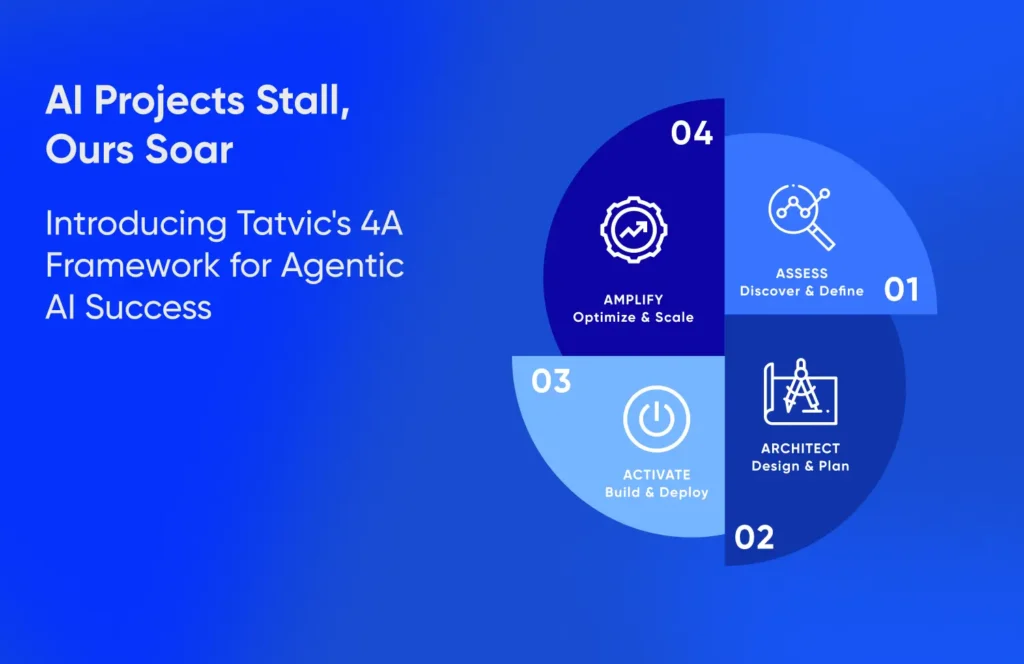
AI Projects Stall, Ours Soar: Introducing Tatvic’s 4A Framework for Agentic AI Success

Tatvic's 4A Framework for Agentic AI Success

Executive Summary

The Challenge: 87% of AI pilots never reach production, costing enterprises millions in wasted investments and missed opportunities

The Solution: Tatvic’s 4A Framework systematically addresses the four critical failure points that derail AI initiatives in large enterprises

The Strategic Value: De-risk your AI investments while building scalable, enterprise-wide capabilities that drive competitive advantage

Your Next Step: Assess your organization’s AI readiness using our proven methodology before your next AI investment

Our series has addressed marketing’s operational challenges.

We’ve detailed the solution: human-in-the-loop Agentic AI. This approach has transformative potential.

We’ve guided you to find your optimal implementation point.

Now comes the most critical question: How do you ensure your Agentic AI initiative actually succeeds?

Here’s an uncomfortable truth: most AI projects don’t just underperform, they fail outright.

According to MIT Sloan’s 2023 AI Implementation Study, 87% of AI pilots never make it to full production.

Marketing ranks among the most challenging domains for successful AI deployment.

The reasons are predictable yet costly:

  • Unclear objectives waste resources.
  • Poor data preparation derails progress.
  • Inadequate change management creates resistance.
  • Most critically, organizations treat AI as a technology project rather than a business transformation initiative.

This is where Tatvic’s approach fundamentally differs.

We’ve developed a proven methodology that addresses the root causes of AI project failure.

Today, we’re sharing our 4A Framework, the systematic approach that ensures your Agentic AI implementation delivers sustainable value rather than becoming another expensive experiment.


You May Also Like To Read ➤ The Ticking Clock: Is Your Marketing Team Drowning in Manual Work While Opportunities Sail By?


Why Most AI Projects Stall: The Four Critical Failure Points

Before diving into our framework, let’s examine why so many AI initiatives stumble.

Our Analysis of Failed AI Implementations Reveals Four Primary Failure Modes:

1. Data Silos

Most large enterprises struggle with disconnected systems that create incomplete intelligence.

Legacy marketing tools weren’t built for AI integration.

This makes it difficult to create the unified data environment that Agentic AI requires for enterprise-scale deployment.

Deloitte’s 2024 State of AI in the Enterprise report found that organizations with integrated data architectures are 3.2x more likely to succeed with AI implementations.

2. Implementation Gaps

Technical teams often lack marketing expertise. Marketing teams lack technical depth.

This creates a dangerous gap where proof-of-concepts show promise but never reach full production.

Additionally, many large enterprises lack the governance frameworks and guardrails necessary for safe AI deployment across multiple business units.

Harvard Business Review’s research on digital transformation indicates that 70% of AI project failures stem from insufficient cross-functional collaboration and unclear governance structures.

3. Tactical vs Strategic Approach

Many organizations implement one-off proof-of-concepts without enterprise-wide vision.

They deploy AI tools without clear use cases.

They miss the “agent” component entirely implementing automation without the intelligence that makes it truly transformative.

McKinsey’s analysis shows that organizations with strategic, enterprise-wide approaches achieve 4x greater business impact than those with tactical, isolated implementations.

4. The Human Factor

Teams are often not equipped to collaborate effectively with AI systems.

Fear of replacement rather than enhancement creates resistance.

Organizations frequently lack comprehensive change management strategies to guide the enterprise-wide transition.

According to MIT Sloan’s 2023 study, human adoption challenges represent the primary barrier to AI success.

The 4A Framework: A Systematic Path to Success

Tatvic’s 4A Framework addresses these failure points through a systematic, human-centric approach.

It prioritizes business value, organizational readiness and continuous improvement at enterprise scale.

Phase 1: ASSESS - Building the Foundation for Success

Strategic Objective: Establish clear business objectives, evaluate organizational readiness, and identify optimal starting points for enterprise-scale Agentic AI implementation.

Business Alignment Assessment

We begin by understanding your unique business context, challenges, and opportunities. This isn’t about finding ways to use AI-it’s about identifying where AI can solve real business problems at scale.

Key Leadership Activities:

  • Sponsor comprehensive mapping of current marketing processes to identify strategic inefficiencies
  • Champion the quantification of business impact from existing operational bottlenecks
  • Ensure stakeholders define specific, measurable success criteria aligned with enterprise goals
  • Oversee alignment of project scope and timelines with organizational priorities

Technical Readiness Evaluation

Not every enterprise is ready for Agentic AI implementation. We evaluate your data infrastructure, system integrations, and technical capabilities to ensure success across multiple business units.

Key Leadership Activities:

  • Commission audit of data quality, accessibility, and governance across the enterprise
  • Direct assessment of existing marketing technology stack and integration capabilities
  • Approve resources to address technical gaps and requirements
  • Ensure security and compliance considerations meet enterprise standards

According to Gartner’s 2024 Data and Analytics Survey, organizations with mature data governance frameworks are 4.1x more likely to successfully implement AI solutions⁵.

Sweet Spot Identification

Using proven criteria, we identify which marketing processes are genuinely ready for Agentic AI implementation across your organization.

Key Leadership Activities:

  • Oversee scoring of marketing processes against proven success criteria
  • Approve prioritization based on business impact and implementation feasibility
  • Select optimal starting points for pilot implementation
  • Establish success metrics and measurement frameworks aligned with business strategy
You May Also Like To Read ➤ The Agentic AI Sweet Spot: Where Can Autonomous Agents Drive Maximum ROI in Your Marketing?


Phase 2: ARCHITECT - Designing for Sustainable Success

Strategic Objective: Design Agentic AI solutions that integrate seamlessly with existing systems while maintaining human oversight and enterprise governance.

Solution Architecture Design

We design AI solutions that enhance rather than replace human capabilities. Solutions integrate seamlessly with your existing marketing technology stack across all business units.

Key Leadership Activities:

  • Approve agent workflows and decision-making parameters that align with business strategy
  • Ensure human-in-the-loop oversight mechanisms maintain appropriate control
  • Oversee system integrations and data flows across the enterprise
  • Establish governance and compliance frameworks that meet regulatory requirements

Change Management Planning

Technical implementation is only half the equation. We design comprehensive change management strategies that ensure organizational adoption and success at scale.

Key Leadership Activities:

  • Identify key stakeholders and change champions across business units
  • Sponsor training programs for marketing teams enterprise-wide
  • Champion communication strategies for organizational alignment
  • Establish feedback loops for continuous improvement and stakeholder engagement

Forrester’s research shows that organizations with comprehensive change management programs achieve 2.8x higher user adoption rates and 65% faster time-to-value⁶.

Risk Mitigation Strategy

Every enterprise AI implementation carries risks. We identify potential challenges and design mitigation strategies before they become problems.

Key Leadership Activities:

  • Review and approve risk assessment covering technical, operational, and business risks
  • Ensure fallback procedures and safety mechanisms meet enterprise standards
  • Oversee monitoring and alerting systems for early risk detection
  • Approve rollback strategies and contingency plans
You May Also Like To Read ➤ Escape the Hamster Wheel: Accelerate Campaigns & Maximize ROI with Agentic AI


Phase 3: ACTIVATE- Implementing with Precision

Strategic Objective: Deploy Agentic AI solutions in controlled environments with clear success criteria and comprehensive human oversight.

Controlled Pilot Deployment

We implement AI solutions in carefully controlled environments that minimize risk while maximizing learning opportunities for enterprise-scale deployment.

Key Leadership Activities:

  • Oversee deployment of agents for selected marketing processes
  • Ensure integration with existing systems and data sources meets enterprise standards
  • Monitor establishment of performance tracking and KPI measurement
  • Champion training of marketing teams on new workflows

Human-AI Collaboration Optimization

The most successful implementations optimize collaboration between humans and AI agents rather than simply replacing human tasks.

Key Leadership Activities:

  • Review and approve agent decision-making parameters based on human feedback
  • Oversee optimization of handoff points between agents and human team members
  • Ensure workflow adjustments based on real-world usage patterns meet business objectives
  • Establish communication protocols between agents and teams

A recent study by Stanford’s AI Lab found that marketing teams with optimized human-AI collaboration achieve 23% higher productivity⁷.

Performance Monitoring & Iteration

We continuously monitor agent performance and make adjustments based on real-world results and user feedback.

Key Leadership Activities:

  • Review performance against established KPIs and business objectives
  • Oversee feedback collection from marketing team members
  • Approve optimization opportunities and implementation priorities
  • Champion refinements and improvements that drive business value

Phase 4: AMPLIFY- Scaling Success Across the Organization

Strategic Objective: Expand successful Agentic AI implementations across the enterprise while building organizational capabilities for ongoing innovation.

Strategic Expansion Planning

Based on pilot results, we identify the next highest-impact opportunities for Agentic AI implementation across your enterprise marketing organization.

Key Leadership Activities:

  • Review pilot performance and lessons learned with strategic implications
  • Approve additional processes for expansion based on business impact
  • Oversee resource allocation and timeline planning for enterprise scaling
  • Ensure expansion sequence maximizes business impact and minimizes risk

Capability Building

We don’t just implement technology, we build your organization’s capabilities to manage, optimize, and expand Agentic AI solutions independently.

Key Leadership Activities:

  • Sponsor training of internal teams on AI management and optimization
  • Establish centers of excellence for ongoing innovation and best practices
  • Oversee creation of documentation and knowledge management systems
  • Approve governance frameworks for sustainable, enterprise-wide growth

Continuous Innovation Framework

The most successful enterprises treat Agentic AI as a platform for ongoing innovation rather than a one-time implementation.

Key Leadership Activities:

  • Establish processes for identifying new AI opportunities across business units
  • Champion feedback loops for continuous improvement and innovation
  • Approve metrics for measuring long-term business impact and competitive advantage
  • Oversee integration with emerging AI technologies and market developments

According to Boston Consulting Group’s research, organizations that successfully scale AI across multiple functions achieve 3-5x greater business impact.

You May Also Like To Read ➤ Beyond the Hype: What is Agentic AI, Really? And Why Your CFO Will Actually Love It


How the 4A Framework Addresses Each Failure Point

The 4A Framework directly addresses each of these critical failure points through systematic, proven approaches:

1. Addressing Data Silos:

The Assess phase includes comprehensive data architecture evaluation, identifying integration points and designing unified data flows that enable effective AI operation.

2. Closing Implementation Gaps:

The Architect phase brings together marketing expertise and technical capabilities, creating clear governance frameworks and production-ready solutions from the start.

3. Strategic vs Tactical:

The entire 4A Framework is built on enterprise-wide vision, ensuring each implementation builds toward broader organizational AI capabilities rather than isolated tactical wins.

4. Human Factor Solutions:

Every phase prioritizes human collaboration and change management, positioning AI as enhancement rather than replacement while building organizational capabilities for long-term success.

According to Boston Consulting Group’s research on AI scaling, organizations that address all four failure points systematically achieve 3-5x greater business impact than those with ad-hoc approaches.

Common Agentic AI Implementation Challenges and How We Address Them

Challenge 1: Our Team is Worried About Job Security

Our Approach: The 4A Framework explicitly positions AI as enhancement, not replacement. We involve marketing teams in the design process and clearly define their evolving roles as strategic decision-makers rather than operational executors.

Challenge 2: We’ve Tried AI Before and It Didn’t Work

Our Approach: The Assess phase specifically examines previous AI experiences to understand failure points. We address technical, organizational, and strategic gaps before moving forward.

Challenge 3: How Do We Measure Success?

Our Approach: Each phase of the 4A Framework includes specific success metrics aligned with business objectives. We measure both technical performance and business impact.

Challenge 4: What if the AI Makes Mistakes?

Our Approach: Human-in-the-loop design ensures human oversight of all agent decisions. We implement graduated autonomy where agents earn trust through demonstrated performance.

Your Next Steps With The 4A Framework

If you’ve followed our series and identified your Agentic AI sweet spots, you’re ready to begin the 4A journey:

1. Start with Assessment:

Don’t rush into implementation. Invest time in understanding your specific business context and readiness.

2. Design for Humans:

Remember that successful AI implementations enhance human capabilities rather than replace them.

3. Plan for Iteration:

Expect refinement and optimization. The best results come from continuous improvement, not perfect initial deployment.

4. Focus on Business Value:

Keep business objectives at the center of every decision. Technology should serve strategy, not drive it.

Looking Ahead: Your First Mission

In our final blog of this series titled: “Your First Agentic AI Mission: A Phased Approach to De-Risking Innovation and Maximizing Marketing ROI,” we’ll provide a concrete roadmap for launching your first Agentic AI initiative using the 4A Framework.

Until then, consider this: every transformative technology faces the same challenge the gap between potential and reality.

The organizations that successfully bridge this gap don’t have better technology; they have better implementation methodology.

The 4A Framework is that methodology for Agentic AI. It’s the difference between another stalled AI project and sustainable transformation that delivers real business value.


📩 Contact Today To Implement Tatvic’s Robust 4A Marketing Transformation Framework


The Agentic AI Sweet Spot: Where Can Autonomous Agents Drive Maximum ROI in Your Marketing?

The Agentic AI Sweet Spot Where Can Autonomous Agents Drive Maximum ROI in Your Marketing - Tatvic
In our journey so far, we’ve:

Now comes the crucial question: Which marketing processes should you target first?

Not all marketing functions are created equal when it comes to AI potential.

This is where understanding the “Agentic AI Sweet Spot” becomes essential by identifying where autonomous agents can deliver maximum value with minimal friction.

Four specific criteria determine whether a marketing process is truly suitable for Agentic AI implementation. When all four align, you’ve found your sweet spot.

The Four Essential Criteria: Where Agentic AI Truly Thrives

1. Explicit Inputs → Process → Outputs

  • What This Means: Agents excel on playbooks with crystal-clear inputs, steps, and outputs; vague processes must mature first.
  • Example: Email campaign deployment has explicit inputs (subscriber list, content, schedule), a clear process (setup, testing, sending), and definite outputs (delivery rates, opens, clicks) making it ideal for automation.
  • Counter-Example: Creative brainstorming lacks defined inputs, follows an intuitive rather than structured process, and has evolving output expectations.

Assessment Questions:

  • Can we document this process as a step-by-step playbook?
  • Are the inputs consistently structured and available?
  • Can we precisely define what successful outputs look like?

2. Reliable, Abundant Data

  • What This Means: Agents need a constant flow of clean, relevant data; with sparse or noisy signals, autonomy degrades.
  • Example: Paid search optimization generates continuous data across thousands of keywords (impressions, clicks, conversions, costs) providing the rich information environment agents need to make decisions.
  • Counter-Example: New product PR strategy typically lacks sufficient historical data, as each launch has unique characteristics and market conditions.

Assessment Questions:

  • Do we have substantial historical data for this process?
  • Is the data clean, structured, and accessible?
  • Are we generating ongoing data that can continuously inform the agent?

According to Gartner’s 2024 Data-Driven Marketing Survey, organizations with high-quality, accessible marketing data see 2.1x greater ROI from their AI implementations compared to those with fragmented or incomplete data sources¹.

3. High-Volume/Repetitive Tasks

  • What This Means: Ideal for automating scale-heavy, monotonous work-agents repeat flawlessly and never tire.
  • Example: Social media content posting requires the same steps repeated dozens or hundreds of times weekly across platforms-perfect for agents that never experience fatigue or boredom.
  • Counter-Example: Quarterly strategic planning sessions happen too infrequently to justify automation, as the investment would outweigh the limited time savings.

Assessment Questions:

  • How frequently do we perform this process?
  • How many repetitions or instances are handled weekly?
  • Does this process consume significant human hours on repetitive tasks?

4. Speed-Sensitive Processes

  • What This Means: Deploy agents only where faster action moves the needle; if delays don’t hurt results, manual is fine.
  • Example: Real-time bidding adjustments in digital advertising directly impact performance-every minute of delay means wasted spend on underperforming placements.
  • Counter-Example: Annual budget allocation doesn’t benefit significantly from faster execution-thoughtful consideration typically trumps speed, making human judgment more valuable than automation.

Assessment Questions:

  • Does faster execution directly improve business results?
  • Are we currently missing opportunities due to delays?
  • Would real-time or near-real-time execution create measurable value?

Forrester’s research on marketing technology ROI found that speed-sensitive processes show 2.5x higher returns on AI investment compared to processes where timing isn’t critical.

Marketing Functions That Often Hit the Sweet Spot

While each organization is unique, these six marketing functions commonly meet all four criteria and represent prime opportunities for Agentic AI implementation.

Let’s see 6 Marketing Functions in Depth That Often Hit the Sweet Spot:

1. Campaign Planning & Management

Agents can independently plan, manage, and optimize multi-channel marketing campaigns with necessary human-in-the-loop steps for peak performance.

  • Explicit Process: Clear campaign setup rules and optimization protocols
  • Abundant Data: Rich performance metrics across channels
  • High-Volume: Continuous optimization across multiple campaigns
  • Speed-Sensitive: Real-time adjustments directly impact performance

According to McKinsey’s research on marketing automation, enterprises that implement AI for campaign management reduce operational costs by 20-30% while simultaneously improving campaign performance by 10-15%.

2. Content Creation at Scale

Agents strategize, create and distribute high-impact content across every channel keeping engagement high without stretching your team.

  • Explicit Process: Clear content templates and distribution rules
  • Abundant Data: Engagement metrics across channels and content types
  • High-Volume: Continuous need for fresh content across numerous platforms
  • Speed-Sensitive: Timely distribution directly impacts audience reach

3. Market Research & Capturing Intent Signals

Agents capture various signals such as product launches, competitor campaigns, and customer adaptations, then provide actionable inputs to sales and marketing teams.

  • Explicit Process: Defined monitoring parameters and reporting frameworks
  • Abundant Data: Continuous streams of market intelligence
  • High-Volume: Constant monitoring across numerous sources
  • Speed-Sensitive: Faster identification of market changes creates advantage

4. Customer Experience & Personalization

Agents automatically personalize customer journeys on digital properties and identify ways to improve the overall experience.

  • Explicit Process: Clear personalization rules based on user behaviors
  • Abundant Data: Rich customer interaction data
  • High-Volume: Personalization across thousands of user sessions
  • Speed-Sensitive: Real-time personalization impacts conversion rates

5. Marketing Intelligence & Analytics

Agents proactively identify anomalies, predict outcomes, and recommend strategic marketing actions based on data patterns.

  • Explicit Process: Defined analytical frameworks and reporting structures
  • Abundant Data: Comprehensive performance metrics
  • High-Volume: Continuous analysis across multiple data streams
  • Speed-Sensitive: Faster insights enable timely strategic adjustments

6. Search Engine Optimization

Agents secure and maintain top organic rankings by continuously adapting to deliver sustained SEO dominance.

  • Explicit Process: Clear optimization rules based on ranking factors
  • Abundant Data: Comprehensive keyword and traffic metrics
  • High-Volume: Optimization across thousands of keywords
  • Speed-Sensitive: Rapid adaptations to algorithm changes preserve rankings

Choosing Your First Agentic AI Mission

Once you’ve identified processes that meet all four criteria, follow this structured approach to implementation:

1. Discovery & Alignment

  • Identify specific marketing goals and pain points
  • Understand your current data landscape
  • Align stakeholders on success metrics

2. MVP/Pilot Scoping

  • Choose a high-impact channel or product line that meets all four criteria
  • Define a clear, limited scope for your pilot
  • Establish specific KPIs to measure success

3. Pilot Implementation (4-6 weeks)

  • Develop Agentic AI for your selected process
  • Integrate with existing systems
  • Establish human oversight mechanisms

4. Pilot Validation (2-3 weeks)

  • Launch your AI-supported campaign/process
  • Gather performance data and user feedback
  • Compare to pre-implementation baselines

5. Pilot Review & Scale Up

  • Evaluate performance against KPIs
  • Refine your approach based on learnings
  • Expand to additional areas meeting the sweet spot criteria

6. Ongoing Governance & Support

  • Maintain human oversight
  • Conduct regular compliance checks
  • Continue optimizing agent parameters

Common Pitfalls to Avoid

As you begin your Agentic AI journey, watch out for these implementation challenges:

  • Starting Outside the Sweet Spot:

    Forcing Agentic AI into processes that don’t meet all four criteria typically leads to disappointing results and wasted resources.

  • Neglecting the Human Element:

    The most successful implementations maintain human guidance throughout. The goal is enhancement, not replacement.

  • Big Bang Approach:

    Starting with too many processes simultaneously often leads to implementation challenges. Begin with one clear sweet spot process, prove the value, then expand.

  • Skipping Process Documentation:

    Even if a process seems obvious, document it thoroughly before implementation. Agents need explicit rules to follow.

Looking Ahead

In our next blog, “AI Projects Stall, Ours Soar: Introducing Tatvic’s A Framework for Agentic AI Success,” we’ll reveal our proven methodology that ensures your Agentic AI initiative delivers sustainable value rather than becoming another stalled experiment.

We’ll show how our 4A Framework-Assess, Architect, Activate, Amplify that keeps AI pilots on track and maximizes your return on investment.

Until then, consider these questions:

  • Which of your marketing processes meet all four sweet spot criteria?
  • Where could you start with a focused pilot that delivers measurable value?
  • How might your team’s roles evolve as agents handle more routine tasks?

The most successful transformations don’t start with the most exciting or innovative processes, they start with the ones that truly fit the Agentic AI sweet spot.

Escape the Hamster Wheel: Accelerate Campaigns & Maximize ROI with Agentic AI

Escape the Hamster Wheel Accelerate Campaigns & Maximize ROI with Agentic AI - Tatvic

Remember the marketing hamster wheel?

That relentless cycle where your talented team runs faster and faster but somehow stays in the same place, drowning in spreadsheets, wrestling with disparate systems and watching opportunities pass by while buried in execution details.

In our previous conversations, we’ve diagnosed the problem:

And Introduced the Solution:

Now let’s get practical:

  • Exactly how does this technology transform your marketing workflow from a months-long marathon into a streamlined sprint, without replacing your team or disrupting your existing systems?

The Marketing Campaign Lifecycle: The Time Sink of Modern Marketing

The traditional marketing campaign process is a masterclass in inefficiency. Gartner’s 2024 Campaign Planning Benchmarks states that the median time from brief to launch for enterprise campaigns is 8-12 weeks¹. That’s up to three months before you even begin measuring results.

Let’s break down where all that time disappears:

  • The Planning Phase: Drowning in Data, Starving for Insights

    Your strategy meetings should be dynamic think tanks where brilliant minds collaborate on market-changing ideas. Instead, they’ve become tedious data review sessions focused primarily on understanding past performance.

According to IDC’s 2024 Data & Analytics Planning Guide, analytical professionals spend a staggering 80% of their time on data discovery, preparation, and governance with less than 20% left for actual analysis. That’s four-fifths of working hours spent not on deriving insights, but simply getting data ready to analyze.

The human cost is substantial:

  • Strategists become data janitors
  • Creatives become report compilers
  • Everyone experiences the frustration of knowing what they could accomplish with more time for real strategy

Now let’s move to the Second Step->

  • The Execution Phase: The Cross-Functional Obstacle Course

    Once a campaign is finally approved, the real hurdles begin. Creative development, compliance reviews, channel setup, audience segmentation, asset preparation. Each step introduces new delays and handoffs.

Forrester’s 2023 Marketing Process Survey reveals that 62% of marketers cite “cross-team process complexity” as their top execution challenge. The average marketer juggles 8+ different technology platforms, creating a patchwork of non-integrated systems that rarely communicate effectively.

The execution bottlenecks are predictable:

  • Every handoff introduces delay
  • Every manual upload creates opportunity for error
  • Every platform requires its own expertise

No wonder the race to market feels like running through quicksand.

  • The Optimization Phase: Too Little, Too Late

    Perhaps most painful is the optimization phase where golden opportunities for improvement are identified only after significant budget has already been spent.

The CMO Council’s 2023 Predictive Analytics Adoption study reveals that only 27% of marketers act on data insights within one day; the majority still operate on weekly or monthly optimization cycles⁴. By the time adjustments are implemented, precious budget has already been wasted on underperforming tactics.

It’s like having a car that only tells you it needs oil after the engine has seized.

Breaking the Cycle: How Agentic AI Transforms Each Phase

Human-in-the-loop Agentic AI doesn’t just speed up existing processes, it fundamentally transforms how your team works at each stage of the campaign lifecycle.

Let’s see exactly how:

Planning Transformation: From Data Wrangling to Strategic Thinking

Traditional Approach (2-3 weeks):

  • Manually extract data from multiple platforms
  • Reconcile inconsistencies and create reports
  • Develop insights based on limited historical data
  • Make decisions based on incomplete information

Agentic AI Approach (2-3 days):

  • AI automatically gathers, cleans, and harmonizes data across platforms
  • Pre-analyzed insights packages await human review
  • Pattern detection identifies opportunities humans might miss
  • Humans focus on strategic decision-making, not data preparation

According to Salesforce’s State of Marketing Report, organizations using AI for marketing data analysis report 37% improvement in their ability to quickly derive actionable insights from marketing data.

Execution Transformation: From Digital Assembly Line to Creative Powerhouse

Traditional Approach (4-6 weeks):

  • Manual creation and adaptation of assets for each channel
  • Sequential handoffs between teams
  • System-by-system implementation
  • Quality checks that catch errors after they’ve multiplied

Agentic AI Approach (3-5 days):

  • AI drafts initial creative variants based on successful patterns
  • Humans refine and improve AI suggestions
  • Parallel workflows with AI handling routine implementation
  • Predictive quality checks flag potential issues before they occur

Forrester’s Total Economic Impact™ Study of AI in Creative Workflows found that creative teams using AI assistance reduce production time by up to 58% for campaign assets⁶, allowing human creatives to focus on strategy and brand storytelling rather than repetitive production tasks.

Optimization Transformation: From Rear-View Mirror to Real-Time Navigation

Traditional Approach (Weekly or monthly cycles):

  • Periodic performance review meetings
  • Manual analysis of what’s working/not working
  • Delayed implementation of optimizations
  • Learning limited to the campaign in question

Agentic AI Approach (Continuous):

  • 24/7 performance monitoring with real-time alerts
  • AI-suggested optimization opportunities for human approval
  • Immediate implementation of approved changes
  • Cross-campaign pattern recognition for continuous improvement

Research from the CMO Council found that teams using AI-powered optimization see an average 25% improvement in campaign ROI compared to those using traditional methods, not because the AI makes better decisions than humans, but because it enables humans to make more decisions, faster.

The Business Impact: Research-Backed Benefits

Agentic AI doesn’t just change how marketing teams work, it transforms business outcomes.

Here’s what industry research tells us about the potential impact:

  • Time-to-Market Acceleration

    The Boston Consulting Group’s research on AI in marketing found that companies with advanced AI integration reduce campaign development cycles by 30-50%. This acceleration isn’t just about efficiency, it’s about competitive advantage in fast-moving markets.

  • Resource Utilization Improvement

    Deloitte’s Marketing Technology Implementation Survey found that marketing teams using AI assistance report a 35% increase in productive time spent on strategic activities. Your existing team can accomplish significantly more without adding headcount.

  • Campaign Performance Enhancement

    McKinsey’s analysis of AI in marketing indicates that companies using AI for campaign optimization see a median improvement of 20% in marketing ROI. That’s a direct bottom-line impact that any CFO would appreciate.

The Implementation Journey: Evolution, Not Revolution

The transition to Agentic AI doesn’t require dismantling your current marketing organization or technology stack.

Tatvic’s approach focuses on integration, enhancement, and evolution keeping humans at the center while freeing them from digital drudgery.

Our implementation typically follows three phases:

Phase 1: Quick Wins (30-60 days)

  • Assessment of your current workflow
  • Integration with existing systems
  • Implementation of initial agents focused on data preparation and reporting
  • Measurable time savings within the first month

Phase 2: Workflow Transformation (60-90 days)

  • Training of core team members
  • Expansion to execution and optimization processes
  • Refinement based on human feedback
  • Significant reduction in campaign lifecycle time

Phase 3: Strategic Evolution (90+ days)

  • Full adoption across marketing workflows
  • Cross-campaign learning and optimization
  • Continuous improvement of AI capabilities
  • Human focus shifts primarily to strategy and innovation

Throughout this journey, your team remains in control, making all strategic decisions, approving all recommendations, and teaching the AI to better support your unique marketing approach.

Beyond Time Savings: The Real Business Impact

While reducing your campaign lifecycle from months to days is impressive, the true business impact extends far beyond efficiency:

  • Market Responsiveness: Respond to competitive moves or market shifts in days instead of months
  • Budget Effectiveness: Eliminate waste by optimizing in real-time instead of after the fact
  • Team Satisfaction: Marketing talent stays engaged when freed from routine tasks
  • Innovation Capacity: With more time for strategic thinking, breakthrough ideas emerge
  • Organizational Agility: Your entire business becomes more responsive to market opportunities

As Gartner notes in their Marketing Technology Survey, marketing organizations that successfully implement AI assistance report 32% higher employee satisfaction and 28% lower staff turnover compared to those that don’t.

Your Next Step: From Concept to Reality

In our next article: “The Agentic AI Sweet Spot: Where Can Autonomous Agents Drive Maximum ROI in Your Marketing Now?”

We’ll help you identify the highest-impact starting points for your Agentic AI journey.

You’ll learn how to prioritize implementation areas based on your specific business challenges and existing technology landscape.

We’ll show where early adopters are realizing 18-25% lift in ROAS within 90 days.

Until then, consider what your marketing organization might accomplish if freed from the hamster wheel of manual execution.

What market opportunities could you seize? What creative breakthroughs might emerge? What competitive advantages could you develop?

The answers to these questions represent the true promise of Agentic AI, not just doing things faster, but doing things that were never possible before.


Bot Icon
Bot Icon

Tatvic Bot

Explore About Tatvic and Services