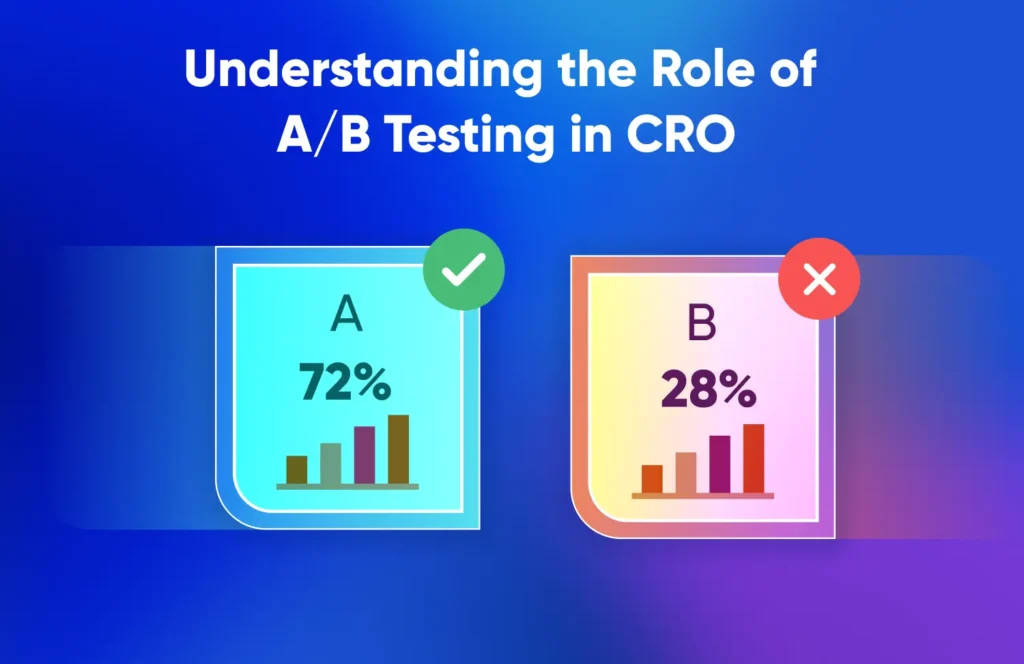
Hello There!

Lorem ipsum dolor sit amet, consectetur adipiscing elit,

Understanding the Role of A/B Testing in CRO

Understanding the Role of AB Testing in CRO - Tatvic

Curious how A/B testing in CRO (Conversion Rate Optimization) helps turn everyday user actions into data-driven strategies that boost conversions?

Every Click, Form Submission or Sale on your site tells a story and A/B testing helps you translate those interactions into smarter decisions.

“You can’t improve what you don’t measure.”
~Peter Drucker

In a world where even a 1% lift in conversion can mean thousands of extra dollars, relying on guesswork just doesn’t cut it.

Instead, you need a systematic, repeatable approach to testing, backed by robust AB testing services and the right services partner to guide you.

Whether you’re a marketer, product manager, UX designer, or business owner, this guide will walk you through everything from the basics of ab testing to advanced statistical methods, real‑world case studies, and a step‑by‑step playbook for running your own high‑impact experiments.

Let’s dive in - >>
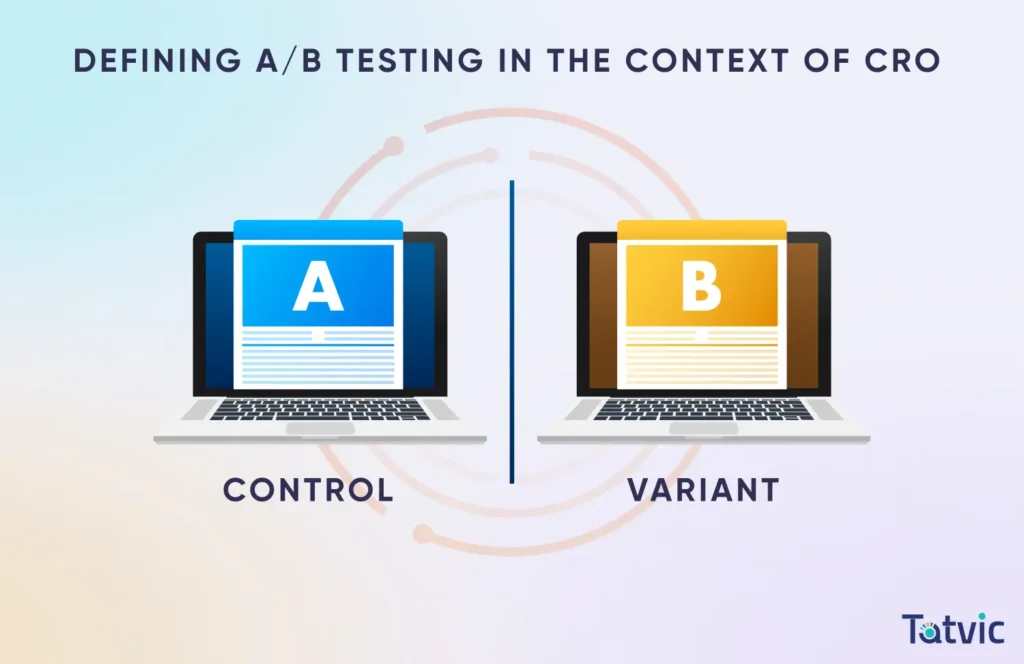
Defining AB Testing in the Context of CRO - Tatvic

Defining A/B Testing in the Context of CRO (Conversion Rate Optimization)

AB testing, also known as split testing, refers to the process of testing multiple variations of a web page to find higher-performing variations and improve the page’s overall conversion rate.

It is a continuous process that allows you to assess and check the variation that works better for your target audience based on strategic statistical analysis.

At its heart, A/B testing in CRO is a controlled experiment:

  1. You show Version A (the control) to some users and
  2. Version B (the variant) to others,
  3. Then measure which one performs better against your key metric be it Click‑Through Rate (CTR), Form Completion or Purchase Rate.

This isn’t hokey magic; it’s a rigorous approach that turns user behavior into a roadmap for improving your site.

Why A/B Testing Is Essential for CRO Success

A/B testing allows you to experiment with different versions of a webpage to see what resonates most with your audience. It takes the guesswork out of optimization by relying on actual user behavior and performance metrics.

By continuously testing and refining elements like headlines, CTAs, and layouts, you can steadily improve conversion rates.

Ultimately, A/B testing empowers data-backed decision-making that leads to measurable growth in your CRO efforts.

Why invest time and budget in AB testing services??

Because it’s the only way to reliably improve conversions without guesswork.
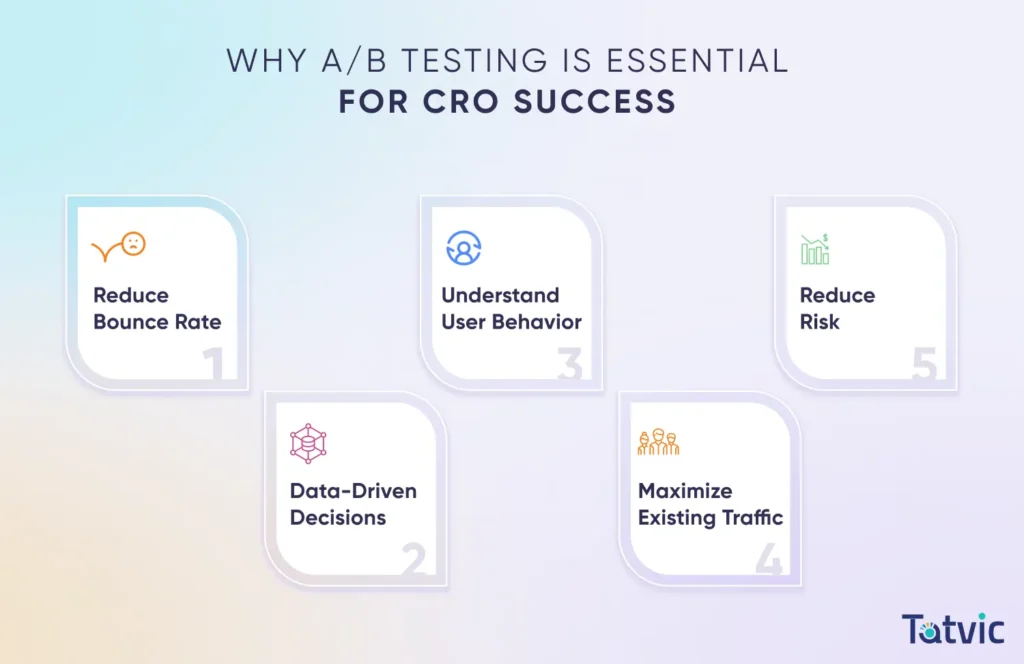
Why AB Testing Is Essential for CRO Success - Tatvic

Here’s How Structured A/B Testing in CRO Fuels Growth:

  • Reduce Bounce Rate:

    By experimenting with different headlines, imagery, and calls‑to‑action, you give visitors exactly what they want keeping them on your site longer and reducing bounce.

  • Data-Driven Decisions:

    Move beyond gut feelings. Test hypotheses and let real user data guide you. Every test result informs your next move.

  • Understand User Behavior:

    Watch how different segments respond. Maybe desktop users love your long‑form copy, but mobile visitors prefer bullet points. AB testing services reveals these nuances.

  • Maximize Existing Traffic:

    Instead of pouring more money into ad spend, get more value from the visitors you already have. Even a 5% lift in conversion from AB testing services often outperforms a new ad campaign.

  • Reduce Risk:

    Rolling out a site‑wide redesign can backfire. With A/B tests, you can roll out incremental changes, validate them, then apply them broadly minimizing the risk of unexpected drops.

Did you know?

Companies that rigorously use A/B testing grow their revenues 1.5 to 2x faster than those that don’t.

Further, monitoring these changes allows you to have statistically significant and reliable data.

Apart from these, A/B testing also helps in:
  • Experimenting with various elements of an app, website, or landing page to boost conversion
  • Encouraging continuous improvement in user experience 
  • Improving user engagement and user navigation 
  • Improving the checkout experience
  • Getting a higher ROI (Return On Investment) without spending
Case Snippet: Titan Eye+

Through A/B testing, Tatvic boosted page views and purchases for Titan Eye+, enhancing their online revenue share. A/B and multivariate testing acted as core pillars of a winning CRO strategy.

A/B Testing in Marketing: Beyond Simple Experiments

A/B testing isn’t just for websites, it’s a universal tool in any digital marketer’s toolbox.

It helps marketers make informed decisions by testing variations in emails, ads, and landing pages to see what performs best.

Whether it’s optimizing subject lines or experimenting with ad creatives, A/B testing brings clarity to campaign performance.

This method reduces assumptions and highlights what truly engages your audience.

When used consistently, it drives smarter strategies and better ROI across all channels.
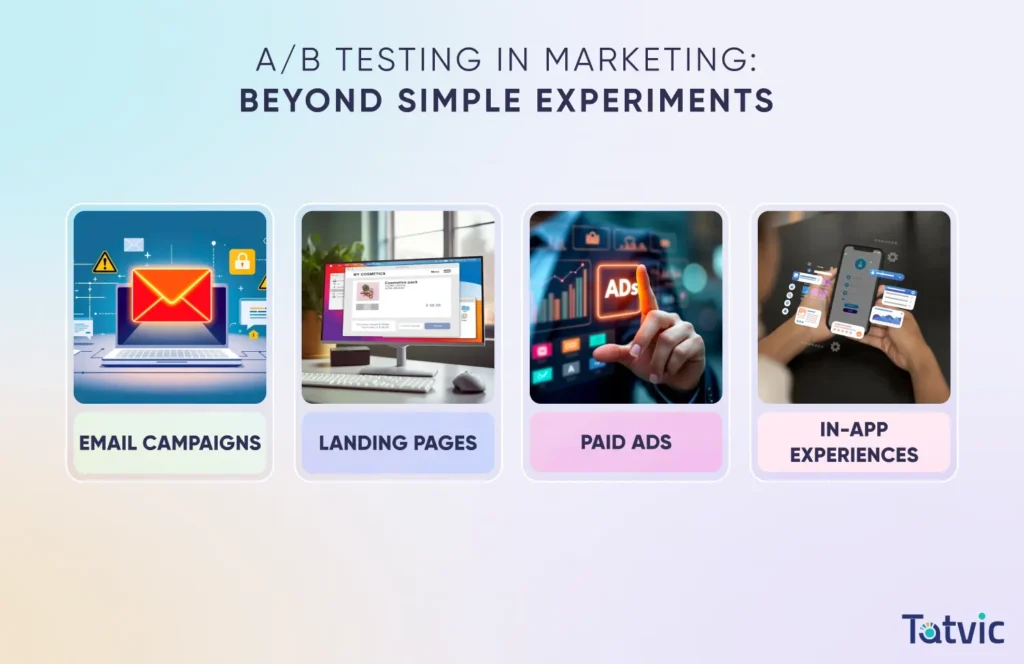
AB Testing in Marketing Beyond Simple Experiments - Tatvic

Here’s how A/B Testing powers different channels:

1. Email Campaigns

  • Subject Lines: “20% off today only!” v/s “Your exclusive 20% savings inside.”
  • Preview Text: Changing the first line can boost open rates by 5-10%.
  • CTA Buttons: Shape, phrasing (“Start Now” v/s “Get Started”), and placement.

2. Landing Pages

  • Headline Positioning: Above the fold v/s further down.
  • Lead Magnet Format: PDF download v/s video series.
  • Form Length: Two fields v/s five fields.

3. Paid Advertisements

  • Ad Copy: Highlighting features v/s benefits.
  • Creative: Static images v/s short GIFs.
  • Ad Format: Carousel v/s single image.

4. In-App Experiences

  • Onboarding Flow: Step‑by‑step tutorial vs. “skip” option.
  • Feature Prompts: Modal window v/s inline tooltip.
  • Pricing Upsells: Hard sell v/s gentle reminder.

A testing tool that supports multi‑channel experiments web, email, ads  and in‑app becomes a force multiplier for your overall marketing ROI.

AB testing services become crucial for results that drive business growth. 

Types of A/B Tests in CRO (Conversion Rate Optimization) & When to Use Them

Different A/B testing methods serve unique goals in the CRO journey, from simple button color changes to complex multi-page experiments.

Knowing which type to use be it split testing, multivariate, or multi-page testing can greatly influence your outcomes.

Each test provides distinct insights into user behavior and interaction patterns.

By aligning the test type with your specific objective, you can optimize user experience and boost conversions more effectively.
Types of AB Tests and When to Use Them-Tatvic

A Deep Dive into the Different Types of A/B Tests Used in CRO

  • Split URL Tests:

    Compare entirely different page designs on separate URLs ideal for landing‑page overhauls and commonly run via AB testing services. These tests are perfect for evaluating drastic design changes or entirely new page concepts. By directing traffic to two or more different URLs, businesses can gather clear performance insights. This method reduces bias from minor tweaks and reveals which page structure truly resonates with users. It’s especially effective for landing pages or campaign microsites.

  • Multivariate Tests (MVT):

    Test multiple elements (headlines, images, CTAs) at once on a single page to pinpoint the best combination. MVT is ideal when you’re optimizing several page elements simultaneously to see which combinations perform best. It provides deeper insights than simple A/B tests by showing interaction effects between variables. However, it requires a larger traffic volume to generate statistically significant results. Use it when you want fine-tuned control over user experience.

  • Server-Side (API) Tests:

    Experiment on backend logic (pricing engines or recommendation modules) for precise control and technical flexibility. These tests go beyond visual changes by focusing on back-end functionalities like algorithmic recommendations or dynamic pricing. Since they run at the server level, they offer faster load times and broader testing capabilities. They’re ideal for more technical teams aiming for deep customization. Server-side testing is great for scaling personalized user journeys.

  • Personalization Tests:

    Deliver tailored content to specific user segments (by behavior, device, or source) to boost relevance and conversions. With these, you serve content tailored to unique user attributes-like geography, browsing history, or referral channel. They help deliver a more relevant experience that increases engagement and conversion. Personalization tests are particularly useful for eCommerce and content-heavy platforms. Over time, they help build loyalty by making users feel understood.

Let’s See Types of A/B Tests & When to Use Them:
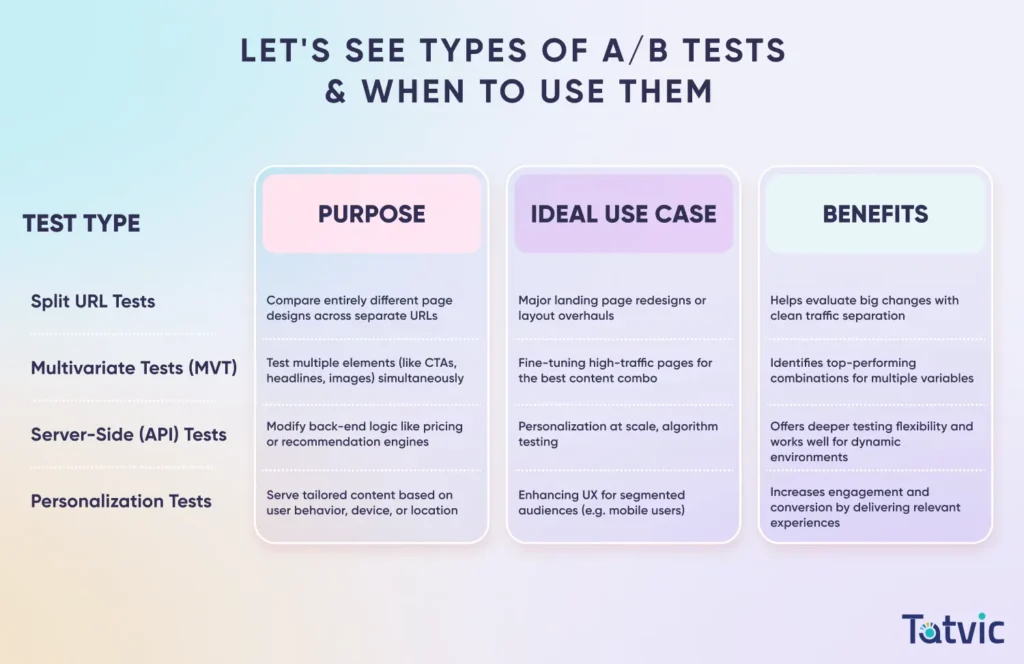
 

Types of A/B Tests & When to Use Them:

Note: Multivariate tests require at least 5× the traffic of split tests to reach statistical significance, so plan accordingly.

In practice, you’ll often run multiple test types in parallel using AB testing services that let you manage Split, MVT  and Server‑Side Tests from one dashboard.

Key Elements You Can Test to Drive Conversions

There are many elements on your website that directly influence a visitor’s decision to convert and A/B testing helps you find which ones matter most.

From headlines and call-to-actions to forms and page layouts, each component plays a role in user experience.

By systematically testing these elements, you can uncover what truly resonates with your audience.

This data-driven approach helps turn insights into higher conversions over time.
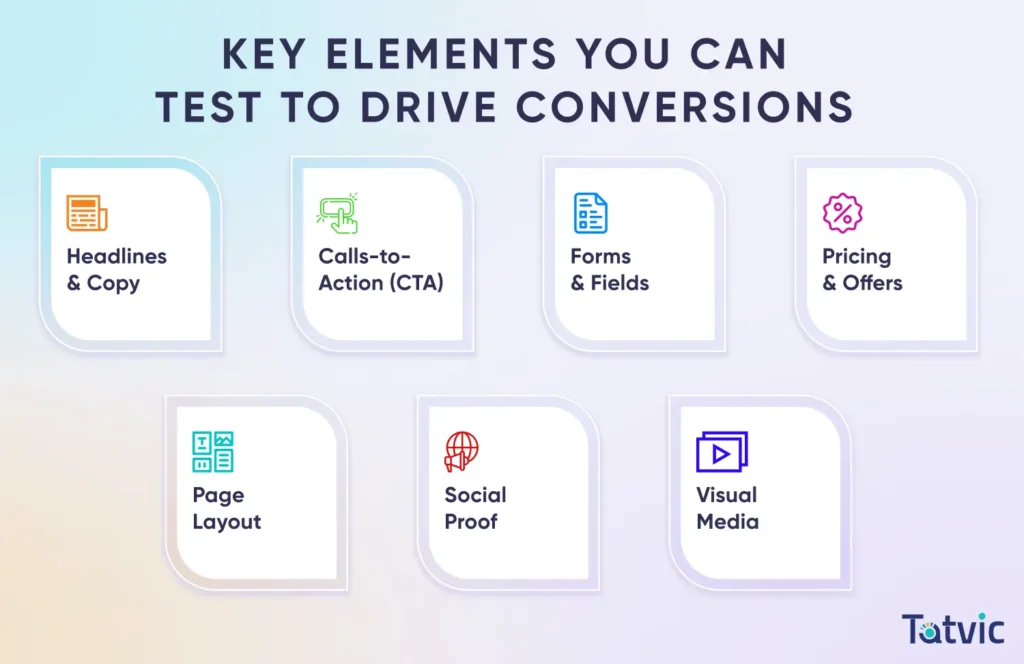
Key Elements You Can Test to Drive Conversions- Tatvic Analytics

Let’s See Few of the Key Elements:

  • Headlines & Copy:

    Your headline is the first impression-make sure it clearly states what you offer and why it matters. Testing different tones, lengths, or emotional triggers helps you discover which messaging hooks your audience most effectively.

  • Calls-to-Action (CTA):

    A CTA button’s wording, size, and placement guide users toward the next step in their journey. By experimenting with phrasing (“Get Started” vs. “Try for Free”), button styles, and positioning, you’ll learn how to drive more clicks and conversions.

  • Forms & Fields:

    Every extra field you ask users to fill feels like friction-fewer inputs usually mean higher completion rates. Test variations in field count, label style (inline vs. above), and real‑time validation to find the sweet spot between data collection and user convenience.

  • Page Layout:

    How you arrange text, images, and CTAs can make or break the user flow. Try different column structures, whitespace levels, and navigation placements to see which layout keeps visitors engaged and moving toward your goal.

  • Social Proof:

    Trust badges, testimonials, and star ratings reassure visitors that they’re making the right choice. A/B test formats (short quotes vs. full case studies) and placement (inline vs. sidebar) to discover which social proof drives the biggest uplift.

  • Visual Media:

    Images, icons, and videos can boost engagement-but only if they’re relevant and high‑quality. Compare static imagery vs. short looping videos or custom illustrations vs. stock photos to learn what best resonates with your audience.

  • Pricing & Offers:

    How you present pricing-discount labels, “Most Popular” badges, or countdown timers-can create urgency and clarity. Test different offer structures (percentage off vs. dollar savings) and time‑limited messages to maximize perceived value and drive more purchases. As you incorporate each tweak, your testing backlog grows-fueling future hypotheses and making your CRO program self-sustaining. Leveraging AB testing services ensures that every test is set up correctly, analyzed properly, and iterated on for long-term performance gains.

Statistical Significance: When to Trust Your Results

Statistical significance tells you whether your A/B test in CRO results are likely due to actual changes or just random chance.

It helps ensure that the improvements you see are reliable and repeatable.

Without it, you might make decisions based on misleading data.

Reaching statistical significance gives you confidence to act on your findings and scale what works.

Gathering data is one thing. Knowing when your results are reliable is another.

Key Statistical Tests Used in CRO Are As Follows:

1. Frequentist Tests

  • Long‑Term Observation: Wait until your sample size is large enough (often tens of thousands of views).
  • P‑Value Threshold: Commonly 0.05 (95% confidence).
  • Pros: Well‑understood, widely supported.
  • Cons: Doesn’t let you peek early without risking false positives.

2. Bayesian Tests

  • Credible Intervals: Gives the probability one variant outperforms another.
  • Flexibility: You can check results mid‑test.
  • Pros: Faster insights; easier to interpret probability statements.
  • Cons: Requires more statistical sophistication and careful priors.

Quick Checklist for Reliable Tests

  • Minimum sample size achieved?
  • Run time covers full business cycles (weekends, weekdays)?
  • No major traffic source changes (like a viral tweet)?
  • One variable changed at a time?

Note: Most AB testing services include built‑in significance calculators. Use them but always double‑check with your own traffic numbers and business context.

Step-by-Step A/B Testing Procedure To Be Used In CRO
A/B testing in CRO starts with identifying a goal, like boosting sign-ups or clicks, followed by forming a clear hypothesis.

Next, you create two versions of the element you’re testing and split your traffic between them.

After running the test for a set period, analyze the results to determine which version performs better.

Finally, implement the winning variation and continue testing to refine further.

A robust testing workflow keeps you organized and ensures each experiment moves you closer to better conversions.

Step-by-Step A/B Testing Procedure To Be Used In CRO

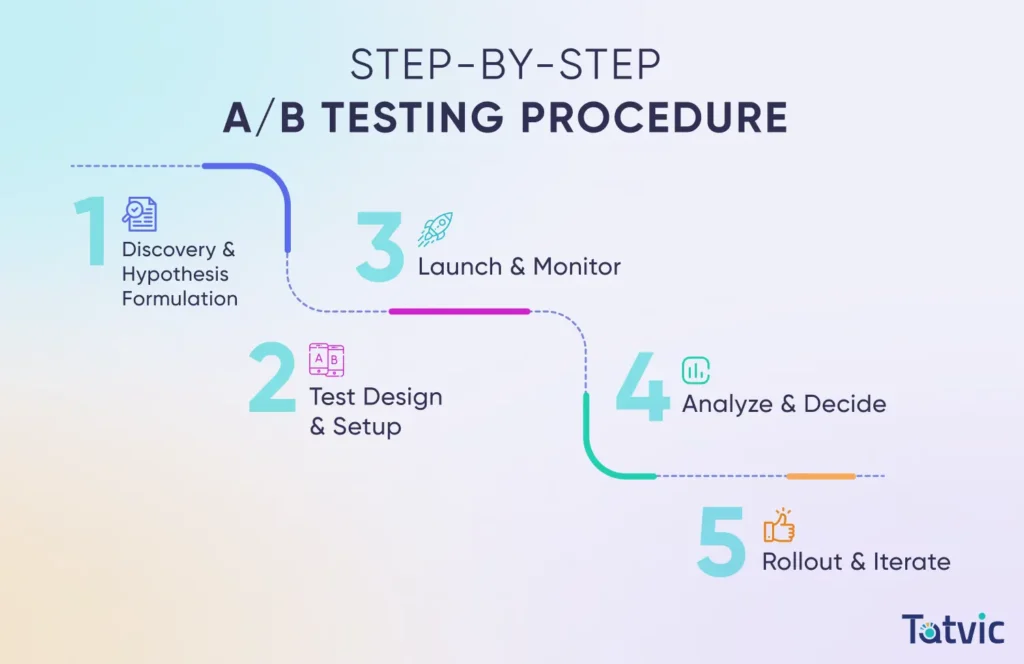
Simplified 5 Steps Process to Do A/B Tests in CRO like a pro:

Step 1: Discovery & Hypothesis Formulation 

  • Audit your analytics: Where are you leaking conversions?
  • Gather qualitative inputs: Heatmaps, session recordings, on‑site surveys.
  • Craft a clear hypothesis: “If we change the hero image to user‑generated photos, conversions will increase by 10%.”

Step 2: Test Design & Setup 

  • Choose your test type: split, MVT, or server‑side.
  • Build your variants in the testing tool (or ask your AB testing services provider to set it up).
  • Define your primary metric (e.g., “add to cart clicks”) and any secondary metrics (time on page, scroll depth).

Step 3: Launch & Monitor 

  • Start the experiment, directing an equal traffic split to each variant.
  • Monitor for technical issues: broken elements, mis‑fires on certain browsers.
  • Keep an eye on sample size projections to know when you’ll reach significance.

Step 4: Analyze & Decide

  • Let the data settle-avoid early peeking.
  • Check overall lift and segment performance (device, geography, traffic channel).
  • Decide: implement the winner, declare a tie, or scrap and learn.

Step 5: Rollout & Iterate 

  • Roll out the winning version sitewide.
  • Document results and lessons learned in your test repository.
  • Ideate the next test based on these insights-rinse and repeat.

Using professional AB testing services means you get templates, QA scripts, and reporting dashboards that streamline this entire process.

CTA: Book a Free CRO consultation today

Real-World Examples: Case Studies of A/B Testing Driving CRO

Theory is great, but real businesses need real results.

Here are three case studies showing how Tatvic’s AB testing services, powered by best‑in‑class testing tools, turned hypotheses into dollars:

1. A Travel Website saw 30% Uplift  in Conversion

Scenario: A leading travel portal faced high drop‑offs on its hotel listing page where users browsed rooms but rarely booked. Analytics and feature‑attribution analysis revealed a lack of urgency as the key barrier.

Approach: Working with Tatvic’s CRO Expert Team , they hypothesized that real‑time scarcity cues would drive bookings. In Variant B set up in our preferred testing tool, they displayed live viewer counts (“X people viewing this hotel”) and a rooms‑remaining indicator. Traffic was split 50/50 to measure impact on booking completions.

Result: The urgency‑driven variant delivered a 30% uplift in completed bookings, directly boosting revenue without any additional ad spend.

2. Online Marketplace Appointment Simplification: 70% More Lead Generation

Scenario: A large used‑car marketplace struggled to convert homepage visitors into appointment bookings. Multi‑stage navigation was causing friction, and only a small fraction of users completed the form.

Approach: Using Tatvic’s AB testing services and comprehensive Google Analytics tracking, they identified the cumbersome navigation as the culprit. Variant B replaced it with a single‐page lead‑gen form headlined “Sell Your Used Car in 30 Minutes,” and swapped out fields (city, date, time, mobile number) for previously under‑utilized inputs. The experiment ran via our testing tool with an equal traffic split.

Result: After two weeks, the desktop variant generated 66% more leads, and the mobile variant saw a 70% increase in leads, validating the simplified workflow.

3. “Book A Test Ride” Form Redesign: 93% increase in leads

Scenario: An Indian multinational motorcycle manufacturer wanted to boost submissions on its “Book Test Ride” form but saw low engagement despite healthy traffic.

Approach: Leveraging Tatvic’s AB testing services and form‑analytics data, they redesigned the form for Variant B, adding a floating CTA on the homepage and reducing the number of fields while reinforcing the call‑to‑action. The new design was implemented in their testing tool and tested across desktop and mobile.

Result: Over 27 days, the desktop variant drove a 93% increase in leads, and the mobile variant delivered a 44% lift, turning the Test Ride form into a top‑performing conversion funnel.

Key Takeaway: In each scenario, targeted experiments backed by Tatvic’s AB testing services and advanced testing tool setups, transformed user insights into significant conversion gains. Continuous testing and iteration are the engines of sustainable growth.

A/B Testing as Part of a Holistic CRO (Conversion Rate Optimization) Strategy

A/B tests are powerful, but they shouldn’t operate in a vacuum. The most successful programs integrate AB testing services into a broader CRO ecosystem to ensure your experiments are meaningful and aligned with larger goals.
To truly maximize conversion rates, A/B testing must be rooted in a deep understanding of the user journey and business objectives. When integrated with research, UX insights and real-time feedback, tests become strategic rather than tactical.

This holistic approach ensures that each experiment moves the needle in a meaningful way.

Ultimately, A/B testing becomes a continuous, cross-functional process not a one-time fix.

AB Testing as Part of a Holistic CRO (Conversion Rate Optimization) Strategy

Few things to always keep in mind:

  • User Research & Personas: Develop empathy for your users. Surveys, interviews, and analytics paint the “who” behind the clicks. AB testing services often use these insights to guide what to test and why.
  • UX Audits & Heuristic Reviews: Experts identify friction points and your test hypotheses often come from these reviews.
  • Qualitative Feedback: On‑site polls, chat transcripts, and session replays reveal why users behave the way they do.
  • Cross-Functional Collaboration: Marketing, design, analytics and development must align around your test roadmap and share ownership of results.

By embedding testing within continuous user research and cross-team workflows, you ensure each experiment builds on the last-creating a virtuous cycle of insights and optimizations.

AB testing services that align with your team structure and user data can accelerate your path to impactful, sustained conversion gains.

Best Practices and Common Pitfalls to Avoid

All too often, teams launch A/B testing services only to see disappointing results, these are usually because they skipped some fundamentals.

Best Practices to be followed while implementing A/B Tests in CRO

  • One Change at a Time: Keep your hypotheses clean by isolating variables.
  • Sufficient Traffic & Duration: Wait until you hit both your sample size and run the test through a full weekly cycle.
  • Thorough QA: Preview variants on multiple devices, browsers, and user states (logged in v/s guest).
  • Document Everything: Maintain a living backlog of tests your institutional memory for what worked, what didn’t and why.

Avoiding Common Pitfalls in A/B Tests for CRO Success

  • Stopping Early: A small early uplift can evaporate with more data-never call a winner too soon.
  • Over-Testing: Too many concurrent experiments can cause interaction effects and muddy results.
  • Ignoring Segments: A 10% overall lift might hide that mobile users saw no benefit or even a drop-in conversion.
  • Neglecting Follow-Up: Negative or inconclusive results are still valuable insights. Capture them before moving on.

Warning: Skipping proper QA and statistical checks can turn every experiment into a potential liability rather than a learning opportunity.
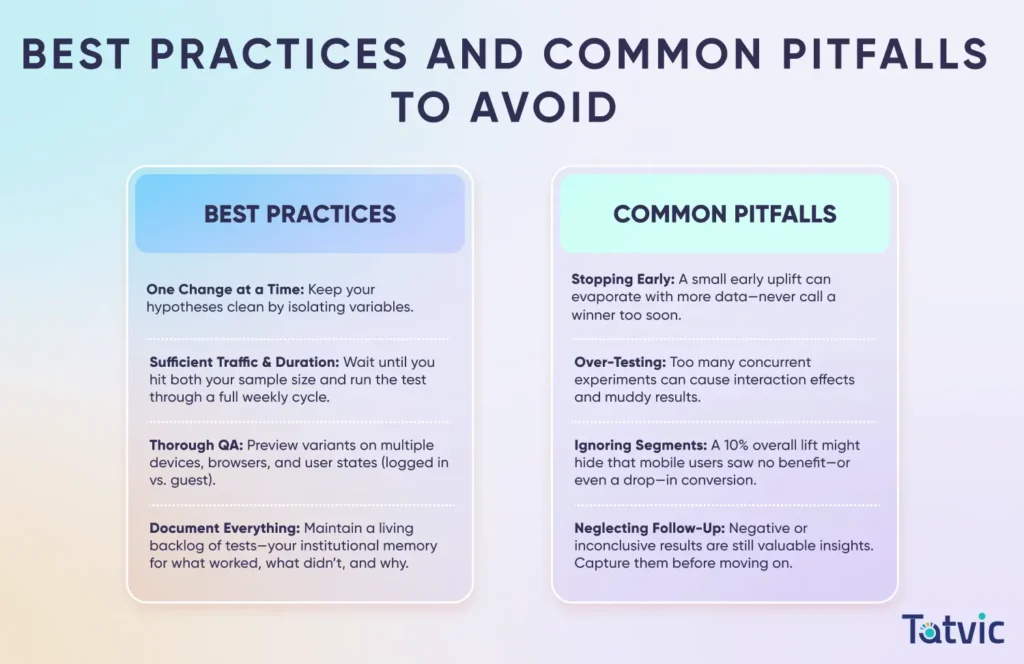
Best Practices and Common Pitfalls to Avoid - AB Testing in CRO

Conclusion: Making A/B Testing in CRO Your Growth Engine

A/B testing is more than just a tool in your CRO toolbox, it’s the very engine that powers continuous, data‑driven growth.

When you pair strategic testing with specialized AB testing services, you:

  • Reduce Risks: Incremental rollouts vs. big‑bang redesigns.
  • Uncover Deep Insights: Understand what truly moves the needle for your users.
  • Iterate Quickly: Establish a cadence of rapid experiments and quick wins.
  • Scale Sustainably: Embed testing within a culture of experimentation and cross‑team collaboration.
Conclusion Making AB Testing Your Growth Engine

At Tatvic, our AB testing services blend technical expertise, behavioral science, and hands-on support to guide you every step of the way from hypothesis generation to test setup, analysis, and rollout.

We tailor our services to your business objectives, ensuring every experiment aligns with your brand voice and long‑term goals.

Ready to put your CRO on autopilot?

Contact us today to kick off your first experiment and discover the true power of data-driven optimization.
Hypothesis Testing The Ultimate Guide to Smarter Decisions & Higher Conversions

Hypothesis Testing The Ultimate Guide to Smarter Decisions & Higher Conversions - Tatvic


TL;DR

Hypothesis testing is the backbone of data-driven decision-making in 2025, helping businesses validate assumptions before scaling changes. By using structured frameworks (null vs. alternative hypotheses), statistical significance, and AI-powered analytics, brands can improve conversion rates, optimize campaigns, and reduce guesswork. Modern hypothesis testing services combine A/B testing, multivariate analysis, and predictive AI to deliver fast, reliable insights that fuel ROI. If you’re not leveraging hypothesis testing yet, you’re likely wasting marketing spend and missing out on scalable growth.

In the fast-evolving world of digital marketing, product optimization, and business growth, one principle remains timeless: decisions should be backed by data, not guesswork. That’s where hypothesis testing comes in.

Whether you’re running an A/B test for conversion optimization, validating a new marketing campaign, or analyzing product improvements, hypothesis testing ensures that your results are statistically valid, reliable, and actionable.

In 2025, with advancements in Agentic AI, real-time analytics, and machine learning-based experimentation platforms, hypothesis testing has evolved into a predictive and adaptive decision-making tool. This guide covers everything you need to know - from fundamentals to advanced applications - so your business can move from intuition to evidence-driven growth.

What is Hypothesis Testing?

Hypothesis testing is a statistical decision-making process that allows businesses and researchers to validate assumptions with real-world data instead of relying on intuition or guesswork.

Hypothesis testing minimizes the risk of biased decisions by quantifying uncertainty and providing a clear framework for interpreting results. In 2025, with businesses leveraging AI-driven analytics and large-scale experimentation, hypothesis testing has become a cornerstone for driving data-backed growth, customer experience optimization, and strategic innovation.

At its core, it answers a simple but critical question:

“Is the change we’re making (a new design, pricing model, ad copy or product feature) genuinely improving results or is it just random noise?”

In 2025, hypothesis testing has evolved far beyond traditional A/B experiments. With the rise of AI-driven analytics, real-time data pipelines, and large-scale experimentation platforms, businesses can now test hypotheses faster, at scale, and with higher accuracy than ever before.

Breaking It Down Simply:

  1. Formulate a Hypothesis

    • Example: “Changing the CTA button color from blue to orange will increase clicks by 10%.”

  2. Test With Data

    • Run an experiment (A/B test, multivariate test, or AI-simulated model).

  3. Analyze the Results

    • Use statistical significance and confidence intervals to see if the impact is real.

  4. Accept or Reject the Hypothesis

    • If the data supports your assumption → accept it.
    • If not → reject it and test a new idea.

👉 You may also like to read:  Why Conversion Rate Optimization (CRO) Agency Is Crucial in 2025 and Beyond?

Why Hypothesis Testing Matters in 2025

In 2025, the business landscape is faster, more AI-driven, and intensely customer-centric. Decision-making is no longer about gut feel, it’s about validating every assumption with data. This is where hypothesis testing emerges as a game-changer.

It enables companies to separate real impact from vanity metrics, ensuring that every strategy, product update or marketing campaign is backed by statistical evidence. By doing so, businesses can confidently scale what works, quickly eliminate what doesn’t, and stay ahead in an environment where precision and speed define competitive advantage.

1. Customer expectations evolve daily

Today’s customers expect personalized, real-time experiences across channels. With Agentic AI and generative personalization at scale, brands can deploy thousands of micro-experiments. But not every idea improves outcomes. Hypothesis testing acts as the scientific filter, proving which changes truly increase engagement, loyalty, and revenue.

2. Data is abundant, but clarity is scarce

Organizations now deal with petabytes of streaming data, from web interactions to IoT signals. Without proper testing, insights often get lost in the noise. Hypothesis testing cuts through the clutter by distinguishing statistical significance from random fluctuations-helping businesses make confident, high-ROI decisions.

3. AI systems need governance and trust

Large Language Models (LLMs) like ChatGPT, Gemini, Claude and Perplexity generate powerful insights and automation. But unchecked, AI can introduce bias, hallucinations, or misaligned outputs. Hypothesis testing ensures every AI-driven recommendation or automation workflow is validated, accurate, and accountable, building trust in both AI governance and business outcomes.

4. Conversion rate optimization is more complex than ever

With digital advertising costs rising and competition tightening, improving conversion rates has become an uphill battle. Best hypothesis testing services give businesses a repeatable, scientific framework to test messaging, design, pricing, and funnels-turning small percentage lifts into major revenue wins.

Simply put:
If you’re not running hypothesis-driven experiments in 2025, you’re running blind. Businesses that combine AI innovation with rigorous hypothesis testing will not only survive but also dominate in this data-first economy.

Core Components of Hypothesis Testing (Explained Simply)

To truly understand hypothesis testing, it helps to break it down into its fundamental building blocks. These components ensure that business leaders, marketers, and researchers can test assumptions with confidence and statistical rigor.

1. Null Hypothesis (H₀) - The Starting Point

The null hypothesis assumes there is no effect, no change, or no relationship between variables.

  • Think of it as the status quo.
  • Example: “Changing the CTA button color will not impact conversion rate.”

In business terms, H₀ acts as your control scenario. Unless you have strong statistical evidence otherwise, the default belief is “nothing has changed.”

2. Alternative Hypothesis (H₁ or Ha) - The Claim You’re Testing

The alternative hypothesis is what you actually want to prove  that a change, relationship or effect exists.

  • Example: “Changing the CTA button color will increase conversion rate.”

In 2025, with AI-driven personalization and experimentation platforms, H₁ helps organizations validate whether micro-optimizations (like pricing tweaks or creative variations) truly move the needle.

3. Significance Level (α) - The Threshold for Evidence

The significance level (alpha) is the cut-off that determines how strong the evidence must be to reject the null hypothesis.

  • The most common threshold is 0.05 (5%), meaning there’s only a 5% chance the results happened randomly.
  • In high-stakes industries like healthcare, fintech, or autonomous systems, stricter levels such as 0.01 (1%) are often used in 2025.

This value sets the bar for how certain you want to be before taking action.

4. P-Value - Measuring Probability

The p-value measures the probability that the observed results occurred purely by chance under the null hypothesis.

  • If p < α, you reject H₀ (the null).
  • If p ≥ α, you fail to reject H₀ (meaning not enough evidence).

In practical terms, a low p-value tells you your strategy, campaign, or experiment is more likely producing real results instead of just noise.

5. Test Statistics - The Math Behind the Decision

A test statistic (like a t-statistic or z-score) is a numerical summary of your sample data that’s compared against a theoretical distribution.

  • It quantifies how far your observed data is from what’s expected under the null hypothesis.
  • Modern analytics platforms in 2025 automate these calculations, but understanding the concept ensures you don’t blindly trust outputs.

6. Confidence Interval (CI) - Measuring the Range of Truth

A confidence interval provides a range of values within which the true effect is likely to lie.

  • A 95% CI means you’re 95% confident the actual effect (e.g., uplift in conversions) is somewhere within that range.
  • Wider intervals mean more uncertainty, while narrower intervals mean more precision.

Confidence intervals are especially valuable in decision-making today not only do they say whether something worked, but also how much impact you can reasonably expect when scaling.

👉 You may also like to read: Understanding the Role of A/B Testing in CRO

Types of Hypothesis Testing (2025 Guide)

When it comes to hypothesis testing, there is no “one-size-fits-all” approach. In 2025, businesses, researchers, and marketers use different types of hypothesis testing depending on the data structure, sample size, and business objectives. Choosing the right test is critical to ensure valid results and reliable decision-making.

Here’s a breakdown of the most widely used types of hypothesis testing in 2025:

1. Z-Test

  • Use Case: Best for large sample sizes (n > 30) and when the population variance (σ²) is known.

  • Application in Business: Ideal for measuring performance metrics at scale, such as comparing conversion rates across massive traffic campaigns.

  • 2025 Update: Thanks to AI-driven analytics, Z-tests are now integrated into platforms like GA4, Mixpanel, and experimentation suites, enabling marketers to run scalable hypothesis testing without manual calculations.

2. T-Test

  • Use Case: Designed for small sample sizes where the population variance is unknown.

  • Application in Business: Perfect for A/B testing landing pages, pricing strategies, or ad creatives where limited traffic is available.

  • 2025 Update: Bayesian-enhanced t-tests now allow marketers to predict outcomes faster, making it easier to adjust campaigns dynamically.

3. Chi-Square Test

  • Use Case: Works with categorical variables (e.g., “clicked vs. not clicked,” “male vs. female,” “region A vs. region B”).

  • Application in Business: Commonly used in customer segmentation, market research, and conversion funnel drop-off analysis.

  • 2025 Update: With advanced customer journey analytics, Chi-Square tests are now automated for funnel optimization in CRO platforms.

4. ANOVA (Analysis of Variance)

  • Use Case: Compares means across 3 or more groups.

  • Application in Business: Useful for testing multiple product variants, pricing tiers, or email subject lines simultaneously.

  • 2025 Update: AI-augmented ANOVA models now detect interaction effects between variables, providing deeper insights beyond just group averages.

5. Non-Parametric Tests

  • Use Case: Best when data doesn’t follow a normal distribution or when outliers heavily influence results.

  • Examples: Mann-Whitney U test, Kruskal-Wallis test.

  • Application in Business: Works well for user behavior data, survey responses, and skewed datasets.

  • 2025 Update: These tests are becoming more popular as real-world data rarely fits textbook assumptions, making them a trusted tool in marketing and behavioral science.

6. Sequential Testing (2025 Trend)

  • Use Case: Unlike traditional tests that require fixed sample sizes, sequential testing allows real-time, adaptive experiments.

  • Application in Business: Critical for fast-paced industries (e-commerce, SaaS, fintech) where waiting weeks for results isn’t practical.

  • 2025 Update: Platforms like Optimizely, VWO and Google Optimize successors now support sequential testing with built-in false discovery rate control, ensuring results remain statistically valid.

Pro Tip for Businesses in 2025 & Beyond:

If you’re looking for the best hypothesis testing services, choose a partner that not only runs tests but also integrates AI-driven experimentation, Bayesian statistics, and adaptive learning models. This ensures faster decisions, higher ROI, and a competitive edge in data-driven marketing.

Hypothesis Testing in A/B Testing & CRO

When businesses talk about hypothesis testing, one of the most practical and revenue-driven applications is A/B testing-a cornerstone of Conversion Rate Optimization (CRO). Instead of guessing which design, message, or feature will work better, hypothesis testing allows marketers to validate every idea with real-world data.

Example Workflow of Hypothesis Testing in A/B Testing

  1. Formulate a Hypothesis: “Adding social proof (like customer reviews or case studies) will increase conversions.”

  2. Design Variants:

    • A (Control) = Original landing page.

    • B (Variation) = Landing page with social proof added.

  3. Split Traffic: Send users randomly to A or B.

  4. Collect Data: Measure performance metrics (CTR, sign-ups, conversions, or revenue).

  5. Run Statistical Tests: Depending on your setup:

      • T-test for continuous metrics (e.g., time on site).

      • Chi-square test for categorical outcomes (e.g., clicked vs. not clicked).

  6. Accept or Reject Hypothesis: Based on statistical significance and confidence intervals.

👉 You may also like to read: 10 Proven Steps to Build a High Converting Landing Page That Converts Like Crazy

Why Hypothesis Testing is Crucial for CRO in 2025 & Beyond

  • Eliminates Guesswork: Every design or messaging change is backed by statistical proof, not intuition.

  • Drives Measurable ROI: Brands see higher conversion rates and lower acquisition costs.

  • Supports AI-Powered CRO Strategies: When combined with predictive analytics, hypothesis testing ensures smarter experiments and continuous optimization.

  • Scales Globally: Businesses running campaigns across geographies can test hypotheses simultaneously across markets, identifying localized behaviors.

Advanced Hypothesis Testing in 2025 & Beyond

In 2025, hypothesis testing has moved far beyond simple A/B experiments. Businesses today operate in a fast-paced, AI-first, customer-centric economy-where every assumption must be validated with real-world data at scale. Modern hypothesis testing isn’t just about proving or disproving; it’s about predicting, automating, and optimizing business outcomes in real time.

Here are the most advanced approaches shaping hypothesis testing in 2025:

1. Agentic AI Hypothesis Testing

Agentic AI agents now handle the end-to-end experimentation cycle-automatically generating, prioritizing, and testing hypotheses based on customer behavior, market signals, and historical data. This allows businesses to run thousands of micro-experiments simultaneously, uncovering high-impact growth levers in days instead of months.

Example: Instead of marketers brainstorming test ideas manually, AI agents monitor user journeys, predict friction points, and instantly launch new variations to validate the best-performing approach.

2. Bayesian Hypothesis Testing

Traditional p-values are becoming obsolete. In 2025, Bayesian hypothesis testing delivers probabilistic confidence levels, making results easier to interpret and more aligned with business decision-making. Instead of asking “Is this statistically significant?”, leaders now ask:
“What’s the probability this variation will increase conversions by at least 10%?”

This shift helps brands take faster, data-backed actions without waiting weeks for fixed sample sizes.

3. Multi-Armed Bandit Algorithms

Static 50/50 traffic splits are outdated. Multi-Armed Bandits dynamically reallocate traffic toward winning variants in real time-reducing wasted impressions, accelerating learnings, and boosting ROI. For high-velocity industries like eCommerce, gaming, and media streaming, this means more conversions, faster.

4. Causal Inference Models

Correlation isn’t causation. Businesses in 2025 rely on advanced causal inference models (propensity score matching, difference-in-differences, synthetic controls) to ensure observed improvements are truly driven by the experiment, not by seasonality, competitor actions, or external economic factors.

This ensures trustworthy, boardroom-ready insights for high-stakes decisions like pricing strategies, product rollouts, or media investments.

5. LLM-Powered Experimentation (ChatGPT, Gemini, Claude & More)

Large Language Models (LLMs) like ChatGPT, Gemini, Claude, and Perplexity have transformed how teams ideate and interpret experiments. These tools can:

  • Generate test hypotheses tailored to your audience.
  • Translate complex statistical results into human-friendly insights.
  • Act as AI copilots, helping analysts and marketers make data-driven decisions in seconds.

Why It Matters:
The future of hypothesis testing is not about running isolated experiments-it’s about building a continuous, AI-driven learning system that keeps businesses ahead of competitors. Companies adopting advanced frameworks today are achieving higher conversion rates, faster product-market validation, and significantly lower testing costs.

Business Benefits of Hypothesis Testing

In 2025, hypothesis testing has become a non-negotiable growth lever for businesses that want to scale intelligently in an AI-driven, customer-centric market. Modern hypothesis testing services combine data science, AI, and causal inference models to eliminate guesswork and validate business decisions with speed and accuracy.

Here’s why top enterprises and digital-first brands invest in the best hypothesis testing services today:

  • Higher Conversion Rates & Revenue Growth

    AI-driven hypothesis testing validates every CRO (Conversion Rate Optimization) experiment-whether it’s landing page design, checkout flow, or ad copy-ensuring results are statistically significant. Businesses report up to 35% higher conversion lifts by running structured, AI-augmented tests.

  • Reduced Risk & Smarter Decision-Making

    By relying on Bayesian models and causal inference, companies avoid costly mistakes that come from gut instincts or biased assumptions. Hypothesis testing quantifies uncertainty, helping leaders invest only where ROI is provable.

  • Optimized Marketing Spend

    Every marketing dollar matters in 2025. AI-powered hypothesis testing helps brands double down on high-impact campaigns while cutting underperforming ones in real time. This ensures marketing budgets generate measurable ROI instead of wasted impressions.

  • Faster Product Innovation & Feature Validation

    From pricing strategies to onboarding flows, hypothesis testing allows companies to pilot test features at scale before global rollouts. Multi-armed bandits and LLM-powered test generation accelerate time-to-market by learning what works in weeks, not quarters.

  • Stronger Data-Driven Culture

    Hypothesis testing shifts teams away from opinion wars toward evidence-based collaboration. Cross-functional teams-from product to growth to UX-align around insights that are backed by AI-validated experiments, strengthening decision confidence.

  • Future-Proofing with AI & Continuous Adaptability

    With customer behavior changing rapidly, businesses can’t rely on static strategies. Hypothesis testing, powered by Agentic AI systems, enables continuous learning loops constantly testing, adapting, and optimizing to keep brands resilient against market volatility.

👉 You may also like to read: Latest Conversion Rate Optimization (CRO) Trends to Follow in 2025 & Beyond

Best Practices for Hypothesis Testing

Hypothesis testing in 2025 has evolved far beyond traditional A/B testing. With AI, automation, and real-time analytics, businesses can run statistically valid experiments faster and with greater accuracy.

To maximize ROI and extract meaningful insights, here are the best practices to follow:

1. Define a Clear and Testable Hypothesis

Avoid vague assumptions. A strong hypothesis should clearly state the variable being tested, the expected outcome, and the reasoning behind it. Example: “Changing the CTA button color from blue to green will increase click-through rate by at least 5%.”

2. Match the Statistical Test to the Data Type

Not all tests are created equal. A/B tests, chi-square tests, t-tests, and multivariate tests each serve different purposes. In 2025, advanced AI-powered testing platforms automatically recommend the best statistical test based on your dataset, reducing human error.

3. Ensure Proper Sample Size and Test Duration

Running underpowered tests leads to misleading results. Use modern sample size calculators and sequential testing techniques to determine when results reach statistical significance. With AI, businesses can dynamically adjust sample sizes without compromising accuracy.

4. Avoid Peeking and Confirmation Bias

Stopping tests too early inflates false positives. In 2025, leading organizations rely on Bayesian and sequential testing methods to allow continuous monitoring without distorting outcomes. This ensures results remain valid even in real-time testing environments.

5. Leverage AI-Powered Automation for Scale

AI-driven hypothesis testing platforms automate experiment setup, data collection, and statistical analysis. This not only saves time but also ensures unbiased results. Leading hypothesis testing services integrate directly with marketing, product analytics, and CRM tools for seamless decision-making.

6. Document and Share Learnings Across Teams

The biggest ROI comes when insights are reused. Create a centralized knowledge hub where every test’s hypothesis, method, and outcome are logged. This builds an organizational memory, prevents repetitive mistakes, and accelerates data-driven innovation.

7. Align Hypothesis Testing with Business KPIs

In 2025, hypothesis testing is not just about conversions-it’s about measurable business outcomes. Whether it’s improving retention, reducing churn, or optimizing pricing models, align every test with core KPIs to maximize strategic impact.

Best Hypothesis Testing Services in 2025 & Beyond

Many businesses struggle with designing, running, and interpreting hypothesis tests. That’s where specialized hypothesis testing services add value.

To maximize ROI from hypothesis testing, businesses should follow these proven practices:

  • Define a clear hypothesis - Be precise with assumptions to ensure measurable outcomes.

  • Choose the right test - Align statistical methods with the type and scale of your data.

  • Ensure adequate sample size - Use advanced calculators or AI tools to avoid underpowered results.

  • Avoid premature conclusions - Run tests to completion or leverage sequential testing techniques.

  • Leverage AI automation - Modern platforms streamline testing, analysis, and decision-making.

  • Document insights - Build a knowledge base to strengthen future experiments.

In 2025, top organizations partner with Tatvic - the best hypothesis testing and CRO service providers,  to combine statistical rigor, AI-driven automation and deep marketing expertise. This ensures faster decisions, higher conversions, and a truly data-driven growth engine.

Conclusion

Hypothesis testing is no longer just an academic exercise, it’s a business-critical strategy in 2025 for driving growth, optimization, and risk reduction. In today’s AI-driven and hyper-competitive landscape, where every decision impacts revenue, hypothesis testing ensures that strategies are backed by real data rather than gut instinct.

From conversion rate optimization (CRO) and advanced marketing analytics to AI-powered product experimentation, hypothesis testing helps brands increase conversions, refine customer experiences, and eliminate wasted marketing spend. Modern approaches go far beyond traditional A/B testing, integrating:

  • Agentic AI for autonomous test design, execution, and scaling

  • Bayesian methods for faster, adaptive decision-making

  • Real-time experimentation platforms that deliver instant, actionable insights

This evolution has made hypothesis testing smarter, faster, and more reliable, turning it into an essential growth engine for forward-thinking businesses.

👉 If you’re looking to maximize conversions and validate every marketing decision with precision, Tatvic’s industry-leading Hypothesis Testing & CRO Services provide the perfect blend of data science, Agentic AI, and experimentation expertise to help brands unlock revenue potential and achieve sustainable growth.

Google Optimize AB Testing for Improved User Experiences

Single-page applications (SPA) are known for their ability to improve the user experience. Except for the fact that test automation for Single-page apps can be difficult and time taking. In this blog, we’ll discuss how you can have a stable quality without burning much time and effort. 

The problem here is, SPAs have many components that are asynchronous with each other. While the automation framework of Google Optimize 360 implicitly runs for static objects, the appearance of objects in SPAs is unpredictable.

Problems with SPA:

Problems with SPA

Apart from the above-stated problem, here are a few complications you might come across:

  • Problems in configuring experiments via Google Optimize 
  • Unable to trigger Google Optimize experiments due to delay in Document Object Model (DOM) structure
  • Your experiment changes reflect before the actual content loads
  • Difficulty in providing a change in the user experience

To have an understanding of the above and overcome the problems faced we first need to understand Activation Events in Google Optimize.


What’s an Activation Event?

An activation event is a custom event that triggers or activates the Google optimize experiment. Keep in mind that the activation event will be used in conjunction with Google optimize targeting rules to perform required actions

Why do we need Activation events?

In SPA’s the pages don’t refresh completely. Moreover, the part of the DOM structure keeps on changing and the required content/structure doesn’t load in real-time, lazy loading (AJAX).

The experiment will wait for the activation event to kickstart in conjunction with the targeting conditions. You can inject the activation event to activate the experiment as many times as you want.

When to add an activation event?

Just push it wherever the need arises.

You can configure it on the dynamic content (history change) or post any customized event reflecting the change on the page in form of fragments or even after hitting a specific virtual pageview, based on the needs.

To sum up, the triggers for the activation event could either be history change,(lazy loading), page-load, any tailor-made custom event reflecting the necessary changes in DOM structure required to load/start Google Optimize or trigger it on all those conditions


Prerequisites-config for Google Optimize via GTM?

  • GTM implemented
  • Optimize snippet installation directly on-page or to be instrumented via GTM

Steps to weave activation event in GTM:

  1. Create a tag of type Custom HTML to inject the activation event
  2. Trigger it on the history change /page load/view

Activation Event Configuration step in Optimize

Once you push the activation event through the data layer, make sure you do configuration changes for activation events in Google Optimize.

Some nuts and bolts for the experiment

Deactivation -

This makes sure your previous changes injected via activation push events are undone or turned off. This makes sure that it’s not affecting the experiment changes in the DOM structure.

Push the activation event to deactivate the experiment; it will check for other targeting conditions set for activating the experiment. In any case, if optimize doesn’t find other targeting conditions, it would deactivate the changes itself.

Reactivation -

To rekindle your experiment changes: Push the activation event and if the targeting conditions are met, your aim of reactivating will be achieved.

Benefits of SPA?

You’ll now be thinking of where to apply these details or how to make use of it, in order to get the best out of it. Let’s understand it through use cases

Some Interesting Use Cases

Industry: Lead Gen 

Need: Tweak the image in the pre-lead section

The aim of the experiment was to display a dynamic image to 50% of the audience landing the pre-lead page/section. But the flickering issues, as well as a swapping of the original image -variant image -the original image was being noticed instead of displaying

the variant image. As, the website was developed in React js, and so the page was changing and images were being replaced in fractions. But we could avoid it altogether by pushing the activation event upon loading the pre-lead page.

Industry: Lead Gen 

Need: alter text besides ‘Buy now’ CTA

Another experiment was to display a special text below the lead/CTA to 30% of the target audience. The critical issue of race conditions between the events like history change and activation couldn’t reflect the variant changes. Again the activation event helped us display changes to the variant.

Generic use cases

Here are a few use cases that will help to visualize the role of activation events in SPA:-

Industry: eCommerce


Need: Display gift voucher

Aim: Display an exclusive gift voucher via optimization if a user adds a premium brand’s product to their basket. With a condition that when the user removes that premium product, swipe that voucher off the page.

In this case, push the activation event when a user performs the required action. This will activate the experiment.

Deactivate the experiment to remove the voucher being displayed, once the user removes the premium product from the bucket, push the activation event that deactivates the experiment.

Reactivate the experiment again if the user adds the premium product again to display it again.

Industry: eCommerce 

Need: Show Tagline below ‘Buy Now

Aim: To show an exclusive tagline below the ‘buy now button. In this case, the page comprising the ‘buy now button won’t load initially. Here you can push an activation event on the historical change and that event would activate the experiment by adding a tagline below the ‘buy now button.

Caution

Flickering - Image


While using an activation event, you can come across flickering issues in the DOM Structure. The flickering issue should not bother you if your element to be changed via- Google Optimize is lying below the fold.

Bottomline:

To summarize, we have discussed the nitty-gritty of activation events, their needs, and the nucleus, along with the way to weave activation events in GTM and optimize them as well. Also, we have covered its beauty via use cases and a note of caution.

I hope this pocket-sized blog helps you ease the implementation of Google Optimize in SPAs.

Still, experiencing issues? Or have a story to share? Write to us in the comment section and let our experts help you!

Happy Experimenting!

Google Optimize 360 vs Optimizely vs VWO: Through an Infographic

infographic

There are few popular A/B Testing and Personalization tools in the market that truly stand up to the users’ expectations and provide a complete platform to plan, execute, test and monitor experiments. Enhancing user journey is a talk of the town these days and Google Optimize 360 is the newest entrant making it’s way up to businesses who are on the lookout to personalize their users’ journey on a website through targeted testing. In this post, we have drawn up a comparison between Google Optimize 360 and two other historically popular A/B Testing tools Optimizely and VWO. We hope this helps you understand these tools a little better and gives you an insights as to what Google Optimize 360 can do for you.

For any queries, further assistance or inquiries, please leave a comment in the section below and we’ll get back to you. Click here for an in-depth understanding of the Value Propositions of Google Optimize 360 and our Service Offerings for A/B Testing and Website Personalization.

Sources:

  1. http://rich-page.com/website-optimization/which-low-cost-testing-tool-google-content-experiments-vs-optimizely-vs-visual-website-optimizer/
  2. http://www.blastam.com/blog/google-optimize-360-vs-optimizely-royal-testing-rumble
  3. https://vwo.com/blog/what-you-really-need-to-know-about-mathematics-of-ab-split-testing/
  4. https://vwo.com/knowledge/ab-test-mobile-apps
Bot Icon
Bot Icon

Tatvic Bot

Explore About Tatvic and Services