Hello There!

Lorem ipsum dolor sit amet, consectetur adipiscing elit,

Persona × Intent Marketing: Why One Trend Never Means One Campaign

Deep-Purple-Banner-Picsart-AiImageEnhancer

In our last blog, we talked about why brands miss big marketing moments even when they spot trends early. The real issue wasn’t discovery -it was decision-making. Teams often see opportunities but struggle to act on them quickly.

But even when speed improves, another challenge starts to appear.

Acting early doesn’t automatically mean campaigns will land well. Because the same trend can mean very different things to different audiences all at the same time.

This is where many “should’ve worked” campaigns quietly fall apart. Not when they launch, but when brands misunderstand what the trend actually means to the people they’re trying to reach.

Most marketers think speed is the biggest advantage.
In reality, understanding is.

When Speed Is Solved, Relevance Becomes the Constraint

Marketing teams have gotten better at moving fast. Tooling is stronger. Approval workflows are leaner than they used to be. Some teams even have dedicated “rapid response” pods for cultural moments.

And still, plenty of campaigns launched early fail to make a dent.

That’s because the problem has shifted.

The bottleneck is no longer timing.
Its interpretation.

When brands respond to a trend without understanding who it matters to and why it usually shows up in the work as:

  • messaging that feels too general (“for everyone”),
  • creative that looks like trend-chasing,
  • or campaigns that get attention but not action.

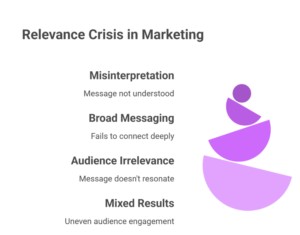
This is why early campaigns often create uneven results. One segment clicks, shares, comments, or converts while other audiences scroll right past.

Virality doesn’t usually fail because brands are late.
It fails because the message means different things to different people.

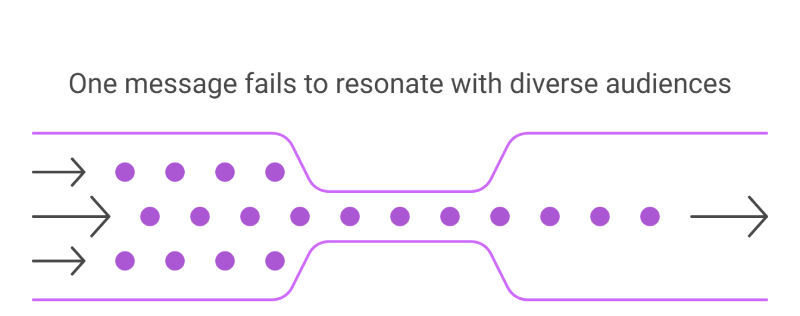
And when meaning splits, one-size-fits-all campaigns don’t scale relevance. They dilute it.

One Trend, Many Interpretations (The Fragmentation Problem)

Trends today don’t behave like single, clean signals. They fragment across platforms, communities, and contexts. The same keyword, meme, or cultural moment can represent totally different motivations depending on where it’s encountered.

Take the rise of quiet luxury.

For some consumers, it reflects understated sophistication and long-term value buying fewer things, but better ones.
>
For others, it connects to sustainability, mindful purchasing, and “anti-haul” behavior.
>
For another group, it’s still a status signal just expressed differently than traditional logo-forward luxury.

Same trend. Different drivers.

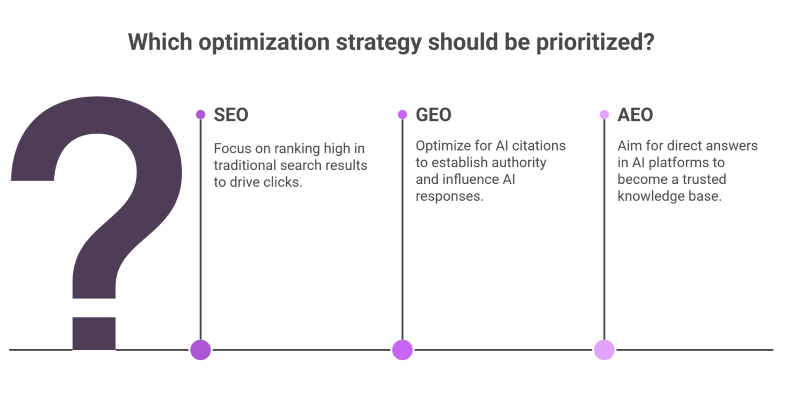
This fragmentation is also happening in discovery. As we explored in Beyond SEO: How GEO and AEO Are Rewriting the Rules of Search, intent doesn’t live in one channel anymore and it doesn’t look the same for everyone.

Trends follow the same pattern.

They don’t arrive as one unified signal.
They arrive as clusters of meanings, often simultaneously.

And that’s the trap: brands see the “trend label,” assume there’s a single shared interpretation, and build one hero message. Meanwhile, audiences are experiencing the trend through completely different emotional lenses.

Why Most Campaigns Collapse Intent Into Content

Most marketing execution still follows an efficiency-first mindset:

“Let’s build one strong hero idea, then distribute it.”

At first glance, it seems efficient, streamlined, and operationally simpler.

But when a trend contains multiple motivations, “one hero message” becomes a shortcut that quietly breaks relevance.

Here’s what typically happens:

  1. The team identifies a trend.
  2. Creative starts developing an idea that “fits.”
  3. Personas (if they exist) get applied later as targeting filters.
  4. The team tries to stretch one message across multiple audiences.
  5. Performance comes back mixed, and the trend is blamed.

But the trend wasn’t the problem. Interpretation was.

When you compress different motivations into one message, you don’t just lose personalization you lose emotional precision. The message becomes broad enough to avoid being wrong, but not specific enough to feel true.

It’s the difference between:

  • “Here’s what this means to you,” and
  • “Here’s a safe version of what this might mean to someone.”

Speed doesn’t solve that. It amplifies it.

If you move fast with a generic interpretation, you just launch the disconnect earlier.

What Persona × Intent Marketing Actually Means

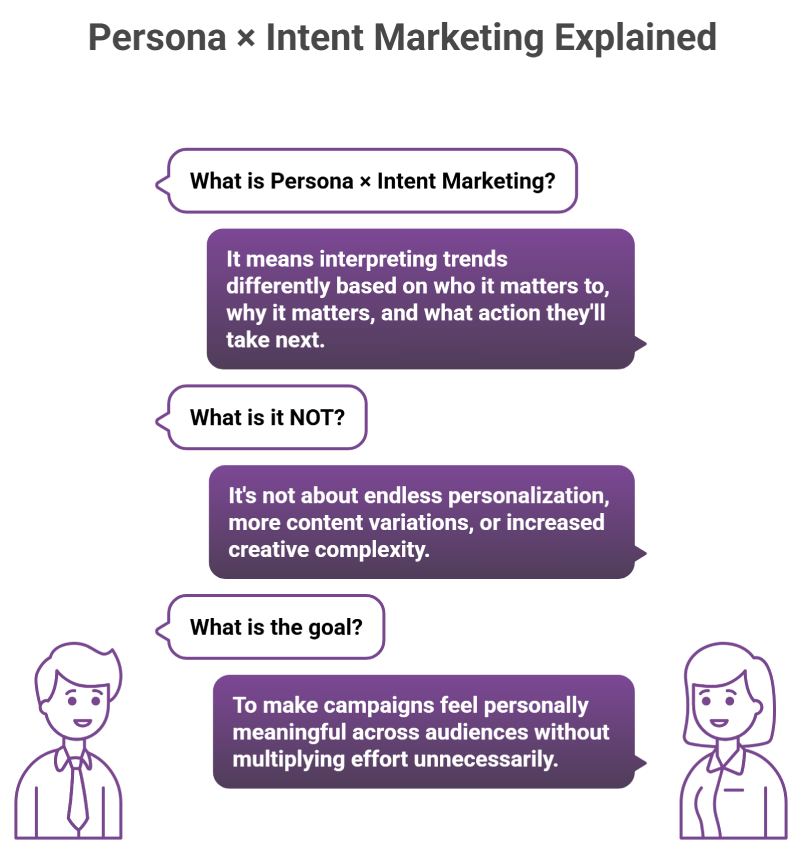
Persona × Intent Marketing is a more practical way to respond to trends without losing relevance.

Simply put, it means:

Interpreting one trend differently depending on who it matters to, why it matters, and what action they’re likely to take next.

It also helps to clear up what this is not:

  • It’s not endless personalization for its own sake.
  • It’s not “make 50 variations and hope one works.”
  • It’s not complexity disguised as strategy.

Persona × Intent is about reducing ambiguity, not increasing workload.

It gives teams a way to build multiple clear campaign directions from one strong insight without turning execution into chaos. The objective isn’t to multiply content. It’s to multiply relevance.

A clean way to think about it:

  • Persona answers: Who is experiencing this trend?
  • Intent answers: What are they trying to do/feel/decide right now?
  • Persona × Intent answers: What should we say and what should we ask them to do next?

This is why the same trend can’t mean one campaign. Because audiences don’t share one reason for caring.

Where Insight-to-Creative Automation Fits (Without the Hype)

This is where Insight-to-Creative Automation becomes powerful, but not in the “automation will replace marketing” way that most people dislike (and rightly ignore).

Automation doesn’t decide what’s trending.
It helps teams understand how a trend should be interpreted across audiences at the same time.

Decision-readiness answers when you should act.
Persona × Intent clarity answers how you should act once you do.

In practical terms, Insight-to-Creative Automation supports the messy middle:

  • spotting the same signal across multiple channels,
  • identifying which personas are reacting,
  • separating different motivations,
  • and shaping channel-appropriate creative directions.

The point isn’t speed for speed’s sake. It’s coordination. It’s preventing the team from collapsing multiple meanings into one average message.

One Signal, Multiple Campaign Paths

Imagine a growing cultural conversation around digital well-being.

If a brand treats it as one trend and launches one message, say, “Take control of your screen time” it will feel relevant to some people and tone-deaf to others.

Now look at Persona × Intent:

1) Productivity-driven professionals (intent: focus and performance)

Digital well-being here is about reducing distractions, improving focus, and getting more done with less noise.

Campaign direction:

  • “Build better work habits.”
  • “Protect deep work.”
  • “Cut the context switching.”

Channels that often work well:

  • Search, LinkedIn, email, product-led landing pages

2) Younger, socially aware audiences (intent: balance and mental health)

For this persona, digital well-being may connect to burnout, anxiety, and lifestyle health.

Campaign direction:

  • “Create healthier boundaries.”
  • “Choose calm over constant updates.”
  • “Use tech with intention.”

Channels that often work well:

  • Short-form video, creators, community-led content, social storytelling

3) Business leaders (intent: team sustainability and outcomes)

For this persona, digital well-being can map to employee satisfaction, retention, and sustainable performance.

Campaign direction:

  • “Reduce burnout risk.”
  • “Improve employee experience.”
  • “Build healthier digital culture at scale.”

Channels that often work well:

  • Thought leadership, webinars, ABM, case studies

The insight stays the same.
Only the interpretation changes.

And once interpretation changes, your creative, CTA, and channel strategy should change too.

That’s not “more work.” That’s smarter work.

Why This Changes How Virality Works

We often talk about virality like it’s purely a distribution problem: timing, reach, algorithm, media spend.

But modern virality works differently.

Virality is increasingly a relevance effect.

It happens when the right audience sees something that feels specific to them and they pass it along because it signals identity, values, humor, or usefulness.

A trend-based campaign goes viral when:

  • It lands early enough to feel timely,
  • clearly enough to feel personal,
  • and consistently enough across touchpoints to feel real.

Many brands compete to spot trends first.
Long-term advantage belongs to brands that understand trends most accurately and apply that understanding at scale.

When campaigns reflect audience meaning from the start, engagement grows naturally. It’s not dependent on shouting louder. It’s dependent on being more precise.

How Teams Can Apply Persona × Intent Without Slowing Down

A common fear is: “If we do this properly, we’ll slow down.”

The opposite is usually true because Persona × Intent reduces indecision.

Here’s a lightweight way teams operationalize it:

  1. Name the trend signal (what are we seeing?)
  2. List the top 2-4 personas involved (who is reacting?)
  3. Map intent by persona (why do they care?)
  4. Assign one clear campaign angle per persona-intent pair
  5. Define one primary CTA per angle
  6. Choose channels where that intent naturally shows up

The goal is not perfection. The goal is clarity fast enough to matter.

This is also where Insight-to-Creative Automation can help: by turning those mappings into consistent, repeatable flows so the team doesn’t rebuild the wheel every time.

If one trend can lead to multiple audience-aligned campaign directions, the next question becomes obvious:    How do brands scale this approach without increasing cost, effort, or operational complexity?

In the final blog of this series, we’ll explore how insight-to-creative automation helps brands turn one validated signal into multiple launch-ready campaigns without slowing teams down or creating execution overload.

If your team consistently spots trends but struggles to turn them into audience-relevant campaigns, it may be time to review your execution process-not your creativity.

If you’d like to explore what Persona × Intent looks like in your current campaigns, connect with Tatvic for a strategic consultation

Brands Don’t Miss Trends. They Miss the Moment: How Automation Closes the Gap Between Insight and Action

Brands Don’t Miss Trends

Automation matters not because it makes teams faster, but because it changes when decisions get made. Most brands don’t lose trends due to lack of insight - they lose them in the space between seeing a signal and agreeing to act on it. That gap, where validation, alignment, and execution stall, is where momentum fades. Closing it is less about speed and more about decision readiness.

The Real Myth to Kill

Most brands don’t miss trends.

They see them. Track them. Discuss them in Monday meetings with coffee still warm.

And still do nothing with them.

The problem isn’t awareness. It’s activation latency.

If you’re interested in why insight alone doesn’t move brands forward, our first blog: Insight to Creative Automation digs into exactly that - why signals often die in translation before they even become decisions.

Trends don’t reward discovery. They reward decisions made early enough to matter-before the conversation moves on, before competitors claim the territory, before the algorithm stops caring.

You can be the first to spot a signal and still arrive too late. That’s not a failure of insight. It’s a failure of infrastructure.

The Thread From Before

In our first blog, we showed why insights die in translation, how the journey from data to decision loses clarity at every handoff. The second blog revealed how search is fragmented across platforms, scattering audience intent into signals brands can barely track, let alone act on.

This blog answers the next logical question: Even if I see trends early, why do I still miss the moment?

Because speed isn’t your constraint. Decision-readiness is.

When a trend surfaces, most teams enter a familiar loop: validate the signal, check if it’s on-brand, debate the format, assign ownership, wait for creative approval. By the time all those boxes are checked, the trend has either peaked or pivoted into something else entirely.

The bottleneck isn’t how fast you move. It’s how long it takes to know what to move on to.

Decision Debt: The Hidden Cost

Let’s name what’s actually happening here.

Decision debt is the accumulation of unanswered questions that delay action until the opportunity expires.

Every trend that lands on your radar arrives with a string of unresolved decisions:

  • Is this signal real or noise?
  • Is this on-brand, or are we stretching?
  • Which persona does this actually apply to?
  • Who owns the call: social, performance, brand?
  • What format should we launch in: video, carousel, article, or ad?

These aren’t trivial questions. They’re necessary. But when every trend requires this much internal negotiation, velocity dies.

Here’s the insight most teams miss: Trends don’t expire on feeds. They expire inside organizations.

The half-life of a trend isn’t determined by TikTok’s algorithm or Twitter’s Explore tab. It’s determined by how long your team takes to move from “interesting” to “live.”

And that’s where decision debt compounds. One unresolved question triggers another. Creative waits on strategy. Strategy waits on validation. Validation waits on data that’s already outdated.

By the time the green light comes, the moment is gone.

Why Manual Trend Monitoring Fails

Most teams rely on some version of this:

  • Weekly trend reports compiled by junior analysts
  • Static dashboards showing what spiked yesterday
  • Platform-specific signals (what’s trending on Instagram vs. LinkedIn vs. Google)
  • Gut feel from someone who “stays plugged in”

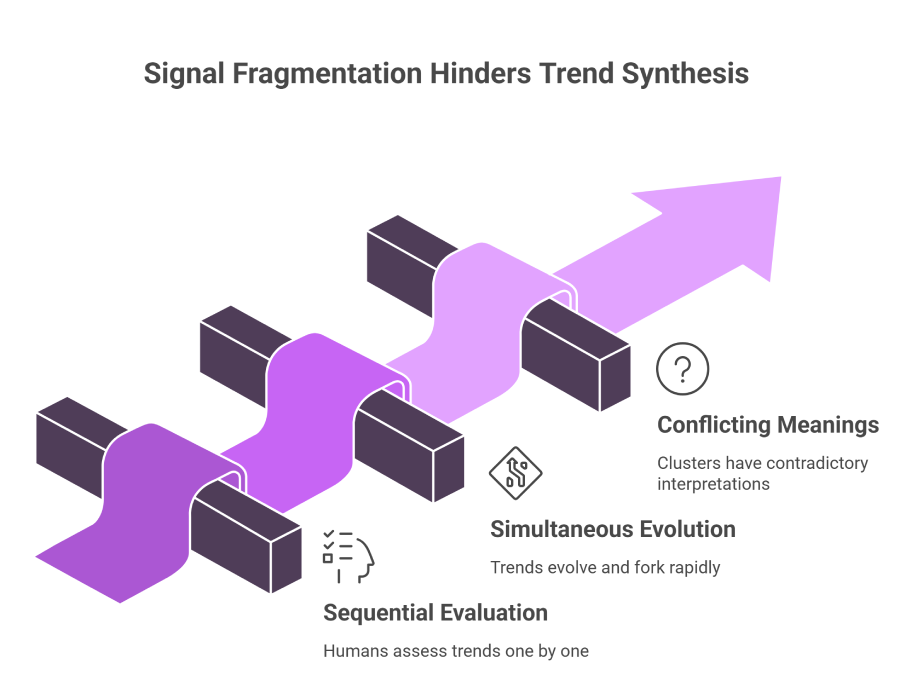
The problem isn’t effort. Teams work hard. The problem is signal fragmentation.

Trends don’t live in one place anymore. They’re scattered across:

  • Search queries
  • Social feeds
  • Generative AI answers
  • Community forums
  • Creator content
  • Platform-curated recommendations

Humans see fragments. Virality requires synthesis.

And here’s where it gets harder: humans evaluate trends sequentially. You look at one signal, assess it, move to the next. But trends evolve simultaneously. By the time you’ve validated one angle, the conversation has already forked into multiple intents.

Take “quiet luxury” as an example. When it first surfaced, it meant different things depending on where you looked:

  • On Pinterest: minimalist wardrobe inspiration
  • On LinkedIn: workplace professionalism discourse
  • On TikTok: anti-flexing Gen Z sentiment
  • In search: premium product recommendations

If your team is monitoring these platforms separately, you’re not seeing a trend. You’re seeing conflicting data points. And conflicting data paralyzes decisions.

Trends don’t arrive as single signals. They arrive as clusters with conflicting meanings.

Read: Beyond SEO - how GEO & AEO are rewriting the rules of search

That’s why manual monitoring fails-not because people aren’t paying attention, but because the structure of trend discovery itself has outpaced human capacity to synthesize it in real time.

The Missing System:

Automation That Decides When Not to Act

Here’s the insight most automation pitches miss:

Automation isn’t valuable because it moves fast. It’s valuable because it filters aggressively.

The real competitive advantage isn’t jumping on every trend. It’s knowing which ones to ignore.

Insight-to-Creative Automation doesn’t ask: “What’s trending?”

It asks:

  • What’s accelerating, not peaking? (Momentum matters more than volume)
  • What aligns with this brand, not any brand? (Relevance filters out noise)
  • What maps to this persona × intent? (Signal meets strategy)
  • What can be executed now, not someday? (Actionability gates everything)

The output isn’t content. It’s decision clarity.

You don’t get a list of trends to consider. You get trends worth acting on-pre-filtered for brand fit, audience intent, execution readiness, and momentum trajectory.

This is the shift: Automation doesn’t replace judgment. It decides when judgment is required.

Most decisions don’t need a committee. They need a system that knows your brand well enough to filter what lands on your desk in the first place.

Book a call with Tatvic to assess how automation can close the gap between insight and action - without adding complexity or risk.

The Automation Loop That Changes Everything

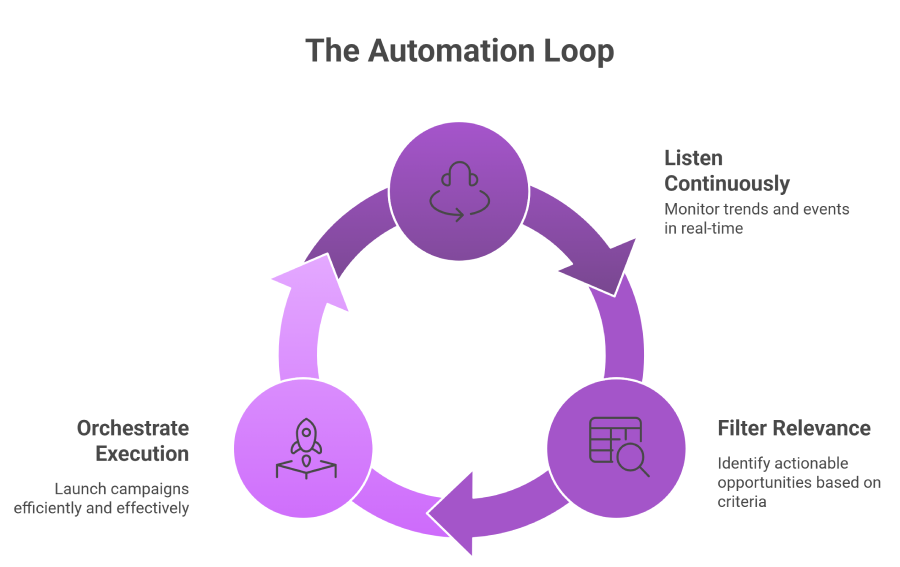
Real automation isn’t a feature. It’s a closed-loop system that does three things simultaneously:

1. Continuously listens

Not daily. Not weekly. Continuously.

Trends don’t wait for your Monday report. They emerge on Saturday afternoons, Tuesday evenings, during product launches, breaking news cycles, and cultural moments. If your listening is periodic, you’re always behind.

2. Pre-filters relevance

Brand voice. Category boundaries. Audience intent. Execution feasibility.

The system doesn’t surface everything. It surfaces what your brand can own,right now, with the assets you have, for the audience that matters.

3. Orchestrates execution paths

Ads, social posts, landing pages, search content, already shaped, formatted, and channel-ready.

This isn’t about generating ideas. It’s about collapsing the distance between signal and asset. The output isn’t a brief. It’s a launchable campaign.

The system doesn’t surface trends. It surfaces opportunities worth acting on now.

That’s the difference between tools that inform and systems that activate.

Same Signal, Different Outcomes

Let’s make the gap undeniable.

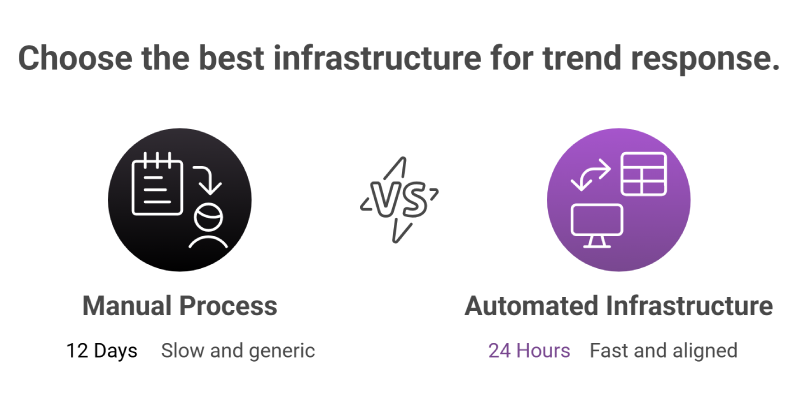
Two teams. Same emerging signal: “coffee alternative” searches spiking 40% week-over-week.

Team A (Manual Process)

  • Analyst adds it to the weekly tracker
  • Strategy meeting scheduled for Thursday
  • Creative brief circulated Friday
  • Approvals drag into next week
  • Generic “looking for coffee alternatives?” creative launches 12 days later
  • Trend has already peaked; creative feels late

Team B (Automated Infrastructure)

  • Automation flags the signal within hours
  • Filters confirm brand alignment + persona intent match
  • Channel-ready creative variants generated: search ad, carousel, blog snippet
  • The campaign goes live in 24 hours
  • Captures early momentum while competition is still scheduling meetings

The insight wasn’t the advantage. The infrastructure was.

Team A had the same data. They just didn’t have the system to act on it before it expired.

The Next Competitive Moat

This isn’t just a marketing execution story. It’s a strategic shift.

The next competitive moat isn’t:

  • Better creatives (everyone has good designers)
  • Faster approvals (speed alone isn’t a strategy)
  • Bigger teams (headcount doesn’t solve decision debt)

It’s systems that collapse insight → decision → execution into one loop.

The brands that win in the next era won’t be the ones who spot trends first. They’ll be the ones who’ve built infrastructure that turns signal into action before competitors finish their first meeting.

And here’s the leadership-level insight most miss:

The advantage isn’t moving faster. It’s knowing what not to launch.

In a world where trends multiply daily, restraint becomes the skill. Automation permits you to ignore 90% of what’s trending, because you have confidence that the 10% you act on is strategically sound, brand-aligned, and execution-ready.

That confidence is what separates reactive brands from those building compounding advantages.

What Comes Next

If your team can see trends but can’t act on them fast enough, the issue isn’t talent. It’s tooling.

The gap between awareness and activation is structural. And the structure can be rebuilt.

In the next piece, we’ll break down how Persona × Intent automation turns one emerging signal into multiple campaigns-without slowing teams down or sacrificing brand coherence.

That’s where trend discovery becomes a repeatable system, not a lucky hit.

Book a call with Tatvic’s experts to evaluate where your insight-to-action pipeline is breaking - and what it would take to fix it.

Turn data into competitive edge with Agentic AI

Agentic AI for Marketing: Driving Results with Intelligent Automation

Agentic AI for Marketing: Driving Results with Intelligent Automation - Tatvic

Do you Know?

Marketers Saw a 13.7% Average ROI from Agentic AI in 2026
~BCG

We’re at a turning point in how work gets done , not just faster, but fundamentally smarter.

The rise of Agentic AI for marketing is transforming how decisions are made, actions are taken and results are scaled in real time.

But what exactly is it and why is now the moment to care for Agentic AI for marketing automation?

Agentic AI refers to a new class of AI systems that go beyond traditional automation or even advanced machine learning.

AI for Marketing has long promised efficiency gains, but Agentic AI for Marketing systems are goal-seeking, context-aware and capable of autonomous decision-making across complex tasks  often with minimal human intervention.

While “AI” is a term that’s been hyped for years, Agentic AI is not about chatbots or basic scripts.

It’s about delegating entire jobs, not just tasks to intelligent agents that continuously learn, optimize and coordinate with other tools or systems.

Agentic AI for Marketing: Scaling Marketing Automation In A Smarter Way

Traditional Marketing Automation is built on predefined workflows and static rules.

While it helps streamline repetitive tasks, it often lacks the flexibility and intelligence needed to thrive in today’s dynamic digital landscape.

As customer behaviors shift in real time and campaign complexity grows, businesses need more than automation, they need autonomy.

Agentic AI introduces a new paradigm: autonomous and goal-driven agents that not only execute tasks but also plan, adapt, and optimize marketing actions intelligently.

These agents continuously learn from data, make context-aware decisions, and operate with minimal human intervention-enabling marketers to move faster, target smarter, and respond in real time.

By combining the power of machine learning, decision intelligence, and real-time feedback loops, Agentic AI allows marketing teams to scale their efforts more intelligently.

It unlocks smarter automation, driven not just by efficiency, but by adaptability and strategic outcomes.

In this guide, we explore how Agentic AI is redefining marketing automation and how organizations can leverage it to deliver greater performance, personalization and ROI at scale.

Why This Guide on Agentic AI For Marketing Automation Exists?

Despite its potential, Agentic AI for marketing automation can feel complex or out of reach for many teams. There’s a lot of noise, hype, and confusion around terms like “autonomous agents” or “multi-agent systems.” That’s why we created this guide - to make Agentic AI for marketing automation understandable, actionable, and above all, applicable to real-world marketing challenges.
Agentic AI for Marketing: Scaling Marketing Automation In A Smarter Way

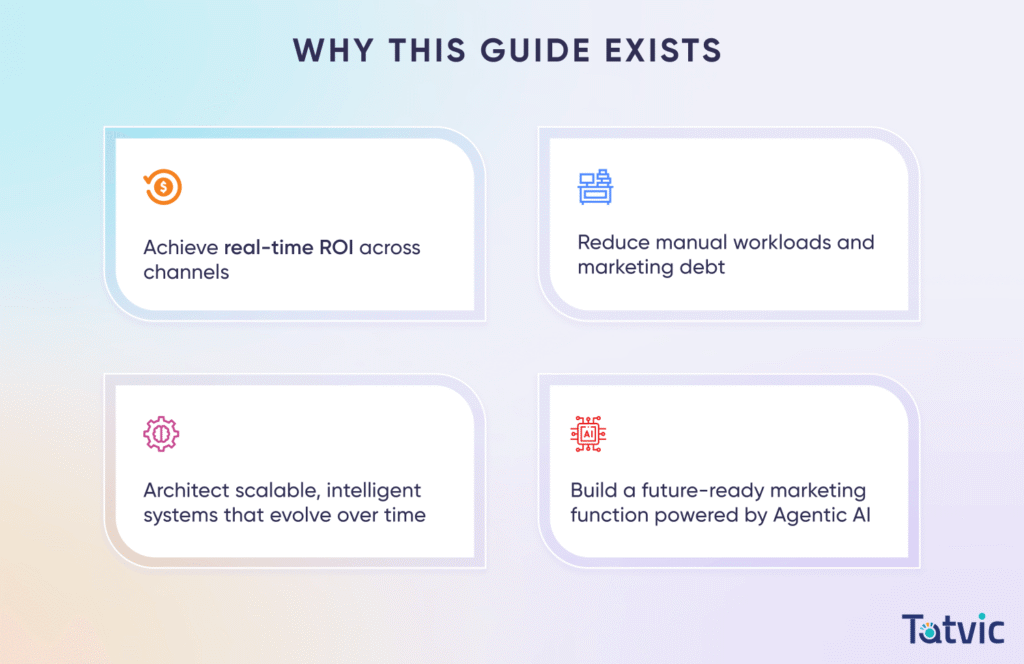
This isn’t just a trendwatcher’s report. It’s a practical, strategic roadmap for marketers looking to:

  • Achieve real-time ROI across channels
  • Reduce manual workloads and marketing debt
  • Architect scalable, intelligent systems that evolve over time
  • Build a future-ready marketing function powered by Agentic AI
You may also like to read👉 Agentic AI vs AI Agents: A Complete Guide for 2026 & Beyond


What the Early Data Tells Us about the Role of Agentic AI in Marketing?

Early evidence across industries shows that Agentic AI for marketing automation is already delivering tangible value.

Here are three verified data points from leading research:

Revenue Uplift in Marketing & Sales

63% of companies surveyed by McKinsey report higher revenue in marketing and sales after scaling AI, making these functions the biggest beneficiaries of AI-driven growth.
Source: McKinsey Global AI Survey, 2023

Cost Reductions in Operations

44% of the same respondents say AI has cut costs by at least 10% in the units where it’s deployed, with marketing operations among the top areas realizing these savings.
Source: McKinsey Global AI Survey, 2023

Widespread AI-Powered Personalization

Over 50% of marketers have deployed AI-driven personalization tools to tailor customer experiences in real time-resulting in an average 20% boost in engagement metrics.
Source: Gartner Marketing Technology Survey, 2024

These figures underscore a clear trend: businesses embracing Agentic AI for marketing automation see faster execution, lower costs, and measurable revenue uplifts proving the technology is ready for prime time.

Why Agentic AI in Marketing Really Matters Now?

The pressure on marketers in 2026 has never been more intense.

Marketing teams today are navigating a perfect storm of heightened expectations, constrained budgets, and an overwhelming explosion of data.

Agentic AI for marketing automation offers a real way forward. By using agents that are goal-driven, adaptive and self-improving, marketing teams can break the cycle of reactive execution and start operating proactively, intelligently and at scale.
Why Agentic AI in Marketing Really Matters Now - Tatvic

This moment is unique. Advances in real-time data infrastructure, scalable LLMs, and edge computing have converged, making Agentic AI truly autonomous. If you want AI Marketing that adapts on the fly, eliminates manual bottlenecks, and delivers real-time ROI, there’s never been a better time to embrace Agentic AI for marketing automation.

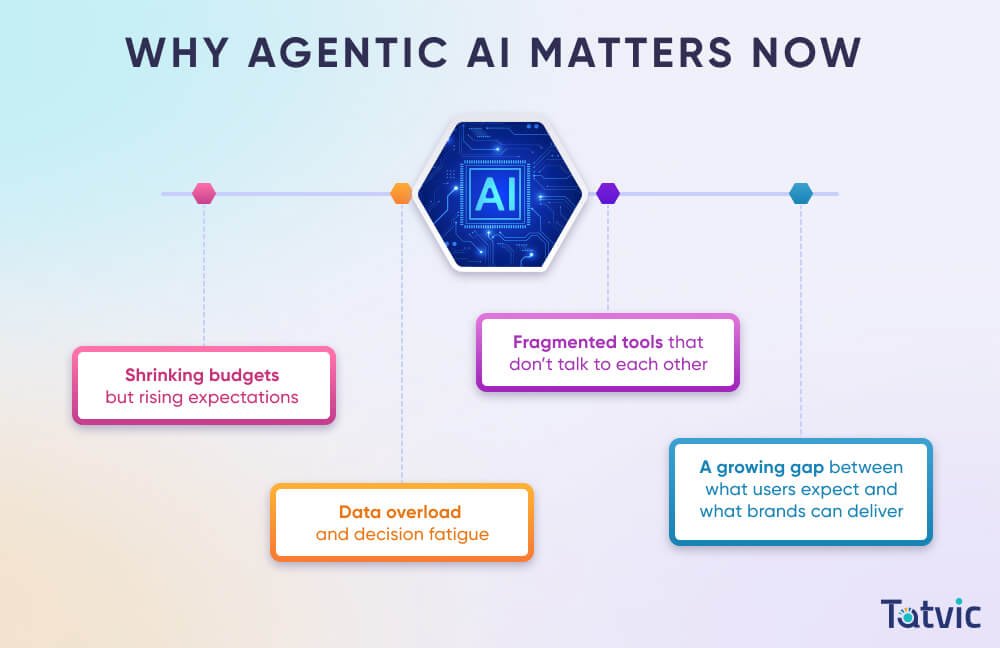
Despite access to advanced Martech stacks, many still face persistent challenges:

  • Shrinking budgets, rising KPIs: Marketing leaders are being asked to do more with less. Optimize performance, personalize experiences and scale campaigns, all while operating with reduced spend.
  • Data deluge and decision fatigue: With vast amounts of customer and campaign data pouring in across channels, marketers struggle to turn insights into timely action.
  • Disconnected tools and siloed systems: Legacy marketing automation platforms and fragmented data stacks don’t integrate seamlessly, leading to inefficiencies and lost opportunities.
  • Sky-high customer expectations: In 2026, consumers expect real-time relevance, hyper-personalization, and instant gratification-standards that outdated automation simply can’t meet.

Enter Agentic AI: The Future of Marketing Automation

Agentic AI isn’t just another upgrade in your Martech toolkit, it’s a fundamental shift.

This new wave of intelligent, autonomous agents redefines how marketing gets done.

Instead of relying on rigid workflows and static rules, Agentic AI empowers marketers with systems that are:

  • Goal-driven: Agents operate with clear business objectives in mind-whether it’s maximizing ROAS, improving engagement, or reducing churn.
  • Self-improving: These agents learn continuously from real-time data and past outcomes to refine strategies dynamically.
  • Context-aware: They understand the environment, customer signals, and business context, adjusting campaigns on the fly for optimal impact.
  • Proactive, not reactive: Instead of waiting for inputs or approvals, agents anticipate what’s needed and act autonomously to achieve it.

Why Agentic AI in Marketing Is Important Now?

The timing couldn’t be more critical or more promising.

In 2026, we’ve hit a powerful inflection point where technology finally enables true marketing autonomy:

  • Scalable LLMs (Large Language Models) are now fine-tuned for industry-specific marketing applications, enabling more precise, context-rich decision-making.
  • Real-time data infrastructure powered by event-driven architectures (e.g., Kafka, Snowpipe, and Apache Flink) allows instant feedback and action loops.
  • Edge computing and privacy-aware AI make it possible to deliver personalized experiences at speed while maintaining compliance with evolving data regulations like the Digital Markets Act and India’s DPDP Bill.
  • Agentic orchestration platforms are replacing clunky dashboards, automating campaign management, A/B testing, audience segmentation, and even creative optimization at scale.

It’s time to stop patching together workflows and start building self-directed marketing systems.

Agentic AI isn’t just the next step, it’s the leap toward marketing that’s faster, smarter, and more ROI-driven than ever before.

  • You don’t need more dashboards-you need decisions.
  • You don’t need more tools-you need outcomes.
  • You don’t need more rules-you need results.
  • You don’t need more Automation -you need Autonomy.

Agentic AI delivers all Four!
The Imperative for Real-Time ROI

The Imperative for Real-Time ROI

In 2026, marketers no longer have the luxury of time or guesswork.

Campaigns are no longer judged by monthly wrap-ups or post-mortem dashboards.

Every initiative is tethered to real-time performance metrics, tight budgets and high-stakes KPIs.

The question CMOs are asking isn’t just “Did this work?”, it’s:

“What’s working right now and what must change immediately?”

Traditional marketing automation tools simply can’t keep pace with the speed of decision-making required today.

That’s where Agentic AI for marketing automation steps in not as an enhancement, but as a game-changing necessity.

You may also like to read👉 Agentic AI vs Generative AI in 2026: Definitions, Use Cases and Key Differences


Why Real-Time Marketing Is No Longer Optional

In today’s high-velocity digital landscape, delayed insights cost money, attention, and conversion. Modern marketing needs to react not in hours or days but in seconds.

Agentic AI delivers real-time ROI by enabling autonomous decision loops across every marketing touchpoint. It’s not about analyzing last week’s campaign, it’s about optimizing this second’s results.

Imagine intelligent AI Agents that:

  • Pull live performance data from multiple platforms (Google Ads, Meta, DV360, CRM, etc.)
  • Analyze campaign signals across audiences, creatives, and channels in real time
  • Reallocate budget dynamically toward high-performing assets or underexposed audiences
  • Auto-generate and A/B test subject lines, CTAs, or creative elements on the fly
  • Trigger contextual next-best actions for users based on their real-time behaviors

The Tech Convergence That Made It Possible

The shift to real-time, agentic marketing is powered by a unique convergence of technologies now fully matured in 2026:

  • Streaming data pipelines (e.g., Snowflake Snowpipe, Apache Kafka, Confluent Cloud) now handle billions of real-time events with near-zero latency.
  • Next-gen LLMs, like GPT-5 and Claude 3.5, are now fine-tuned for marketing decision-making, generating not just content, but strategy and performance recommendations.
  • Edge computing and serverless architectures enable data processing at the point of interaction no more waiting for centralized batch jobs.
  • Autonomous agent frameworks are built to execute adaptive marketing strategies without requiring constant human oversight.

Marketers have long leaned on automation to scale execution.

But 2026 demands more than automation, it demands intelligent action at speed.

Agentic AI turns automation into autonomy, empowering systems that not only act but adapt.

That agility directly translates into:

  • Higher conversion rates
  • Smarter budget allocation
  • Increased marketing velocity
  • Immediate feedback loops for continuous improvement

Real-time ROI isn’t a buzzword, it’s a business imperative.

Every moment you wait to optimize is a moment lost in a hyper-competitive market.

  • With Agentic AI, you’re not just keeping up -> you’re staying ahead.
  • You’re not just automating -> you’re advancing.
  • You’re not just reporting ROI -> you’re accelerating it.

Welcome to the new standard in performance marketing.


You may also like to read👉 How AI Is Reshaping Marketing in 2026: Trends, Tools & Tactics


Why 2026 Is the Breakthrough Year for Instant ROI with Marketing Automation

2026 isn’t just another year of AI hype, it’s the inflection point where marketing automation and real-time ROI converge.

The pressure on marketing teams to do more with less has never been greater.

Budget scrutiny is at an all-time high, C-suite patience is at an all-time low, and delayed insights are no longer acceptable.

Yet, according to BCG’s October 2024 report, despite multi-year investments in AI, 74% of companies still struggle to scale meaningful value.

The culprit?

Most AI deployments remain siloed in pilots, dashboards or POCs failing to deliver measurable outcomes.

Only 1 in 4 enterprises have matured their AI strategy enough to drive cross-functional, ROI-generating impact.
- Source: BCG, “Where’s the Value in AI?”, 2024

The Leaders Have a Different Playbook

What sets the frontrunners apart isn’t just access to AI, but how they integrate it deeply into their revenue engines and cost-optimization workflows.

  • 45% of AI leaders deploy AI for enterprise-wide cost transformation (vs. just 10% of laggards)
  • Over 33% use AI directly to fuel top-line growth-boosting revenue through smarter decision-making and personalized automation
  • Leaders close the loop between insights and action with minimal human intervention

With real-time data pipelines and cloud-native LLMs now mainstream, Agentic AI for marketing automation is finally live. In a world of shrinking budgets and zero patience for lag, this is the year AI Marketing proves its ROI.

From ROI Lag -> ROI Live

In traditional marketing automation, results are often reactive. You launch a campaign, wait days for performance data, and only then make changes.

With Agentic AI, the game changes:

  • ROI insights surface in real time, not in post-campaign retrospectives.
  • Campaign performance is continuously optimized based on dynamic behavior and live feedback loops.
  • Budgets shift automatically toward what’s working, eliminating waste and maximizing impact without waiting for manual intervention.

In 2026, Agentic AI doesn’t just report ROI. It delivers it instantly.

Agentic AI Marketing Automation 101: From Predictive to Prescriptive to Fully Autonomous

The Evolution of AI in Marketing Automation

The evolution of AI in marketing is a story of growing intelligence, autonomy, and business impact. What began as data-driven support tools has now matured into fully autonomous systems that not only recommend but execute.
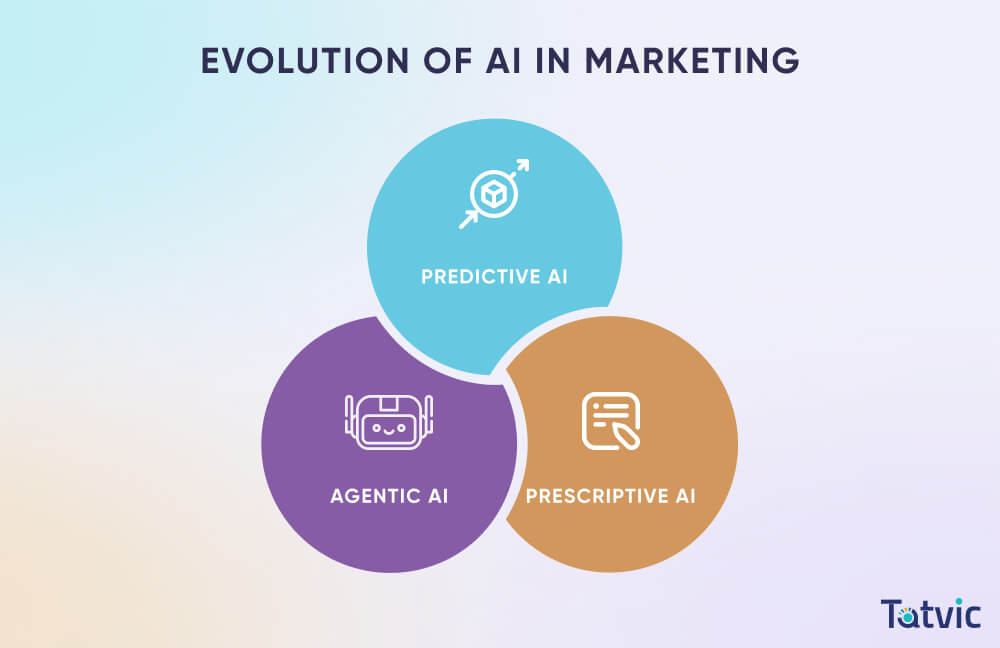
Evolution of AI in Marketing

Stage 1: Predictive AI - Seeing What’s Likely to Happen

Predictive AI was the first major milestone. It helped marketers move from gut-feel decisions to data-backed forecasting.
These models:

  • Scored leads based on conversion potential
  • Predicted customer churn
  • Recommended best-next products or offers
  • Identified behavior trends across segments

While powerful, predictive AI still left the actioning to humans.

Stage 2: Prescriptive AI - Suggesting What to Do

Next came prescriptive AI tools that not only anticipated outcomes but suggested the optimal path forward.
These solutions would:

  • Recommend campaign budget reallocations
  • Suggest subject line improvements based on audience insights
  • Optimize bidding strategies for paid media
  • Guide content sequencing based on user journey modeling

However, execution still required human validation. Think of this phase as AI copilots, not commanders.

Stage 3: Agentic AI - Acting Autonomously in Real Time

Welcome to 2026: the age of Agentic AI for marketing automation.

Agentic AI systems represent a breakthrough leap. These aren’t just intelligent advisors, they’re autonomous agents with the ability to:

  • Ingest and analyze real-time cross-channel data
  • Make data-driven decisions with minimal latency
  • Dynamically execute changes across campaigns, budgets, creatives, and journeys
  • Learn continuously and self-improve with each interaction

There’s no need for human-in-the-loop delays. These agents think, act, and adapt at machine speed enabling fully self-driving marketing operations.

This evolution from predictive to prescriptive to autonomous is what sets Agentic AI apart in the marketing tech landscape.

It allows brands to:

  • Move from insights to impact instantly
  • Deliver hyper-personalization at scale
  • Eliminate manual bottlenecks across the marketing funnel
  • Continuously optimize based on real-world results-not assumptions

In 2026, with cloud-native LLMs, real-time data streams, and scalable edge computing,

You may also like to read👉 Agentic AI vs ChatGPT: What Marketers Need to Know in 2026


Agentic AI isn’t just an upgrade, it’s a redefinition of what’s possible in marketing.

Core Capabilities & Business Impacts

In 2026, the most transformative marketing automation systems are no longer just reactive-they’re agentic, proactive, and self-evolving. At the heart of Agentic AI lies a new class of intelligent systems defined by three breakthrough capabilities: goal-seeking behavior, collaborative agents, and real-time self-optimization.

Together, these elements enable marketing teams to unlock unprecedented efficiency, agility, and growth at scale.

1. Goal-Seeking Decision-Making Agents

Agentic AI systems are designed to pursue outcomes, not just execute tasks.

These intelligent AI Agents:

  • Continuously scan and interpret thousands of signals across campaigns, channels, and user touchpoints
  • Prioritize marketing actions aligned with predefined business objectives (e.g., ROAS, CAC, LTV)
  • Make high-frequency decisions without human bottlenecks

This allows for dynamic, autonomous marketing orchestration-with minimal manual intervention and maximal business alignment.

2. Real-Time Learning & Continuous Optimization

Unlike traditional automation that relies on static rules or pre-trained models, Agentic AI adapts in real time:

  • Refines strategies based on immediate performance feedback
  • Tests and evolves content, creatives, timing, and placement on the fly
  • Adjusts for shifting market signals, user behaviors, or budget thresholds instantly

The result?

A self-improving marketing engine that becomes smarter and more effective with every interaction.

3. Automated Activation Across the Full Funnel

Agentic AI doesn’t just suggest actions, it executes them.

These systems can:

  • Launch campaigns and deploy assets autonomously
  • Reallocate budgets from underperforming to high-performing channels in real time
  • Rewrite subject lines, CTAs, or product recommendations instantly to boost performance
  • Trigger multichannel journey updates based on live intent signals

This eliminates lag between insight and impact turning real-time intelligence into immediate business outcomes.

The result?

Marketers shift from firefighting to strategy elevating AI Marketing from static reporting to dynamic, ROI-driven action and turning Agentic AI for marketing automation into your most reliable growth engine.

6 Ways How Agentic AI Is Transforming Marketing in 2026

As marketing complexity explodes in the era of hyper-personalization, shrinking attention spans, and real-time consumer expectations, Agentic AI emerges as the breakthrough force that doesn’t just automate but intelligently orchestrates marketing at scale.

These next-gen AI agents don’t wait for commands; they anticipate, act and adapt 24/7.
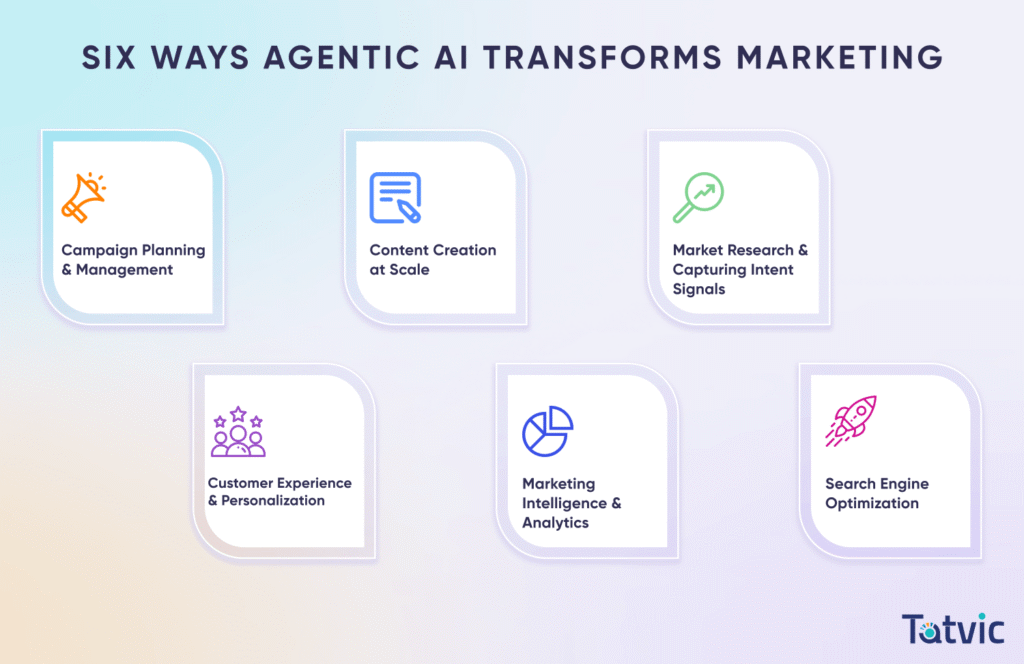
6 Ways How Agentic AI Is Transforming Marketing in 2025 - Tatvic

Here’s how Agentic AI is redefining what’s possible across the marketing value chain in 2026:

1. Campaign Planning & Management

Agentic AI independently plans, manages, and optimizes multi-channel campaigns from start to finish. With the right human-in-the-loop checkpoints, it ensures every marketing effort is both agile and effective.

  • Data-Driven Planning: AI agents scan real-time market signals-trending keywords, channel performance, and competitor moves-to draft ROI-ranked growth plans.
  • Scenario Forecasting: Run “what-if” models on budget, creative, and channel mix to predict campaign outcomes.
  • Live Optimization: Campaign blueprints refresh automatically as market conditions shift, keeping your strategy one step ahead.

2. Content Creation at Scale

Create compelling, tailored content across formats and platforms-intelligently crafted, iterated, and delivered by agents.

  • Smart Content Generation: Agents auto-write emails, ads, and landing pages based on real-time data and user behavior.
  • Multiformat Output: Instantly generate graphics, videos, and copy variants that adhere to brand standards.
  • Always-On Testing: Every creative element is tested and refined continuously to drive higher engagement.

3. Market Research & Capturing Intent Signals

Agentic AI captures a wide range of market signals and translates them into action-ready intelligence for sales and marketing.

  • Trend Monitoring: Track competitor launches, customer usage patterns, and industry shifts.
  • Intent Detection: Surface high-interest segments based on behavioral and contextual cues.
  • Actionable Inputs: Deliver timely recommendations to sales and marketing teams to act before opportunities or risks escalate.

4. Customer Experience & Personalization

Personalize digital journeys on the fly, using real-time signals to enhance engagement and improve customer experience.

  • Real-Time Journey Mapping: AI agents adjust user flows dynamically based on behavior, sentiment, and engagement.
  • Triggered Messaging: Deliver personalized emails, chat nudges, or app prompts exactly when needed.
  • Adaptive Personalization: Each customer’s path evolves as they interact-ensuring optimal relevance and conversion potential.

5. Marketing Intelligence & Analytics

Proactively surface insights, detect anomalies, and recommend the next best actions to steer marketing efforts in the right direction.

  • Predictive Forecasts: Access forward-looking projections on pipeline, revenue, and ROI.
  • Anomaly Detection: Flag dips, spikes, or unusual activity early-before they hurt performance.
  • Tactical Recommendations: Get guided advice on whether to scale, pause, or pivot-all within your dashboard.

6. Search Engine Optimization

Automate and scale your SEO strategy to stay ahead in search rankings-without manual lift.

  • Continuous Optimization: AI agents adjust keyword strategy, content structure, and internal linking in real-time.
  • SERP Intelligence: Monitor algorithm shifts and competitor positioning to protect your ranking.
  • Sustained Performance: Deliver long-term SEO results with adaptive, self-improving AI workflows.

Embedding these six intelligent capabilities into your marketing stack isn’t just future-proofing, it’s performance-proofing.

In 2026, Agentic AI for marketing automation isn’t just about working smarter; it’s about scaling faster, executing sharper, and connecting deeper than humanly possible.

How Agentic AI Marketing Automation Works Across Critical Jobs

Each marketing function from demand generation to sales enablement benefits uniquely from Agentic AI for marketing automation.
How Agentic Marketing Automation Works Across Critical Jobs

Below are role-based ‘Agent Recipes’ with key inputs and actions:

1. Demand Generation & Lead Nurturing

Inputs: Website behavior, firmographics, intent signals
Agent Actions:

  • Dynamically adjust offer thresholds based on visitor engagement
  • Send targeted drip-email sequences
  • Trigger retargeting ads when intent signals spike

2. Creative & Content Personalization

Inputs: Demographic profiles, past interactions, time of day
Agent Actions:

  • Generate personalized subject lines and headlines
  • Create hero banners and ad visuals tailored to audience segments
  • Rotate and test creative variants in real time

3. Marketing Analytics & Insights

Inputs: Cross-channel performance metrics, attribution models, spend data
Agent Actions:

  • Auto-generate consolidated dashboards
  • Flag anomalies or unexpected performance shifts
  • Recommend budget reallocations to maximize ROI

4. Sales Enablement & Handoff Automation

Inputs: CRM activity logs, lead scores, engagement triggers
Agent Actions:

  • Alert sales reps to high-intent leads instantly
  • Auto-populate relevant case studies or collateral in outreach emails
  • Schedule follow-up tasks and reminders within CRM

By aligning each agent’s inputs with precise actions, Agentic AI seamlessly automates and optimizes critical marketing jobs, so your teams can focus on strategy and growth.

Tatvic’s 4A Framework for Agentic AI Adoption in Marketing

Tatvic’s 4A Framework provides a clear, step-by-step roadmap to adopt Agentic AI in your marketing stack from uncovering the highest-value opportunities to scaling proven pilots organization-wide.

It helps marketing leaders navigate technical readiness, prioritize quick wins, and align AI initiatives with business goals.

By systematically moving through each stage, organizations can reduce adoption risk, accelerate ROI, and build lasting competitive advantage in a rapidly evolving digital landscape.
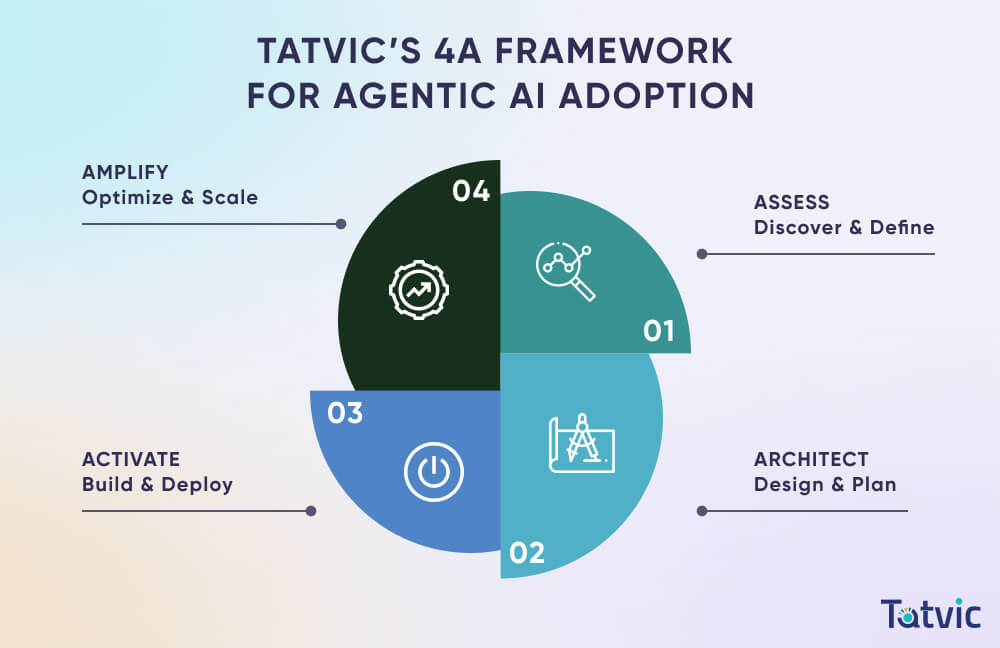
Tatvic’s 4A Framework for Agentic AI Adoption in Marketing

1. ASSESS: Discover & Define

The journey starts by evaluating your current marketing capabilities and data landscape. This phase identifies where Agentic AI can make the most immediate impact.

  • Audit Existing Systems: Evaluate CRM, CDP, analytics, and ad platforms for data quality, coverage, and governance gaps.
  • Identify AI Opportunities: Pinpoint high-impact use cases where intelligent agents can drive efficiency or unlock new value.
  • Define KPIs & Roadmap: Set measurable goals (e.g., CPL, ROI, pipeline contribution) and outline a phased implementation plan.

2. ARCHITECT: Design & Plan

With opportunities identified, the next step is to build the architecture-defining the workflows, systems, and rules that your AI agents will operate within.

  • Design Agent Workflows: Map decision paths, triggers, and actions across your marketing ecosystem.
  • Plan Integrations: Align APIs, webhooks, and services for seamless interoperability with your current martech stack.
  • Set Guardrails: Establish governance policies and safeguards to ensure reliability, compliance, and trust.

3. ACTIVATE: Build & Deploy

Now it’s time to bring your agents to life. This phase involves configuring agents, integrating them into live systems, and training your team to work with the new model.

  • Deploy Pilot Agents: Launch AI agents in a controlled environment, aligned to specific use cases and KPIs.
  • Run Real-World Tests: Monitor performance in live conditions, with human-in-the-loop support to catch issues early.

Team Readiness: Train marketing teams on the new workflows, ensuring they’re equipped to manage and scale the solution.

4. AMPLIFY: Optimize & Scale

After validating success, it’s time to scale. This phase is about expanding agent coverage, optimizing based on real-world feedback, and embedding continuous learning.

  • Scale Across Campaigns: Extend AI adoption across regions, channels, and marketing functions.
  • Automate Optimization: Use feedback loops, automated alerts, and model retraining to keep agents sharp.
  • Track Value Over Time: Maintain dashboards and reporting cadences to ensure ROI, efficiency, and agility continue to improve.

Following these four steps ensures rapid pilots, seamless integration and sustained ROI unlocking autonomous marketing at scale.

Building Your Data & Technology Foundation for AI Marketing Automation

To unlock the full potential of Agentic AI for marketing automation, a strong data and tech foundation is essential.

Intelligent agents require more than just data they need a curated, governed, and interoperable system that delivers context and continuity across the customer journey. It starts with making sure your data is not only collected, but ready for real-time, autonomous action.
Building Your Data & Technology Foundation

1. Data Readiness

  • Completeness & Hygiene: Clean, de-duplicate, and normalize records to prevent decision errors.
  • Governance & Security: Implement data classification, encryption, and consent management in line with GDPR and CCPA.

2. Tech Stack Integration

  • CRM/CDP Connectivity: Native connectors for Salesforce, HubSpot, and major CDPs.
  • Ad Platform APIs: Seamless bid and budget control on Google Ads, LinkedIn, and programmatic platforms.
  • Analytics Streams: Real-time web behavior via Google Analytics, Adobe Analytics, or custom streams.

3. Scalable Infrastructure Readiness

  • Dynamic Resource Scaling: Utilize cloud-native platforms that automatically adjust compute and storage capacity to support AI agent training, testing, and real-time decision-making.
  • Performance Efficiency: Implement streamlined processing pipelines to ensure minimal delay for time-sensitive campaign execution.
  • Resilient & Future-Ready Systems: Build a flexible architecture that supports growing data volumes, evolving agent logic, and expanding use cases with ease.

Governance & Organizational Readiness for AI Marketing Automation

Integrating Agentic AI for marketing automation demands clear governance, ethical guardrails, and organizational readiness to assign accountability, uphold fairness, and drive user adoption.

These structures ensure autonomous decisions align with business objectives, comply with regulations, and maintain stakeholder trust.

1. AI Governance Framework

  • Define roles & responsibilities: AI Stewards, Data Owners, and an Ethics Board.
  • Establish approval workflows for high-impact agent decisions to maintain control and accountability.

2. Ethical & Compliance Guardrails

  • Privacy-by-Design: Consent management, data minimization, and encryption at every layer.
  • Bias Detection & Fairness Checks: Leverage explainable AI tools (e.g., SHAP dashboards) to ensure equitable decisioning.

3. Change Management & Center of Excellence

  • Launch an Agentic AI Center of Excellence (CoE) with executive sponsorship to drive adoption.
  • Develop training curricula and certification paths for marketers, analysts, and engineers.
  • Build an “AI Champions” network to share best practices, troubleshoot issues, and promote innovation.

4. Risk Monitoring & Audit Trails

  • Continuous drift detection, alerting, and automated retraining cadences.
  • Immutable logs capturing agent actions, human overrides, and compliance reports-essential for audits and regulatory reviews.

By embedding rigorous governance, continuous risk monitoring, and a dedicated Center of Excellence, you transform Agentic AI for marketing automation from a pilot into a trusted, enterprise-wide capability driving autonomous marketing safely, efficiently, and at scale.

Without a stable data foundation, even the smartest agents will deliver subpar results.

Next Steps & Interactive Tools ->

Instant ROI Calculator

Embed our Agentic AI for marketing automation ROI calculator to let prospects estimate their uplift in under five minutes turning passive readers into qualified leads.

➥ Schedule a Discovery Session with our Agentic AI Marketing experts & setting the stage for a rapid & low-risk rollout


How To Design Subscription Pricing Plans To Increase Your Recurring Revenue?

How To Design Subscription Pricing Plans To Increase Your Recurring Revenue

Pricing has always been one of the most debated and misunderstood pillars of marketing. But in 2026, subscription pricing plans are no longer just about choosing a number, they are about psychology, perceived value, behavioral economics, and long-term customer relationships.

You can have a great product. You can drive high-quality traffic. But if your subscription pricing model feels confusing, misaligned, or unfair, users will hesitate - or churn.

In today’s subscription-first economy, the real question is no longer “What should we charge?” It’s “How do we design subscription pricing plans that maximize recurring revenue while still feeling fair and valuable to customers?”

This guide breaks down exactly how to do that.

TL;DR

In 2026, subscription pricing plans are no longer just about choosing a number, they are a strategic growth lever that directly impacts recurring revenue, churn, customer lifetime value, and brand trust. High-performing subscription pricing models are built on real customer research, behavioral psychology, and continuous experimentation.

The most effective subscription pricing strategies focus on perceived value, clear tier differentiation, smart anchoring, usage-based expansion, and frictionless upgrades. Businesses that test pricing regularly, design intentional pricing tiers, restrict free plans by volume (not features), and optimize pricing pages for conversion consistently outperform competitors.

Simply put: pricing isn’t static anymore; it’s a CRO discipline.

Why Subscription Pricing Plans Matter More Than Ever in 2026

The global shift toward a subscription-first economy has permanently changed how customers evaluate pricing, value, and long-term commitment.

In 2026, customers no longer ask a one-time question like:

“Is this product worth the price?”

Instead, they ask a far more demanding question:

“Is this product worth paying for every single month?”

This mindset shift has massive implications for how subscription pricing plans and subscription pricing models must be designed.

Today, pricing is no longer just an acquisition lever. It directly influences whether customers stay, expand, downgrade, or churn.

Well-designed Subscription Pricing Plans Impact:

  • Monthly Recurring Revenue (MRR) by determining upgrade and expansion behavior
  • Net Revenue Retention (NRR) by supporting long-term value realization
  • Upsell and cross-sell opportunities through logical tier progression
  • Churn and downgrade rates, especially during renewal cycles
  • Customer Lifetime Value (CLV) by aligning price with sustained outcomes

A poorly designed subscription pricing plan doesn’t just reduce conversions at checkout. It quietly increases churn, erodes trust, and caps revenue growth over time.

That’s why modern subscription pricing models in 2026 must strike a careful balance between:

▸Profitability (for the business)
▸Fairness (for the customer)
▸Clarity (to reduce decision friction)
▸Scalability (to support long-term growth)

Pricing that feels confusing, unfair, or misaligned with value is no longer tolerated by today’s subscription-savvy users.

Step 1: Define the True Value of Your Product (Not Just the Cost)

Before designing or changing subscription pricing plans, it’s critical to understand how customers perceive value, not how internal teams assign prices to features.

In 2026, pricing decisions based on assumptions, internal opinions, or competitor imitation almost always fail.

Modern pricing strategy starts with one core principle:

Customers don’t pay for features. They pay for outcomes, confidence, and continuity.

How Modern Teams Discover Willingness to Pay

High-growth SaaS and subscription businesses rely on a combination of qualitative insight, behavioral data, and experimentation.

1. Customer Interviews and Sales Conversations

Direct conversations remain one of the most powerful pricing research tools.

Leading teams ask:

  • What problem were you trying to solve?
  • Which alternatives did you consider?
  • At what price would this feel too expensive?
  • At what price would you question the quality?

These conversations reveal how customers mentally anchor value - something analytics alone cannot capture.

2. Price Sensitivity and Value Threshold Analysis

Understanding price elasticity helps identify:

  • The upper price limit before resistance spikes
  • The lower price limit where quality perception drops

In subscription pricing models, underpricing is often more dangerous than overpricing.

3. Behavioral Signals From Usage Data

In 2026, pricing decisions are increasingly guided by product analytics.

Features that strongly correlate with:

  • Retention
  • Expansion
  • Daily or weekly usage
  • Account stickiness

should directly influence pricing tiers and upgrade paths.

If a feature drives long-term value, it should shape how pricing plans are structured.

4. Live Pricing Experiments and Controlled Testing

Modern teams treat pricing as an evolving system.

Responsible pricing experiments such as testing plan framing, tier composition, or value messaging-often uncover insights that theoretical models miss entirely.

Even small pricing changes can significantly impact:

  • Revenue per user
  • Upgrade rates
  • Long-term retention

👉 Lower pricing does not automatically increase conversions.


Step 2: Choose the Right Subscription Pricing Model for Your Business

There is no universal “best” subscription pricing model.

In 2026, the most successful subscription pricing plans are not the most complex or flexible they are the ones that align pricing with how customers experience value over time.

Your pricing model should answer one core question clearly:

How does a customer’s value increase as they continue using your product?

When pricing and value delivery move in sync, retention improves naturally and churn drops without aggressive discounts.

Subscription Pricing Models That Perform Well

Below are the most effective subscription pricing models used by high-growth SaaS and digital businesses today along with when to use them.

1. Tiered Subscription Pricing Plans

Tiered pricing remains the most widely adopted and trusted model.

It works best when:

  • Product value increases with features, sophistication, or scale
  • Customers naturally grow from basic to advanced use cases
  • Different user segments require different levels of functionality

Each tier should represent a clear upgrade in outcomes, not just a longer feature list.

2. Usage-Based Pricing Models

Usage-based pricing has surged in popularity, especially with AI-driven products.

Ideal for:

  • AI tools and copilots
  • APIs and developer platforms
  • Analytics, data, and infrastructure services

Customers pay based on consumption (queries, credits, events, tokens, usage units), which feels fairer and lowers initial friction.

In 2026, many users prefer paying for what they use rather than committing to oversized plans.

3. Per-Seat or Per-User Pricing

Still common in B2B SaaS, collaboration tools, and internal platforms.

This model works when:

  • Value scales with team size
  • Collaboration and shared access are core use cases
  • Seat-based expansion aligns with revenue growth

However, in 2026, many companies are refining this model to avoid penalizing adoption often pairing it with usage or feature limits.

4. Hybrid Subscription Pricing Models

Hybrid models combine a base subscription with usage, credits, or add-ons.

Examples include:

  • Base platform fee + AI credits
  • Core plan + premium integrations
  • Subscription + overage charges

This model is increasingly popular for AI products because it balances predictability with scalability.

Hybrid subscription pricing models often deliver the highest Net Revenue Retention (NRR) when implemented thoughtfully.

5. Freemium Subscription Models

Freemium still works but only when designed intentionally.

Best suited for products that:

  • Benefit from habit formation
  • Deliver value quickly
  • Improve with long-term engagement

In 2026, successful freemium models typically limit volume, not features, allowing users to experience full value while encouraging natural upgrades.

The Real Goal of Subscription Pricing Models

The goal isn’t flexibility for its own sake.

It’s alignment between:

  • What customers pay
  • What they use
  • What they value
  • And what keeps them subscribed

When pricing feels logical, customers don’t question it, they commit to it.

Step 3: Treat Pricing as an Ongoing Experiment, Not a One-Time Decision

One of the biggest mistakes businesses make is treating subscription pricing plans as “set and forget.”

In reality, pricing optimization is continuous.

Markets evolve. Products mature. Customer expectations change. Your pricing must evolve with them.

What You Should Be Testing Regularly

High-performing teams continuously test and refine:

  • Price points (incremental increases or decreases)
  • Monthly vs annual pricing and discount framing
  • Feature bundling across tiers
  • Plan naming and copy clarity
  • Which plan is visually highlighted or recommended
  • Anchoring effects between entry, middle, and premium tiers

Even subtle changes, such as reordering plans or reframing value - can produce significant gains in recurring revenue without impacting acquisition volume.

How Pricing Success Is Measured in 2026

Modern pricing performance is not judged by sign-ups alone.

Instead, leading teams evaluate:

  • Revenue per visitor
  • Retention and churn trends
  • Expansion and upgrade rates
  • Net Revenue Retention (NRR)
  • Long-term Customer Lifetime Value (CLV)

If sign-ups increase but churn rises, pricing is misaligned.

Sustainable growth comes from pricing that compounds value over time.

Step 4: Use Tiered Pricing to Guide Decisions; Not Confuse Users

Humans don’t evaluate prices in isolation. They compare.

That’s why tiered subscription pricing plans remain one of the most effective decision-guiding frameworks in 2026.

The Strategic Role of the Middle Plan

The middle plan is rarely just another option.

In many cases, it serves as a psychological anchor.

Its role is to:

  • Reduce decision fatigue
  • Provide a clear comparison reference
  • Make the premium plan feel like a logical step up

In numerous pricing experiments, simply reshaping or repositioning the middle tier has increased premium plan adoption even when the middle tier itself sees minimal purchases. This is behavioral economics in action.

Customers think:

“For a little more, I get significantly more value.”

When done right, tiered pricing:

  • Feels helpful, not manipulative
  • Guides users toward the right choice
  • Increases average revenue per customer

And importantly, it builds trust.


Perfect, this is already a strong foundation. I’ll enrich, modernize, and expand Step 5 & Step 6 so they’re:

  • 2026-accurate
  • Optimized for AEO, voice search, AI snippets, and LLM retrieval
  • Naturally infused with Subscription Pricing Plans and Subscription Pricing Models (plus LSI terms)
  • Human, authoritative, and EEAT-aligned
  • Ready to plug directly into your long-form blog

Step 5: Free Plans Still Work If You Restrict the Right Things

Free plans are not obsolete in 2026. What’s obsolete is offering too much value without a growth ceiling.

High-performing subscription businesses no longer use free plans as a blunt acquisition tactic. Instead, free tiers are designed as controlled onboarding ecosystems that introduce value, build trust, and create organic upgrade momentum.

How High-Growth Products Design Free Plans

The most effective freemium subscription pricing models follow a clear philosophy:

“Let users feel success - but not scale it.”

Winning free plans typically:

  • Provide access to core functionality (so users experience real value)
  • Restrict volume, limits, or automation, not usability
  • Lock advanced analytics, governance, integrations, or AI controls
  • Introduce natural upgrade triggers as usage increases
  • Align free-tier constraints with real business growth moments

For example:

  • A CRM may limit active contacts
  • An AI tool may cap monthly generations
  • An analytics platform may restrict historical data or exports
  • A SaaS tool may disable workflows, scheduling, or automation at scale

This approach ensures users don’t hit artificial walls, they hit meaningful ones.

Why This Works Psychologically

Well-designed free subscription pricing plans:

  • Build trust before asking for commitment
  • Encourage habit formation and daily usage
  • Allow users to self-qualify for paid plans
  • Make upgrades feel inevitable, logical, and value-driven

In 2026, the free plan’s success metric is not immediate conversion.
It’s:

  • Time-to-value
  • Activation depth
  • Expansion readiness
  • Long-term customer lifetime value (CLV)

A free plan should answer one question clearly:

“What will this product unlock for me when I grow?”

Step 6: Optimize Your Pricing Page for Conversion Psychology

Your pricing page is no longer just a comparison table. In 2026, it functions as a decision engine.

Users often visit pricing pages after they already believe in the product. What they’re seeking is reassurance, clarity, and confidence not persuasion.

What High-Converting Pricing Pages Focus On

The best-performing subscription pricing pages optimize for cognitive ease, not information overload.

They emphasize:

  • Clear differentiation between subscription pricing plans
  • Transparent, upfront pricing (no hidden usage surprises)
  • Value-oriented copy that explains who each plan is for
  • A clearly highlighted “Best Value” or “Most Popular” plan
  • Contextual social proof near pricing (logos, stats, testimonials)
  • Simple upgrade, downgrade, and cancellation paths

Pricing pages that remove friction consistently outperform those that try to explain every feature.

How Modern Pricing Pages Guide Decisions

High-performing subscription pricing models use subtle behavioral cues:

  • Strategic plan ordering to anchor value
  • Visual emphasis on the recommended tier
  • Annual vs monthly pricing framed around savings, not discounts
  • Plain-language labels instead of internal feature jargon
  • Short, scannable benefit bullets over dense feature matrices

The result? Users feel in control - and confident enough to commit.

Common Subscription Pricing Mistakes That Limit Revenue

Even mature SaaS and subscription businesses still lose revenue due to avoidable pricing errors:

  • Guessing prices without customer research
  • Overloading tiers with confusing or overlapping features
  • Hiding pricing behind sales calls too early in the journey
  • Heavy discounting that anchors low perceived value
  • Ignoring churn, downgrade, and expansion data

Pricing is not just a revenue lever; it’s a trust signal.

If your subscription pricing plans feel confusing, manipulative, or unclear, users don’t just hesitate, they leave.

Conclusion: Subscription Pricing Is a Growth Strategy, Not a Math Problem

In 2026, subscription pricing plans are no longer a tactical exercise focused on squeezing more revenue per user.

They are a core growth strategy.

Modern pricing decisions shape how customers perceive value, how long they stay subscribed, and how confidently they expand over time.

The most successful businesses design subscription pricing models that focus on:

  • Aligning price with perceived and experienced value
  • Building trust through clear, transparent pricing
  • Reducing friction at high-intent decision moments
  • Supporting long-term customer growth, not short-term wins

Pricing that feels intuitive and fair doesn’t need aggressive persuasion, it earns commitment.

This is why the best subscription pricing models in 2026 are never static.

They evolve continuously, guided by:

  • Real customer behavior and usage data
  • Behavioral economics and decision psychology
  • Ongoing CRO experimentation across pricing pages, plans, and packaging

When pricing is treated as a living system not a one-time setup, the results compound:

  • Conversions increase
  • Churn and downgrades decline
  • Expansion revenue accelerates
  • Monthly recurring revenue becomes more predictable

Where Tatvic Fits In

At Tatvic, subscription pricing is approached as a conversion and growth discipline, not a spreadsheet exercise.

By combining:

  • Deep customer behavior analysis
  • Data-driven experimentation
  • Conversion rate optimization (CRO) frameworks
  • And continuous performance measurement

Tatvic helps SaaS and subscription businesses design pricing strategies that scale with customer value, not against it.

Because when pricing works in harmony with how users grow, adopt, and succeed recurring revenue doesn’t just grow, it compounds.

And that’s the real power of well-designed subscription pricing plans in 2026.

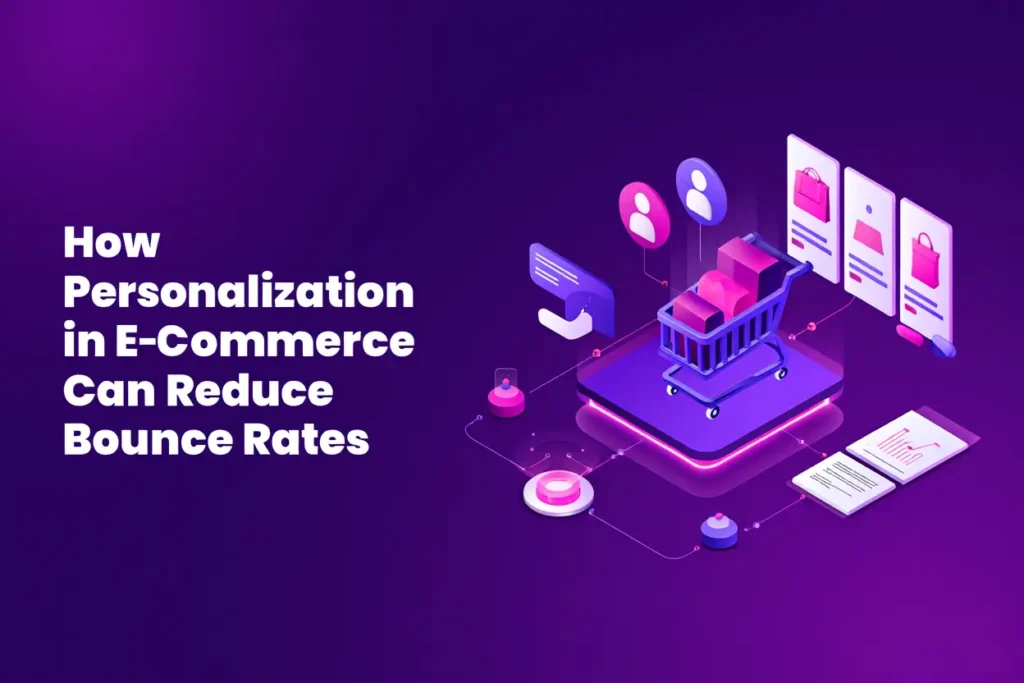
How eCommerce Personalization Can Reduce Bounce Rates in 2026

How Personalization in E-Commerce Can Reduce Bounce Rates

In 2026, eCommerce success is no longer driven just by traffic, it’s driven by relevance. You can bring thousands of users to your online store, but if your experience fails to connect with them in the first few seconds, they’ll leave without hesitation.

This is where eCommerce personalization becomes a growth lever, not just a UX enhancement.

Let’s break down what bounce rate really means today, why it’s rising for many eCommerce brands, and how modern, AI‑powered personalization can dramatically reduce bounce rates while improving conversions and customer lifetime value.

TL;DR

In 2026, high eCommerce bounce rates are less about traffic quality and more about lack of relevance. Users decide whether to stay or leave within milliseconds, and generic, one-size-fits-all experiences no longer work.

eCommerce personalization powered by AI and real-time behavioral data helps reduce bounce rates by showing users the right products, content, offers, and messages at the right moment. From personalized homepages and smart search results to dynamic product recommendations, exit-intent offers, and AI chat support, personalization keeps users engaged and moving toward conversion.

The more understood a visitor feels, the longer they stay and the more likely they are to convert. In short, personalization is no longer optional; it’s essential for sustainable eCommerce growth.

What Is Bounce Rate on an eCommerce Website?

Bounce rate on an eCommerce website refers to the percentage of visitors who leave after viewing only one page, without taking any meaningful action. A “meaningful action” typically includes:

  • Clicking to another page or category

  • Using on-site search

  • Viewing a product detail page

  • Adding a product to the cart or wishlist

  • Signing up, scrolling meaningfully, or engaging with content

In simple terms, bounce rate answers one critical question:
Did the visitor find enough value to continue their journey?

In 2026, this decision happens almost instantly. Multiple studies show that users form an impression of a website in under 100 milliseconds. If the page feels slow, irrelevant, confusing, or generic, users mentally reject it before consciously thinking about it.

It’s important to note that a bounce doesn’t always indicate poor traffic quality. Some users may find quick answers and leave. However, consistently high bounce rates in eCommerce almost always signal a mismatch between user expectations and the on-site experience.

This mismatch could be related to content relevance, product discovery, trust, performance, or personalization.

Why Do eCommerce Bounce Rates Increase in 2026?

User expectations in 2026 are no longer set by average online stores, they’re shaped by Amazon, Netflix, Google, Apple, and AI-first platforms. These brands have trained users to expect speed, relevance, personalization, and clarity by default.

When an eCommerce website fails to meet these expectations, visitors leave without hesitation.

Why Do eCommerce Bounce Rates Increase in 2026?

The Most Common Reasons Behind Increasing eCommerce Bounce Rates Include:

  • Generic, non-personalized landing pages that treat every visitor the same

  • Poor mobile experience, accessibility gaps, or inconsistent layouts across devices

  • Confusing UI/UX, cluttered pages, and cognitive overload

  • Irrelevant or static product recommendations

  • Intrusive pop-ups and aggressive ads that interrupt intent

  • Slow page load speeds, especially on mobile networks

  • Misleading headlines or ad-to-page mismatch

  • Lack of trust signals, such as reviews, ratings, return policies, and security badges

  • Broken links, errors, or technical friction

  • Weak, unclear, or poorly placed calls-to-action (CTAs)

At its core, the problem isn’t traffic or marketing spend.

➥ The real issue is that the website does not adapt to the user.

And in a world where users expect relevance instantly, non-adaptive experiences lose attention fast.

👉 You may also like to read: Latest Conversion Rate Optimization (CRO) Trends to Follow in 2026 & Beyond


The Solution: eCommerce Personalization

In 2026, the most effective way to reduce eCommerce bounce rates is through intelligent personalization. Instead of presenting the same experience to every visitor, eCommerce personalization adapts the website in real time to match each user’s intent, behavior, and context. By delivering relevant products, content, and messages at the right moment, personalization removes friction, increases engagement, and encourages users to continue their journey rather than exit.

What Is eCommerce Personalization?

eCommerce personalization is the practice of dynamically tailoring the shopping experience-including content, product recommendations, offers, layouts, and messaging based on individual user behavior and intent.

eCommerce Personalization leverages data such as:

  • Browsing behavior and on-site interactions

  • Purchase and transaction history

  • Search queries and product affinity

  • Device type, location, and time of visit

  • Demographics and lifecycle stage

  • Engagement patterns across sessions

In 2026, eCommerce personalization is no longer rule-based alone.

It is powered by:

  • AI and machine learning models

  • Real-time behavioral signals

  • Predictive intent analysis

  • Context-aware decision engines

This allows brands to respond instantly to what a user is most likely to want right now, not just what they did in the past.

When eCommerce personalization is done right:

  • Users feel understood rather than targeted

  • Navigation feels intuitive instead of overwhelming

  • Product discovery becomes effortless

  • Bounce rates drop naturally as engagement rises

In short, eCommerce personalization transforms eCommerce from a static catalog into a responsive experience one that keeps users engaged, reduces bounce rates, and accelerates conversions.

Key Benefits of eCommerce Personalization in Reducing Bounce Rate

Effective eCommerce personalization is no longer just a UX enhancement, it’s a measurable growth driver. When personalization is executed with intent and intelligence, it directly impacts how long users stay, how deeply they engage, and whether they convert.

Brands using advanced personalization consistently see:

  • Higher user engagement and longer session durations
  • Significantly lower bounce and exit rates
  • Improved conversion rates across devices
  • Increased average order value (AOV) through relevant upsells
  • Stronger brand trust and emotional loyalty
  • Higher customer lifetime value (CLV) driven by repeat purchases

The common thread?
Personalized experiences make users feel understood and understood users don’t bounce.

eCommerce Personalization Strategies to Reduce Bounce Rates

Let’s explore practical, high-impact eCommerce personalization strategies that eCommerce leaders are using in 2026 to reduce bounce rates and increase conversions.

1. Personalize the Homepage Experience

Your homepage is the first impression and primary decision point for most visitors.

In 2026, top-performing eCommerce brands no longer show a static homepage. Instead, they dynamically adapt the experience based on user context and intent.

Modern homepage personalization includes:

  • Serving different layouts and content to new vs returning users
  • Highlighting trending, best-selling, or seasonal products for first-time visitors
  • Resuming journeys for returning users by showing recently viewed, saved, or carted items
  • Adapting banners, CTAs, and messaging based on traffic source, campaign, or referral intent

For new visitors, clarity is critical. Clean navigation, strong value propositions, trust badges, and popular categories help users orient themselves quickly.
For returning users, continuity reduces friction. Familiar products, remembered preferences, and contextual recommendations encourage deeper exploration instead of exits.

Personalize the Homepage Experience

2. Recommend Categories and Products Based on Browsing History

Browsing behavior is one of the strongest intent signals in eCommerce personalization.

By analyzing what users view, hover over, scroll through, or interact with, brands can:

  • Display recently viewed or high-interest categories
  • Recommend similar or complementary products
  • Reduce cognitive load and product discovery friction

When users immediately see products aligned with their interests, the experience feels effortless not overwhelming. This relevance dramatically reduces frustration-driven bounces.

3. Personalize Search Results With AI-Driven Smart Search

On-site search users typically have high purchase intent, making search personalization one of the most effective bounce-rate reducers.

In 2026, AI-powered smart search includes:

  • Predictive autocomplete and intelligent query suggestions
  • Personalized search results based on past behavior and preferences
  • Visual and image-based product search
  • Natural language queries such as “black running shoes under $100”

A fast, accurate, and personalized search experience helps users find what they want instantly - keeping them engaged and moving toward conversion instead of exit.

4. Use Dynamic Content and Contextual Messaging

Every visitor arrives with a different motivation, mindset, and expectation.

Dynamic content personalization allows brands to:

  • Change banners, headlines, and CTAs in real time
  • Show category-specific or intent-based offers
  • Personalize messaging based on location, season, device, or lifecycle stage
  • Trigger incentives for new users, returning users, or loyal customers

For example, a discount aligned with the category a user is browsing feels helpful and relevant - while generic offers often feel intrusive and increase bounce.

Personalize Product Pages and Segment Users

5. Personalize Product Pages and Segment Users

Product pages are where buying decisions are made and where personalization has the highest ROI.

Effective product page personalization includes:

  • “Customers also bought” and “frequently bought together” recommendations
  • Intelligent cross-sell and upsell suggestions
  • Contextual social proof (reviews, ratings, popularity)
  • Dynamic offers or pricing for loyal or high-value customers

User segmentation further enhances relevance.

Common segments include:

  • New visitors
  • Returning browsers
  • First-time buyers
  • Repeat or high-value customers

Each segment can receive tailored messaging, product recommendations, and follow-up communication reducing bounce-back behavior and increasing purchase likelihood.

6. Use Personalized Exit-Intent Offers and Smart Triggers

Exit-intent personalization is your final opportunity to retain a user before they leave.

In 2026, effective exit-intent strategies are contextual and restrained, including:

  • Personalized discounts based on viewed products or categories
  • Cart or wishlist reminders
  • Lead capture offers aligned with user interest
  • Helpful messages instead of aggressive pop-ups

When timed correctly, exit-intent personalization can recover abandoning sessions. When overused, it increases bounce making relevance and timing critical.

Use Personalized Exit-Intent Offers and Smart Triggers

7. Offer Real-Time Assistance With Chatbots and Live Support

Conversational commerce is now a core part of eCommerce personalization.

AI-powered chatbots and live chat help by:

  • Answering product, delivery, and policy questions instantly
  • Guiding users through decision-making in real time
  • Recommending products conversationally
  • Reducing uncertainty and purchase hesitation

Personalized, real-time assistance builds trust and trust keeps users engaged longer, reducing bounce rates across the funnel.

Conclusion: Personalization Is the Foundation of Sustainable eCommerce Growth

High bounce rates are rarely random. They are clear behavioral signals.

Signals that visitors didn’t find what they were looking for fast enough, relevant enough, or intuitively enough.

In 2026, reducing bounce rates is no longer about driving more traffic, adding more pop-ups, or pushing deeper discounts. It’s about delivering relevance at every moment of the user journey. And that relevance is powered by eCommerce personalization.

To consistently reduce bounce rates and increase conversions, modern eCommerce brands must:

  • Understand user intent deeply using real-time behavioral and contextual data

  • Deliver personalized experiences across every touchpoint, from homepage to checkout

  • Leverage AI and machine learning responsibly to anticipate needs without overwhelming users

  • Build trust through transparency, accuracy, and relevance rather than aggressive tactics

When customers feel understood, they don’t rush to leave. When they stay longer, they explore more. And when the experience feels effortless and personal, conversions follow naturally.

But eCommerce personalization isn’t just about selling more products.

It’s about building long-term relationships, reducing friction, earning trust, and creating shopping experiences that customers genuinely want to return to again and again.

This is where having the right Conversion Rate Optimization (CRO) partner makes all the difference.

Tatvic is one of the leading CRO agencies helping eCommerce brands in 2026 reduce bounce rates, unlock higher conversion rates, and scale sustainably through data-driven experimentation, AI-powered personalization, and advanced analytics. With deep expertise across GA4, experimentation frameworks, and personalization engines, Tatvic helps brands turn user intent into measurable growth.

If you’re looking to reduce bounce rates, improve conversions, and build high-performing personalized eCommerce experiences: 👉 Connect with Tatvic’s CRO experts today and start turning relevance into revenue.

Beyond SEO: How GEO and AEO Are Rewriting the Rules of Search

Your SEO strategy is working.

Your traffic is growing.

And you’re still losing the search game.

Here’s why: People aren’t searching on Google alone anymore. They’re asking ChatGPT. They’re querying Perplexity. They’re getting answers from Claude, Gemini, and a dozen other AI engines.

And if your content isn’t optimized for those platforms, you’re invisible - no matter how well you rank.

Welcome to the era of GEO and AEO.

The Search Landscape Just Fractured And Most Brands Missed It

2020: 92% of searches happened on Google. You optimized for one algorithm. You ranked. You won.

2024: Search is fragmented across:

  • Traditional search engines (Google, Bing)
  • Generative AI platforms (ChatGPT, Perplexity, Claude)
  • AI-enhanced search (Google SGE, Bing Chat)
  • Social discovery (TikTok, Instagram, Reddit)

Each platform has different ranking logic. Different content formats. Different user intent.

SEO alone doesn’t cut it anymore.

SEO → GEO → AEO: What Actually Changed

SEO (Search Engine Optimization)

  • What it optimizes for: Rankings on traditional search engine results pages
  • How it works: Keywords, backlinks, technical structure, page speed, mobile optimization
  • User behavior: Clicks through 10 blue links, evaluates options, chooses
  • Your goal: Rank #1 for target keywords

GEO (Generative Engine Optimization)

  • What it optimizes for: Being cited in AI-generated summaries and responses
  • How it works: Authoritative source signals, structured data, contextual relevance, citation-worthy content
  • User behavior: Reads AI-generated summary, rarely clicks through
  • Your goal: Be the source AI engines quote

AEO (Answer Engine Optimization)

  • What it optimizes for: Direct answers in conversational AI platforms (ChatGPT, Claude, Perplexity)
  • How it works: Conversational query matching, expertise signals, up-to-date information, multi-turn dialogue relevance
  • User behavior: Asks follow-up questions, expects nuanced answers
  • Your goal: Be the knowledge base AI assistants reference

The shift: From “rank to get clicks” to “get cited to build authority.”

Why This Matters Right Now

The Traffic Paradox

You might still see traffic growth from traditional SEO. But look closer:
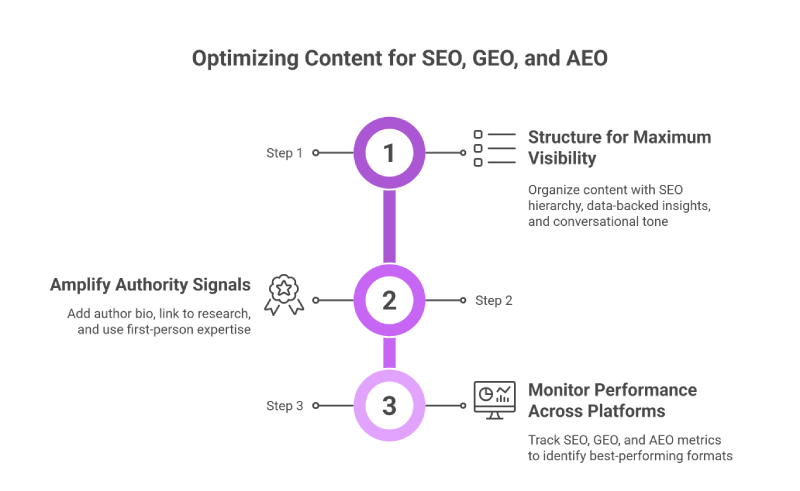
  • Click-through rates are dropping - AI summaries answer queries without clicks
  • Brand recall is declining - Users remember the AI answer, not the source
  • Attribution is breaking - Traffic comes from “AI referral” with no keyword data

Translation: You’re creating content AI engines consume, but you’re not getting credit.

The Authority Gap

When ChatGPT answers “What’s the best project management tool for remote teams?” it synthesizes information from multiple sources.

If your brand isn’t one of those sources, you don’t exist in that conversation.

Even if you rank #1 on Google for that exact keyword.

How Insight-to-Creative Automation Optimizes for GEO and AEO

Traditional SEO tools weren’t built for this shift. They optimize for Google’s algorithm, not AI engines’ citation logic.

Insight-to-Creative Automation adapts content strategy for all three paradigms simultaneously.

Step 1: Multi-Platform Query Analysis

The system identifies how the same user intent manifests across platforms:

1. Traditional Search (SEO):

  • “project management software for remote teams”
  • “best remote team collaboration tools 2024”

2. Generative Search (GEO):

  • “Compare project management tools for distributed teams”
  • “What features matter most for remote project management?”

3. Conversational AI (AEO):

  • “We’re a 50-person remote team switching from Asana. What should we consider?”
  • “Help me evaluate project management tools based on our specific workflow”

Why this matters: Same intent, different phrasing, different content requirements.

Step 2: Content Format Optimization

The system recommends content structures based on platform:

1. For SEO: Keyword-optimized landing pages, structured data markup, traditional blog posts

2. For GEO: Citation-worthy comparison tables, data-backed claims with sources, expertise signals (author bios, credentials)

3. For AEO: Conversational FAQs, nuanced opinion pieces, multi-perspective analysis, scenario-based guidance

One topic → Three content formats → Maximum visibility across platforms

Step 3: Authority Signal Amplification

AI engines prioritize sources with strong authority signals:

  • Expert author credentials
  • Original research and data
  • Multi-source corroboration
  • Recency and update frequency
  • Structured, parse-able content

The system identifies which authority signals your content lacks and recommends enhancements.

Real Example: SaaS Brand Optimizes for All Three Paradigms

The Challenge: A cybersecurity SaaS company ranked well for “endpoint security solutions” (SEO) but wasn’t appearing in ChatGPT or Perplexity responses about choosing security tools.

The Traditional SEO Content:

  • Product feature pages
  • “Top 10” listicles
  • Keyword-stuffed blog posts

What Insight-to-Creative Automation Recommended:

For GEO (Generative Citation):

Created “The 2024 Endpoint Security Buyer’s Guide” with:

  • Comparison matrix (structured data)
  • Industry benchmark data (original research)
  • Expert commentary from named security architects
  • Clear sourcing and citations

Result: Cited in Google SGE summaries 340% more than previous content

For AEO (Conversational Relevance):

Published “Choosing Endpoint Security: A Decision Framework” addressing:

  • Specific scenarios (“We have 500 remote employees…”)
  • Trade-off analysis (“If budget is limited, prioritize X over Y”)
  • Implementation guidance (“Here’s what to evaluate during proof-of-concept”)

Result: Referenced in ChatGPT responses 8x more frequently

For SEO (Traditional Ranking):

Maintained existing keyword-optimized pages but enhanced with:

  • Structured FAQ schema
  • Author expertise markup
  • Regular content updates

Result: Maintained #1-3 rankings while improving other channels

Combined Impact:

  • 280% increase in “brand mention” across AI platforms
  • 45% increase in qualified demo requests (attributed to “AI referral”)
  • Positioned as category authority in AI-mediated research

Step-by-Step: Optimizing One Piece of Content for All Three

Let’s say you’re creating content around “employee onboarding best practices.”

Before any content is written, the first step is understanding how the same intent shows up across discovery platforms.
Search engines surface keyword-driven queries, generative engines look for comparative and explanatory prompts, and conversational AI reflects real-world, situation-specific questions. This intent mapping ensures you’re solving the same problem - but in the language each platform understands.

Step 1: Structure Content for Maximum Visibility

SEO Layer:

  • Clear H1/H2 hierarchy with target keywords
  • Meta descriptions optimized for click-through
  • Internal linking to related resources

GEO Layer:

  • Lead with data-backed insight: “Companies with structured onboarding see 50% higher retention”
  • Include comparison tables, statistics, expert quotes
  • Add structured data markup for key facts

AEO Layer:

  • Write in conversational, advice-giving tone
  • Address specific scenarios and edge cases
  • Include “if/then” guidance and decision frameworks
  • End sections with “What this means for you” summaries

Step 2: Amplify Authority Signals

AI engines don’t just evaluate what you say - they evaluate who is saying it and why it should be trusted.

  • Add author bio with relevant credentials
  • Link to original research or proprietary data
  • Include publication date and “last updated” timestamp
  • Cross-reference credible external sources
  • Use first-person expertise (“In our work with 200+ companies…”)

Step 3: Monitor Performance Across Platforms

Success is no longer measured in rankings alone.

  • SEO metrics: Rankings, organic traffic, CTR
  • GEO metrics: Citations in AI summaries, brand mentions in generative results
  • AEO metrics: References in ChatGPT/Claude/Perplexity responses (manual audit), “AI referral” traffic

The system tracks all three, showing which content formats perform best on which platforms.

What Early Adopters Are Seeing

B2B SaaS:

  • 340% increase in AI engine citations
  • 67% increase in “AI referral” attributed demos
  • 5.2x improvement in brand recall in buyer research conversations

E-commerce:

  • 420% increase in product mentions in shopping-related AI queries
  • 89% increase in “voice search” and AI assistant-driven purchases
  • 3.1x improvement in brand consideration during AI-mediated research

Professional Services:

  • 560% increase in expertise-based citations across AI platforms
  • 78% increase in qualified inbound leads from conversational AI referrals
  • 4.7x improvement in “top of mind” awareness in buyer interviews

The Competitive Moat This Creates

Most brands are still playing the old game-optimizing for Google while ignoring where their audience is actually searching.

When you optimize for GEO and AEO:

  • You get cited when competitors get ignored
  • You build authority in AI-mediated research
  • You capture demand in conversational discovery
  • You future-proof against further search fragmentation

This isn’t about abandoning SEO. It’s about expanding beyond it.

What’s Next: Real-Time Trend Hijacking

You now understand how to optimize content for traditional search, generative engines, and conversational AI.

But what about speed? How do you identify which trends to optimize for before they saturate?

In our next piece, we’ll show you how to surface cultural moments in real-time and align them with audience personas and intent signals-turning viral opportunities into campaigns that launch before your competitors even notice the trend.

Because being discoverable matters. Being discoverable first wins.

Ready to see how your content performs across SEO, GEO, and AEO? Connect with Tatvic’s team to audit your search visibility across all three paradigms.

The search game changed. Are you still playing by the old rules?

Bot Icon
Bot Icon

Tatvic Bot

Explore About Tatvic and Services