Hello There!

Lorem ipsum dolor sit amet, consectetur adipiscing elit,

Agentic AI vs Generative AI in 2025: Definitions, Use Cases and Key Differences

Agentic AI vs Generative AI in 2025: Definitions, Use Cases and Key Differences

In 2025, choosing between Agentic AI vs Generative AI isn’t just about capabilities, it’s a strategic decision that defines how businesses execute. While Generative AI excels at crafting content based on prompts, Agentic AI acts autonomously across systems to drive outcomes. Together, they offer a powerful combination: creativity plus execution.

As per Statista, the generative AI market is expected to grow to $62.72 billion by 2025, and the Agentic AI market (i.e., AI or machine learning that operate without human intervention) is expected to grow to $196.6 billion by 2034 at a stunning 43.8% compound annual growth rate.

This blog explores how these two powerful technologies differ, where they shine and how enterprises are now combining them to drive both creativity and execution at scale.

Agentic AI vs Generative AI (TL;DR)

Agentic AI is designed to autonomously plan, execute and adapt multi-step tasks using reasoning, memory and tool orchestration often without human intervention. It acts like a digital agent, capable of making decisions and taking action to achieve defined goals. In contrast, Generative AI focuses on producing original content such as text, images, audio or code based on user prompts.

While Generative AI supports creativity, content generation, and ideation, Agentic AI powers workflow automation, decision-making, and real-time business execution. In 2025, businesses are increasingly combining both: using Generative AI for content and Agentic AI for action.

This article answers key questions like:

  • What is the difference between Agentic AI and Generative AI in 2025?
  • Agentic AI vs Generative AI: Features & Trends in 2025
  • Agentic AI vs Generative AI: Know What Works Best & When?

What is Generative AI (GenAI) in 2025?

Generative AI (GenAI) refers to a class of artificial intelligence models designed to generate original content based on input prompts. It can produce text, images, audio, video, and code, making it one of the most widely adopted AI technologies in 2025. Unlike traditional automation tools, Generative AI uses deep learning and large language models (LLMs) to mimic human-like creativity, enabling rapid content creation across industries.

In contrast to Agentic AI, which focuses on autonomous decision-making and task execution, Generative AI is primarily used for creative assistance, content generation, and ideation workflows.

Popular Generative AI Tools (as of 2025)

The GenAI ecosystem has matured significantly, and several tools now dominate specific creative domains:

Domain

Leading Tools (2025)

Text & Reasoning ChatGPT-5, Gemini Ultra, Claude 3.5, Mistral Medium
Visual Generation Midjourney V6, Adobe Firefly 2, Ideogram, Leonardo AI
Audio & Voice Suno AI, Udio, ElevenLabs, Resemble AI
Code & DevOps GitHub Copilot X, Amazon Code Whisperer, Tabnine

These tools are being integrated into enterprise workflows, customer support, product design, and even legal document drafting at scale.

How Generative AI Works?

Generative AI is powered by transformer-based deep learning architectures, trained on large and diverse datasets. These models learn statistical patterns and relationships in data to predict and generate new content based on user input. In 2025, many GenAI systems are multimodal, meaning they can process and generate across multiple media types text, image, audio, and video simultaneously.

For Example: ChatGPT-5 can now analyze an uploaded image, generate a caption, write a blog based on it, and convert the blog into a narrated podcast all within a unified workflow.

Common Use Cases of Generative AI in 2025

Generative AI is helping companies and creators accelerate content production and innovation.

Some of the most impactful use cases of Generative AI include:

  • Marketing & Content: Drafting blogs, social media posts, ad copies, and email campaigns
  • Design & Branding: Creating visual concepts, product mockups, and personalized creatives
  • Software Development: Generating, reviewing, and optimizing code blocks or documentation
  • Customer Support: Powering AI chatbots, auto-replies, and response synthesis
  • Learning & Research: Summarizing academic papers, generating study materials, and transcribing interviews

Generative AI in 2025 is no longer just about clever text generation. It’s a foundational capability across industries, enabling scale, speed, and personalization in every content-related function. As enterprises begin combining Agentic AI and Generative AI, they’re unlocking entirely new workflows from content ideation to campaign execution, all powered by intelligent automation.

What is Agentic AI in 2025?

Agentic AI represents the next frontier in artificial intelligence systems designed not just to respond to prompts, but to autonomously plan, reason, execute and adapt based on defined goals. Unlike Generative AI, which primarily creates content, Agentic AI takes action, often across multi-step workflows, without requiring ongoing human input.

In 2025, Agentic AI is gaining widespread adoption across marketing automation, finance, cybersecurity, customer operations and supply chain optimization, as enterprises look beyond content creation toward AI-driven execution and decision-making.

Definition (Tatvic 2025): “Agentic AI is an intelligent, autonomous system that can set sub-goals, make context-aware decisions, and execute complex tasks by orchestrating tools, APIs and even other AI models without continuous human intervention.”

Where Generative AI stops at generating content, Agentic AI starts there and finishes the job often coordinating between multiple tools, datasets, and platforms to achieve results.

Modern Architecture of Agentic AI (2025)

Agentic systems are typically composed of multiple coordinated layers that mimic executive-level reasoning and action-taking capabilities.

Below is the core framework observed in most 2025-ready Agentic AI stacks:

Layer

Role & Description

Core Model A large foundational model (e.g., GPT-5, Claude 3.5) used for reasoning and dialogue
Policy Layer Determines what actions to take based on the current state and goal
Memory & Feedback Stores contextual and episodic memory to learn from past tasks and iterate smarter
Execution Layer Uses APIs, browser tools, CRM platforms, or spreadsheets to complete real-world tasks
Monitoring & Reasoning Continuously evaluates output quality, detects failures, and self-corrects

These components work together to allow Agentic AI to function like a digital team member not just offering suggestions, but completing tasks from start to finish.

Real-World Examples of Agentic AI (2025)

Agentic AI is already operational in many cutting-edge business environments.

Here are prominent use cases of Agentic AI live today:

  • Agentic Marketing Assistants:

    Agentic AI solution autonomously manages full-funnel campaigns planning strategy, generating creatives via GenAI, setting up ads, A/B testing, optimizing bids, and reporting performance.

  • Ad Optimization Bots (PMax):

    Agentic AI agents that dynamically manage Google Performance Max campaigns, reallocating budgets and testing creatives in real-time based on live performance data.

  • Security Operations Agents:

    Used in enterprise SOCs (Security Operations Centers) to detect, triage, and respond to threats-reducing time-to-remediation by over 70% without human intervention.

  • Customer Operations Agents:

    Handling incoming support tickets, retrieving data from internal systems, generating personalized replies (via GenAI), and escalating only when necessary

Features of Agentic AI and Generative AI

Understanding the key features of both Agentic AI and Generative AI is crucial for making informed decisions about where and how to apply each in business and technology. While they share a common foundation in advanced machine learning and large language models, their capabilities, design goals, and operational functions are significantly different.

Let’s explore how these two powerful technologies compare in terms of core functionality, intelligence, and real-world usability as of 2025.

Key Features of Generative AI (GenAI)

Generative AI excels at producing original content whether that’s long-form copy, visual designs, code snippets, or audio. Its features are tailored to scale creativity and ideation workflows across marketing, design, education, software, and more.

Feature

Description

Prompt-Based Content Generation Produces coherent text, code, visuals, or audio from a user-defined input
Multimodal Capabilities Supports text, image, video, audio, and code generation via unified models
Pattern Recognition at Scale Trained on vast datasets to mimic human language, style, and logic
Reactive Interaction Responds to instructions or prompts; does not act autonomously
Assistive & Creative Intelligence Ideal for content brainstorming, storyboarding, and speeding up ideation
Low Memory Dependency Typically limited context window or stateless across tasks
Best For Content creators, marketers, educators, developers, and designers

Example Use Cases of GenAI (2025):

  • Writing SEO-optimized blogs and ads in seconds
  • Auto-generating UI/UX design ideas
  • Creating brand voice-aligned social content at scale
  • Summarizing large PDFs, contracts, or research docs

Key Features of Agentic AI

Agentic AI is built for goal-directed behavior it can independently plan, execute, and improve multi-step processes using reasoning, memory, and tool integration. Unlike GenAI, which creates content, Agentic AI gets things done.

Feature

Description

Autonomous Goal Execution Operates with minimal human oversight to complete complex tasks
Task Planning & Self-Initiation Breaks large goals into subtasks and executes them in logical order
Memory & Learning Loops Remembers past actions, adjusts strategy based on results
Multi-Tool Orchestration Connects with APIs, databases, CRMs, ad platforms, etc.
Reasoning Engine Makes decisions based on logic, outcomes, and predefined policies
Human-in-the-Loop Optionality Can operate independently or with optional human approvals
Best For Enterprises needing execution-focused automation (marketing, ops, finance)

Example Use Cases of Agentic AI (2025):

  • End-to-end ad campaign automation (from setup to performance tuning)
  • Complete SEO Automation
  • Revenue operations: budget allocation, spend optimization, alert systems
  • AI-powered project managers or executive assistants
  • Cybersecurity agents monitoring and responding to threats autonomously

Agentic AI vs Generative AI: Key Differences

In 2025, Agentic AI and Generative AI represent two powerful but fundamentally different branches of artificial intelligence. While both are built on advanced machine learning architectures like large language models (LLMs), their purpose, outputs and strategic applications vary significantly.

  • Generative AI specializes in creating content like text, images, audio or code based on prompts.
  • Agentic AI is engineered for autonomous goal execution planning, acting and adapting to complete multi-step business tasks with minimal human input.

For business leaders, marketers and technology teams, understanding these differences is critical.

It helps answer a central question:

When should you use AI for creativity and ideation, and when should you deploy it for autonomous execution and results?

Agentic AI vs Generative AI: Key Functional & Strategic Differences (2025)

Feature

Generative AI

Agentic AI

Core Function Generates original content such as text, images, audio, and code Executes tasks, solves problems, and drives outcomes toward defined goals
Input Type Prompt-based input from a human user Goal/task-based input (can be user-defined or self-generated)
Primary Output Creative assets (e.g., blog posts, designs, scripts, ads) Executed workflows, decisions, action logs and measurable business results
Autonomy Level Reactive; relies on human prompting and direction Proactive; plans and acts autonomously with optional human-in-the-loop
Tool Orchestration Limited to content generation within a single model Deep integration with APIs, databases, CRMs, marketing platforms and more
Memory & Adaptation Minimal or stateless; limited memory context across prompts Persistent memory; learns from past executions and adapts in real-time
Optimization Ability Cannot self-optimize workflows or iterate on goals Uses feedback loops and evaluation layers to optimize outputs autonomously
Scalability Scales content creation and ideation Scales execution, decision-making, and operational efficiency
Example Use Case Write an email newsletter draft End-to-end campaign setup: write email, segment audience, schedule, track ROI
Business Impact Increases productivity and creativity for individuals and teams Drives efficiency, ROI, and performance by automating complex business logic

Real-World Analogy:

  • Generative AI is like your creative assistant: it helps you think, write, design, or code faster.
  • Agentic AI is your autonomous project manager: it understands objectives, builds a plan, executes across tools, and reports back.

Strategic Insight (2025):

In 2025, the shift from Generative AI to Agentic AI is not about replacement, it’s about graduating from creativity to capability. Smart enterprises are embedding Generative AI into Agentic AI pipelines, enabling systems that don’t just write the brief, they launch, test and optimize the entire campaign.

Agentic AI vs Generative AI: Technical Foundations

Beneath the surface of what these AI systems can do lies the critical question of how they work. In 2025, the technical architectures of Agentic AI and Generative AI differ not just in complexity, but in intention.

Generative AI systems are designed to generate content from context. Agentic AI systems are built to think, plan, act, and adapt across environments. Let’s explore the foundational building blocks of each.

Technical Foundations of Generative AI (2025)

Generative AI is powered by transformer-based models a breakthrough deep learning architecture introduced by Google in 2017. These models process massive volumes of data to predict the most probable next word, image pixel, or sound frame based on previous inputs.

Key Technical Components:

  • Architecture: Transformer neural networks with attention mechanisms
  • Training Paradigm: Self-supervised learning on massive datasets (e.g., RedPajama, Common Crawl, Books3, StackOverflow, GitHub, and legal/medical corpora)
  • Token-Based Prediction: Generates output by predicting the next token in a sequence
  • Multimodality: Newer models like GPT-5, Claude 3.5, and Gemini Ultra can process and produce text, images, code, video, and audio-all in one model
  • Deployment Formats: Available as APIs (e.g., OpenAI, Anthropic), chat interfaces (e.g., ChatGPT), or embedded in enterprise software (e.g., Microsoft 365 Copilot)

Generative AI’s strength lies in its ability to generate creative, coherent, and contextually relevant content at scale, making it ideal for tasks such as copywriting, prototyping, and documentation.

Technical Foundations of Agentic AI (2025)

Agentic AI systems are fundamentally more complex and layered than Generative AI. Rather than focusing on content output, they are engineered to pursue goals, make decisions, and execute across tools and systems often embedding Generative AI modules for content as part of broader workflows.

Core Technical Characteristics:

  • Architecture: Multi-layered design that includes a base LLM, memory layer, planning/policy modules, tool interface, and monitoring loop
  • Memory & State Management: Stores state across tasks, tracks history, and applies reasoning over time (episodic and semantic memory)
  • Goal-Based Planning: Uses structured goal hierarchies and subtask decomposition engines (e.g., PDDL, task trees, graph planners)
  • Tool & API Orchestration: Interfaces with real-world software (e.g., CRMs, ad platforms, analytics dashboards) via APIs and agents
  • Feedback Loops: Evaluates outcomes, retries if failed, escalates when needed-like a human manager
  • Embedded Generative Modules: Uses GenAI internally for writing emails, generating reports, summarizing results, etc.
  • Emerging Frameworks:

      • AutoGen (Microsoft Research) - for multi-agent planning
      • LangGraph - memory-aware agent orchestration
      • CrewAI - collaborative agents with role-based task delegation

Agentic AI vs Generative AI: Architectural Comparison

Aspect

Generative AI

Agentic AI

Purpose Content generation Autonomous task planning and execution
Architecture Transformer LLMs Multi-layered: LLM + planning + memory + tool use + reasoning
Data Flow Prompt → Prediction → Output Goal → Planning → Tool Use → Action → Evaluation
Memory Handling Context window only (stateless) Stateful with persistent memory and feedback
Tool Integration Rare (some tools simulate this within the LLM) Native API-level tool execution
Typical Use Case Drafting a blog Planning, writing, publishing, and promoting the blog end-to-end
Technical Skill Required Moderate (prompt engineering) Advanced (multi-agent system design, tool orchestration, security)

Key Insight for 2025:

Generative AI creates content.
Agentic AI creates outcomes.

For businesses that want to go beyond ideation and into intelligent automation, understanding this architectural difference is key to scaling impact.

2025 Real-World Use Cases of Agentic AI vs Generative AI

As AI adoption matures in 2025, enterprises are no longer experimenting-they’re scaling. While Generative AI is driving creativity and productivity, Agentic AI is powering execution, automation, and decision-making across critical business functions.

Here’s a breakdown of how leading organizations are deploying each type of AI across sectors highlighting not just what the technology can do, but what it’s actually doing right now.

Generative AI Use Cases (2025)

1. UI/UX Design Automation

Design teams now rely on tools like Figma AI, Uizard, and Midjourney V6 to auto-generate wireframes, mockups, and visual components-dramatically reducing time from concept to prototype.

2. HR & Recruitment

HR departments use platforms powered by Claude 3.5 and ChatGPT-5 to auto-generate job descriptions, candidate screening summaries, and even personalized performance reviews saving time and enhancing fairness.

3. Content Production at Scale

Content agencies and in-house teams use Notion AI, Copy.ai, and Jasper to generate SEO blogs, LinkedIn posts, email campaigns, and ad copy-reducing turnaround times by over 60%.

4. Legal & Research

Legal firms leverage GenAI tools like Harvey AI and Lexis+ AI to summarize contracts, extract clauses, and draft legal opinions streamlining billable hours without compromising accuracy.

5. Customer Engagement

Chatbots and email tools enhanced with GenAI deliver hyper-personalized communication across channels tailored based on customer behavior, preferences, and previous touchpoints.

Agentic AI Use Cases (2025)

1. Marketing Automation & Campaign Execution

Agentic AI for Marketing manages ad operations across platforms like Google Ads, Meta, and LinkedIn. It doesn’t just create campaigns, it autonomously:

  • Sets up A/B tests
  • Optimizes budgets across channels
  • Iterates creative using GenAI
  • Tracks conversions
  • Generates performance reports
👉  Transform Your Marketing With Tatvic’s Agentic AI Services


2. Finance & Budgeting

Finance teams use Agentic AI agents to monitor spend, flag anomalies, and autonomously reallocate budgets based on ROI and forecasts. These agents integrate directly with ERP systems like SAP, Oracle Fusion, and Zoho Books.

3. Customer Success & Support Automation

Agentic agents autonomously handle tier-1 support queries via CRM integrations, access knowledge bases to resolve issues, and escalate edge cases only when human input is necessary-reducing average ticket resolution time by 45%.

4. Cybersecurity Threat Response

Security Operations Centers (SOCs) now deploy agentic systems to detect, triage, and even remediate live cyber threats often without human intervention. These systems analyze logs, apply patches, and update firewalls in real time.

5. Operations & Workflow Orchestration

Enterprises use Agentic AI to manage supply chain triggers, automate internal workflows (like invoice approvals or SLA escalations), and ensure cross-tool coordination between platforms like Slack, Jira, HubSpot and Salesforce.

The Agentic + Generative Synergy

In 2025, the conversation isn’t Agentic AI vs Generative AI, it’s Agentic AI with Generative AI.

These two AI paradigms aren’t competitors. They’re collaborators.

While Generative AI focuses on content creation and creativity, Agentic AI is engineered for decision-making, execution, and process management. Together, they form a powerful, full-stack intelligence system capable of both ideation and action.

How They Work Together: A Real-World Example

Let’s walk through a typical business task: launching an email marketing campaign.

Step 1: Task Initiation (Agentic AI)

An Agentic AI system receives a high-level objective:
“Launch an email campaign to promote the new product line to existing customers.”

Step 2: Content Generation (Generative AI)

The Agentic AI delegates the creative components to embedded Generative AI modules, which:

  • Craft multiple subject line variants for A/B testing
  • Write email body copy tailored to audience segments
  • Generate CTA options, formatting suggestions, and even visuals if needed

Step 3: Execution & Optimization (Agentic AI)

Once the content is ready, Agentic AI:

  • Schedules and deploys the campaign via integrated CRM tools (e.g., HubSpot, Salesforce, Mailchimp)
  • Monitors performance metrics in real-time (opens, CTRs, conversions)
  • Iterates on content, timing, and segmentation rules using performance feedback
  • Escalates insights to marketers or autonomously pauses underperforming variants

Result:

What once took a full team several days now happens in minutes with consistent learning, optimization and scale.

Why This Agentic + Generative Synergy Matters in 2025

In 2025, organizations are no longer satisfied with fragmented AI tools that either generate content or automate tasks in isolation. What modern enterprises truly need are integrated AI ecosystems systems that can think strategically, create intelligently, execute autonomously and adapt dynamically.

The synergy between Agentic AI and Generative AI delivers exactly that.

By combining the creative intelligence of Generative AI with the goal-oriented autonomy of Agentic AI, businesses unlock:

  • Faster decision-to-execution cycles
  • Massive reductions in manual intervention
  • Real-time adaptability across functions

This hybrid approach forms the technological backbone of:

  • Autonomous marketing systems that ideate, test, and scale campaigns without human bottlenecks
  • Smart sales enablement tools that craft proposals, trigger workflows, and follow up automatically
  • Intelligent business operations that monitor KPIs, predict bottlenecks, and course-correct in real time

In short, the Agentic + Generative fusion enables enterprises to shift from AI-enhanced productivity to AI-led performance and decision-making a game-changer in today’s hyper-competitive, data-driven landscape.

Agentic AI vs Generative AI: Know What Works Best & When (2025)

Choosing between Agentic AI and Generative AI isn’t about which one is “better”, it’s about matching the right intelligence to the right objective.

While Generative AI excels at producing content, ideas, and creative assets based on prompts, Agentic AI thrives when there’s a business goal to be achieved through a sequence of decisions, actions, and iterations.

Use this 2025-ready guide to decide which AI paradigm fits your needs:

Situation

Go for Generative AI

Go for Agentic AI

You need creative content ✅ Ideal for generating blogs, ad copy, visuals, and code ❌ Not its primary function
You want to automate execution ❌ Requires human direction and input ✅ Perfect for automating multi-step tasks across platforms
You aim to save time on repetitive tasks ⚠️ Limited (needs prompting each time) ✅ Continuously operates based on logic and goals
Task requires human-like reasoning & memory ❌ Lacks persistent memory or deep reasoning ✅ Maintains memory and adapts based on prior outcomes
Process includes multiple tools or systems ❌ Can generate content, but doesn’t interact with tools ✅ Orchestrates tools, APIs, and platforms autonomously
You need fast drafts or ideation support ✅ Great for brainstorming, writing, and asset generation ❌ Overkill for simple one-off content tasks
Task must be reviewed before execution ✅ Keeps humans in control ⚠️ Optional human-in-the-loop (depending on risk/criticality)
You want outcomes, not just ideas ❌ Produces suggestions but can’t act on them ✅ Delivers measurable, end-to-end outcomes

Agentic AI vs Generative AI: Trends in 2025

As we move deeper into the AI-driven era, 2025 marks a major inflection point. Businesses are no longer just adopting AI, they’re strategically scaling it. Both Agentic AI and Generative AI are evolving rapidly, each carving out distinct roles across industries.

Below are the most important trends shaping each technology in 2025.

Generative AI Trends in 2025

1. Deep Integration Into Enterprise Software

Generative AI is now a standard feature in productivity platforms like Microsoft 365 (via Copilot), Google Workspace, and Adobe Creative Cloud-helping teams write documents, generate designs, and ideate faster without switching tools.

2. Shift Toward Enterprise-Grade Customization

Businesses demand more than general-purpose GenAI. In 2025, there’s a massive push for domain-specific LLMs-custom-tuned models that understand verticals like healthcare, law, finance, and retail.

3. Focus on Accuracy and Trustworthiness

With increased reliance on AI-generated content, hallucination reduction is a key priority. Companies now require models that provide source-grounded answers, citations, and compliance-aware outputs.

4. Rise of Multimodal Content Creation

GenAI tools like Gemini Ultra and Claude 3.5 are capable of producing cross-modal assets-a single prompt can generate an entire campaign pack: blog, image, social post, and voiceover-ready script.

5. On-Device and Private GenAI

Thanks to new edge computing breakthroughs, organizations are deploying GenAI models locally or within private clouds, reducing latency and increasing data control.

Agentic AI Trends in 2025

1. Rapid Adoption for Workflow Automation

More enterprises are deploying Agentic AI for goal-driven automation across departments marketing, IT, customer service, finance, and operations. Agentic systems are managing everything from ad campaigns to ticket routing autonomously.

2. Emergence of Full-Stack Agentic Platforms

Platforms like CrewAI, AutoGen, and LangGraph are gaining traction by offering end-to-end agent design frameworks-equipping developers to build complex AI workflows without starting from scratch.

3. Agent Swarms & Multi-Agent Ecosystems

Organizations are embracing multi-agent systems, where multiple agents collaborate like digital teams. For example: one agent handles email campaigns, another manages reporting, and a third adjusts spend based on performance-all without human prompting.

4. Built-in Guardrails & Ethical Reasoning Layers

Due to the autonomy of Agentic AI, new frameworks now include policy engines, audit logs, and ethical reasoning protocols to ensure agents don’t overstep boundaries or violate business rules.

5. Expansion Beyond Tech & Marketing

Agentic AI is no longer just for digital-first teams. It’s now powering public sector governance, healthcare triaging, supply chain optimizations, and climate simulations, showcasing its potential in mission-critical environments.

In 2025, the smart move isn’t choosing between them, it’s building AI ecosystems that leverage Generative AI for creativity and Agentic AI for execution.

Governance & Ethical Challenges

With great autonomy comes great responsibility. As AI agents take on high-stakes decisions, organizations face complex governance issues:

1. Accountability & Liability

Who’s at fault when an AI agent makes a wrong call? Businesses must define clear chain-of-responsibility frameworks to assign human oversight for agent decisions-especially in regulated industries.

2. Explainability & Transparency

Agentic systems often make decisions through a combination of logic, feedback loops, and generative modules.

This “black box” behavior creates a challenge:

  • Can stakeholders audit the decision path?
  • Are agents making ethically sound choices?

Solution: Emerging standards like AI auditing APIs, decision logs, and explainability layers are being implemented to ensure transparency.

3. Security & Robustness

As agents gain API access and execute actions independently, they also become prime targets for adversarial attacks. Security practices now include:

  • Input validation and role-based access control
  • Red teaming of agents for stress-testing behaviors
  • Real-time agent activity monitoring dashboards

Final Thoughts: Choosing the Right Intelligence for the Right Outcome

As we reach a pivotal point in AI evolution, it’s clear that Agentic AI isn’t just a trend, it’s a strategic transformation layer. While Generative AI unlocked creative scale, Agentic AI is unlocking operational intelligence by autonomously executing complex, goal-driven tasks.

In 2025, understanding the difference between Agentic AI and Generative AI is no longer optional, it’s mission-critical for decision-makers across marketing, operations, product, and IT. CMOs, CTOs, and digital leaders are rethinking their AI stacks not based on hype, but on real-world value delivery.

  • Use Generative AI when you need scalable ideation, content production and creative assistance.
  • Use Agentic AI when the goal is autonomous execution, system orchestration and intelligent outcomes.
  • Use both to build a full-spectrum AI strategy that spans from prompt to performance.

The most forward-thinking brands aren’t choosing one over the other. They’re blending Generative creativity with Agentic action to scale growth, improve margins, and make smarter decisions faster.

If 2023 was about experimenting with AI, 2025 is about deploying it with purpose, precision and performance.
IF you want Customized Agentic AI Services in Marketing for your Business
👉 Book a Free Call with our Agentic AI Experts

How AI Is Reshaping Marketing in 2025: Trends, Tools & Tactics

How AI Is Reshaping Marketing in 2025 Trends, Tools & Tactics - Tatvic

The year is 2025, and AI in marketing has evolved from a buzzword to a business imperative. What was once experimental is now foundational.

From hyper-personalized customer journeys and predictive analytics to autonomous media buying, AI-generated content, and agentic AI systems that run full campaigns, artificial intelligence isn’t just assisting marketers anymore; it’s co-piloting the entire strategy.

We’ve officially entered a new era where AI is not just enhancing marketing, it’s orchestrating it.

Gone are the days when AI was siloed to ad optimization or basic automation.

In 2025, AI sits at the core of strategic decision-making, enabling brands to anticipate user intent, generate content at scale, personalize interactions in real-time, and optimize ROI across every touchpoint.

The rise of Agentic AI, capable of autonomous actions with minimal human intervention, is accelerating this shift giving brands an unprecedented edge in efficiency, accuracy, and growth velocity.

This comprehensive guide will dive deep into the top AI marketing trends shaping our present, explore the must-have tools powering this revolution, and reveal the winning tactics that define success in this AI-first era.

We’ll ensure your brand is equipped not just to adapt, but to genuinely pioneer the next wave of digital marketing, ensuring it stands out, scales effectively, and thrives all while adhering to Google’s rigorous E-E-A-T standards for Experience, Expertise, Authoritativeness, and Trustworthiness.

Get ready to truly lead the charge??

AI in Marketing Era of 2025

Artificial Intelligence has evolved beyond simple automation. In 2025, it’s about agentic AI, marketing systems that operate with autonomy, optimize decision-making and adapt dynamically in real-time.

This means AI isn’t just following rules; it’s learning, predicting, and even initiating actions based on complex data analysis.

The paradigm of using AI in marketing has shifted from a novel approach to a fundamental necessity. The business impact is undeniable.

According to joint research from Deloitte and McKinsey, brands that strategically integrate AI across their entire marketing funnel from creative ideation and targeting to performance optimization and attribution are observing an astonishing ROI growth of up to 3.4X.

This isn’t merely about adopting AI; it’s about orchestrating it strategically, leveraging its predictive power to anticipate customer needs and market shifts.

The rapid pace of innovation dictates that brands not only embrace AI but truly understand its potential to drive unprecedented connection and conversion.

The current trends in marketing are unequivocally centered around AI’s expanding capabilities.


👉 Agentic AI for Marketing: Driving Results with Intelligent Automation


Top AI Marketing Trends in 2025

The role of AI in marketing in 2025 isn’t just transformational, it’s foundational.

As we step deeper into a machine-assisted future, marketing teams are co-piloting with AI to unlock speed, precision, and personalization like never before.

What was once hype has now matured into action.

In this section, we spotlight the most influential AI marketing trends shaping 2025, trends that aren’t just improving performance, but reinventing how marketing is planned, executed, and optimized.

From Agentic AI that autonomously drives full-funnel campaigns to real-time creative generation, these innovations are giving marketers superpowers enabling them to do more with less, faster.

Let’s Deep Dive Into Top AI Marketing Trends in 2025 >>>

Trend 1: Hyper-Personalization at Scale

In 2025, personalization isn’t just about using a first name in an email. AI uses an intricate web of behavioral signals, past actions, real-time intent data, and contextual triggers to create truly unique customer journeys. This goes beyond simple segmentation to delivering experiences that feel custom-tailored to each individual. This level of AI powered marketing ensures every interaction is relevant.

How AI fuels hyper-personalization:

  • Tailored Product Recommendations:

    AI analyzes past purchases, Browse history, wish lists, and even real-time click patterns to suggest products with pinpoint accuracy. For an online fashion retailer, this means recommending a specific style of dress based on a user’s recent clicks on similar items, combined with their preferred color palette and even local weather data (e.g., lightweight fabrics for Ahmedabad’s summer).

  • Dynamically Changing Website UI:

    AI can reconfigure website layouts and content blocks on the fly. A first-time visitor might see a prominent “About Us” section, while a returning customer who frequently browses gadgets might see new product launches and personalized bundles highlighted on the homepage.

  • Adjusting Content Formats Based on Attention Span:

    AI assesses user engagement patterns (e.g., how long they spend on a video vs. an article) and adapts content delivery. If a user consistently drops off long videos, AI might prioritize short-form animated explainers or detailed infographics for them.

  • Adaptive Messaging Across Devices:

    AI ensures a consistent and relevant experience whether a user is on their desktop, mobile app, or smart TV. A customer browsing a travel package on their phone might receive a concise push notification reminder, while on desktop, they’d see a more detailed itinerary and booking options.

Example Tools in Action:

Dynamic Yield, Adobe Target, ON24, Insider, and Salesforce Marketing Cloud’s Einstein AI. These platforms leverage machine learning to create these seamless, anticipatory experiences, boosting engagement and conversion rates significantly.

Why It Matters (E-E-A-T):

Personalized experiences fundamentally improve user engagement (Experience), foster deep trust (Trustworthiness) by demonstrating understanding, and deliver more authoritative (Authoritativeness) brand interactions by showing genuine relevance. This level of insight signals to both users and search engines that your brand offers unparalleled value.

Trend 2: AI-First Content Creation & Curation

Content production has exploded thanks to Generative AI. But in 2025, the best-performing content transcends mere generation; it’s a strategic blend of human insight and AI efficiency. This represents a significant AI in digital marketing development.

Key characteristics of 2025’s top-performing content:

  • Co-created by AI and Humans:

    The most impactful content results from a synergistic partnership. AI handles the heavy lifting - research, drafting, ideation, and even generating multiple creative variations. Humans then inject the unique brand voice, emotional depth, strategic nuance, compelling storytelling, and critical fact-checking. For example, an AI might draft a detailed blog post on “sustainable living,” but a human marketer adds real-world experiences, local examples from sustainable brands in Gujarat, and a unique perspective that resonates with the audience.

  • Optimized for AI Discoverability (AEO & GEO):

    Content isn’t just for human readers; it’s also for AI models. This means structuring content in a way that large language models (LLMs) can easily interpret, summarize, and reference. This involves using clear, concise language, well-defined sections, and structured data.

  • Distributed Across Personalized Channels:

    AI helps identify the optimal channels and timing for content delivery based on individual user preferences and historical engagement. This ensures content reaches the right person, at the right time, on the right platform.

Top Use Cases & Examples:

  • Blogs, Emails, Social Copy:

    Tools like ChatGPT, Jasper, Copy.ai, and Claude are indispensable for generating initial drafts, brainstorming ideas, summarizing research, and creating variations for A/B testing.

  • AI Video Generation:

    Platforms such as Pictory, Synthesia, and RunwayML enable marketers to create professional-quality videos with AI-generated voiceovers, animated visuals, and even realistic AI avatars, dramatically reducing production costs and time.

  • Visuals & Design:

    Canva Magic Studio, Midjourney, and DALL-E 3 empower marketers to generate stunning images, illustrations, and design elements based on text prompts, ensuring consistent brand aesthetics.

  • Podcast & Audio Content:

    AI tools can now assist in scripting podcasts, generating background music, and even editing audio for clarity and flow.

Tactic: Implement a “human-guided AI draft” workflow. AI generates the initial content, then human experts enrich it with unique perspectives, brand storytelling, real-world experience, and external citations. This approach, emphasized by WPP Open, ensures content is both scalable and uniquely engaging.

Trend 3: Autonomous Media Buying & Ad Optimization

Programmatic advertising has fully embraced AI-nativeness. Platforms are no longer just tools; they are intelligent agents that automate every step of the media buying process, from creative ideation to real-time budget adjustments. This represents a significant advancement for AI for digital marketing.

  • End-to-End Automation:

    Platforms like Google Performance Max and Meta Advantage+ are prime examples. They take your campaign goals and assets, then autonomously generate creative variations, identify optimal target audiences, manage bids, pace budgets, and even perform real-time attribution and reporting. This allows marketers to focus on strategy rather than granular manual adjustments.

  • AI-Driven Creative Generation:

    AI can now create multiple versions of ad copy, headlines, and even visual assets based on performance data. It learns what resonates best with specific audience segments and generates more variations of successful creatives.

  • Predictive Bidding & Budget Scaling:

    AI models constantly analyze performance data, predicting the likelihood of conversion for each impression. They dynamically adjust bids in real-time to maximize ROI, automatically scaling budgets for high-performing campaigns and reallocating spend from underperforming ones.

  • Advanced Attribution and Reporting:

    AI can attribute conversions across complex customer journeys, even in a cookieless environment, providing a more accurate understanding of marketing ROI. For instance, Delta Airlines famously leveraged an AI network to attribute an astonishing $30M in ROI directly to its Olympic advertising spend, demonstrating the power of AI in understanding campaign effectiveness.

Pro Tip: To get the most out of autonomous media buying, feed the AI high-quality first-party data and diverse creative assets. The more robust and varied the input, the smarter the AI models become, leading to superior campaign performance. Continuous testing and providing clear conversion signals are also crucial for training these intelligent systems.

Trend 4: SEO Evolves into GEO + AEO

Traditional Search Engine Optimization (SEO) is undergoing a significant transformation. With the rise of conversational AI tools like ChatGPT, Gemini, and Perplexity AI, user behavior is shifting from simple keyword searches to more complex, question-based queries and direct answers. This necessitates a strategic evolution in how content is created and optimized. This is one of the most impactful ai marketing trends affecting visibility.

Enter the new frontiers of search:

  • GEO (Generative Engine Optimization):

    This involves optimizing your content to be referenced, summarized, and utilized by Large Language Models (LLMs) and AI-powered search engines. It’s about making your information easily discoverable and consumable by AI, so it can confidently pull from your content when providing answers.

  • AEO (Answer Engine Optimization):

    This focuses on structuring your content to directly provide answers to user queries, making it prime for featured snippets, voice search results, and AI-generated answers. It’s about being the definitive source for a question.

SEO Must-Haves in 2025 to excel in GEO & AEO:

  • Structured Schema Markup:

    Implementing rich schema markup (e.g., FAQ schema, HowTo schema, Product schema) helps AI understand the context and purpose of your content, making it easier to extract precise answers.

  • Author Bios (E-E-A-T):

    Clearly showcasing the experience, expertise, and authority of your content creators and contributors (especially for “Your Money or Your Life” (YMYL) topics like finance or health) is crucial. Strong author bios with relevant credentials and external links to their professional profiles enhance trustworthiness for both human readers and AI crawlers.

  • Factual + Well-Cited Data:

    AI thrives on verifiable information. Always back claims with credible sources and link to them. This not only boosts trustworthiness for users but also signals to AI that your content is authoritative.

  • Long-form Pillar Pages with Semantic Coverage:

    Comprehensive, in-depth pillar pages that cover a broad topic semantically (not just keyword stuffing) are highly valued. These pages provide a rich dataset for AI to draw from, establishing your content as a complete resource.

  • Topic Clusters:

    Organizing your content into interconnected topic clusters (a central pillar page linked to several supporting sub-articles) demonstrates comprehensive expertise on a subject, making it easier for AI to understand the relationships between different pieces of information.

Bonus Tip: Add conversational FAQ blocks with high semantic richness throughout your content. These clearly structured question-and-answer pairs are prime candidates for direct answers in AI Overviews and voice search, significantly boosting your AEO. For instance, an Ahmedabad-based travel blog might have an FAQ section “How do I book a taxi in Ahmedabad using an app?” with a concise, direct answer.

Trend 5: Strategic AI as a Marketing Copilot

AI isn’t just an executor of tasks; it’s rapidly evolving into a strategic advisor, offering unprecedented insights for high-level decision-making. CMOs and marketing leaders are increasingly leveraging AI as their “copilot” to navigate complex market dynamics and optimize strategy. This strategic using AI in marketing approach is defining leadership.

How CMOs use AI as a strategic advisor:

  • Predict Customer Churn:

    AI models analyze customer behavior, engagement patterns, and historical data to identify customers at risk of churning. This allows marketing teams to proactively intervene with targeted retention campaigns, personalized offers, or enhanced support.

  • Model Campaign Impact:

    Before launching major campaigns, AI can simulate their potential impact, forecasting ROI, audience response, and potential budget requirements. This helps marketers optimize campaign parameters for maximum effectiveness before committing significant resources.

  • Recommend Budget Allocations:

    AI can analyze past performance across various channels and campaigns, recommending optimal budget allocations to maximize overall marketing ROI. This dynamic resource management ensures funds are always directed where they will have the most impact.

  • Spot Audience Micro-segments:

    Beyond broad demographics, AI can identify incredibly niche, high-value audience micro-segments based on subtle behavioral cues and preferences that human analysis might miss. This allows for hyper-targeted campaigns that resonate deeply.

Tools Which Can Be USed:

  • Salesforce Einstein (integrates AI across CRM functions),
  • WPP Open (a proprietary AI platform for WPP’s vast agency network), and
  • various internal LLM platforms are empowering marketers with these strategic capabilities.

Pairing AI analysis with human insight leads to faster, more confident decisions. While AI provides the raw data and predictive models, human marketing leaders apply their intuition, experience, and understanding of brand values and market nuances to finalize strategies. This symbiotic relationship fosters agility and precision in decision-making.

Trend 6: Ethical AI & Transparency in Marketing

With great AI power comes great responsibility. As AI in digital marketing becomes more deeply embedded, ethical considerations and transparency are paramount. Building and maintaining consumer trust is no longer just a good practice; it’s a critical competitive differentiator and an E-E-A-T essential.

Key Ethical Considerations in 2025 Marketing:

  • Avoiding AI-Generated Bias:

    AI models are trained on vast datasets, and if those datasets reflect societal biases (e.g., related to race, gender, income, location), the AI can perpetuate or even amplify them in its outputs (e.g., ad targeting, content recommendations). Marketers must actively audit AI outputs for bias and work with data scientists to use diverse, representative training data and employ bias detection tools. For instance, ensuring AI doesn’t disproportionately show certain job ads to one gender or promote high-cost loans only to specific income groups.

  • Disclosing AI Use in Messaging:

    Transparency builds trust. Brands are increasingly disclosing when AI is used in creating content (e.g., “This blog post was generated with AI assistance”), powering chatbots, or personalizing experiences. This honesty empowers consumers to make informed choices.

  • Prioritizing Data Privacy and Consent:

    With tightening global regulations (like GDPR and CCPA), AI’s ability to handle vast amounts of data must be coupled with robust privacy measures. Marketers must ensure explicit consent for data collection, secure storage, and transparent policies on how AI uses personal information. This is crucial for brands operating in India, where data privacy regulations are also evolving.

  • Using Explainable AI Models (XAI):

    Consumers and regulators are demanding more transparency about how AI makes decisions. Explainable AI (XAI) models, like those utilizing the SODA framework (Search, Organize, Discuss, Act), provide insights into why an AI recommended a specific product or personalized an experience in a certain way. This demystifies AI and fosters greater trust. For example, if an AI recommends a particular insurance policy, an XAI system could explain it’s due to the user’s recent car purchase and age group.

E-E-A-T Factor: Transparency directly increases trustworthiness (T) and reinforces a brand’s expertise (Expertise) by demonstrating responsible innovation. Brands that proactively address ethical concerns will build stronger customer loyalty and gain a significant advantage in a privacy-conscious market.

👉 Explore Tatvic’s Agentic AI Services in Marketing to be ahead in the race


Winning AI Marketing Tactics in 2025: Bridging Intelligence with Impact

To truly leverage the transformative potential of AI in Marketing 2025, marketers must go beyond automation and embrace tactics that intelligently merge machine efficiency with human creativity and strategy. The future isn’t just about deploying tools-it’s about orchestrating experiences where AI becomes your growth co-pilot.

Here’s how industry leaders are tactically integrating AI to scale smarter, act faster, and connect deeper.

1. Build AI-Augmented Full-Funnel Ecosystems

AI has matured from a single-point tool into a funnel-wide enabler, driving value from discovery to conversion to retention.

Top Applications:

  • Content Ideation → Creation → Distribution
    Use AI tools to uncover trending topics, generate structured outlines, draft first-cut blogs, and schedule content-while your content team enriches the final output with strategic tone, human nuance, and proprietary insights.

  • Paid Ads → Asset Generation → Optimization
    AI now automates ad copy, visual testing, budget allocation, and dynamic targeting in real time-helping you continuously refine campaigns without manual bottlenecks.

  • CRM Workflows → Lead Scoring → Retention Triggers
    AI engines analyze behavioral patterns to score leads, trigger personalized drip sequences, and flag churn-risk customers for proactive retention.

Real-World Example: An Ahmedabad-based D2C beauty brand uses AI-driven insights to identify peak engagement hours, tailor creatives in Gujarati for regional resonance, and automate product recommendation emails based on hyperlocal shopping trends.

2. Blend Human + Machine Creativity for Authenticity

AI can generate, but only humans can resonate.

In 2025, winning brands are those who keep humans in the creative loop, using AI to scale content and humans to shape it.

What This Looks Like:

  • Use AI for ideation, rough drafts, and A/B versions
  • Infuse human originality through storytelling, brand voice, and case studies
  • Incorporate proprietary data to build trust and differentiation
  • Create emotionally intelligent content that mirrors customer pain points and aspirations

Tip: Think of AI as your creative intern not your creative director. Let humans approve, enhance, and lead the narrative.

3. Streamline Internal Marketing Operations with AI

AI isn’t just for front-end engagement, it’s revolutionizing internal efficiency, unlocking bandwidth for strategy and innovation.

Efficiency-Driven Use Cases:

  • Automated A/B Testing: AI tools can test multiple creatives simultaneously, learn from performance signals, and double down on high-converting variants in real-time.
  • Competitive Intelligence: Instantly analyze competitor campaigns, ad spend, keyword gaps, and audience overlaps through AI-powered tools.
  • Smart Briefing: Generate detailed and structured content briefs-complete with audience personas, SEO targets, and tone guidelines-within minutes.
  • AI-Led Performance Audits: Spot underperforming web pages, broken user journeys, and budget leaks across paid media or SEO campaigns using intelligent diagnostics.


4. Optimize for GEO (Generative Engine Optimization) & AEO (Answer Engine Optimization)

In 2025, SEO alone doesn’t cut it.
With generative AI platforms like ChatGPT, Gemini, and voice-first interfaces influencing discovery, brands must optimize for how AI interprets and recommends content.

Tactical Moves:

  • Structure content with clear headers, bullet points, and concise summaries
  • Use schema markup for FAQs, reviews, and local data
  • Craft answers in natural, conversational language optimized for voice assistants and AI-driven snippets
  • Regularly test how your content surfaces across AI engines not just Google

5. Set Up Continuous Monitoring, QA & AI Governance

AI marketing tactics must be evaluated frequently to ensure effectiveness, compliance, and brand safety.

Key Audit Parameters:

  • Content Accuracy & Quality: Is the output factual, on-brand, and relevant?
  • Bias & Ethical Red Flags: Are AI models introducing unintended bias or exclusionary language?
  • Attribution & ROI Clarity: Can the ROI from AI-generated content or campaigns be tracked with precision?
  • Tool Reliability: Are the AI tools adapting to evolving inputs and maintaining performance consistency?

Pro Tip: Build an internal AI QA framework, or deploy AI monitoring dashboards to review outputs weekly-especially in high-stakes environments like healthcare, finance, or e-commerce.

AI in marketing in 2025 isn’t just about using smart tools, it’s about using them strategically, ethically, and creatively. The brands that win this decade will be those that balance automation with authenticity, scale with empathy, and innovation with impact.

Top AI Marketing Tools & Platforms to Use in 2025

Maximize ROI with the Smartest AI Stack for Modern Marketers

As AI in marketing in 2025 becomes not just a competitive advantage but a necessity, your success will depend heavily on the tools you deploy. The AI landscape is evolving at lightning speed, and the right stack can supercharge everything from ideation and automation to personalization and analytics.

Here’s a carefully curated list of top AI marketing tools and platforms, categorized by function, to help you build a future-ready, high-performing martech stack.

1. AI-Powered SEO & Content Intelligence Tools

These tools are essential for planning, optimizing, and scaling content strategies that rank not just on Google but also on generative AI platforms.

  • Surfer SEO - AI-backed SEO content optimization using SERP data and NLP scoring
  • MarketMuse - AI-driven content briefs, topic clustering, and optimization plans
  • Clearscope - Real-time SEO scoring and keyword recommendations for higher visibility
  • INK Editor - Combines SEO and AI copywriting in a single writing assistant

Why it matters in 2025: These tools help content marketers win visibility across both search and AI-powered answer engines.

2. AI Content Creation & Copywriting Tools

AI can’t replace great storytelling, but it can get you 70% of the way there-fast.

  • Jasper - Enterprise-grade AI writing assistant with brand voice memory
  • Writesonic - Quick content generation for blogs, landing pages, ads, and emails
  • Copy.ai - Ideal for short-form marketing copy like headlines, CTAs, and product descriptions
  • Notion AI - Useful for internal documentation, content notes, and early drafts

Pro Tip: Always humanize the AI output by adding context, emotion, and insights unique to your brand.

3. Visual Content & AI Creative Design Platforms

AI is reshaping how marketing teams produce on-brand visuals, videos, and creatives-at scale and speed.

  • Canva Magic Studio - AI tools for image resizing, visual content creation, and copy assistance
  • Runway ML - Next-gen video editing with text-to-video and motion tracking
  • Designs.ai - Automate logos, videos, banners, and mockups with minimal input
  • Pika Labs - Create short-form video creatives from text prompts (ideal for ads & reels)

Why this matters in 2025: Visual speed and creative variation are critical for multi-channel ad testing and personalization.

4. AI-Powered AdTech & Media Buying Platforms

Unlock higher ad performance with AI tools that automate bidding, audience segmentation, and creative optimization.

  • Google Performance Max - AI-driven ad campaign management across all Google properties
  • Meta Advantage+ - AI-enhanced ad delivery and automated creative testing
  • Madgicx - Unified ad automation for Facebook and Google, with AI-driven media buying
  • Pattern89 (by Shutterstock) - Predictive analytics for digital ads using historical trends

Pro Tip: Use these tools in tandem with your human performance marketers for smarter budget allocation and faster testing.

5. AI Email Marketing & Personalization Engines

Gone are the days of one-size-fits-all emails. These tools bring personalization down to a micro level.

  • Seventh Sense - AI-optimized send-time delivery for higher open rates
  • Mailmodo - AMP email builder with AI content recommendations
  • Mutiny - B2B personalization tool that tailors landing pages and messaging in real-time
  • Iterable - Cross-channel customer journey orchestration with predictive AI

Why it works in 2025: Personalized, timely, and relevant emails continue to drive the highest ROI among digital marketing channels.

6. AI Marketing Analytics & Performance Tracking

Track what matters and let AI tell you what you might have missed.

  • Pave AI - Converts Google Analytics data into actionable marketing insights
  • Windsor.io - Connects ad platforms with revenue data for full-funnel attribution
  • Crimson Hexagon (Now part of Brandwatch) - Advanced AI for social listening and sentiment analysis
  • Supermetrics + Looker Studio AI Integration - Automated reporting and insights across all channels

Why it’s a game-changer: These tools provide real-time campaign intelligence and attribution that drive better decisions.

7. AI Chatbots & Conversational Marketing Tools

Whether for lead generation, support, or commerce, these AI tools bring human-like responsiveness to your digital touchpoints.

  • Drift - AI-enhanced chatbots for B2B sales enablement
  • Tidio - Smart chatbots for small businesses with built-in eCommerce support
  • ManyChat - Conversational flows across Messenger, WhatsApp, and Instagram
  • Intercom Fin AI - A GPT-4-powered customer support assistant

In 2025, your brand needs to be available 24/7 across channels-and AI makes that feasible without ballooning costs.

8. Bonus: AI Workflow Automation & Integration Tools

Let AI eliminate repetitive tasks and keep your marketing machine humming.

  • Zapier AI - Build intelligent workflows with GPT-4-based logic and automation
  • n8n + OpenAI - Self-hosted, flexible workflows combining data, logic, and AI
  • HubSpot AI Features - Smart CRM, lead scoring, content gen, and email automation all under one roof
  • Adobe Sensei - Advanced AI layer powering personalization and automation across Adobe products

Top AI Marketing Tools & Platforms to Use in 2025: Quick Overview

Category

Tool Examples

Key Functionality

Content Creation ChatGPT, Jasper, Copy.ai, Claude, Pictory, Synthesia, RunwayML, Canva Magic Studio Text generation (blogs, social, email), AI video creation, image generation, content ideation.
SEO & Optimization Surfer SEO, Frase, Clearscope, SEMrush AI, Ahrefs AI, Google Search Console Content optimization for keywords/topics, SERP analysis, content gap analysis, AEO/GEO insights.
Ad Automation Google Performance Max, Meta Advantage+, Omneky, AdCreative.ai, Smartly.io Automated creative generation, targeting, bidding, budget pacing, campaign scaling, dynamic ads.
Personalization & CX Adobe Target, Dynamic Yield, Insider, Optimizely, ON24, Salesforce Marketing Cloud AI Real-time content personalization, dynamic website UI, behavioral targeting, journey orchestration.
Analytics & Insights WPP Open, Salesforce Einstein, Looker, Google Cloud AI/Power BI, Mixpanel Predictive analytics, churn prediction, campaign impact modeling, audience segmentation, actionable dashboards.
Video AI RunwayML, Pictory, Descript, HeyGen AI-powered video editing, script-to-video, realistic AI avatars, voice cloning, content repurposing.
Automation & Integration HubSpot AI, Zapier, n8n + LLM integrations, UiPath Automating workflows, lead scoring, CRM integration, personalized email sequences, task automation.
Customer Data Platforms Segment, Klaviyo, Tealium, mParticle Unifying first-party customer data, creating rich customer profiles, powering hyper-personalization.

In the rapidly evolving world of AI in Marketing 2025, your toolstack is your growth engine. By adopting the right AI marketing tools and platforms backed by human oversight and strategic thinking you can supercharge performance, save time, and create more meaningful customer experiences.

  • Start with a pilot.
  • Measure impact fast.
  • Iterate intelligently.

Stay agile, stay updated and let AI do the heavy lifting while you focus on what matters most: strategy, storytelling, and connection.

Final Takeaways: The Future is AI-First, Human-Guided

As we navigate the fast-evolving terrain of AI in Marketing 2025, one thing is clear:

AI is no longer an add-on, it’s the foundation.

But while AI tools are rewriting the rules of engagement, automation, and optimization, the brands that will truly lead in this decade are the ones that stay human at the core.

To thrive in an AI-powered marketing ecosystem, brands must:

  • Strategically embed AI across the full marketing funnel

    From predictive analytics to generative content and autonomous media buying, successful marketing teams are using AI not in silos but as a unified force-powering awareness, conversion, and retention.

  • Deliver hyper-personalized, meaningful experiences

    AI’s real value lies in its ability to turn data into relevance. Winning brands use AI to craft dynamic customer journeys-personalized in real-time and deeply aligned with user intent.

  • Optimize for visibility beyond SEO

    The rise of AEO (Answer Engine Optimization), GEO (Generative Engine Optimization), and AIO (AI Interaction Optimization) means marketers must now build content ecosystems discoverable not just by humans, but also by AI agents and digital assistants.

  • Uphold ethical standards and transparency

    With great power comes great responsibility. In 2025, trust is currency. AI must be implemented transparently-ensuring data privacy, eliminating bias, and maintaining brand integrity.

  • Blend machine efficiency with human creativity

    AI can process. Humans can imagine. Together, they’re unstoppable. Forward-thinking marketers don’t fear AI-they collaborate with it to unlock original storytelling, bold campaigns, and future-ready strategies.

AI will not replace marketers, but marketers who use AI strategically will replace those who don’t.

The winners of tomorrow are not the ones who automate everything blindly, but those who use AI to think bigger, act faster, and connect deeper.

Let 2025 be the year you shift from reactive marketing to AI-powered, proactive growth.

Your role as a marketer has evolved from creator to conductor.

And AI?

It’s the orchestra!!

Ready to future-proof your marketing?


Let Tatvic’s Agentic AI experts help you build an AI-first, results-led growth engine.


👉 Talk to an Expert | | Explore ROI Calculator for FREE 


Your First Agentic AI Mission: A Phased Approach to De-Risking Innovation and Maximizing Marketing ROI

Your First Agentic AI Mission A Phased Approach to De-Risking Innovation and Maximizing Marketing ROI - Tatvic

Executive Summary

The Challenge: Moving from Agentic AI strategy to successful implementation requires a structured, risk-conscious approach that delivers measurable business results

The Solution: A proven six-phase mission framework that de-risks innovation while accelerating time-to-value for large enterprises

The Strategic Value: Systematic approach that transforms marketing operations while building enterprise-wide AI capabilities for sustained competitive advantage

Your Next Step: Begin with Discovery & Alignment to establish the foundation for scalable, high-ROI Agentic AI implementation

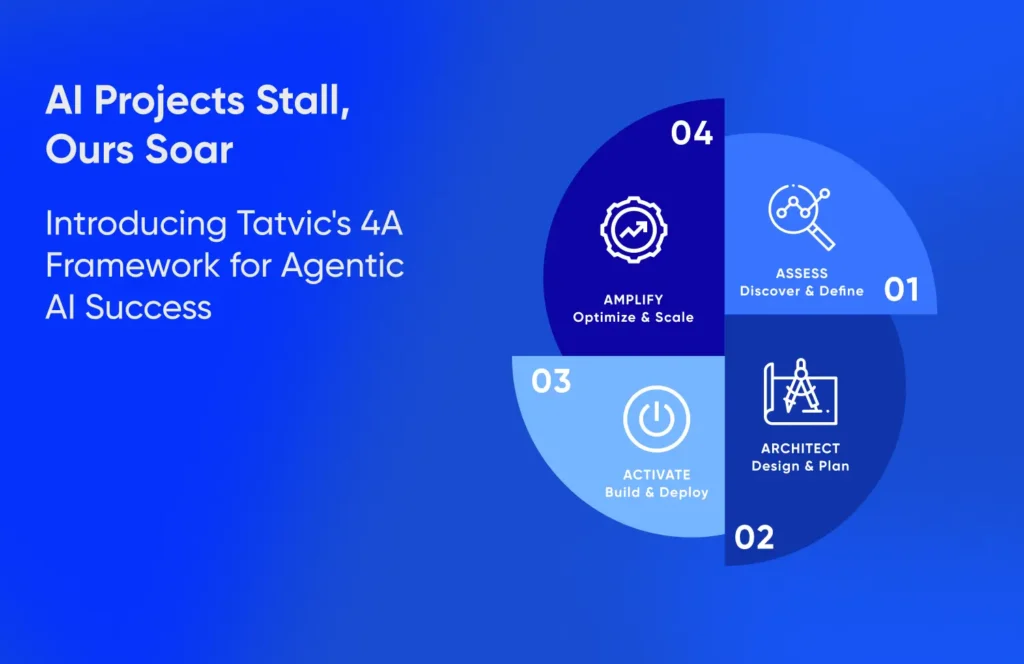
Throughout our series, we’ve taken you from problem identification to solution understanding. We’ve shown you how to find your sweet spot. We’ve introduced our 4A Framework for systematic implementation.

Now comes the moment of truth: How do you actually launch your first Agentic AI mission with confidence?

Here’s what we’ve learned from enterprise AI implementations: success comes not from having the best technology, but from having the most disciplined approach to deployment.

According to McKinsey’s 2024 State of AI Report, organizations that follow structured implementation methodologies are 2.3x more likely to achieve their AI objectives within the first year.

Your first Agentic AI mission isn’t just about solving an immediate marketing challenge. It’s about establishing the foundation for enterprise-wide transformation while proving measurable ROI that justifies broader investment.

Today, we’re providing your complete phase wise mission roadmap that bridge Tatvic’s 4A Framework with practical implementation steps that minimize risk and maximize business impact.

Why Your First Mission is Make-or-Break!

Your initial Agentic AI implementation sets the tone for your entire enterprise AI strategy.

Gartner’s 2024 AI Strategy Survey found that organizations with successful first AI projects are 4.2x more likely to achieve enterprise-wide AI adoption within three years.

The stakes are significant:

  • Success creates organizational momentum and secures future AI investments
  • Failure can delay enterprise AI adoption by 12-18 months and create lasting resistance
  • The approach you establish becomes the template for all future AI initiatives

This is why a structured, proven approach isn’t just recommended-it’s essential.

The Six-Phase Mission Framework

Our mission framework systematically implements Tatvic’s 4A methodology through six concrete phases that large enterprises can execute with confidence.

Phase 1: Discovery & Alignment (Assess Foundation)

Strategic Objective:

Establish clear business objectives and organizational alignment before any technology deployment.

Duration:

2-3 weeks

Identify Marketing Goals & Data Landscape

Begin by understanding your current marketing ecosystem and defining what success means for your organization.

Key Executive Activities:
  • Charter a cross-functional team with representatives from marketing, IT, data, and compliance
  • Define specific, measurable business objectives
  • Inventory existing data sources and quality
  • Assess current team capabilities and identify skill development needs

Align on Success Metrics

Critical Success Metrics:
  • Efficiency Gains
  • Performance Improvements
  • Resource Optimization
  • Strategic Impact

According to Deloitte’s AI Implementation Benchmark, projects with clearly defined success metrics are 3.1x more likely to deliver expected ROI within the first six months.

Phase 2: MVP/Pilot Scoping (Architect Strategy)

Strategic Objective:

Select the optimal starting point and define precise scope for maximum impact with minimal risk.

Duration:

1-2 weeks

Choose High-Impact Channel or Product Line

Selection Criteria:
  • Explicit Inputs → Process → Outputs
  • Reliable, Abundant Data
  • High-Volume/Repetitive Tasks
  • Speed-Sensitive Processes

Define Pilot Scope & KPIs

Scope Definition Framework:
  • Geographic Focus
  • Channel Limitation
  • Timeline Boundaries
  • Budget Parameters

Forrester’s Technology Implementation Research shows that focused pilots with limited scope achieve 67% higher success rates than broad, multi-channel approaches.

Phase 3: Pilot Implementation (Activate Technology)

Strategic Objective:

Deploy Agentic AI solutions within defined scope while maintaining full human oversight and control.

Duration:

4-6 weeks

Develop Agentic AI for Your Ecosystem

Implementation Priorities:
  • System Integration
  • Human-AI Handoffs
  • Safety Mechanisms
  • Performance Monitoring

Establish Governance Framework

Governance Elements:
  • Approval Workflows
  • Compliance Monitoring
  • Risk Management
  • Documentation Standards

MIT’s AI Governance Research indicates that organizations with comprehensive governance frameworks experience 45% fewer implementation challenges.

Phase 4: Pilot Validation (Activate Performance)

Strategic Objective:

Launch AI-supported operations and gather comprehensive performance data to validate business impact.

Duration:

60-90 days

Launch AI-Supported Campaign

Launch Protocol:
  • Gradual Rollout
  • Continuous Monitoring
  • Team Training
  • Stakeholder Communication

Gather Performance Data & User Feedback

Data Collection Framework:
  • Quantitative Metrics
  • Qualitative Feedback
  • Technical Performance
  • Business Impact

Stanford’s Human-AI Collaboration Research found that organizations collecting both quantitative and qualitative feedback during pilots achieve 31% better long-term adoption rates.

Phase 5: Pilot Review & Scale Up (Amplify Success)

Strategic Objective:

Evaluate results, refine approach, and plan strategic expansion to additional channels and product lines.

Duration:

2-3 weeks

Evaluate Results & Refine Approach

Evaluation Framework:
  • ROI Analysis
  • Operational Impact
  • Strategic Value
  • Lessons Learned

Expand to More Channels & Product Lines

Expansion Strategy:
  • Prioritization Matrix
  • Resource Planning
  • Capability Building
  • Risk Management

Boston Consulting Group’s AI Scaling Research shows that organizations with systematic expansion strategies achieve 2.8x greater business impact from their AI investments.

Phase 6: Ongoing Governance & Support (Amplify Capability)

Strategic Objective:

Establish sustainable operations with continuous optimization and enterprise-wide capability building.

Duration:

Ongoing

Maintain Human Oversight & Compliance

Ongoing Governance:
  • Regular Performance Reviews
  • Compliance Audits
  • Continuous Training
  • Innovation Pipeline

Continuous Optimization

Optimization Framework:
  • Performance Analytics
  • Feedback Integration
  • Technology Updates
  • Best Practice Development

De-Risking Your Innovation Investment

Technical Risk Mitigation
  • Gradual autonomy increase
  • Human override capabilities
  • Comprehensive testing

Business Risk Mitigation

  • Limited scope pilots
  • Clear success metrics
  • Stakeholder alignment

Operational Risk Mitigation

  • Change management protocols
  • Training programs
  • Documentation standards

Accenture’s AI ROI Analysis indicates that organizations following structured implementation approaches achieve positive ROI an average of 35% faster than those with ad-hoc approaches.

Expected ROI Timeline and Milestones

Month 1-2: Foundation establishment
Month 3-4: AI deployment with performance indicators
Month 5-6: Business impact with 15-25% efficiency gains
Month 7-8: Strategic expansion
Month 9+: Enterprise-wide optimization and ROI

Your Mission Begins Now

Your Next Steps:

  1. Assemble Your Mission Team
  2. Begin Discovery & Alignment
  3. Select Your Pilot Opportunity
  4. Partner with Proven Expertise

Ready to Launch Your Agentic AI Mission?

Contact Tatvic for a confidential strategy session where we’ll help you:

  • Assess Agentic AI opportunities
  • Design a customized mission plan
  • Define timelines and success metrics
  • Create a roadmap for enterprise AI

The mission framework provides the path.

The 4A methodology provides the discipline.

The decision to begin is yours.

How Anomaly Detection Safeguards Business Performance

How Anomaly Detection Safeguards Business Performance -Tatvic

Anomaly Detection is the silent guardian of your data, constantly at work behind the scenes.

Are hidden issues silently draining your business’s revenue, jeopardizing your security, or skewing your crucial data insights?

In today’s hyper-connected, data-rich world, unexpected deviations can appear anywhere from a sudden dip in website conversions to a subtle, yet dangerous, shift in network traffic.

These “anomalies,” often invisible to the naked eye, hold the key to uncovering both significant threats and untapped opportunities.

It’s a powerful discipline at the intersection of data science, AI, and machine learning, focused on identifying those rare events, observations, or data points that diverge significantly from the expected pattern.

More than just a buzzword, anomaly detection is becoming an indispensable tool for businesses aiming to stay competitive, secure, and data-driven.

In this comprehensive guide, we’ll peel back the layers of anomaly detection.

You’ll learn exactly what it is, why it’s not just a technicality but a strategic imperative for your business, its various types, how it works, and its impactful real-world applications.

We’ll also address common challenges and best practices for implementation, ultimately showing you how Tatvic empowers businesses like yours to harness this technology for smarter, safer operations.

What is Anomaly ?

An anomaly is any data point, event, or observation that significantly deviates from the normal or expected pattern within a dataset.

It’s an outlier or an irregularity that doesn’t conform to the typical behavior or trend.

These unusual occurrences can signal anything from a data error to a critical system issue, a fraudulent activity, or an unexpected but important business trend.

What Exactly is Anomaly Detection?

At its core, Anomaly Detection (also known as Outlier Detection) is the process of identifying data points or patterns that do not conform to an expected behavior.

Think of it as finding the “needle in the haystack” that one data point, or a sequence of points, that is significantly different from the vast majority of other data points.

While “normal” data often follows predictable trends and distributions, anomalies stick out because they violate these norms.

These deviations can be caused by various factors, including:

  • Errors: Data entry mistakes, sensor malfunctions.
  • Rare Events: A sudden, legitimate spike in sales due to a viral campaign.
  • Malicious Activity: Fraudulent transactions, cyber-attacks.
  • System Failures: Server crashes, network outages.

Unlike simple thresholding, which flags values above or below a fixed limit, anomaly detection often involves sophisticated algorithms that learn the “normal” baseline behavior from historical data.

This allows it to identify subtle, complex, or evolving abnormalities that a static rule might miss. It’s about understanding the context and the relationships within the data, rather than just isolated values.

What is Anomaly Detection - Tatvic

The ‘Why’: Why Anomaly Detection is Critical for Modern Businesses

In an era where data is king, overlooking anomalies is akin to leaving money on the table or an open door for threats.

Anomaly detection is not just a ‘nice-to-have’ technical capability; it’s a strategic ‘must-have’ that delivers tangible business benefits across various functions.

Importance Of Anomaly Detection In Various Business Functions:

1. Safeguarding Revenue & Preventing Fraud

Fraudulent activities, whether in financial transactions, advertising clicks, or e-commerce purchases, can lead to substantial revenue loss. Anomaly detection systems continuously monitor patterns, flagging suspicious transactions, unusual login attempts, or abnormal clickstream data that deviate from typical user behavior, allowing for rapid intervention and prevention.

2. Enhancing Operational Efficiency & Predictive Maintenance

For businesses with physical assets or complex IT infrastructures, anomalies can signal impending equipment failure or operational bottlenecks. By detecting unusual sensor readings (e.g., temperature spikes, abnormal vibrations) or unexpected latency in IT systems, companies can perform predictive maintenance, minimize downtime, and optimize operational costs, moving from reactive fixes to proactive solutions.

3. Optimizing Digital Marketing & User Experience

For Tatvic’s core audience, this is paramount.

Anomaly detection can transform digital marketing efforts:

  • Website Traffic: Identify sudden, inexplicable drops or spikes in traffic that could indicate bot activity, tracking errors, or a trending issue.
  • Conversion Rates: Pinpoint abnormal shifts in conversion rates for specific campaigns, channels, or user segments, allowing for quick A/B test adjustments or problem resolution.
  • Ad Spend & Performance: Flag unusual ad spend patterns, click fraud, or campaigns underperforming unexpectedly, ensuring budget efficiency.
  • Customer Journey: Spot deviations in user behavior sequences that might indicate frustration, confusion, or a new successful path.

4. Improving Data Quality & Accuracy

Garbage in, garbage out. Anomalies within your datasets can skew analysis, leading to incorrect conclusions and flawed strategies. Anomaly detection helps cleanse data by identifying erroneous entries, sensor glitches, or data collection issues, ensuring that your analytics and machine learning models are built on a solid foundation of reliable data.

5. Strengthening Cybersecurity & IT Operations

In the face of ever-evolving cyber threats, anomaly detection is a first line of defense. It helps identify:

  • Unusual Network Activity: Malicious intrusions, data exfiltration, or unauthorized access attempts.
  • System Performance Degradation: Subtle shifts indicating a server overload or an application issue before it escalates.
  • Insider Threats: Employee behaviors that deviate from their normal work patterns.

6. Gaining Competitive Advantage

By proactively identifying and addressing issues, optimizing performance, and preventing losses, businesses leveraging anomaly detection gain a significant edge. They can react faster to market changes, maintain higher levels of service quality, and make data-driven decisions with greater confidence.

What Are The Types of Anomalies? Understanding the Deviations

Not all anomalies are created equal.

Understanding the different types helps in selecting the most appropriate detection methods and interpreting their significance.

Let’s Explore Different Types Of Anomalies:

1. Point Anomalies (Outliers)

These are single data instances that deviate significantly from the rest of the dataset.

  • Example: A credit card transaction of $10,000 in an account where the average transaction is $50.
  • Example in Marketing: A single blog post suddenly receiving 10x its usual traffic for no apparent reason, or a single day with 0 conversions on an otherwise active e-commerce site.

2. Contextual Anomalies

A data instance is anomalous only in a specific context. It might be normal in a different context.

  • Example: A temperature of 30°C in a server room is normal during summer but highly anomalous in winter.
  • Example in Marketing: A spike in website traffic at 2 AM is normal for a global product launch, but anomalous for a local business on a typical weekday.

3. Collective Anomalies

A collection of related data instances that collectively behave anomalously, even if individual data points within the collection are not anomalous.

  • Example: A gradual, sustained decrease in network bandwidth over several hours, which individually might seem small, but collectively indicates a problem.
  • Example in Marketing: A consistent, but slight, drop in session duration across multiple pages over a week, signaling potential user frustration that isn’t evident from individual page metrics.

How Anomaly Detection Works: Methods & Techniques

The core idea behind anomaly detection is to build a model of “normal” behavior and then identify instances that deviate significantly from this model.

The methodologies employed can range from simple statistical rules to complex machine learning algorithms.

1. Overview of the Process:

  1. Data Collection: Gathering relevant data streams (e.g., logs, sensor data, transaction records, website analytics).
  2. Data Preprocessing: Cleaning, normalizing, and transforming data to suit the chosen method.
  3. Model Training: Teaching the algorithm what “normal” looks like based on historical data.
  4. Anomaly Scoring/Classification: Assigning an anomaly score to new data points or classifying them as normal/anomalous.
  5. Alerting & Action: Notifying relevant personnel or triggering automated responses when anomalies are detected.

2. Statistical Methods

These are often the simplest forms, suitable for data with clear statistical properties.

  • Z-score/Standard Deviation: Identifies data points that are a certain number of standard deviations away from the mean.
  • Interquartile Range (IQR): Flags values outside a certain range based on quartiles, robust to outliers.
  • Gaussian Models: Assumes data follows a normal distribution and flags points with low probability under this distribution.

3. Machine Learning Approaches

These are more sophisticated and can learn complex, non-linear relationships, making them suitable for high-dimensional or complex data.

  • Clustering-based: Algorithms like K-means or DBSCAN group similar data points together. Anomalies are data points that fall outside these clusters or form very small, isolated clusters.
  • Classification-based: Training a classifier (e.g., One-Class SVM) on “normal” data. Any new data point not classified as normal is an anomaly.
  • Proximity-based: Methods like Isolation Forest or Local Outlier Factor (LOF) identify anomalies by how “isolated” or how different they are from their neighbors.
  • Deep Learning: Neural networks like Autoencoders can learn compressed representations of normal data. Data points that reconstruct poorly (high reconstruction error) are considered anomalous.

4 Time Series Specific Methods

When dealing with sequential data (like website traffic or server logs), specialized methods account for temporal dependencies.

  • ARIMA (Autoregressive Integrated Moving Average): Models past values to predict future ones, flagging significant deviations from predictions.
  • Prophet (Facebook): Designed for forecasting time series data with trends, seasonality, and holidays, useful for detecting anomalies against a predicted baseline.

Anomaly Detection Method (Practical Approach)

Machine learning is useful to learn the characteristics of the system from observed data.

Common anomaly detection methods on time series data learn the parameters of the data distribution in windows over time and identify anomalies as data points that have a low probability of being generated from that distribution.

Another class of methods include sequential hypothesis tests like cumulative sum (CUSUM) charts, sequential probability ratio test (SPRT) etc., which can identify certain types of changes in the distributions of real-time data. All these methods use some predefined thresholds to alert to changes in the distributions of time series data.

At their core, all methods test if the sequence of values in a time series is consistent to have been generated from an i.i.d (independent and identically distributed) process.

This approach becomes infeasible and impractical for environments and infrastructures which are complex and of extremely large scale. As the complexity increases, fixed thresholds can’t adapt to the volume of data changing over time.

At Tatvic, we define anomaly detection as the identification of data points which deviate from normal and expected behaviour.

For example, in our system, we use historical data to construct a quantitative representation of data distribution exhibited by each metric being monitored.

Real-time data points are compared against these quantitative representations and are assigned a score.

A decision is made on whether the real-time data point is an anomaly or not, based on a threshold we derive from recent observations of the data. One of the key advantages of this approach is that the thresholds are not static, but rather, evolve with data.

Anomaly Dectection Time Series - Tatvic

Let me simplify further with an example of a website traffic data pattern. Tatvic’s solution starts with collecting the website’s behavioural data.

Three primary components of trend, namely fixed trends, cyclical trends, and seasonal data are measured individually and aggregated.

The system collects behavioural and conversion data with Google Analytics 360 and uses the Real Time Management APIs to export relevant metrics into a separate database.

Then, the algorithm looks for unexpected changes in the data and sends automated real-time alerts to concerned users using an SMS API and email server.

Some of the meticulously tracked metrics could be online-form completion rates, goal conversion rates, and page-loading time for specific browsers and operating systems.

This solution is built using R - a popular, robust and free programming language - for statistical computing and visualization.

Google Analytics 360 data can be exported into R for advanced analysis through the RGoogleAnalytics Library.

With this, Tatvic can decouple data between trends and seasonality as shown below.

Anomaly detection machine learning - Tatvic

Real-World Applications & Industry Use Cases

Anomaly detection isn’t confined to a single industry; its versatility makes it invaluable across diverse sectors:

1. Digital Marketing & Analytics (Tatvic’s Expertise!)

  • Traffic Anomalies: Sudden, unexplained spikes in bot traffic, or drops in organic search volume for key terms.
  • Conversion Rate Drops: Unexpected dips in checkout conversion rates, form submissions, or lead generation.
  • Campaign Performance: Ad campaigns showing unusually high click-through rates (potential click fraud) or abnormally low return on ad spend.
  • A/B Test Monitoring: Detecting if an A/B test is producing anomalous results that might indicate a technical issue rather than a genuine user preference.
  • Customer Journey Analysis: Identifying unusual navigation paths that might indicate user frustration or new, unexpected success funnels.

2. Financial Services & Fraud Detection

  • Credit card fraud, money laundering, insurance claim fraud, insider trading detection.
  • Example: A bank flagging a series of small, rapid transactions in an unusual location, followed by a large withdrawal.

3. IT Operations & Network Security

  • Network intrusions, denial-of-service (DoS) attacks, unusual access patterns, server performance degradation.
  • Example: An IT team identifying an employee logging in from an unfamiliar country at an odd hour.

4. Manufacturing & IoT

  • Predictive maintenance for machinery, quality control defect detection, supply chain disruptions.
  • Example: Sensors on a factory machine detecting abnormal vibrations or temperature, signaling a potential breakdown before it occurs.

5. Healthcare

  • Patient vital sign monitoring, disease outbreak detection, medical insurance fraud.
  • Example: An automated system alerting doctors to a sudden, inexplicable change in a patient’s heart rate patterns.

Anomaly Detection Case Study!

Magicbricks is India’s top high-end property portal. The website caters to a global market with its unique services and novel online features for both- buyers and sellers.

Given their commitment to user experience and performance across their site’s global operations, they needed a real-time solution to monitor and optimize against their key digital KPIs.

Tatvic helped the company to develop a way to reduce website downtime and promptly alert management when outages would occur.

Using our real-time anomaly alerts platform, the company could clearly see variances in KPIs and move quickly to troubleshoot and fix them.

One day, the page leads generated reduced below the threshold limit and this triggered alerts and an email was immediately sent to the relevant team to take corrective steps on the same day; otherwise, probably a substantial chunk of leads would have been lost.

Result: 70% faster response time

The automated SMS alert system is used to alert outages, determine severity, and provide real-time performance updates to senior and middle managers throughout Magicbricks.

Today, the entire Magicbricks team can make the most of these real-time insights to keep the site up and running and earning more every day.

The full story of anomaly detection for Magicbricks can be found on the Google Analytics blog 👉 here.

Overcoming Challenges in Anomaly Detection

While powerful, implementing anomaly detection is not without its hurdles:

  • Defining ‘Normal’ is Hard:

    What constitutes “normal” can be highly subjective, dynamic, and evolve over time, making it challenging to build robust models.

  • Data Scarcity for Anomalies:

    Anomalies are rare by definition. This scarcity makes it difficult to train models that accurately recognize them, leading to imbalanced datasets.

  • High Dimensionality:

    Modern datasets often have hundreds or thousands of features (dimensions), making it harder to discern patterns and spot anomalies.

  • Evolving Patterns:

    What was normal last month might be anomalous today, and vice-versa. Models need to adapt to concept drift.

  • False Positives/Negatives:

    Overly sensitive models can flood you with false alarms (false positives), leading to alert fatigue. Under-sensitive models might miss critical anomalies (false negatives).

  • Interpretability:

    Understanding why an anomaly was flagged can be challenging, especially with complex deep learning models, making it hard to take targeted action.

Implementing Anomaly Detection: Best Practices for Success

To maximize the effectiveness of your anomaly detection efforts, consider these best practices:

  • Start with Clear Objectives:

    Define what you want to achieve. Are you preventing fraud, optimizing marketing spend, or predicting system failures? Clear goals guide your data collection and model selection.

  • Ensure Data Quality & Preprocessing:

    Clean, consistent, and relevant data is foundational. This includes handling missing values, normalizing features, and feature engineering.

  • Select the Right Algorithm:

    There’s no one-size-fits-all. The best method depends on your data type (time series, categorical, numerical), the nature of anomalies, and your specific problem.

  • Continuous Monitoring & Feedback Loops:

    Anomaly detection models are not set-it-and-forget-it solutions. Regularly monitor their performance, update models with new data, and incorporate human feedback to refine accuracy.

  • Integrate with Existing Systems:

    To make anomaly detection actionable, integrate it with your alerting systems (e.g., Slack, email), dashboards (e.g., Google Looker Studio, Power BI), and operational tools.

  • Start Simple, Then Scale:

    Begin with simpler methods and gradually move to more complex ones as your understanding of the data and problem deepens.

  • Focus on Actionable Insights:

    The goal isn’t just to find anomalies, but to act on them. Ensure your system provides enough context for teams to understand and address the flagged issues.

How Tatvic Empowers Businesses with Anomaly Detection

At Tatvic, we understand that true business intelligence comes from not just seeing the data, but understanding the subtle shifts that impact your bottom line.

We move beyond generic tools, offering tailored Anomaly Detection solutions that integrate seamlessly with your existing data ecosystem.

Tatvic’s Approach To Empower Businesses with Anomaly Detection:

  • Custom Model Development:

    Leveraging our expertise in AI and Machine Learning, we build bespoke anomaly detection models tuned to your specific business needs, data types, and operational context. Whether it’s detecting fraudulent transactions in finance or pinpointing unusual customer behavior in e-commerce, our solutions are purpose-built.

  • Integration with Leading Analytics Platforms:

    We seamlessly integrate anomaly detection capabilities with your existing tools, including Google Analytics 4, Adobe Analytics, Google BigQuery, and other cloud data platforms. This means you get real-time alerts and insights directly within your familiar dashboards.

  • Proactive Alerting & Visualization:

    Beyond just detection, we focus on making anomalies actionable. We design intuitive dashboards and automated alerting systems that notify the right teams instantly, providing context and severity assessments to enable rapid response.

  • Data Health Monitoring:

    Our solutions help you maintain high data quality, identifying inconsistencies or errors that could skew your analytics and impact business decisions.

  • Fraud & Security Optimization:

    For digital marketing, we implement sophisticated models to identify and mitigate various forms of ad fraud, click fraud, and unusual user behavior, protecting your marketing spend and brand reputation.

  • End-to-End Implementation & Support:

    From initial data assessment and model training to deployment, monitoring, and ongoing refinement, Tatvic provides comprehensive support, ensuring you maximize the value of anomaly detection without heavy internal resource allocation.

Success Story Snippet: Imagine a leading e-commerce client who was struggling with unexplained drops in conversion rates during peak seasons. Tatvic implemented a real-time anomaly detection system that identified specific product categories experiencing unusual traffic sources and checkout flow errors, enabling the client to rectify issues within hours, preventing significant revenue loss.

The Future of Anomaly Detection

The field of anomaly detection is constantly evolving, driven by advancements in AI and the increasing complexity of data.

Anomaly Detection Key trends to watch :

  • Real-time Detection at Scale:

    The ability to detect anomalies instantaneously across massive, streaming datasets will become standard.

  • Explainable AI (XAI):

    As models become more complex, XAI will be crucial to provide human-understandable explanations for why an anomaly was flagged, fostering trust and enabling quicker action.

  • Automated Anomaly Resolution:

    Moving beyond just alerting, future systems may suggest or even initiate automated responses to certain types of anomalies.

  • Multi-Modal Anomaly Detection:

    Integrating data from various sources (e.g., text, images, sensor data, time series) to detect more complex, holistic anomalies.

Conclusion

In a world drowning in data, anomaly detection emerges as a lifeline transforming raw data into actionable intelligence.

It’s the silent guardian protecting your business from unseen threats and the intelligent guide revealing paths to untapped growth.

By identifying the unusual, you gain unparalleled insights into your operations, security, and customer behavior.

Don’t let hidden anomalies erode your profits or jeopardize your reputation.

Partner with Tatvic, and leverage our expertise in advanced analytics and machine learning to build robust anomaly detection capabilities tailored to your unique business challenges.

Transform your data into your most powerful defense and a dynamic engine for growth.

Ready to uncover hidden insights and protect your business?
👉 Contact Tatvic today for a consultation on implementing cutting-edge Anomaly Detection solutions.


AI Projects Stall, Ours Soar: Introducing Tatvic’s 4A Framework for Agentic AI Success

Tatvic's 4A Framework for Agentic AI Success

Executive Summary

The Challenge: 87% of AI pilots never reach production, costing enterprises millions in wasted investments and missed opportunities

The Solution: Tatvic’s 4A Framework systematically addresses the four critical failure points that derail AI initiatives in large enterprises

The Strategic Value: De-risk your AI investments while building scalable, enterprise-wide capabilities that drive competitive advantage

Your Next Step: Assess your organization’s AI readiness using our proven methodology before your next AI investment

Our series has addressed marketing’s operational challenges.

We’ve detailed the solution: human-in-the-loop Agentic AI. This approach has transformative potential.

We’ve guided you to find your optimal implementation point.

Now comes the most critical question: How do you ensure your Agentic AI initiative actually succeeds?

Here’s an uncomfortable truth: most AI projects don’t just underperform, they fail outright.

According to MIT Sloan’s 2023 AI Implementation Study, 87% of AI pilots never make it to full production.

Marketing ranks among the most challenging domains for successful AI deployment.

The reasons are predictable yet costly:

  • Unclear objectives waste resources.
  • Poor data preparation derails progress.
  • Inadequate change management creates resistance.
  • Most critically, organizations treat AI as a technology project rather than a business transformation initiative.

This is where Tatvic’s approach fundamentally differs.

We’ve developed a proven methodology that addresses the root causes of AI project failure.

Today, we’re sharing our 4A Framework, the systematic approach that ensures your Agentic AI implementation delivers sustainable value rather than becoming another expensive experiment.


You May Also Like To Read ➤ The Ticking Clock: Is Your Marketing Team Drowning in Manual Work While Opportunities Sail By?


Why Most AI Projects Stall: The Four Critical Failure Points

Before diving into our framework, let’s examine why so many AI initiatives stumble.

Our Analysis of Failed AI Implementations Reveals Four Primary Failure Modes:

1. Data Silos

Most large enterprises struggle with disconnected systems that create incomplete intelligence.

Legacy marketing tools weren’t built for AI integration.

This makes it difficult to create the unified data environment that Agentic AI requires for enterprise-scale deployment.

Deloitte’s 2024 State of AI in the Enterprise report found that organizations with integrated data architectures are 3.2x more likely to succeed with AI implementations.

2. Implementation Gaps

Technical teams often lack marketing expertise. Marketing teams lack technical depth.

This creates a dangerous gap where proof-of-concepts show promise but never reach full production.

Additionally, many large enterprises lack the governance frameworks and guardrails necessary for safe AI deployment across multiple business units.

Harvard Business Review’s research on digital transformation indicates that 70% of AI project failures stem from insufficient cross-functional collaboration and unclear governance structures.

3. Tactical vs Strategic Approach

Many organizations implement one-off proof-of-concepts without enterprise-wide vision.

They deploy AI tools without clear use cases.

They miss the “agent” component entirely implementing automation without the intelligence that makes it truly transformative.

McKinsey’s analysis shows that organizations with strategic, enterprise-wide approaches achieve 4x greater business impact than those with tactical, isolated implementations.

4. The Human Factor

Teams are often not equipped to collaborate effectively with AI systems.

Fear of replacement rather than enhancement creates resistance.

Organizations frequently lack comprehensive change management strategies to guide the enterprise-wide transition.

According to MIT Sloan’s 2023 study, human adoption challenges represent the primary barrier to AI success.

The 4A Framework: A Systematic Path to Success

Tatvic’s 4A Framework addresses these failure points through a systematic, human-centric approach.

It prioritizes business value, organizational readiness and continuous improvement at enterprise scale.

Phase 1: ASSESS - Building the Foundation for Success

Strategic Objective: Establish clear business objectives, evaluate organizational readiness, and identify optimal starting points for enterprise-scale Agentic AI implementation.

Business Alignment Assessment

We begin by understanding your unique business context, challenges, and opportunities. This isn’t about finding ways to use AI-it’s about identifying where AI can solve real business problems at scale.

Key Leadership Activities:

  • Sponsor comprehensive mapping of current marketing processes to identify strategic inefficiencies
  • Champion the quantification of business impact from existing operational bottlenecks
  • Ensure stakeholders define specific, measurable success criteria aligned with enterprise goals
  • Oversee alignment of project scope and timelines with organizational priorities

Technical Readiness Evaluation

Not every enterprise is ready for Agentic AI implementation. We evaluate your data infrastructure, system integrations, and technical capabilities to ensure success across multiple business units.

Key Leadership Activities:

  • Commission audit of data quality, accessibility, and governance across the enterprise
  • Direct assessment of existing marketing technology stack and integration capabilities
  • Approve resources to address technical gaps and requirements
  • Ensure security and compliance considerations meet enterprise standards

According to Gartner’s 2024 Data and Analytics Survey, organizations with mature data governance frameworks are 4.1x more likely to successfully implement AI solutions⁵.

Sweet Spot Identification

Using proven criteria, we identify which marketing processes are genuinely ready for Agentic AI implementation across your organization.

Key Leadership Activities:

  • Oversee scoring of marketing processes against proven success criteria
  • Approve prioritization based on business impact and implementation feasibility
  • Select optimal starting points for pilot implementation
  • Establish success metrics and measurement frameworks aligned with business strategy
You May Also Like To Read ➤ The Agentic AI Sweet Spot: Where Can Autonomous Agents Drive Maximum ROI in Your Marketing?


Phase 2: ARCHITECT - Designing for Sustainable Success

Strategic Objective: Design Agentic AI solutions that integrate seamlessly with existing systems while maintaining human oversight and enterprise governance.

Solution Architecture Design

We design AI solutions that enhance rather than replace human capabilities. Solutions integrate seamlessly with your existing marketing technology stack across all business units.

Key Leadership Activities:

  • Approve agent workflows and decision-making parameters that align with business strategy
  • Ensure human-in-the-loop oversight mechanisms maintain appropriate control
  • Oversee system integrations and data flows across the enterprise
  • Establish governance and compliance frameworks that meet regulatory requirements

Change Management Planning

Technical implementation is only half the equation. We design comprehensive change management strategies that ensure organizational adoption and success at scale.

Key Leadership Activities:

  • Identify key stakeholders and change champions across business units
  • Sponsor training programs for marketing teams enterprise-wide
  • Champion communication strategies for organizational alignment
  • Establish feedback loops for continuous improvement and stakeholder engagement

Forrester’s research shows that organizations with comprehensive change management programs achieve 2.8x higher user adoption rates and 65% faster time-to-value⁶.

Risk Mitigation Strategy

Every enterprise AI implementation carries risks. We identify potential challenges and design mitigation strategies before they become problems.

Key Leadership Activities:

  • Review and approve risk assessment covering technical, operational, and business risks
  • Ensure fallback procedures and safety mechanisms meet enterprise standards
  • Oversee monitoring and alerting systems for early risk detection
  • Approve rollback strategies and contingency plans
You May Also Like To Read ➤ Escape the Hamster Wheel: Accelerate Campaigns & Maximize ROI with Agentic AI


Phase 3: ACTIVATE- Implementing with Precision

Strategic Objective: Deploy Agentic AI solutions in controlled environments with clear success criteria and comprehensive human oversight.

Controlled Pilot Deployment

We implement AI solutions in carefully controlled environments that minimize risk while maximizing learning opportunities for enterprise-scale deployment.

Key Leadership Activities:

  • Oversee deployment of agents for selected marketing processes
  • Ensure integration with existing systems and data sources meets enterprise standards
  • Monitor establishment of performance tracking and KPI measurement
  • Champion training of marketing teams on new workflows

Human-AI Collaboration Optimization

The most successful implementations optimize collaboration between humans and AI agents rather than simply replacing human tasks.

Key Leadership Activities:

  • Review and approve agent decision-making parameters based on human feedback
  • Oversee optimization of handoff points between agents and human team members
  • Ensure workflow adjustments based on real-world usage patterns meet business objectives
  • Establish communication protocols between agents and teams

A recent study by Stanford’s AI Lab found that marketing teams with optimized human-AI collaboration achieve 23% higher productivity⁷.

Performance Monitoring & Iteration

We continuously monitor agent performance and make adjustments based on real-world results and user feedback.

Key Leadership Activities:

  • Review performance against established KPIs and business objectives
  • Oversee feedback collection from marketing team members
  • Approve optimization opportunities and implementation priorities
  • Champion refinements and improvements that drive business value

Phase 4: AMPLIFY- Scaling Success Across the Organization

Strategic Objective: Expand successful Agentic AI implementations across the enterprise while building organizational capabilities for ongoing innovation.

Strategic Expansion Planning

Based on pilot results, we identify the next highest-impact opportunities for Agentic AI implementation across your enterprise marketing organization.

Key Leadership Activities:

  • Review pilot performance and lessons learned with strategic implications
  • Approve additional processes for expansion based on business impact
  • Oversee resource allocation and timeline planning for enterprise scaling
  • Ensure expansion sequence maximizes business impact and minimizes risk

Capability Building

We don’t just implement technology, we build your organization’s capabilities to manage, optimize, and expand Agentic AI solutions independently.

Key Leadership Activities:

  • Sponsor training of internal teams on AI management and optimization
  • Establish centers of excellence for ongoing innovation and best practices
  • Oversee creation of documentation and knowledge management systems
  • Approve governance frameworks for sustainable, enterprise-wide growth

Continuous Innovation Framework

The most successful enterprises treat Agentic AI as a platform for ongoing innovation rather than a one-time implementation.

Key Leadership Activities:

  • Establish processes for identifying new AI opportunities across business units
  • Champion feedback loops for continuous improvement and innovation
  • Approve metrics for measuring long-term business impact and competitive advantage
  • Oversee integration with emerging AI technologies and market developments

According to Boston Consulting Group’s research, organizations that successfully scale AI across multiple functions achieve 3-5x greater business impact.

You May Also Like To Read ➤ Beyond the Hype: What is Agentic AI, Really? And Why Your CFO Will Actually Love It


How the 4A Framework Addresses Each Failure Point

The 4A Framework directly addresses each of these critical failure points through systematic, proven approaches:

1. Addressing Data Silos:

The Assess phase includes comprehensive data architecture evaluation, identifying integration points and designing unified data flows that enable effective AI operation.

2. Closing Implementation Gaps:

The Architect phase brings together marketing expertise and technical capabilities, creating clear governance frameworks and production-ready solutions from the start.

3. Strategic vs Tactical:

The entire 4A Framework is built on enterprise-wide vision, ensuring each implementation builds toward broader organizational AI capabilities rather than isolated tactical wins.

4. Human Factor Solutions:

Every phase prioritizes human collaboration and change management, positioning AI as enhancement rather than replacement while building organizational capabilities for long-term success.

According to Boston Consulting Group’s research on AI scaling, organizations that address all four failure points systematically achieve 3-5x greater business impact than those with ad-hoc approaches.

Common Agentic AI Implementation Challenges and How We Address Them

Challenge 1: Our Team is Worried About Job Security

Our Approach: The 4A Framework explicitly positions AI as enhancement, not replacement. We involve marketing teams in the design process and clearly define their evolving roles as strategic decision-makers rather than operational executors.

Challenge 2: We’ve Tried AI Before and It Didn’t Work

Our Approach: The Assess phase specifically examines previous AI experiences to understand failure points. We address technical, organizational, and strategic gaps before moving forward.

Challenge 3: How Do We Measure Success?

Our Approach: Each phase of the 4A Framework includes specific success metrics aligned with business objectives. We measure both technical performance and business impact.

Challenge 4: What if the AI Makes Mistakes?

Our Approach: Human-in-the-loop design ensures human oversight of all agent decisions. We implement graduated autonomy where agents earn trust through demonstrated performance.

Your Next Steps With The 4A Framework

If you’ve followed our series and identified your Agentic AI sweet spots, you’re ready to begin the 4A journey:

1. Start with Assessment:

Don’t rush into implementation. Invest time in understanding your specific business context and readiness.

2. Design for Humans:

Remember that successful AI implementations enhance human capabilities rather than replace them.

3. Plan for Iteration:

Expect refinement and optimization. The best results come from continuous improvement, not perfect initial deployment.

4. Focus on Business Value:

Keep business objectives at the center of every decision. Technology should serve strategy, not drive it.

Looking Ahead: Your First Mission

In our final blog of this series titled: “Your First Agentic AI Mission: A Phased Approach to De-Risking Innovation and Maximizing Marketing ROI,” we’ll provide a concrete roadmap for launching your first Agentic AI initiative using the 4A Framework.

Until then, consider this: every transformative technology faces the same challenge the gap between potential and reality.

The organizations that successfully bridge this gap don’t have better technology; they have better implementation methodology.

The 4A Framework is that methodology for Agentic AI. It’s the difference between another stalled AI project and sustainable transformation that delivers real business value.


📩 Contact Today To Implement Tatvic’s Robust 4A Marketing Transformation Framework


Bot Icon
Bot Icon

Tatvic Bot

Explore About Tatvic and Services