Hello There!

Lorem ipsum dolor sit amet, consectetur adipiscing elit,

The Missing Link in GA4 Data Integrity: AI-Powered GTM Health Checker

AI-Powered GTM Health Checker

You validated every tag. Your GA4 dashboard looks clean. Yet, something feels off. The data doesn’t quite add up - and you can’t figure out why.

Most businesses think validating GA4 is enough. They run periodic checks, review their reports, and assume their measurement foundation is solid. But here’s what they’re missing: GA4 data integrity actually starts before data is even collected - inside your Google Tag Manager.

Your GTM container is the foundation of everything. When it’s compromised, every downstream validation effort becomes meaningless. Even perfect GA4 setups can’t compensate for a broken GTM foundation. This is where automated data quality checks become essential - and where understanding container health monitoring transforms how organizations maintain measurement integrity.

If you missed Part 1 of this series on fixing GA4 data corruption at the source, you can read it here: From Broken Signals to Trusted Insights: How Agentic AI Secures Data Collection

Why GTM Health Is Critical for Accurate Data

Google Tag Manager is the control center of your data collection. It determines when tags fire, what information gets passed along, and how your tracking codes interact across your digital properties. When GTM is healthy, it’s incredibly powerful. When it’s not, it silently sabotages your data quality.

Think of your GTM container like a car. When it’s new, everything runs smoothly. But without regular maintenance, small issues compound. The engine gets less efficient, parts wear down, and one day you’re stranded, wondering why you didn’t catch the warning signs earlier.

The cascading failures caused by poor GTM container health:

  • Marketing teams allocate millions based on incomplete tracking
  • Analytics teams waste hours troubleshooting mysterious data gaps
  • Websites load slowly because of bloated tag setups
  • Compliance teams face regulatory risks from misconfigured tracking

What starts as a simple container with a dozen tags evolves into a complex ecosystem with hundreds of elements. Without continuous data monitoring, problems multiply silently while you’re completely unaware. By the time issues surface in your reports, weeks of corrupted data have already influenced business decisions.

Common GTM Health Issues That Undermine Data Quality

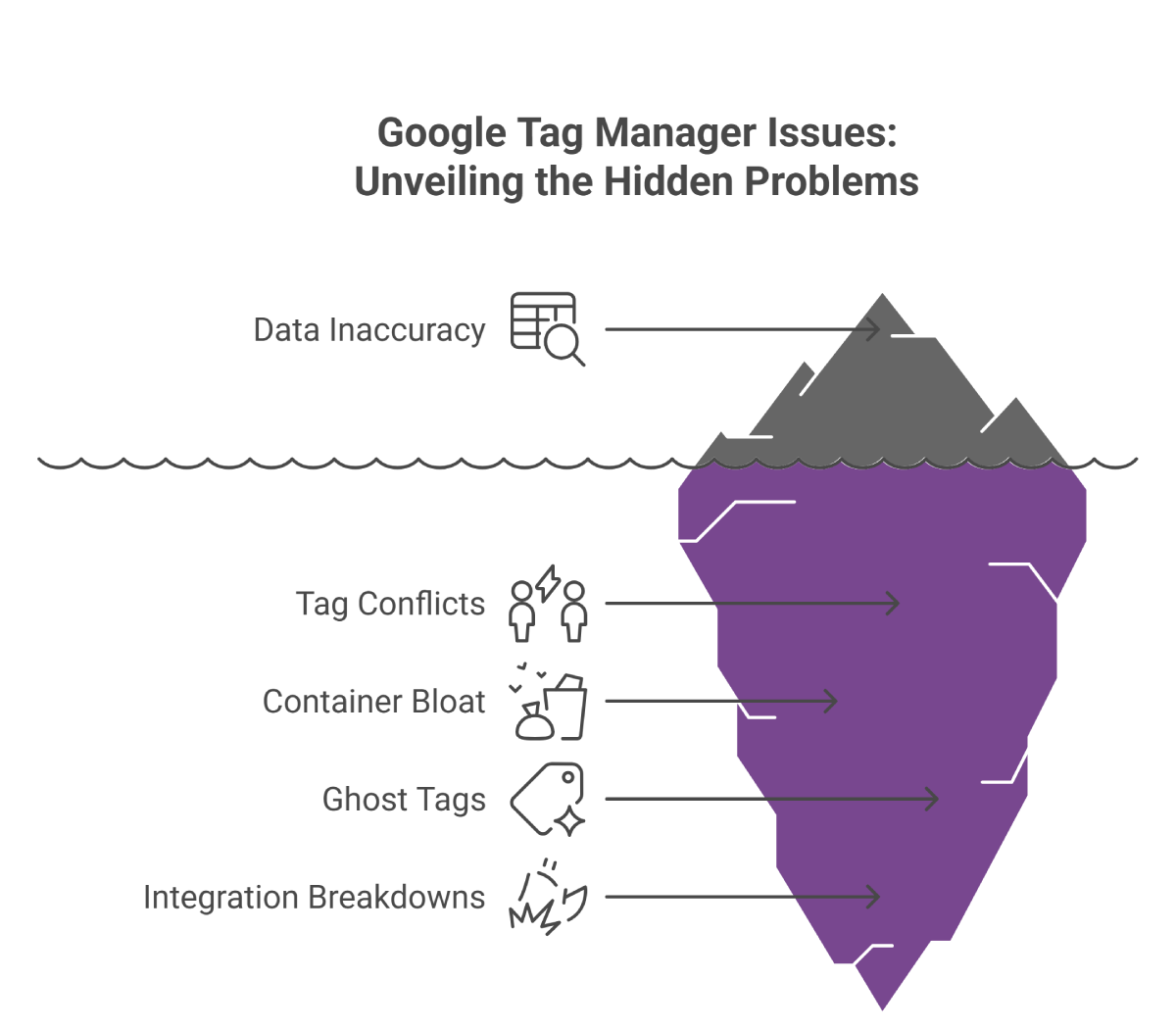
Let’s explore the most common problems that silently destroy your data quality automation efforts.

Tag Conflicts

Imagine two people trying to squeeze through the same doorway simultaneously. That’s what happens with tag conflicts in GTM. Multiple tags fire at the same time or in the wrong order, interfering with each other.

Consider this scenario: Your e-commerce conversion tag fires before product data loads. Transactions get recorded, but you have no idea which products drove revenue. Your merchandising analytics become useless.

These conflicts emerge gradually as containers grow. Regular Google Tag Manager audit processes become critical for catching these issues before they snowball.

Ghost Tags

“Ghost tags” are perhaps the most common issue discovered when auditing Google Tag Manager containers. These are tags created for specific campaigns or tests that should have been removed - but weren’t.

The issue: These abandoned tags keep firing indefinitely. They collect data nobody uses, sometimes break newer implementations, and always add unnecessary weight to your container. Teams often have zero visibility into which tags serve a purpose and which are digital deadweight.

Container Bloat

Over time, GTM containers accumulate digital clutter. Old campaign tags, unused tracking codes, forgotten configurations - they all pile up.

The impact: Every unnecessary tag slows your website. Users don’t wait for slow pages - they bounce. Higher bounce rates mean less data collected, undermining the very analytics you’re trying to improve. Without automated data quality management, this bloat keeps growing unchecked.

Integration Breakdowns

Your GTM container must connect properly with GA4, advertising platforms, and other tools. When these connections break or get misconfigured, you develop measurement blind spots.

Without continuous GTM container health monitoring, these failures go undetected for weeks or months. By the time someone notices something looks off, corrupted data has already influenced major decisions.

If GTM clutter, tag conflicts, or ghost tags sound familiar, this guide on automated audits will help. Read: AI-Powered Tag Auditor
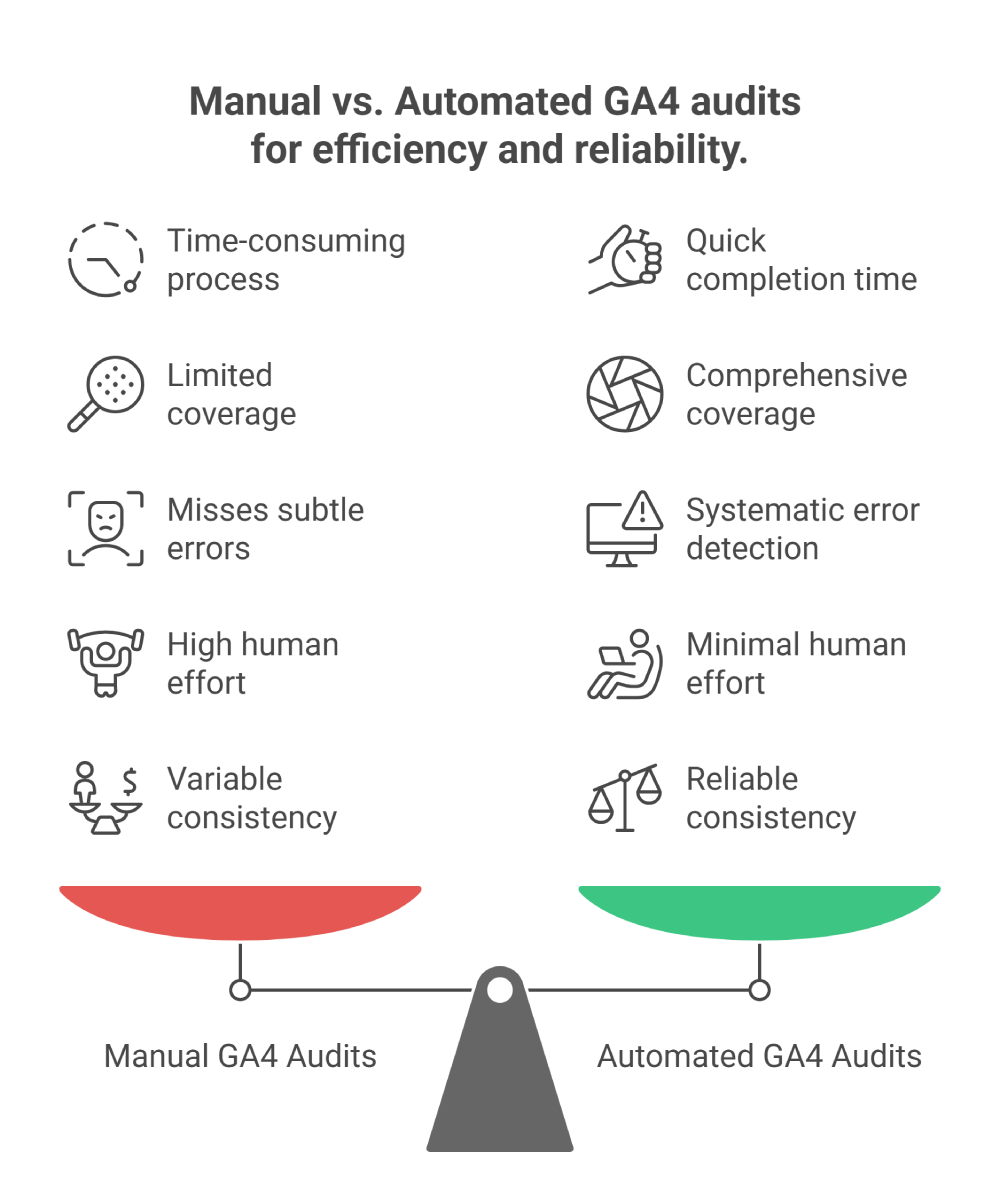
Why Manual GTM Audits Fall Short

Most organizations handle GTM maintenance through periodic manual audits - maybe quarterly if they’re disciplined, maybe just when something breaks. A specialist reviews the container, tests some tags, documents issues.

The fundamental limitations:

  • You Can’t Check Everything: Even thorough manual reviews barely scratch the surface. Manual processes typically examine less than 5% of potential issues. You’re operating blind on 95% of your container.
  • You’re Always Playing Catch-Up: Manual audits show what was wrong last week. By the time you finish documenting and fixing issues, new problems have emerged. You’re perpetually behind.
  • It Depends on Who’s Checking: Audit quality varies significantly. Different specialists can reach completely different conclusions about identical containers. This inconsistency undermines your data quality automation strategy.
  • It Consumes Valuable Time: Manual Google Tag Manager audit processes consume days of specialist time-time that could be spent on strategic improvements instead of hunting for problems.

Moreover, manual approaches provide no continuous data monitoring. You get a snapshot of a moment in time, not ongoing visibility. Modern businesses can’t operate on quarterly check-ups when campaigns launch daily and tracking requirements change constantly.

Manual audits weren’t built for the pace of modern marketing. Here’s a smarter way to maintain accuracy 24/7. Read: Beyond Manual Checks: How Data Sanity Automation Protects GA4 Integrity

Understanding AI-Powered GTM Health Monitoring

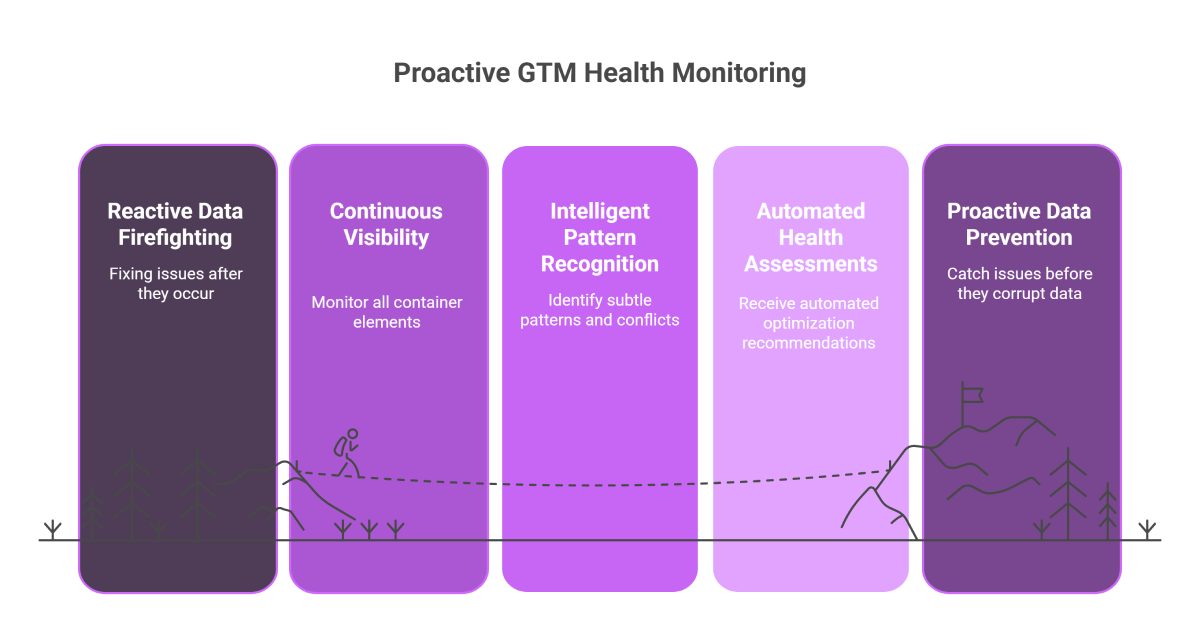
What if you could examine every element of your GTM container continuously - identifying issues before they corrupt your data? That’s the fundamental question driving modern approaches to container health management.

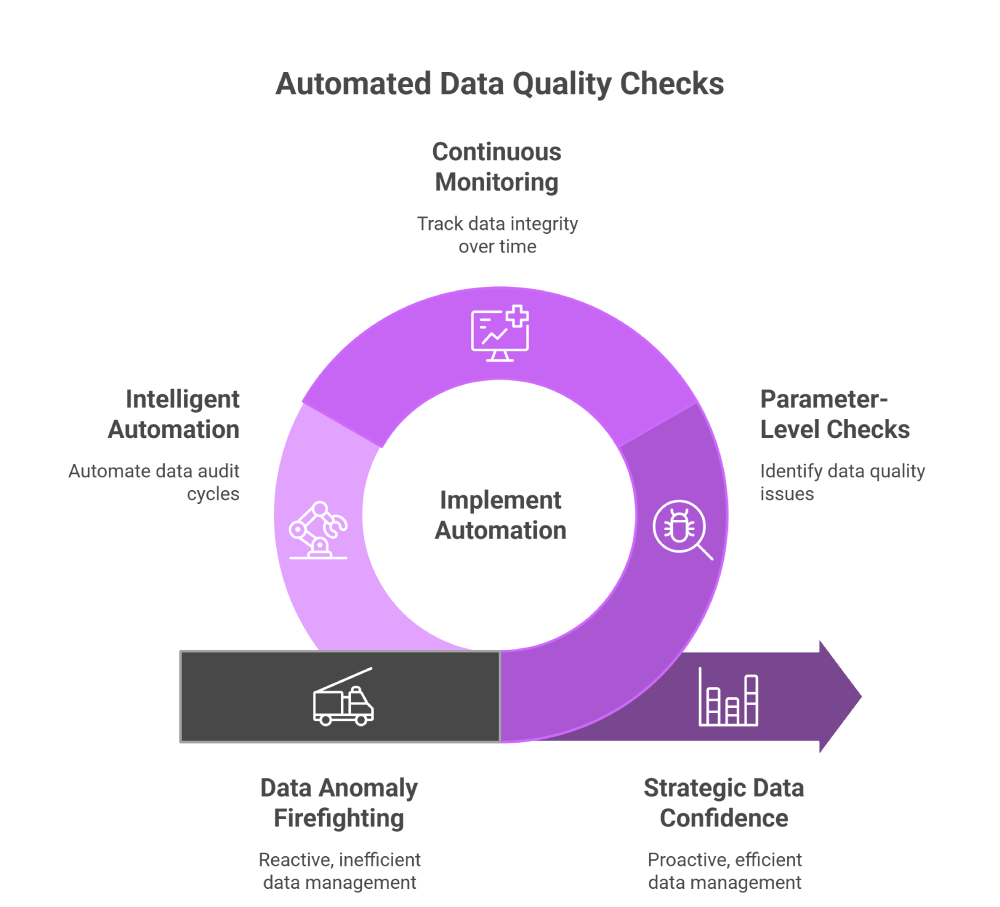
AI-powered health monitoring represents a shift from periodic audits to continuous intelligence. Rather than checking a fraction of your container occasionally, these systems examine everything constantly - learning patterns, identifying anomalies, and flagging potential issues before they impact data collection.

The underlying principle: Prevention beats remediation. Understanding container health in real-time enables proactive maintenance rather than reactive firefighting.

Assess your current GTM health and uncover hidden issues, we can walk you through it → Book a free consultation

1. Complete Container Visibility

Modern monitoring systems examine every element continuously - every tag, trigger, variable, and connection. Unlike manual processes that sample configurations, automated data quality checks achieve 100% coverage.

What continuous monitoring reveals:

  • All tags and their firing status in real-time
  • Potential conflicts between tags before they cause problems
  • Container size and its performance impact
  • Unused elements cluttering your setup
  • Connections to downstream platforms
  • Overall GTM container health metrics

Nothing slips through the cracks. You gain complete visibility that manual Google Tag Manager audit processes simply cannot match.

2. Intelligent Pattern Recognition

Advanced systems don’t just flag obvious errors - they identify subtle patterns that indicate emerging problems. By analyzing how tags interact, when they fire, and what data they pass, these systems detect conflicts before they cause measurement failures.

For instance, the system might notice that a new tag’s firing pattern overlaps with existing tags in ways that could create race conditions. Rather than waiting for data corruption to surface in reports, you receive early warnings about potential issues.

This proactive approach prevents measurement failures rather than documenting them after damage occurs. That’s data quality automation at its most effective - catching problems before they become problems.

3. Automated Health Assessments

Instead of manual spreadsheet reviews, modern systems provide automated health assessments. They identify ghost tags and unused elements, calculate container efficiency metrics, and recommend specific optimizations.

It’s analogous to having continuous code review for your measurement infrastructure - systematic evaluation that catches issues human reviewers might miss. Your container stays lean and performant without constant manual effort.

4. Real-Time Integration Monitoring

The system continuously validates connections between GTM and all downstream platforms. If a connection breaks or degrades, you know immediately - not weeks later when numbers look unusual.

This continuous monitoring ensures your tag management optimization efforts actually deliver results rather than creating new blind spots.
The Business Impact

Organizations implementing AI-powered solutions to automate data quality experience measurable improvements across operations.

1. Shift From Reactive to Proactive

GTM audit processes that previously consumed 6-8 hours now complete automatically in minutes. More importantly, the shift from periodic audits to continuous monitoring fundamentally changes how teams approach container health. Specialists work on what actually moves the needle - strategy, optimization, growth initiatives.

2. Earlier Issue Detection

Automated data quality checks catch issues before they impact collection. Problems get resolved during scheduled maintenance rather than emergency sessions. You shift from reactive firefighting to proactive prevention - maintaining GA4 data integrity without constant crisis management.

3. Measurable Performance Improvements

Optimized containers mean faster page loads and better user experiences. Organizations see measurable Core Web Vitals improvements after implementing systematic cleanup. Users stay longer, convert more often, and provide more behavioral data.

4. Continuous Compliance Monitoring

Automated monitoring helps ensure tracking complies with evolving privacy regulations. You can quickly identify and address potential compliance issues before they become legal problems. This automated data quality management provides ongoing compliance visibility without constant manual oversight.

The 5-Pillar Measurement Excellence Framework

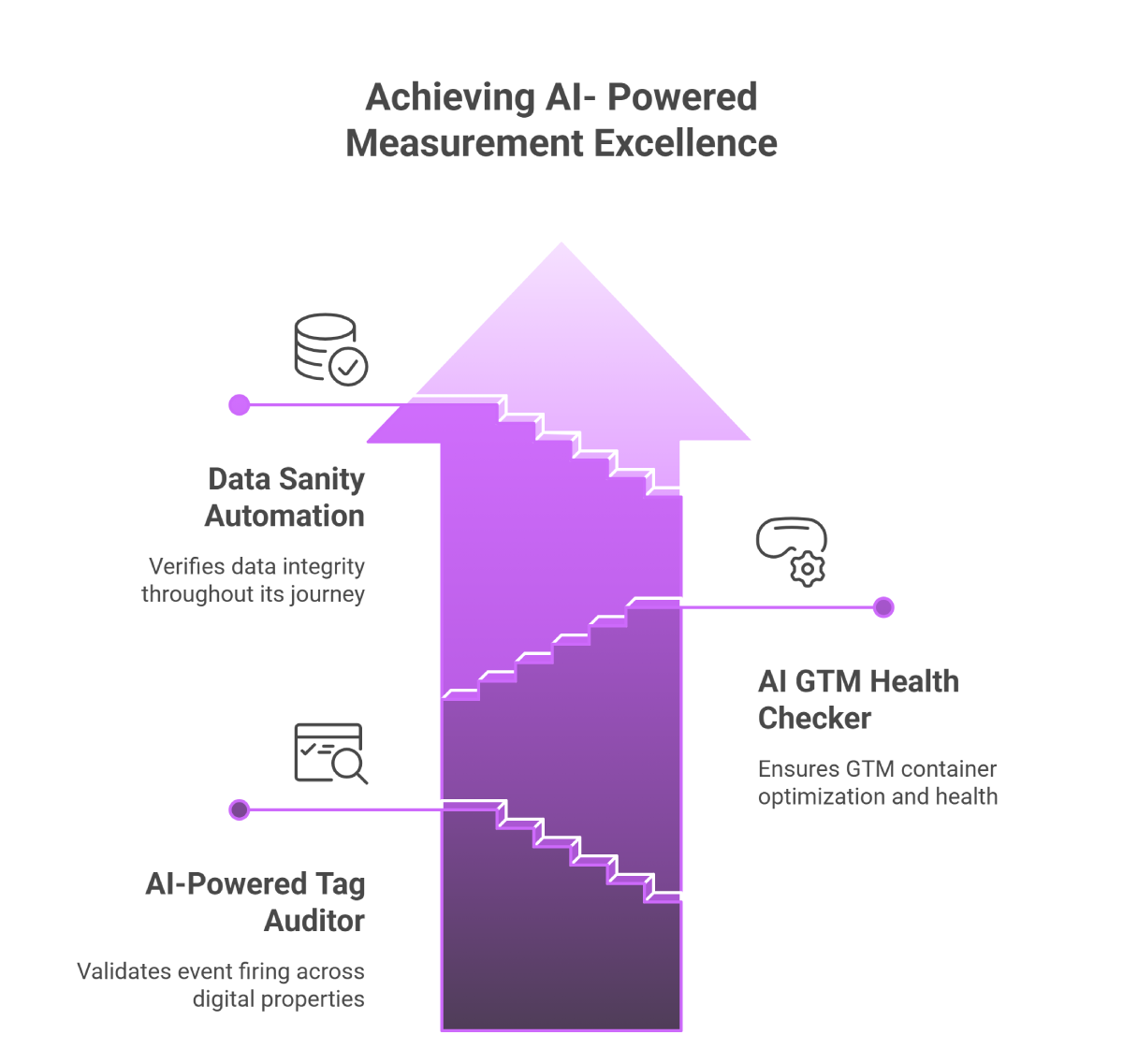
The complete picture of tag management optimization becomes clear through a comprehensive five-pillar approach:

Pillar 1: AI-Powered Tag Auditor validates events fire correctly across your properties, confirming implementation quality in real-world conditions.

Pillar 2: AI-Powered GTM Health Checker ensures your container is optimized at the source, maintaining GTM container health continuously.

Pillar 3: Data Sanity Automation verifies data maintains integrity throughout its journey into GA4, ensuring what lands in reports is trustworthy.

Pillars 4 & 5: Two additional elements complete the framework, addressing advanced aspects of analytics infrastructure and continuous optimization.

Together, these create comprehensive protection for data integrity - from configuration through collection to validation. This integrated approach represents a fundamental shift. Instead of waiting for problems, you continuously monitor health at every stage and catch issues before they cause damage.
Your Path Forward

The evolution of Google Tag Manager audit processes points toward automation, intelligence, and continuity. Organizations adopting these approaches gain measurable advantages - faster websites that convert better, more reliable tracking that supports evidence-based decisions, and greater confidence in measurement foundations.

Manual audits will always have coverage gaps. Reactive troubleshooting will always cost more than proactive prevention. The question isn’t whether GTM health issues exist in your container - they likely do.

The real question: Will you discover and address them before they compromise your data quality and impact business decisions?

Take the first step toward measurement excellence. Schedule a Free Consultation and Explore AI-Powered GTM Health Checker

Understanding your container’s actual health state, rather than assuming it’s fine - represents the first step toward building truly reliable measurement infrastructure.

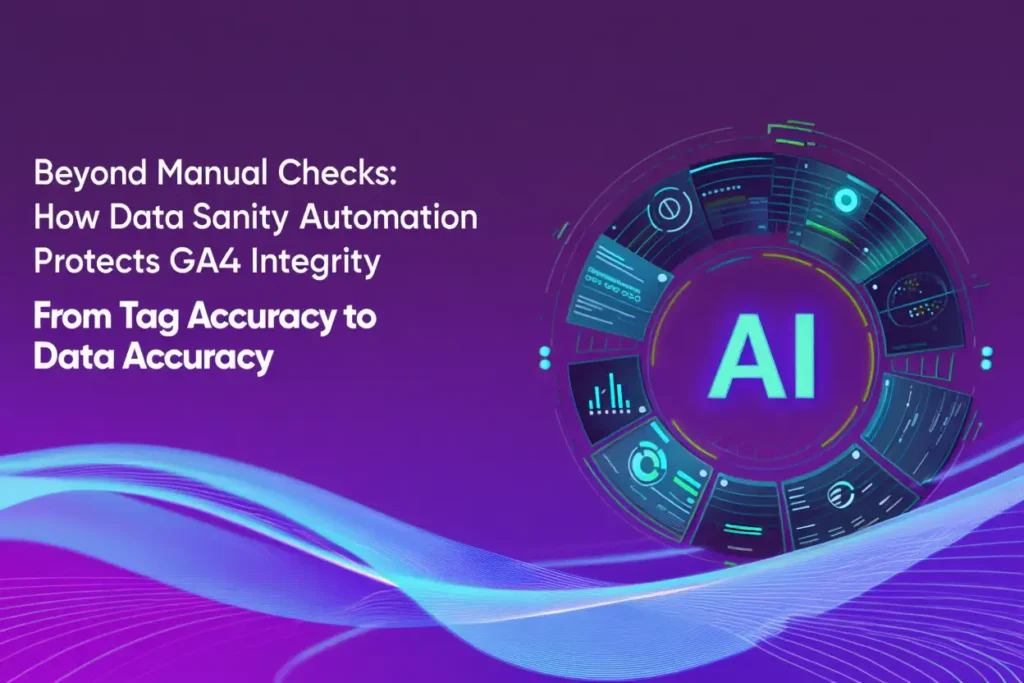
Beyond Manual Checks: How Data Sanity Automation Protects GA4 Integrity

From Tag Accuracy to Data Accuracy

In our comprehensive exploration of the AI-Powered Tag Auditor, we uncovered a foundational truth: making sure events fire correctly at the source is absolutely crucial for reliable measurement. When tags are properly validated and firing as intended across your websites and applications, many organizations breathe a sigh of relief, thinking their data integrity challenge is finally solved.

Why Perfect Tagging Isn’t Enough?

But here’s the thing - the story doesn’t end with successful tag firing. Even with perfect tagging implementation, your data can lose its integrity during that complex journey into GA4. Parameters can get corrupted during transmission. Critical fields may default to ‘not set’ values. Compliance violations can slip through unnoticed. Gradual data drift erodes accuracy over time..

This is precisely where data sanity automation becomes not just useful, but absolutely essential - fundamentally transforming how organizations approach data integrity in GA4. 

  • Tag Auditor protects data quality at the point of collection,
  • Data sanity automation ensures that what ultimately lands in GA4 remains trustworthy, complete, and ready to support those business-critical decisions you’re making every day.

Why Manual Data Checks Fall Short

The traditional approach to ensuring data accuracy in analytics has long relied on manual validation processes. You know the drill - data analysts regularly extract samples from GA4 reports, manually review parameters across different events, scan for obvious anomalies, and document their findings in spreadsheets for stakeholder review.

This approach worked well when ecosystems were simpler. However, in today’s complex measurement landscape, manual GA4 data audit processes create fundamental limitations that compromise data reliability.

The core bottlenecks are systemic and costly:

  • Limited Scope and Coverage: Manual checks only scratch the surface. Even the most experienced analysts can review a handful of parameters, leaving the rest unchecked. When your organization tracks hundreds of events with dozens of parameters each, manual sampling becomes woefully inadequate for comprehensive automated data quality checks.
  • Human Error and Inconsistency: Different analysts may interpret the same data differently, leading to inconsistent assessments of data health. What one person flags as problematic through parameter-level checks, another might overlook entirely, creating gaps in event schema validation.
  • Resource Drain Without Guarantees: Hours spent on repetitive manual processes still provide no guarantee of catching critical issues across complex data structures, making it impossible to ensure consistent data accuracy in analytics.
  • Detection Delays: By the time issues are manually discovered and documented, weeks of potentially corrupted data have already influenced your dashboards, reports, and business decisions, undermining data integrity in GA4.
The outcome? Wasted time, missed insights, and declining confidence in the data foundation that’s supposed to drive growth.


The Hidden Errors That Distort Your Decisions

Real-world GA4 data audit findings reveal common patterns that directly undermine business intelligence and decision-making accuracy. These issues represent systemic challenges across industries that effective data sanity automation can prevent:

  • Currency and Revenue Distortions: E-commerce implementations frequently suffer from currency mismatches where revenue reports display “not set” values or incorrect currency codes. This breaks ROAS calculations, distorts international performance comparisons, and leads to misallocated advertising budgets across markets. Without proper automated data quality checks, these errors compound over time.
  • Product Data Inconsistencies: Truncated or inconsistent item names in product tracking create false signals in merchandising analytics. When event schema validation processes fail to catch these naming issues, inventory decisions, promotional strategies, and product development priorities become based on flawed intelligence rather than accurate customer behavior data.
  • Event-Level Accuracy Gaps: Funnel analysis becomes unreliable when different events show dramatically different accuracy rates. For instance, when add-to-cart events register only 60% accuracy while checkout events show 100% completion, conversion optimization efforts target the wrong bottlenecks entirely, wasting resources and missing real opportunities.
  • Attribution Model Failures: Missing or corrupted client IDs and user identifiers fundamentally compromise attribution modeling capabilities. Without systematic parameter-level checks, customer journey analysis becomes guesswork rather than science, undermining personalization and retargeting efforts.
  • Compliance and Privacy Violations: PII data accidentally captured in event parameters creates significant regulatory risk that manual reviews often miss due to their limited scope and inconsistent application.

These aren’t minor technical glitches - they represent systematic failures in data integrity in GA4 that directly distort business-critical reporting and strategic decision-making processes.

Learn how Agentic AI secures data collection and builds a reliable measurement foundation in our detailed guide - From Broken Signals to Trusted Insights

Poor data quality costs organizations an average of 15-25% of their operating budget, with some reporting losses as high as $15 million annually due to data quality issues.

Enter Data Sanity Automation: Always-On Accuracy

Tatvic’s data sanity automation solution transforms this entire paradigm through comprehensive, intelligent validation that operates continuously rather than periodically, ensuring consistent data accuracy in analytics.

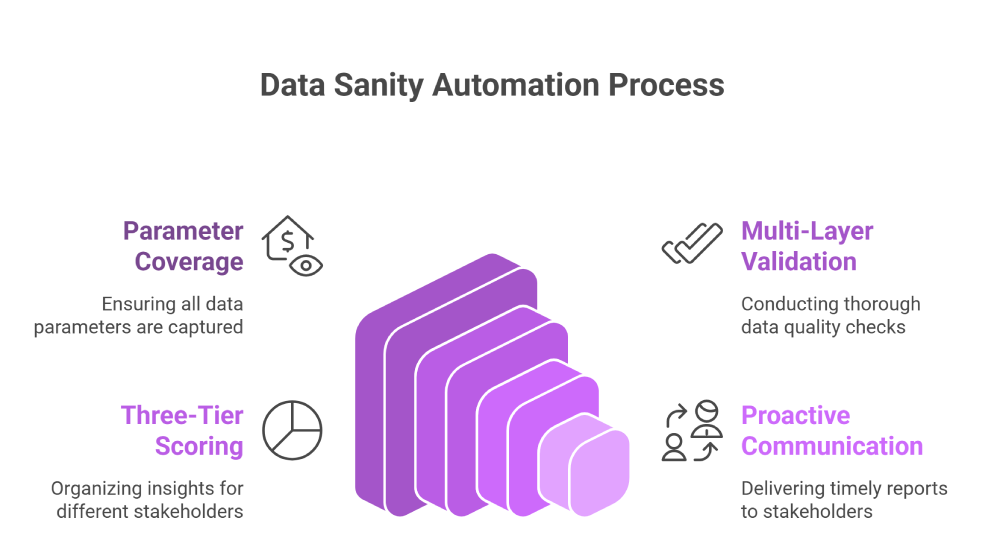
The system fundamentally differs from manual approaches through several key innovations:

  1. Complete Parameter Coverage: Unlike manual sampling that can only check a fraction of available data, the system leverages GA4 APIs to capture and examine every parameter across all events simultaneously. This comprehensive approach eliminates the blind spots that plague traditional GA4 data audit methods.
  2. Sophisticated Multi-Layer Validation: The system runs intelligent automated data quality checks including currency code verification, product naming consistency analysis, parameter completeness assessment, invalid character detection, PII identification, and data drift monitoring across time periods.
  3. Intelligent Three-Tier Scoring Framework: Results are organized into actionable intelligence layers:
  • Overall data integrity scores providing executive-level visibility into complete data health
  • Event-level reliability metrics enabling tactical prioritization of fixes through systematic event schema validation
  • Parameter-level checks delivering technical teams specific resolution guidance for immediate action

4. Proactive Stakeholder Communication: Rather than relying on manual documentation and delayed                 reporting, the system generates detailed automated reporting for GA4 that reaches relevant stakeholders                   immediately, enabling rapid response to data quality issues before they impact business decisions.

This AI-powered data audit approach transforms continuous data monitoring from an aspiration into an operational reality, ensuring data integrity in GA4 becomes a competitive advantage rather than a constant concern.

Data Sanity Automation Impact Across Teams

For Data Analysts: From Firefighting to Strategic Analysis

Data sanity automation fundamentally transforms the analyst experience by eliminating the tedious, repetitive work that currently consumes a large portion of their time.

  • Dramatically Reduced Manual Work: Hours of sampling, checking, and documenting now happen automatically in minutes.
  • Faster Issue Resolution: Real-time alerts with parameter-level guidance cut investigation time from days to hours.
  • Enhanced Analytical Confidence: Analysts can trust their insights because data validation runs continuously in the background.
  • Strategic Value Creation: Freed from repetitive validation tasks, analysts can now prioritize advanced analysis and predictive modeling

For Marketing Managers: Accurate Insights Drive Better Decisions

Marketing teams gain immediate operational advantages that directly impact campaign performance and budget allocation.

  • Accurate Campaign Reporting: Real-time checks ensure conversions, attribution, and ROAS reflect actual performance, not guesswork.
  • Smarter Budget Allocation Decisions: Continuous validation directs spend to channels that truly perform, not just those that look good on paper.
  • Faster Campaign Optimization: Detect issues instantly and pivot strategies quickly to keep campaigns on track.
  • Compliance Peace of Mind: Automated privacy and PII checks help marketing stay compliant compliant with GDPR, CCPA, and other regulations without requiring constant manual oversight.

For Executives and CDOs: Strategic Confidence at Scale

Leadership gains the strategic advantages necessary for bold decision-making and competitive positioning:

  • Strategic Decision Confidence: Make high-stakes decisions quickly, knowing your data is continuously validated and reliable. Eliminating hesitation in major strategic decisions.
  • Faster Go-to-Market Execution: Launch products and enter new markets with confidence, without waiting for manual checks. 
  • Competitive Advantage Through Speed: Automated data integrity lets your organization act faster on opportunities, leaving competitors tied down by slow, error-prone validation.
  • Risk Mitigation and Governance: Continuous monitoring provides peace of mind with regulatory compliance, accurate reporting, and governance - all without the extra effort.

Critical Business Risks of Manual Gaps

When automated data quality checks fail or remain incomplete, the business consequences extend far beyond technical inconvenience:

Campaign Performance Distortion: Inaccurate conversion tracking leads to misallocated advertising spend, with budgets flowing toward underperforming channels while high-value opportunities remain underfunded. Without reliable data sanity automation, marketing teams operate on false signals.

Revenue Forecasting Errors: When GA4 data audit processes miss revenue reporting inconsistencies, financial planning, investor communications, and strategic resource allocation decisions become based on fundamentally flawed assumptions that can impact company valuation and growth projections.

Attribution Model Breakdown: Poor data accuracy in analytics makes it impossible to understand true customer journeys, leading to suboptimal experience design, missed retention opportunities, and ineffective personalization strategies that reduce customer lifetime value.

Compliance and Risk Exposure: Manual event schema validation processes often miss PII violations or other regulatory issues that could result in significant legal and financial consequences, particularly under GDPR, CCPA, and other privacy regulations.

With comprehensive data sanity automation, these risks transform into opportunities. Decisions become backed by data you can trust, operations scale confidently, and teams can act on insights in real time rather than questioning their validity.

The Measurable Business Impact: From Firefighting to Strategic Advantage

Organizations implementing systematic automated data quality checks typically experience transformational improvements across multiple operational and strategic dimensions:

  1. Dramatic Accuracy Improvements: Data accuracy in analytics commonly improves from approximately 70% baseline levels to 95%+ following systematic issue identification and resolution guided by comprehensive parameter-level checks and continuous data monitoring.
  2. Operational Efficiency Revolution: GA4 data audit cycles that previously consumed 4-6 hours of skilled analyst time now complete in minutes through intelligent automation, freeing valuable human resources for strategic analysis, optimization work, and growth initiatives.
  3. Cultural and Operational Transformation: Teams fundamentally shift from reactive firefighting of data anomalies to proactive scaling of campaigns and initiatives with complete confidence in their measurement foundation and data integrity in GA4.
  4. Strategic Decision Velocity: Leadership gains the confidence to make bold, rapid decisions because continuous data monitoring through AI-powered data audit systems ensures that insights reflect reality rather than measurement artifacts or data corruption.
  5. Competitive Market Positioning: Organizations with reliable automated reporting for GA4 can respond to market opportunities faster than competitors still struggling with manual validation processes and unreliable data foundations.

The transformation extends beyond operational efficiency - data sanity automation converts analytics from an organizational liability into a genuine growth lever and sustainable competitive differentiator.

The Future of GA4 Measurement & Intelligent Automation

As we look toward the next evolution of measurement infrastructure, data sanity automation represents just the beginning of what’s possible when AI meets analytics:

AI-Driven Anomaly Detection

The next generation of data sanity automation will leverage machine learning to identify subtle patterns and anomalies that even comprehensive rule-based systems might miss. These intelligent systems will:

  • Learn Normal Patterns: AI algorithms will establish baseline patterns for each organization’s unique data ecosystem, making anomaly detection more precise and reducing false positives
  • Predict Data Quality Issues: By analyzing historical patterns, AI systems will predict potential data integrity problems before they occur, enabling proactive rather than reactive data management
  • Contextual Intelligence: Advanced AI will understand business context, seasonal patterns, and campaign cycles to distinguish between legitimate data changes and genuine quality issues

Predictive Insights for Campaign Optimization

Future measurement systems will extend beyond validation to provide predictive intelligence that directly drives performance improvements:

  • Performance Forecasting: AI-powered systems will analyze data quality trends alongside performance metrics to predict campaign outcomes and recommend optimization strategies
  • Attribution Optimization: Machine learning algorithms will continuously refine attribution models based on validated data patterns, improving the accuracy of customer journey analysis and budget allocation decisions
  • Real-Time Campaign Adjustments: Intelligent automation will automatically adjust campaign parameters when data quality issues are detected, maintaining performance while corrections are implemented

Integration with Personalization Engines and Multi-Touch Attribution

The convergence of data sanity automation with other intelligent systems will create unprecedented opportunities for sophisticated customer experience optimization:

  • Verified Personalization Data: Clean, validated customer behavior data will power more accurate personalization engines, improving customer experiences and conversion rates
  • Enhanced Attribution Modeling: Multi-touch attribution systems will operate on verified interaction data, providing more accurate insights into customer journey effectiveness and channel performance
  • Cross-Platform Intelligence: Integrated systems will validate and synchronize data across multiple platforms and touchpoints, creating unified customer profiles that support advanced marketing automation and experience optimization

Building the Future of Intelligent Data Measurement

This technological progression tells a complete story of measurement evolution: With the AI-Powered Tag Auditor, we ensured data fires correctly and consistently at the source. With data sanity automation, we validate that data maintains complete integrity throughout its complex journey into GA4 and beyond.

Together, these solutions represent how Agentic AI is fundamentally transforming data management from reactive, manual patchwork into a trusted, intelligent, and automated system that scales seamlessly with organizational growth and complexity.

The larger strategic picture becomes clear: intelligent automation doesn’t merely solve individual technical problems - it creates a comprehensive, adaptive shield around data integrity in GA4. This ensures that every downstream application, from attribution modeling to AI-driven personalization systems, operates on a foundation of verified accuracy rather than assumed reliability.

Your Path to Continuous Data Confidence

The future of measurement is automated, intelligent, and operates 24/7 without human intervention. Data sanity automation represents more than a technical upgrade. It is a fundamental shift toward measurement systems that scale with ambition rather than constraining it.

Organizations that embrace this evolution gain sustainable competitive advantages: faster decision-making, accurate attribution, better campaign performance, and the confidence to invest in growth initiatives backed by trustworthy data.

Discover how Data Sanity Automation uncovers hidden data leaks in GA4.

Build continuous confidence for your growth initiatives. The next-generation measurement infrastructure is here, transforming how leaders ensure data integrity in GA4.

Common Myths About GA4 Data Integrity

Myth 1: “If Tags Fire Successfully, Data Integrity is Guaranteed”

Reality: Tag firing is just the beginning of the data journey. Even perfectly implemented tags can result in corrupted data due to transmission issues, processing errors, or parameter mismatches.

Solution: Comprehensive data sanity automation validates data integrity throughout the entire pipeline, from collection to reporting.

Myth 2: “Manual Sampling Provides Sufficient Data Quality Assurance”

Reality: Manual sampling typically covers less than 5% of available data parameters, creating massive blind spots. Critical issues often exist in the 95% of data that manual processes never examine.

Solution: Automated systems examine 100% of parameters across all events, eliminating blind spots that manual processes create.

Myth 3: “GA4’s Built-in Validation is Enough for Enterprise Needs”

Reality: GA4’s native validation focuses on basic data formatting and doesn’t catch business-specific issues like currency mismatches, PII violations, or custom parameter consistency problems that directly impact decision-making.

Solution: Advanced data sanity automation provides business-context validation that goes far beyond GA4’s basic technical checks.

Myth 4: “Data Quality Issues Don’t Significantly Impact Business Decisions”

Reality: Organizations regularly misallocate 15-25% of their marketing budgets due to data quality issues. Revenue forecasting errors from poor data integrity can impact investor relations and strategic planning at the highest levels.

Solution: Continuous validation ensures that business-critical decisions are based on accurate, reliable data rather than corrupted measurements.

Myth 5: “Automated Systems Create More False Positives Than Value”

Reality: Modern AI-powered data audit systems achieve higher accuracy in issue detection while dramatically reducing the time required for validation. The false positive rate is actually lower than human error rates in manual processes.

Solution: Intelligent three-tier scoring frameworks distinguish between critical issues requiring immediate attention and minor discrepancies that can be addressed during regular maintenance cycles.

Myth 6: “Data Sanity Automation is Too Complex for Most Organizations”

Reality: Leading data sanity automation solutions are designed for easy implementation and require minimal technical expertise to operate effectively. Most organizations see immediate value within days of implementation.

Solution: Modern automation platforms provide intuitive dashboards, automated reporting, and clear action items that make data integrity management accessible to all skill levels.

AI-Powered Tag Auditor: Automate GA4 Tag Audits for Reliable Data Integrity

Introduction

In our last blog, we highlighted a crucial principle: data integrity is not a checkpoint. It is an ongoing discipline, protecting every analytics journey from bad data and unreliable insights. Treating data integrity in analytics as a one-time task no longer works - websites evolve daily, campaigns get more complex, and customer interactions are constantly shifting.

Yet, many organizations still depend on manual tag audits. These audits once served as a safety net, but today they are slow, resource-heavy, and prone to error. Even a single implementation mistake like a missing GA4 purchase event or incorrectly mapped parameter can cause dashboards to break, reporting to misalign, and confidence to collapse.

Once leadership loses trust in data, decisions stall, campaigns underperform, and revenue potential slips away. This is precisely why businesses need an AI-powered Tag Auditor to transform their approach to automated GA4 tag audits.

The Current State: Manual Tag Audits

At first glance, manual tag audits look methodical. The typical process involves:

  • Preparing the event schema
  • Mapping events across customer journeys
  • Observing requests through browser DevTools
  • Recording findings in spreadsheets

But this approach shows cracks almost immediately:

  • Time-intensive → audits can drag on for days or weeks
  • Human error → testers miss small but critical payload mismatches
  • Inconsistent documentation → one tester’s notes rarely match another’s
  • Scalability issues → large sites or apps overwhelm teams

Instead of strengthening data integrity, the process creates fragility. Every new website feature or marketing campaign triggers another lengthy cycle. Teams repeat the same checks again and again, but errors still creep in through this outdated automated tag testing approach.

Meanwhile, analysts spend hours buried in logs rather than driving strategic insights. Stakeholders are left with inconsistent dashboards, questioning whether the numbers in GA4 are even accurate.

Put simply, manual tag audits are no longer built for the speed and scale of modern digital ecosystems. This is where tag auditing automation becomes essential for business success.

The Bottlenecks That Hurt

The true pain of manual auditing isn’t just inefficiency - it’s the bottlenecks it creates across the business.

  1. Signals not firing correctly → A checkout click or lead form submission may never appear in GA4.
  2. Inconsistent classifications → One tester marks an event “valid,” another flags it as “fail.”
  3. Repetitive cycles → Every product release or campaign update resets the audit process.
  4. Resource drain → Analysts spend hours firefighting instead of optimizing campaigns.
  5. Lost trust → Once executives see gaps in dashboards, they doubt the data altogether.

These challenges ripple across the organization. Marketing teams hesitate to scale campaigns. Product teams delay launches, waiting for “clean data.” Leadership grows skeptical of reporting, slowing decision-making.

In short, manual tag audits don’t just cost time. They erode the data trust that every business relies on to compete. An effective event validation tool can eliminate these bottlenecks entirely.

Why GA4 Needs Automated Audits More Than Ever

For most organizations, GA4 has become the source of truth for performance measurement. Campaign budgets, product roadmaps, and leadership dashboards depend on it. The GA4 migration has introduced higher complexity in events, schema drift, and more parameters that can break.

But when tags misfire even slightly - the downstream impact is massive:

  • Missed conversions → Paid media ROI appears lower than it is.
  • Faulty attribution → Campaigns that work get underfunded.
  • Skewed user journeys → Drop-offs or repeat purchases go untracked.
  • Eroded credibility → Executives question whether to act on analytics reports.

Real-world GA4 tracking failures happen more frequently than teams realize. Consider this scenario: an e-commerce site launches a flash sale, but the purchase completion event stops firing on mobile devices due to a recent site update.

Manual audits won’t catch this until the campaign ends - by then, thousands of conversions go untracked, skewing campaign performance data and wasting ad spend.

This is why ensuring GA4 data accuracy is not just a technical exercise - it’s a business necessity. Accurate tags power sharper insights, more efficient spend, and faster decisions. And that’s exactly where automated GA4 tag audits change the game.

Manual vs Automated Tag Audits: A Side-by-Side Comparison

Let’s put it side by side to understand why tag auditing automation is crucial:

Manual Tag Audits Automated GA4 Tag Audits
Relies on human testers Runs schema-based validation automatically
Prone to missed errors Eliminates human oversight gaps
Takes days or weeks per cycle Completes audits in hours
Documentation inconsistent Produces standardized, repeatable reports
Breaks down at scale Scales effortlessly across sites/apps
Resource-intensive Minimal human intervention required
Reactive approach Proactive continuous monitoring

The difference is not just speed. Automated tag testing guarantees precision, consistency, and confidence-qualities manual audits simply cannot sustain at enterprise scale.

Enter the AI-Powered Tag Auditor

This is where Tatvic’s AI-powered Tag Auditor enters the picture - purpose-built to solve the limitations of manual auditing. This advanced event validation tool represents the next evolution in tag auditing automation.

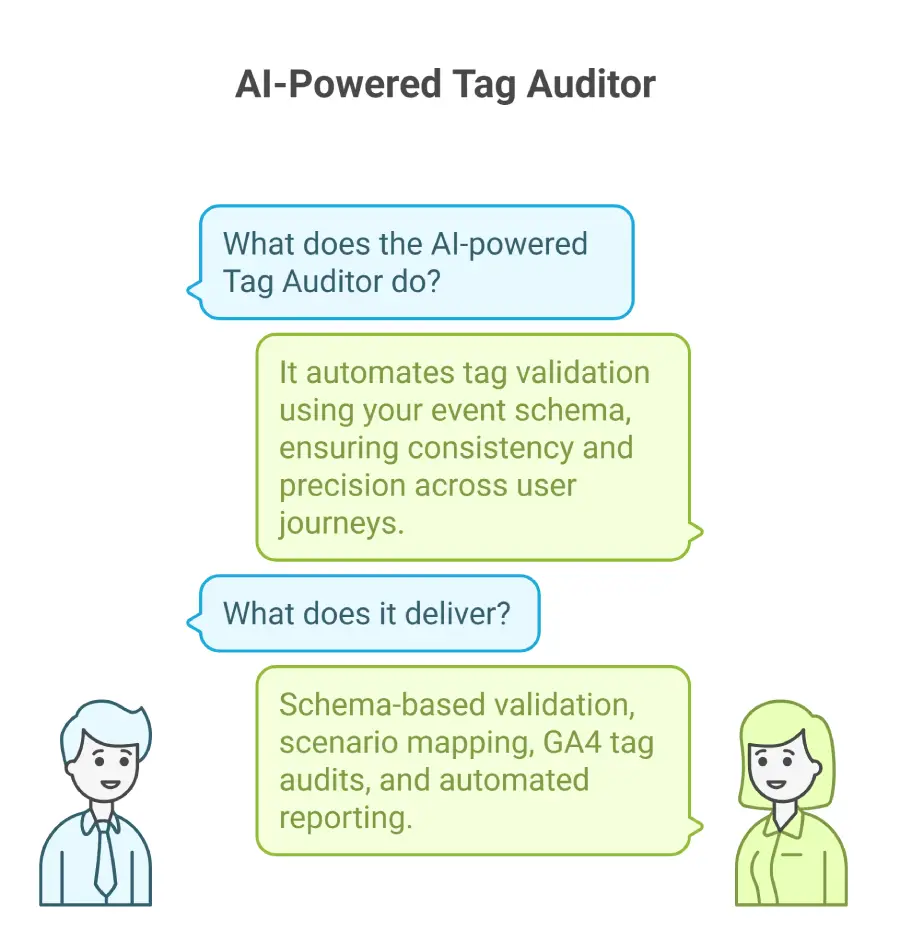
The tool automates every step of tag validation, using your event schema as its north star. Instead of analysts manually observing DevTools logs, the AI-powered Tag Auditor validates tags systematically, across journeys, with consistency and precision.

Here’s what it delivers:

  • Schema-based validation → every event checked against your blueprint
  • Scenario mapping → full user journeys tested end-to-end
  • GA4 tag audits → requests validated in real time
  • Automated reporting → results clean, structured, and bias-free

The outcomes are immediate:

  • Faster deployments → audits no longer block go-live
  • Continuous monitoring → auditing becomes ongoing, not one-off
  • Error-free validation → no oversights or inconsistencies
  • Protected data integrity → safeguarded across all properties

The biggest win is confidence. Teams no longer waste energy debating whether GA4 numbers are accurate. Leaders no longer second-guess dashboards. Campaigns launch faster because validation is built in.

How Continuous Tag Monitoring Protects Campaign ROI

Traditional manual audits operate on a “test once, deploy forever” mentality. But modern digital environments are dynamic - tags can break between audits due to site updates, third-party integrations, or code deployments.

This is where continuous tag monitoring tools become invaluable. Consider this scenario: if checkout clicks break on Day 2 of a high-spend campaign, manual audits won’t catch it in time. By the time the next scheduled audit occurs, thousands of dollars in ad spend could be wasted on seemingly “non-converting” traffic.

The AI-powered Tag Auditor positions itself as not just QA but ongoing insurance for your analytics investment. It continuously validates that:

  • Purchase events fire correctly across all devices
  • Lead form submissions reach GA4 without data loss
  • Campaign parameters track properly throughout the customer journey
  • Custom events maintain proper schema compliance

This continuous validation approach protects campaign ROI by catching issues before they impact business decisions. Marketing teams can confidently scale campaigns knowing their event tracking QA tool is monitoring performance 24/7.

In Action: How It Works

What makes the AI-powered Tag Auditor powerful is its simplicity:

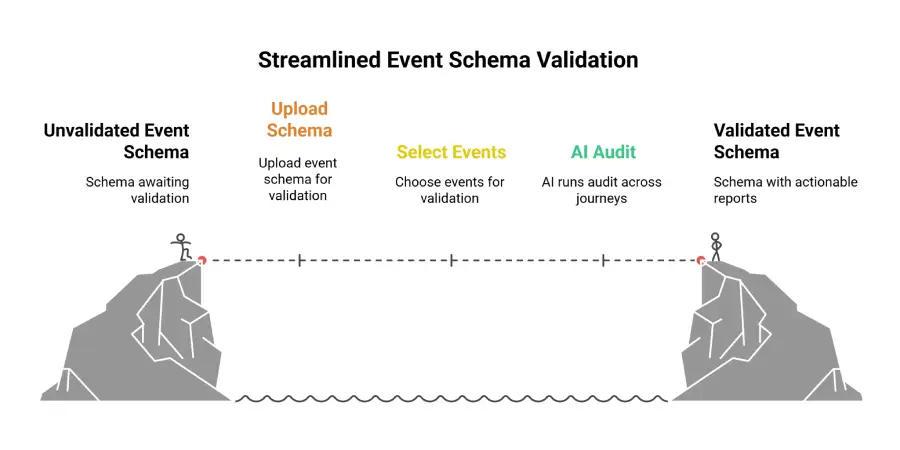
  • Upload your event schema
  • Select the events you want to validate
  • Let AI run the audit across journeys
  • Receive instant, actionable reports

Unlike manual audits, this automated tag testing tool checks multiple events simultaneously. It produces standardized reports every time. And it requires no additional team bandwidth.

Once the schema is uploaded, automated GA4 tag audits can be repeated anytime without starting over. That means QA cycles are shorter, release timelines are faster, and campaign launches move at the pace of business.

Organizations using the AI-powered Tag Auditor report audits completed ~70% faster than manual processes. What used to consume days now takes hours - a true transformation in tag auditing automation efficiency.

And it’s not just about speed, it’s about trust. The tool gives stakeholders confidence that their GA4 dashboards reflect reality. That every conversion, every lead, every signal is firing as intended.

How AI-Powered Tag Auditor Enhances Data Trust

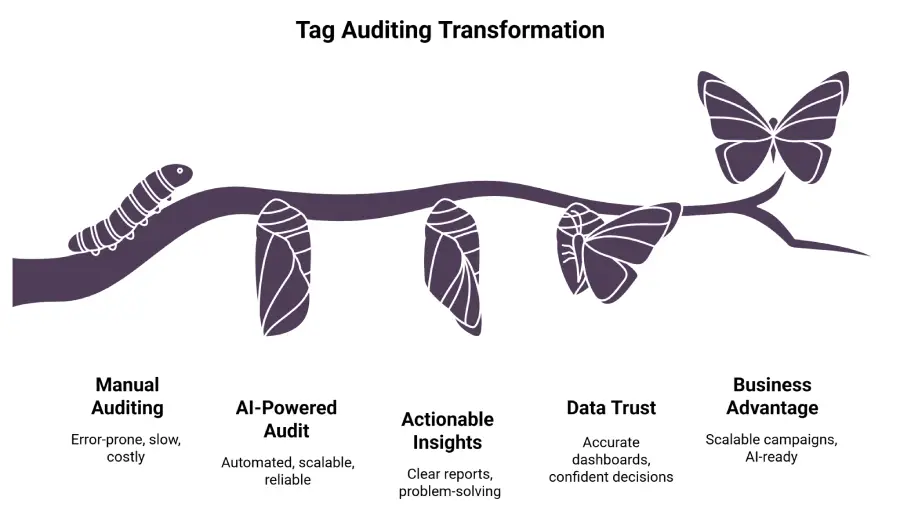
Trust in data is fragile. Once lost, it takes months to rebuild. Data integrity in analytics becomes the foundation upon which all business decisions rest.

The AI-powered Tag Auditor prevents this cycle by ensuring:

  • Accuracy & reliability → Every tag validated against schema, free from human bias.
  • Scalability → Audits run across multiple sites and apps, no extra resources needed.
  • Smarter insights → Reports flag missing events, highlight mismatches, and recommend fixes.
  • Executive confidence → Dashboards remain consistent, unlocking faster business decisions.

Instead of data being questioned, it becomes the trusted foundation for scaling campaigns, testing new strategies, and driving ROI. This event validation tool ensures that data integrity in analytics is maintained consistently across all touchpoints.

Benefits & Business Value

The value of Tatvic’s AI-powered Tag Auditor lies in its ability to transform auditing into a business advantage through comprehensive tag auditing automation.

  • Accuracy & reliability → Human error eliminated. Validation becomes consistent and repeatable.
  • Efficiency & scalability → One property or dozens, the tag monitoring tool scales seamlessly.
  • Smarter insights → Analysts move from firefighting to optimizing strategy.
  • Confidence in decisions → Leadership moves faster when dashboards are trusted.
  • Cost reduction → Fewer resources needed for ongoing automated tag testing.
  • Risk mitigation → Continuous monitoring prevents data integrity issues before they impact business.

Taken together, these benefits shift auditing from a drain on resources to a competitive edge. Instead of worrying about broken tags, teams focus on optimizing campaigns, driving ROI, and growing the business with reliable automated GA4 tag audits.

Closing Takeaway

Auditing doesn’t need to be slow or painful. With Tatvic’s AI-powered Tag Auditor, it becomes a source of speed, trust, and scale through advanced tag auditing automation.

  • No more broken tags disrupting dashboards.
  • No more wasted days on manual checks.
  • No more doubt in GA4 reports.

Instead, businesses gain reliable data integrity in analytics, faster releases, and insights they can act on with confidence. Our automated GA4 tag audits ensure that your analytics foundation remains solid while your business scales.

In today’s digital world, the winners aren’t just those who collect data - they are the ones who protect it at scale with intelligent event validation tools and continuous tag monitoring.

Schedule a call with Tatvic experts today and see how AI-powered Tag Auditor can transform your analytics with reliable automated tag testing and seamless GA4 data accuracy.

Stay tuned for the next blog in this series: Data Sanity - The Autonomous Agent That Ensures Your Analytics Pipelines Never Go Off Track.

From Broken Signals to Trusted Insights: How Agentic AI Secures Data Collection

In the realm of digital marketing, achieving successful campaigns hinges on one critical factor: data quality. 

Did you know that a staggering 80% of AI pilots fail due to fragile data foundations? Misguided decisions based on unreliable data can starkly undermine your marketing efforts. In this blog, we will dive deep into the data quality issues that plague organizations and explore how Agentic AI can turn broken data signals into actionable insights.

The Hidden Threat of Broken Data

Behind every underperforming campaign and misleading dashboard lies a silent culprit: broken data.

It doesn’t announce itself with alarms. Instead, it creeps in quietly:

  • A missing conversion tag here.
  • A mislabeled event there.
  • An integration that silently fails overnight.

By the time teams realize something’s wrong, weeks or even months of decisions have already been made on a shaky foundation.

Leaders frequently attribute poor performance to strategy missteps, implementation flaws, or even technological inadequacies. However, the core issue often lies upstream - the way data is gathered, validated, and transmitted. When data inputs fail, the entire system collapses, leading to missed opportunities and misallocated resources.

The Importance of Data Quality in Marketing

Data quality isn’t just about clean spreadsheets - it’s the foundation of business growth and decision-making. When it breaks down, entire strategies falter.

  • Gartner reports that poor data quality costs organizations an average of $12.9 million annually, draining resources that could otherwise fuel innovation and growth.

  • A Monte Carlo Data Quality Survey, found that businesses lose over 30% of their revenue due to poor data quality - a figure that highlights how broken signals directly impact the bottom line.

  • Analysts consistently warn that many data and analytics initiatives fail not because of strategy or execution, but because they are built on fragile, unreliable inputs.

The takeaway? Poor data quality isn’t a back-office problem. It’s a growth blocker that erodes trust, wastes budgets, and limits the ability of AI and analytics to deliver reliable insights.

So the critical question becomes: Where exactly does data break down in the collection process and how can Agentic AI solve it?

The Digital Platforms’ Data Collection Journey

Every organization today runs on a pipeline of customer and operational data. On the surface, it seems straightforward. But in reality, it’s a multi-step relay, where a dropped signal at any stage can compromise the entire system.

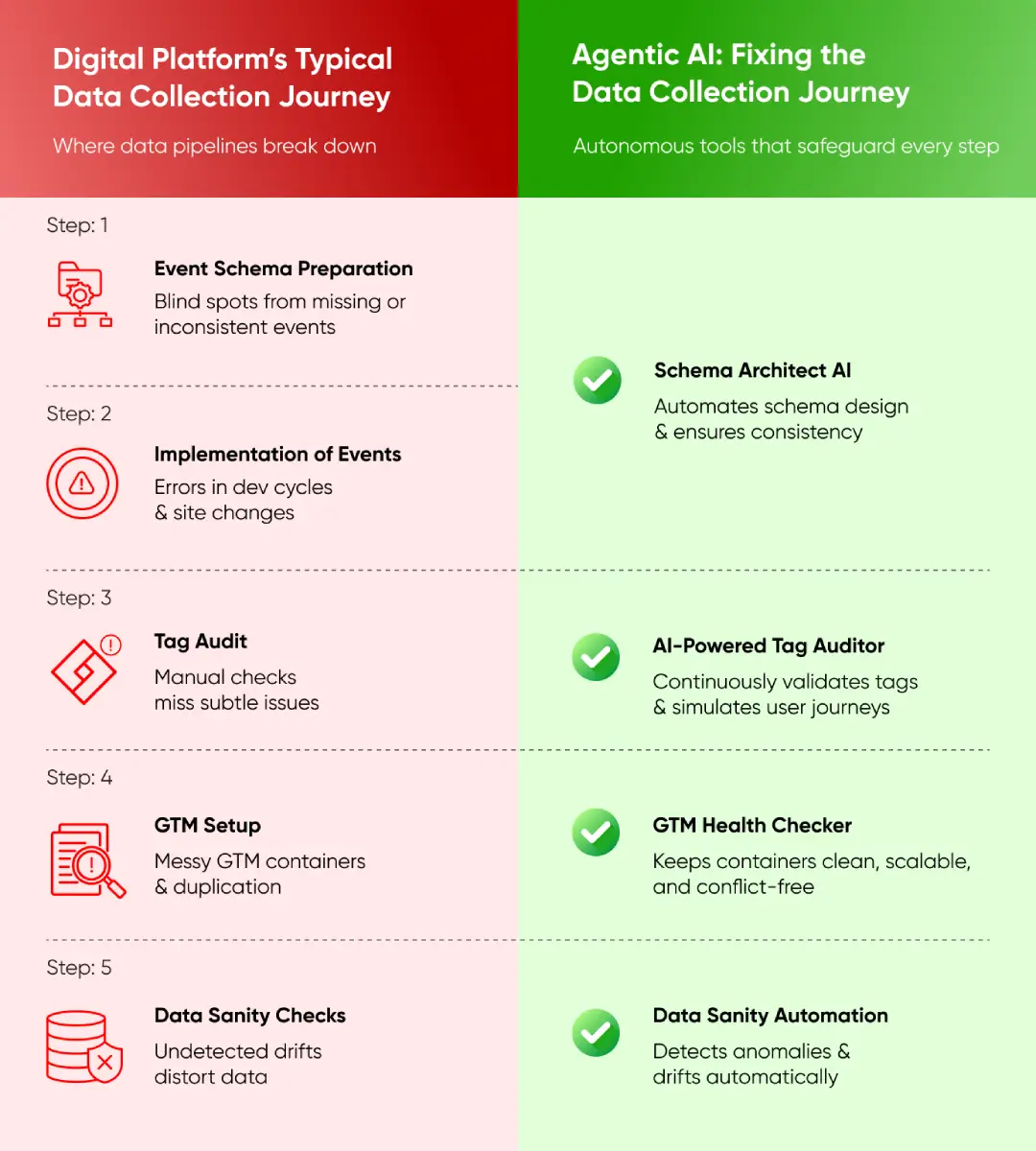
Here’s how the data journey typically unfolds:

1. Event Schema Preparation

The schema is the global master blueprint for measurement. It determines what user behavior (page views, sign-ups, purchases) is worth measuring, what parameters to record, and how to normalize naming conventions across platforms.

If events are misconfigured or tags are missing, the entire downstream system is compromised.

Where it breaks:

  • Missing or misconfigured tags create blind spots.
  • The same event is labeled differently across tools, fragmenting data.
  • Developers push updates without QA, introducing silent breaks.

2. Implementation of events

Developers build the data layers based on the schema. This is the all-important translation phase - converting the blueprint into live data signals that can be collected with analytics tools. The schema outlines what to track (events, parameters, user actions), and developers put this into the site or app code.

Where it breaks:

  • API updates that change field names but aren’t reflected in the connector.
  • Events failing to sync without immediate visibility.
  • Ad platform integrations sending incomplete or delayed data.

3. Tag Audit

After deployment, tags must be checked against the schema to ensure they are firing appropriately and at the correct times. Tag audits happen where data is gathered - when events exit the browser/app and enter analytics platforms.

Where it breaks:

  • Schema drift (categories change over time, leaving old ones behind).
  • Duplicate or incomplete records.
  • Metrics that don’t reconcile between warehouse and BI tools.

Over time, these inconsistencies create systemic blind spots, making reporting untrustworthy.

4. GTM Setup

Google Tag Manager is the orchestration center where tags, triggers, and variables are controlled. Events are also set inside the GTM container here, enabling disciplined tracking. A tidy, modular GTM setup simplifies updates and scaling.

Where it breaks:

  • Validation is skipped due to lack of bandwidth.
  • Checks are conducted reactively (only when something is clearly broken).
  • By the time issues are detected, budgets have already been wasted.

5. Data Sanity Checks

After data is persisted in GA4, sanity checks ensure that what’s being captured is expected. These involve audits of event volumes, parameter distributions, and anomalies over dimensions.

Where it breaks:

  • Campaigns optimized against faulty signals.
  • Budgets wasted due to unreliable attribution.
  • Stakeholder trust erodes when reports don’t align with reality.

Where It Breaks: The Silent Culprits of Data Quality Problems

Broken data doesn’t usually come from one catastrophic failure. Instead, it’s the cumulative effect of small, invisible cracks:

  • Tagging & Event Setup → Missing tags, mislabeled events, rushed deployments.
  • Data Transfer → API mismatches, failed syncs, incomplete ad platform integrations.
  • Data Storage → Schema drift, duplicates, unreconciled metrics.
  • Validation → Sporadic, manual, skipped entirely when resources are stretched.
  • Reporting → Dashboards aggregating incomplete or delayed signals.

By the time reporting surfaces these cracks, it’s already too late. Decisions have been made. ROI has leaked. Trust is lost.

According to Accenture, 63% of companies using AI are still “experimenting” without mature, problem-specific data architectures - leading to fragile systems that break under scale.

The Cost of Broken Signals

The consequences of weak data integrity ripple through the business:

  • Wrong optimization decisions → Campaigns tuned to noise instead of actual performance signals.
  • ROI leakage → Budgets wasted due to misdirected spend.
  • Erosion of trust → Executives question whether dashboards reflect reality.
  • Stalled AI adoption → 80% of AI pilots fail (Harvard Business Review) largely because they’re built on fragile, unreliable data foundations.

This isn’t about lacking data. It’s about not being able to trust the data you already have.

image-22

How Agentic AI Changes the Equation

Traditional approaches to data quality rely on manual audits, reactive fixes, and one-off validations. They’re slow, resource-heavy, and rarely keep pace with the complexity of modern data pipelines.

Agentic AI transforms this dynamic by acting as an autonomous guardian of the data ecosystem. Unlike static monitoring, it continuously observes, validates, and corrects issues across the pipeline - without waiting for humans to intervene.

Think of it as a living toolkit that self-heals your measurement backbone.

Agentic AI in Action

Here’s how autonomous agents step in at the most failure-prone steps:

1. Schema Architect 

  • Suggests the right events, parameters, and taxonomies based on business goals and industry benchmarks.
  • Runs automated tag audits to ensure every event is firing correctly.
  • Uses auto-capture to detect and log user interactions without relying solely on manual tagging.

Outcome: Fewer missed events, reduced developer dependency, and schemas that stay lean yet comprehensive.

2. AI-powered Tag Auditor

  • Continuously validates firing rules across GA4, GTM, and ad platforms.
  • Replicates real user journeys to catch hidden errors in event tracking.
  • Flags duplicate or unused tags before they bloat your GTM container.

Outcome: Cleaner, conflict-free tags and more trustworthy first-party data at the source.

3. GTM Health Checker

  • Monitors schema alignment in real time to prevent drift or anomalies.
  • Blocks flawed inputs from contaminating reporting dashboards and ML models.
  • Aligns event structures with downstream BI tools for seamless handoffs.

Outcome: Reliable data pipelines that support consistent decision-making and AI accuracy.

4. Data Sanity Automation

  • Automates post-deployment GTM audits so issues don’t slip through.
  • Runs continuous sanity checks on live data, spotting spikes, gaps, or abnormal patterns the moment they happen.
  • Converts one-off audits into permanent safeguards against recurring errors.

Outcome: A self-healing system that keeps data clean, even as your digital ecosystem evolves.

From Fragile Pipelines to Trusted Insights

The difference between broken signals and trusted insights isn’t just about accuracy - it’s about resilience.

With Agentic AI:

  • Every step of the data journey is validated and corrected continuously.
  • Leaders can operate with confidence in their dashboards.
  • Teams spend less time firefighting and more time driving growth.
  • AI adoption becomes sustainable because foundations are strong.

Instead of relying on sporadic audits, organizations gain a self-healing, always-on data backbone that keeps insights reliable at scale.

Checklist: Is Your Data Pipeline at Risk?

Ask yourself:

  • Are our tags and events validated automatically - or only during campaign launches?
  • Do our dashboards reconcile with warehouse numbers consistently?
  • How quickly do we detect schema drift or API mismatches?
  • Are data quality issues identified in real time - or after budget has already leaked?
  • Can our AI initiatives scale without fragile foundations?

If most of these answers aren’t reassuring, your pipeline is already showing cracks.

Closing Takeaway

Data integrity isn’t a one-time checkpoint - it’s a continuous process.

Agentic AI transforms fragile pipelines into resilient, self-healing systems, turning broken signals into trusted insights leaders can act on with confidence.

Don’t let cracks in your data collection slow growth.
Explore how Tatvic’s Agentic AI services can safeguard your data pipeline and unlock reliable AI insights at scale.

The Reason 80% of AI Pilots Fail: Broken Data

When you hear that 80% of AI pilots fail, it sounds shocking but not surprising. Many leaders assume the cause is a lack of AI maturity, limited technical talent, or organizational resistance. These are the usual explanations.

But one of the most overlooked reasons  AI pilots fail isn’t a lack of ambition or cutting-edge algorithms. It’s something far more fundamental, and often overlooked: broken data.

You’ve probably felt this pain first-hand - investments in AI pilots that promised ROI but never scaled, months of effort undermined by blind spots you only discover much later, and decisions based on dashboards that don’t reflect reality.

The culprit? Data that was never captured, misclassified, or silently broken before it ever reached your AI system.

Broken Data in the Real World

So, what does broken data really look like in the trenches of marketing and technology? Not abstract quality issues, but everyday failures that quietly sabotage AI pilots:

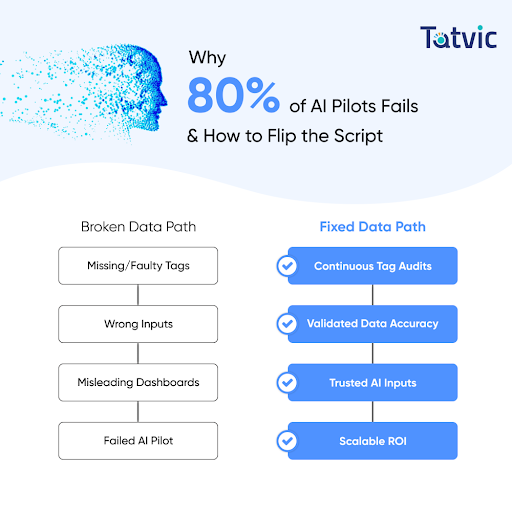
  • Missing tags: Your high-budget campaign runs, but a missing conversion tag means none of the outcomes are logged. When AI models try to optimize campaigns, they’re working blind.
  • Faulty tag implementation: Tags are present, but mapped incorrectly. A lead form submission shows up as a generic “page view.” The system optimizes for noise instead of real business signals.
  • Silent GA gaps: Critical customer interactions aren’t being collected in Google Analytics - and the team only realizes weeks later, when performance reports look suspiciously low. By then, opportunities are already lost.
  • Data layer pitfalls: Development teams are tasked with implementing tags via data layer snippets. Delays, overlooked dependencies, or small coding errors mean the AI receives patchy or inconsistent data.
  • Audit blind spots: Without systematic tag audits, broken setups persist unnoticed. AI models churn confidently on flawed inputs, creating outputs that look valid but steer strategy in the wrong direction.

This is the silent sabotage of broken data. It doesn’t show up with warning signs, it lurks in the background, distorting the foundation your AI relies on. By the time the issue is spotted, the pilot has already underdelivered.

Why Leaders Feel the Frustration

For senior leaders responsible for AI adoption, this problem is more than a technical nuisance - it’s a business headache.

  • Investment vs. outcome mismatch: You’ve funded an AI pilot expecting efficiency or revenue lift, only to see minimal impact because the underlying data collection was flawed.
  • Scaling failures: Even if a pilot works in a controlled environment, scaling exposes inconsistencies. Suddenly, broken tags or misaligned categories across regions or products amplify errors.
  • Eroding confidence: Each failed AI initiative creates skepticism across teams and the boardroom. Leaders hesitate to back new pilots, slowing transformation while competitors push forward.

This cycle repeats not because AI is inherently unreliable, but because the data feeding it is inaccurate, incomplete, or simply missing.

Why Broken Data Persists

If leaders know data accuracy and data quality are critical, why do broken setups continue to cripple AI pilots?

  1. Complex tracking environments: Modern marketing and analytics rely on hundreds of tags across websites, apps, and customer journeys. One misstep in tag setup snowballs into broken insights.
  2. Dynamic Environment - With the ever-increasing developments on Apps and Websites, it becomes difficult for analysts to keep up with audit requirements, even when new implementations get audited, older implementations are likely to be ignored.
  3. Speed over validation: In today’s fast-paced environment with tight deadlines,  teams often skip rigorous audits of tag setups and data collection pipelines. The result: projects and AI Pilots run on incomplete data.
  4. Lack of continuous monitoring: Most companies validate tags at setup but don’t continuously check database accuracy. Over time, integrations break, behaviors change, and data quietly drifts.

The bottom line: AI can’t outperform the data it’s trained on. If the signals are wrong, the outputs will be wrong - no matter how advanced the model.

AI Pilot ROI Depends on Data Trustworthiness

Here’s the hard truth: Agentic AI ROI depends less on the brilliance of the algorithm and more on the reliability of the data feeding it.

  • A personalization pilot with incomplete tags delivers irrelevant, even off-putting results.
  • A fraud detection model with wrong event categories flags real customers while missing fraud.

Without accurate, complete, validated data, even the best models collapse under weak foundations.

That’s why data trust is the first checkpoint before we deploy Agentic AI in any process. Once the foundation is stable, autonomous agents can focus on what they do best - driving measurable ROI at scale.

Want to see where autonomous agents can create the biggest business impact? Explore our blog on The Agentic AI Sweet Spot: Where Can Autonomous Agents Drive Maximum ROI in Your Marketing?

The Missing Link: Continuous Data Validation

The real solution isn’t a one-time audit or cleanup. Tagging setups and data pipelines degrade constantly - campaigns change, websites are updated, integrations break, and customer behavior evolves.

What’s needed is continuous validation of tags, categories, and data flows. Leaders need assurance that data collection is not only implemented correctly but remains reliable day after day.

This is where database accuracy and data quality shifts from back-office concerns to boardroom priorities. Because without them, AI initiatives are set up to fail.

Introducing Agentic AI for Smarter Data Measurement

This is exactly where Agentic AI for smarter data measurement comes into play.

Unlike traditional measurement, which checks outcomes after the fact, the Agentic AI Measurement toolkit intervenes throughout the AI lifecycle:

  • Continuously audits tags
  • Validates data accuracy in real time
  • Detects missing or misclassified inputs before they reach the model
  • Ensures trustworthy data streams that scale reliably

For leaders, this means confidence that:

  • GA events fire correctly
  • Data layers are error-free
  • AI models receive reliable signals - not distorted noise

In short: AI pilots built on validated, accurate data - pilots that actually deliver ROI.

From Pilot Failure to Scalable Success

The harsh truth is that AI pilot failure will remain the default until organizations confront broken data head-on. But the hopeful truth is this: with the right tools, leaders can flip the narrative.

  • From pilots that stall → to AI initiatives that scale.
  • From skepticism in the boardroom → to repeatable, measurable ROI.
  • From lagging behind competitors → to driving AI innovation that sticks.

This blog kicks off a new series on Tatvic’s Agentic AI for Smarter Data Measurement - the antidote to broken data.

In the coming weeks, we’ll dive deeper into how this toolkit goes beyond outcome reporting to continuously audit tags, validate database accuracy, and safeguard the integrity of your AI pipelines.

For now, the takeaway is clear: AI doesn’t fail - broken data does. Fixing it is the first step to unlocking meaningful, scalable AI ROI.

Want to ensure your AI pilots deliver measurable ROI, not broken outcomes? Discover how Tatvic’s Agentic AI Services can help you build smarter, scale faster, and achieve trustworthy AI adoption.

Explore Agentic AI Services

Bot Icon
Bot Icon

Tatvic Bot

Explore About Tatvic and Services