In 2024, Conversion Rate Optimization (CRO) is experiencing a transformative evolution with the integration of advanced technologies and innovative strategies. From AI-driven predictive analytics to immersive augmented reality (AR) experiences, businesses are redefining user journeys to enhance engagement and boost conversions. With 77% of companies already using or exploring AI and 83% prioritizing it, the importance of advanced analytics in modern marketing is undeniable [Source: Statista].
This blog explores the latest conversion rate optimization strategies, providing actionable insights to elevate your online presence and achieve measurable results. Learn how businesses are leveraging these advancements by leveraging conversion rate optimization services to stay competitive in the digital landscape.
What is conversion rate and why does it matter?
Before we begin exploring methods to increase conversion rates, it’s important to understand what a conversion rate actually encompasses. It’s not merely the number of customers who purchase your products; rather, your conversion rate refers to the number of people who perform any specific action you request on your site, whether that’s making a purchase, signing up for a newsletter, or filling out a contact form. The goal of conversion rate optimization (CRO) is to make the most of the traffic you already have by improving the user experience and persuading more visitors to convert.
Conversion Rate Optimization (CRO) is essential as it maximizes marketing investments by enhancing the value of every visitor, increasing the likelihood of conversion and boosting overall ROI. It directly increases revenue and reduces customer acquisition costs, as more value is gained from existing traffic. It also enhances user experience, making websites easier to navigate and more enjoyable, which can increase customer satisfaction and loyalty.
Now, let’s look at our top conversion rate optimization strategies.
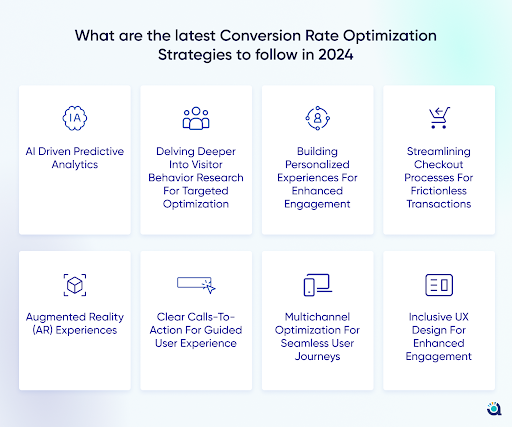 1. AI Driven Predictive Analytics:
In a world where 77% of companies are either already using or actively exploring AI, and 83% view it as a top priority, AI-powered predictive analytics stands out as an indispensable asset.[Source:Link] Utilizing AI-powered predictive analytics empowers businesses to anticipate user behavior with exceptional precision. Through analyzing extensive historical data, AI algorithms identify complex patterns, segment audiences, and predict future actions. This insight enables marketers to efficiently optimize campaigns, refine user experiences, and deliver highly targeted messaging, resulting in significant improvements in conversion rates.
Example -
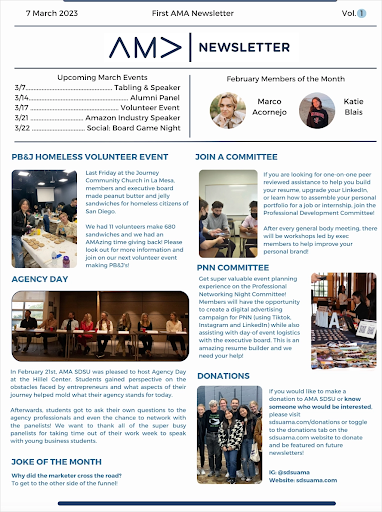
The American Marketing Association (AMA), a prominent global marketing organization, uses AI to personalize its newsletter for over 100,000 subscribers across diverse sectors. Through AI-powered automation and natural language processing, AMA has not only reduced monthly workload by over 75 hours but also achieved an impressive average open rate of 48%, contributing to a substantial increase in new readership.
Source
2. Delving Deeper into Visitor Behavior Research for Targeted Optimization:
In order to create online experiences that really hit the mark with your audience, it’s crucial to dive deep into understanding your visitors. That means using tools like heatmaps, session recordings, form analytics, and surveys to get a clear picture of how people are interacting with your site. These conversion rate optimization tools give you valuable insights into what your visitors want and what’s frustrating them, so you can tailor your online experience to meet their needs and preferences effectively.
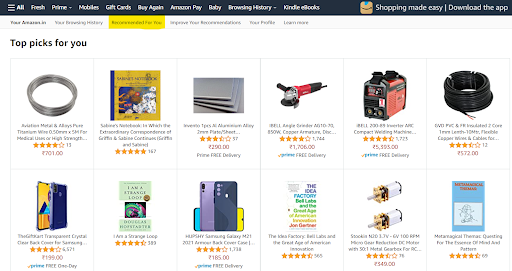
For instance, take Amazon, a global e-commerce giant renowned for its seamless shopping experience. Amazon excels in customer satisfaction by implementing features such as “Customers who bought this also bought” recommendations and personalized product suggestions. Moreover, they offer alternative payment methods and provide clear shipping information, eliminating last-minute surprises for customers and ultimately boosting conversion rates and customer retention.
Amazon’s success underscores the importance of optimizing the customer journey through visitor behavior research powered by efficient conversion rate optimization services. By studying how users interact with your website and leveraging data-driven insights, you can create tailored online experiences that meet the needs and preferences of your audience, ultimately driving engagement, satisfaction, and loyalty.

Source
3. Building Personalized Experiences for Enhanced Engagement
Ever been on a website where it feels like they read your mind? That’s the power of personalized experiences. It’s like having a personal shopper who knows your style and shows you exactly what you love.
Creating personalized experiences is like customizing each interaction with your customer to maximize their interest and action. It’s about understanding their preferences and behaviors so
well that every step of their journey feels tailor-made for them.
When customers feel like you understand them-whether it’s through personalized product recommendations, relevant content suggestions, or timely offers-they feel valued. And that feeling of being valued translates into loyalty. It’s not just about making a sale; it’s about fostering a long-term relationship where customers keep coming back because they know you ‘get’ them.
Here’s is why personalization is crucial for developing a high-quality customer experience:
Tailored Solutions: Personalization ensures that each customer receives products or services that align with their specific needs and preferences, enhancing satisfaction.
Enhanced Engagement: Customized experiences increase engagement by delivering relevant content, offers, and recommendations that resonate with each customer individually.
Improved Retention: When customers feel understood and valued, they are more likely to remain loyal to your brand, reducing churn rates.
Building Trust: Personalization fosters trust as customers perceive the brand as attentive and responsive to their individual requirements, leading to stronger relationships.
Increased Conversions: By delivering personalized experiences, businesses can improve conversion rates as customers are more likely to make purchases based on their personalized interactions and recommendations.
Long-term Value: Personalization not only drives immediate sales but also enhances customer lifetime value (CLV) by nurturing long-term relationships and repeat business.
Starbucks offers one of the best rewards programs known for its user-friendly interface and clear rewards structure. Their “Birthday Treat” program is a standout success, offering personalized birthday offers based on each user’s purchasing behavior. This initiative strengthens customer relationships, drives engagement, and builds brand loyalty. By leveraging address data, Starbucks customizes offers to enhance customer satisfaction and drive conversions effectively.

Source
4. Streamlining Checkout Processes for Frictionless Transactions
Imagine you’re in an online store, ready to buy something you really want. You’ve picked out your items and you’re excited to check out. But then, the checkout process feels like you’re stuck in a slow-moving line at a supermarket, not because of other shoppers, but because of all the extra questions and forms you have to fill out. Frustrating, right?
Just like in a real store, the checkout experience in online shopping can make or break your decision to purchase. It’s not just about paying; it’s about how smoothly you can complete your order.
According to the Baymard Institute’s 2023 summary of nearly 50 studies, 70% of shopping carts are abandoned during online purchases. Converting just a portion of these abandoned carts could lead to substantial revenue growth for businesses.
When the checkout process is quick and straightforward, it’s like finding the shortest line at the store’s checkout counter. You feel satisfied and more likely to come back for more shopping.
That’s where checkout process optimization comes in. It’s about making that online buying journey as effortless as possible-from adding items to your cart to hitting ‘confirm purchase’. Every step should be clear and simple, without unnecessary hurdles.
By fine-tuning each part of the checkout journey, businesses can reduce frustration and boost satisfaction. It’s all about creating a seamless experience that leaves customers smiling, not abandoning their carts.
Nike’s mobile checkout design adopts a streamlined three-step process.Against all odd, the form fields are minimal, the steps are quick to navigate, and all buttons and calls-to-action (CTAs) are prominently displayed and user-friendly, reducing friction for customers.
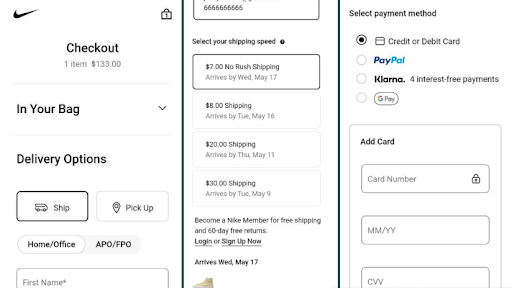
Three step checkout process (from left to right) on mobile version.
5. Augmented Reality (AR) Experiences
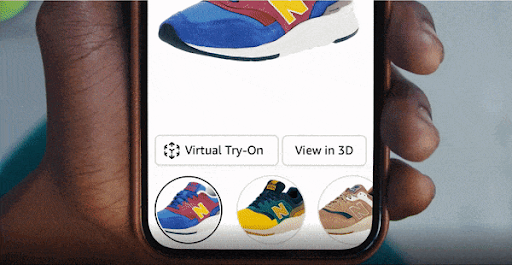
Augmented Reality (AR) enhances conversions by offering interactive product visualization, reducing purchase uncertainty, providing personalized recommendations, enhancing engagement, and generating positive word-of-mouth marketing. Through AR, customers can virtually try products in their real-world environment, leading to increased confidence and reduced abandonment rates.
For instance, according to Shopify, products featuring augmented reality (AR) content have 94% higher conversion rates.[Source:Engine Creative]. This finding demonstrates the potential of AR to not only increase engagement but also significantly impact eCommerce brands’ conversion rates. Additionally, AR can analyze customer preferences to offer tailored recommendations, further boosting conversion rates.
Imagine browsing through an online store and being able to visualize how a piece of furniture would look in your living room, or how a pair of sunglasses would fit your face, all in real-time and within your own physical space. This level of interactivity not only captures users’ attention but also bridges the gap between the digital and physical worlds, making the online shopping experience more immersive and dynamic

 6. Clear Calls-to-Action for Guided User Experience
Clear calls-to-action are essential for guiding users through the conversion process. It tells users what action to take next. Whether it’s “Buy Now,” “Subscribe,” or “Learn More,” CTAs guide users towards the desired conversion action, reducing confusion and increasing the likelihood of conversion.
CTAs improve website usability by providing clear direction and reducing friction in the user journey. When users know exactly what action to take and are encouraged to do so through compelling CTAs, they are more likely to convert, whether that means making a purchase, signing up for a service, or taking any other desired action.
Additionally, CTAs are excellent candidates for A/B testing, allowing businesses to experiment with different designs, copy, placements, and colors to determine which variations result in the highest conversion rates.
Furthermore, the influence of CTAs on conversion rates is quantifiable and can be refined over time. Through monitoring the performance of your CTAs, you can employ data-driven strategies to enhance their efficacy, whether by adjusting their positioning, color schemes, or text. This ongoing process helps you keep boosting your website’s conversion rates and get the most out of the traffic you’re bringing in.
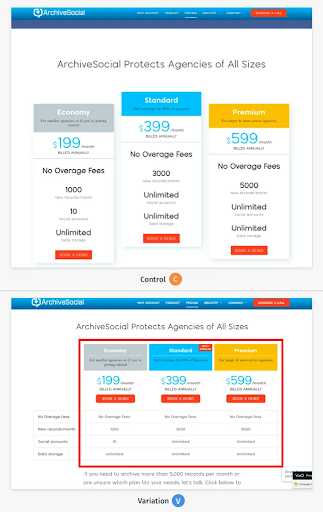
ArchiveSocial significantly enhanced their primary CTA’s visibility and effectiveness by relocating it to a prominent position above the fold and employing contrasting colors. This strategic adjustment resulted in a remarkable 101% increase in clicks on the form.[Source:VWO]
For instance, consider an e-commerce website with a prominent “Add to Cart” button strategically placed below each product image. This CTA directs user behavior by clearly indicating the next step in the purchasing process. Additionally, on a subscription-based service website, a clear “Sign Up Now” button at the top of the homepage enhances usability by providing users with a straightforward path to begin the registration process.

Source
 7. Multichannel Optimization for Seamless User Journeys:
Multichannel optimization is about ensuring that every step of a user’s journey, from discovering a brand to making a purchase, is smooth and seamless across different platforms like websites, social media, and emails.
Imagine it like this: we’re using various channels to reach users, whether it’s through a website, app, or email. And the main goal? Making sure their journey from first click to conversion is super easy. No bumps in the road.
To pull it off, we need everything to sync up perfectly. That means keeping our message and branding consistent across all those different channels. Whether someone’s checking out our Instagram or browsing the website, they should feel like they’re in the same universe.
But we’re not just guessing here. We’re using data to guide us. By keeping an eye on how users are moving through these channels and what they’re responding to, we can fine-tune things to give them an even better experience.


Source
In this Advertisement, this woman talks about how you can drive more traffic to your website with SemRush’s free website audit and keyword tracking and get tons of recommendations to boost your SEO instantly.
Similarly, the landing page that is associated with the ad has clear messaging and branding, helping viewers to reduce confusion and increase the likelihood of conversion.
8. Inclusive UX Design for Enhanced Engagement
When we talk about UX design, we’re really diving into how your website or app connects with every visitor. It’s not just about looks; it’s about making everyone feel welcome and understood from the moment they arrive.
Think of it this way: Imagine your digital platform as a friendly, intuitive guide that greets each user warmly and understands their needs right away. This initial interaction sets the stage for everything that follows. If your interface is seamless and appealing, users instantly feel at ease and valued.
Why does this matter? Well, studies consistently show that when users feel good about their experience, they’re more likely to stick around and take action-whether that’s making a purchase, signing up, or simply exploring more of what you offer.
By focusing on inclusive UX, you’re essentially removing barriers that could frustrate or alienate potential customers. It’s about creating an environment where everyone, regardless of background or ability, can navigate smoothly and find what they’re looking for effortlessly.
Ultimately, investing in inclusive UX isn’t just about making things look pretty (though that helps!). It’s a strategic move to boost your conversion rates and foster long-term customer satisfaction. When your digital space is inclusive and engaging, it becomes a powerful tool for growth, ensuring that every visitor feels valued and more inclined to become a loyal customer.
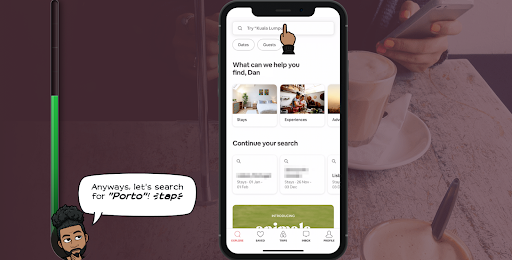
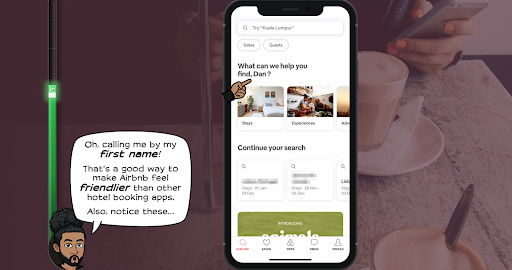
Airbnb exemplifies this approach through its commitment to seamless user experiences. Featuring a straightforward navigation menu with categories like “Homes,” “Experiences,” and “Places,” Airbnb ensures users can easily discover what they seek. The prominently displayed search bar further streamlines searches for destinations and properties.
Through rigorous A/B testing, Airbnb refined its booking process, resulting in an impressive 30% increase in user sign-ups. This dedication to user-centric design not only fueled Airbnb’s rapid growth but also cemented its leadership in the accommodations industry.
Leveraging Conversion Rate Optimization Services
As businesses embrace advanced technologies and data-driven strategies, optimizing Conversion Rate Optimization Strategies becomes essential for sustained growth and customer retention in 2024. Whether through the precision of AI-powered analytics, the immersive experiences enabled by augmented reality, or the personalized touch of inclusive UX design, businesses have a wealth of tools at their disposal. By continuously refining these conversion rate optimization strategies based on user data and feedback, organizations can not only enhance their conversion rates but also build lasting relationships with their customers.
Get in touch with Tatvic’s Certified CRO Specialists today to develop robust and successful conversion strategies!



 About Janvi Sharma