Hello There!

Lorem ipsum dolor sit amet, consectetur adipiscing elit,

Event Auto Capture: When Your Analytics Can’t Keep Up With Your Business

Discover how Tatvic’s Event Auto Capture eliminates manual tagging delays and delivers real-time GA4 analytics automation. Build data accuracy and scale measurement with AI-powered automation.

The Launch-Day Lag

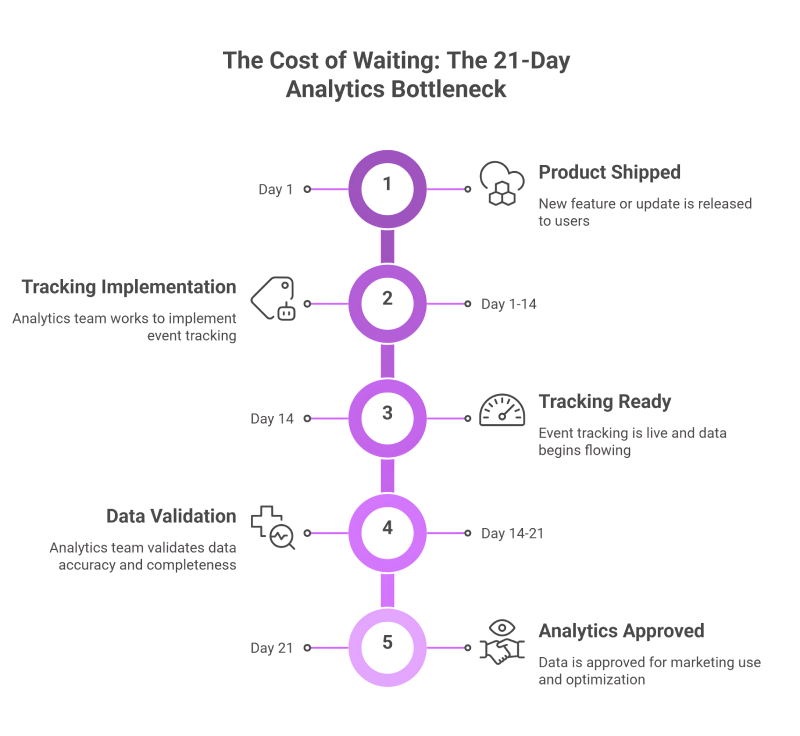
Your team just launched a new campaign - but analytics automation is still two weeks behind.

That’s not just a delay. It’s lost data accuracy. Missed insights. Momentum gone cold. The feature is live, users are interacting, but you’re optimizing based on assumptions instead of real-time analytics.

Your development team celebrates the deployment. Marketing fires up ads. Product managers wait eagerly for feedback. But the analytics dashboard? Still empty. Still waiting for tags to be configured, implemented, validated, and approved.

Here’s what nobody talks about: Why does analytics lag behind everything else in your stack? Your CRM updates instantly. Ad platforms report in real-time. Customer service tools track your every interaction live. But analytics? That’s trapped in manual cycles that feel increasingly out of place in a world that moves at digital speed.

Every innovation in your product roadmap hits the same wall - manual event implementation. And that wall is getting higher as digital analytics automation becomes essential rather than optional.

The Hidden Cost of Manual Tagging

Behind every “pending analytics” status lies a complex coordination dance that most organizations have simply accepted as inevitable.

Marketing needs the data to optimize campaigns. Developers are buried in implementation backlogs. Analytics teams are validating existing tracking while new requirements pile up. Everyone’s waiting on everyone else, and meanwhile, your campaign is live without the visibility needed to improve it.

First comes schema preparation - days of meetings to agree on what needs tracking, which parameters matter, and how events should be named. Different stakeholders bring different perspectives. Marketing wants certain dimensions. Product teams need different attributes. Analytics advocates for standardization. These discussions turn simple tracking requests into multi-week processes.

Then comes implementation dependency. Developers can’t build until schemas are finalized. QA can’t validate until implementation is complete. Marketing can’t optimize until validation confirms data accuracy. Each handoff adds days or weeks to the cycle.

Even when events are implemented, validation reveals gaps. A button was missed. A form submission lacks parameters. A CTA doesn’t track properly. 

It’s like rebuilding your data foundation every time you add a room to your house. The structure exists, but somehow you’re starting from scratch with every expansion.

Manual event implementation isn’t a technical flaw - it’s an operational speed trap that limits business velocity regardless of how skilled your teams are.


The Cracks Beneath the Surface: What’s Breaking Behind the Scenes

Let’s explore the breaking points that silently destroy GA4 data integrity: 

  • Configuration Bottlenecks

Preparing event schemas involves extensive documentation, stakeholder alignment, and approval workflows. What should take hours extends into weeks as teams coordinate across time zones, competing priorities, and endless clarification cycles. Every new page means restarting this process.

  • Coordination Delays

Manual event implementation requires constant synchronization between marketing (who needs data), developers (who implement tags), and analytics teams (who validate everything). Each group operates on different timelines with competing priorities. The coordination tax compounds with every new launch.

  • Human Errors

Even experienced developers miss events. Research shows manual processes miss approximately 40% of tracking requirements during initial implementation. A button gets overlooked. A form submission isn’t captured. A CTA lacks proper parameters. By the time validation catches missing events, if it catches them - you’ve lost weeks of user behavior data that affects data accuracy permanently.

  • Maintenance Overload

Every new page or feature compounds the problem. Your digital property grows, but your measurement coverage fragments into a patchwork of tracked and untracked elements. Developers spend time on repetitive maintenance instead of building differentiated features. Analytics teams chase missing events instead of deriving strategic insights.

  • Tracking Gaps

The most painful reality: when you launch new pages, analytics coverage starts at zero. Every element needs manual configuration. Marketing can’t optimize what it can’t measure. Product teams delay decisions waiting for data. Leadership makes strategic choices based on incomplete information because real-time analytics doesn’t exist during critical launch windows.

Each missed event represents a lost opportunity. Every delay means campaigns are optimized too late. When your event implementation takes 2-3 weeks, you’re not just behind - you’re optimizing yesterday’s reality with last week’s data.

The Shift: Why Manual Tagging Can’t Keep Up

The challenge isn’t your team’s skill level. It’s not about hiring better developers or more analytics specialists. The limitation is systemic - your analytics process was built for a different era.

Your analytics methodology was designed for quarterly releases, not daily sprints. For annual campaigns, not continuous experimentation. For desktop-only properties, not omnichannel ecosystems that span web, mobile, apps, and emerging platforms.

Modern marketing runs in real time. Features ship daily. Campaigns pivot hourly. Customer behavior shifts constantly. A/B tests run continuously. But measurement? That’s stuck in 2-3 week cycles that feel increasingly inadequate.
This is where Tatvic’s perspective becomes critical: Measurement shouldn’t lag behind marketing velocity. Digital analytics automation should enable business agility rather than constrain it. Data accuracy should be a competitive advantage, not a perpetual challenge.

If your event implementation takes 2-3 weeks, you’re optimizing yesterday’s features today. By the time tracking is ready, user patterns have shifted. Campaign performance has evolved. The moment for immediate optimization has passed.

You don’t need another manual audit. You need analytics automation that moves as fast as your business.

The Solution: Event Auto Capture

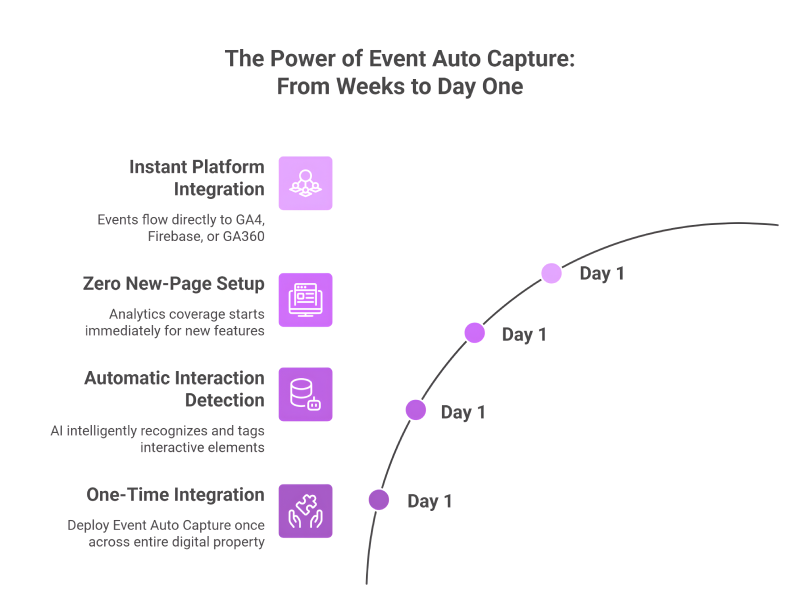
Event Auto Capture is a one-time integration that automatically detects and tracks user interactions - buttons, forms, media, and navigation - instantly. It represents a fundamental shift from manual configuration to intelligent event automation powered by AI.

Unlike traditional tracking that requires explicit setup for every element, event auto capture recognizes interactions and captures events automatically. This isn’t just faster - it’s a completely different approach to achieving data accuracy at scale.

How It Works

  1. Automatic New Page Detection: When developers launch new pages or features, the solution automatically recognizes them without requiring configuration updates. Your analytics coverage expands automatically as your digital property grows.
  2. Intelligent Event Capture: The AI-powered solution identifies interactive elements - CTAs, form submissions, navigation clicks, media interactions - and captures events with appropriate context and parameters. Currently supported interactions include:
  • Form submissions across all pages
  • CTA button clicks with context
  • Navigation button interactions
  • Interactive UI element engagements
  • Menu and icon selections
  • Media interactions (play, pause, complete)
  1. Instant GA4/Firebase Integration: Events flow directly to your analytics platform in real-time, maintaining GA4 data integrity from capture through reporting. No manual data layer configuration. No custom JavaScript. No deployment delays.
  2. Zero Manual Dependency: Launch a new feature in the morning, see real-time analytics by afternoon. The system eliminates the entire 2-3 week cycle that manual event implementation requires.
Ready to experience real-time measurement without waiting weeks for implementation?
Talk to Tatvic’s measurement experts today: Schedule a Free Demo

Why It’s Different

Unlike conventional automation that simply executes predefined rules, event auto capture represents true human + AI collaboration. You define what matters strategically - business goals, conversion objectives, optimization priorities. The AI-powered Event Auto Capture executes and scales those priorities automatically.

This isn’t just faster manual tagging. It’s a fundamentally different measurement paradigm where digital analytics automation adapts to your digital property rather than requiring constant manual adaptation of your tracking to each new page.

The system scales effortlessly. One page or a thousand pages - the analytics automation effort remains constant. Your measurement coverage grows automatically as your business grows, maintaining data accuracy without proportional increases in engineering resources.

The Results: What You’ll See in Weeks

Organizations implementing event auto capture see immediate, measurable improvements:

  • From 2-3 weeks → Same-day analytics: What previously required extensive cross-team coordination now happens automatically through automated tagging at launch. Deploy in the morning, optimize by afternoon with real-time analytics.
  • Reduced dev overhead: Developers focus on building differentiated features instead of repetitive event automation. Engineering capacity is freed for innovation rather than consumed by measurement infrastructure.
  • Immediate launch-day insights: Marketing sees which CTAs perform best from hour one. Product teams identify friction during launch day, not weeks later. Leadership makes informed decisions based on actual behavior, not assumptions.

Imagine launching a new feature in the morning and optimizing it by noon. Picture campaigns that adjust in real time, powered by actual user behavior instead of delayed analytics. And think about product decisions driven by immediate, accurate data - not slowed down by tagging bottlenecks.

This goes far beyond operational efficiency. It’s a competitive edge. While others wait weeks for analytics to load, you’re already iterating. While teams rely on assumptions, you’re moving with real-time intelligence. And as competitors wrestle with manual cycles, your digital analytics automation scales effortlessly.

The Ecosystem: Where It Fits in the Measurement Suite

Event auto capture doesn’t work in isolation. It’s the foundational layer in Tatvic’s comprehensive AI-powered measurement suite designed to maintain GA4 data integrity at scale.

Event Schema Automation ensures events match business logic and strategic objectives. While event auto capture handles detection and collection, schema automation provides the intelligence layer that ensures events align with your unique business requirements and maintain data accuracy across properties.

Tag Auditor validates that events fire correctly through continuous monitoring. It confirms that events are firing as intended, maintaining quality as coverage scales.

GTM Health Checker keeps containers optimized even as automated tagging expands coverage. As your event auto capture system scales to hundreds or thousands of events, the health checker ensures your infrastructure remains performant and maintains GA4 data integrity.

Data Sanity Automation ensures data accuracy and reliability throughout the complete journey from capture to reporting. It verifies that auto-captured data maintains integrity across your pipeline, providing confidence in real-time analytics for decision-making.

Together, these agents create an ecosystem that scales analytics automation with business velocity

This is human + AI collaboration at scale: humans define strategic priorities, AI agents execute those priorities across your entire digital ecosystem, and the system adapts automatically as your business evolves - maintaining real-time analytics and GA4 data integrity without proportional increases in human effort.

Your Path to Real-Time Analytics

Manual implementation delays don’t just slow analytics automation - they slow growth. Every day without data accuracy is a day of optimizing based on assumptions. Every week waiting for events is a week competitors gain ground.

With Tatvic’s event auto capture, every new page comes with instant visibility. Every feature launches with immediate real-time analytics. Every campaign starts with complete data accuracy from day one through intelligent automated tagging.

The future of measurement isn’t just faster manual processes - it’s digital analytics automation that scales effortlessly with business velocity. It’s AI-powered measurement suites that maintain GA4 data integrity automatically. It’s human + AI collaboration that frees teams to focus on strategy rather than infrastructure.

Schedule a Free Demo - Get a personalized walkthrough with our Agentic AI experts and see event auto capture in action on your actual digital properties.

Don’t let manual tagging limit your business velocity. Transform analytics from an operational challenge to a strategic enabler with real-time analytics that scales automatically while maintaining exceptional data accuracy and GA4 data integrity.
Event Schema Automation: The Foundation Your Analytics Has Been Missing

Event Schema automation

Your GA4 dashboard looks flawless. Your tags fire perfectly. But ask two teams to define “conversion” - and you’ll get three answers.

That’s the silent failure of modern analytics: no shared event schema.

The Hidden Foundation of Data Accuracy

Here’s what most organizations overlook: measurement accuracy starts before any tracking happens - in how events are defined. Before you can run a Google Tag Manager audit, optimize containers, or trust your GA4 data integrity, you need a solid event schema. It’s the measurement blueprint that defines what you’re measuring, how you’re measuring it, and why it matters. When that analyst who set up your tracking six months ago leaves for another job, their understanding of why “user_engagement” was defined a certain way leaves with them.

Think of your event schema like architectural plans for a building. You wouldn’t start construction without blueprints, right? Yet, most organizations treat schema creation as an afterthought - a spreadsheet someone updates occasionally, a document buried in Google Drive, or worse, tribal knowledge scattered across teams.

The reality? Your event schema directly determines your analytics foundation. No amount of AI-powered tag audit processes or automated data quality checks can compensate for a poorly designed or inconsistently maintained schema. This is precisely where event schema automation becomes essential - and where most organizations have their biggest blind spot.

Before you can trust your GA4 data integrity, you need a solid event schema - but that’s only one piece of the foundation. Learn how Tag Auditor validates schema implementation accuracy.

The ripple effects of poor schema management:

  • Marketing teams track the same action differently across campaigns
  • Developers implement events inconsistently because documentation is unclear
  • Analytics teams spend hours reconciling conflicting definitions
  • Leadership questions reports because numbers don’t align across dashboards

Without a solid measurement blueprint, your entire tag management system operates on shifting ground. Every downstream process - from Google Tag Manager audit cycles to AI-powered tag audit validations, becomes compromised by inconsistent foundations.

What’s Breaking Behind the Scenes

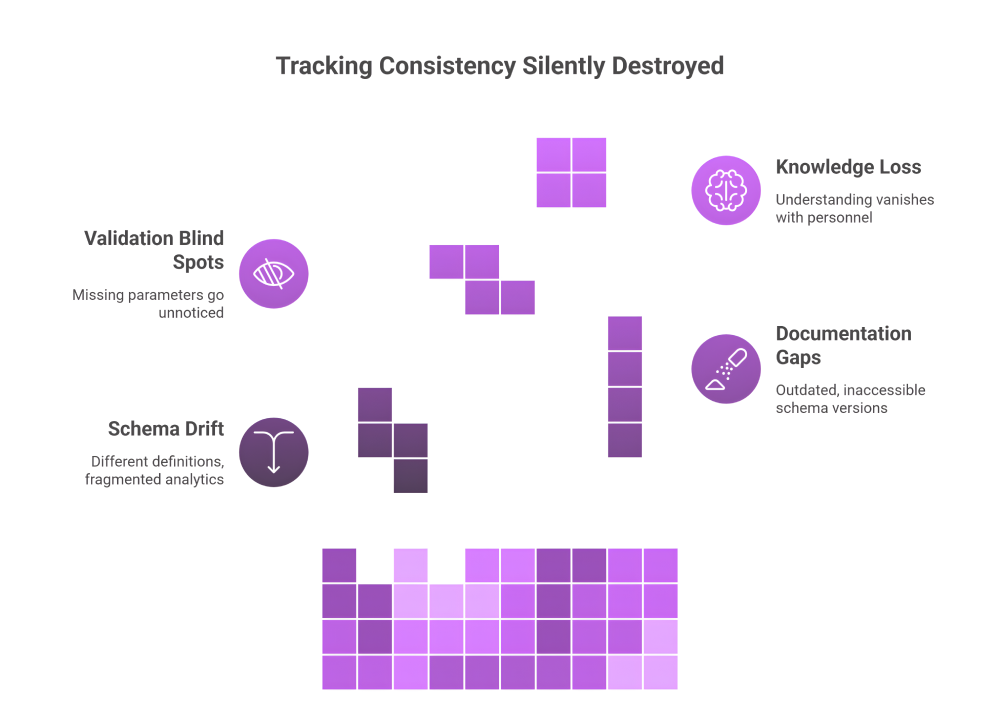
Let’s explore the most common schema failures that silently destroy tracking consistency and compromise your analytics foundation.

  • Schema Drift: When Your Blueprint Becomes Outdated

Imagine this: Your team defined a “purchase_complete” event six months ago. Since then, three developers have added parameters, two campaigns introduced custom dimensions, and nobody updated the master schema. Now, the same event captures different data depending on where it fires. And when key team members leave, the rationale behind these definitions disappears entirely-leaving new hires to guess at the original intent.

Consider this scenario: Your e-commerce site tracks purchases with “item_name” on desktop but “product_title” on mobile. Your merchandising analytics becomes fragmented. Cross-device attribution breaks down. Revenue reports don’t reconcile.

This drift happens gradually. What starts as a well-documented GA4 event schema evolves into an inconsistent mess as teams make changes without central coordination.

  • The Documentation Gap

Most organizations maintain their measurement blueprint in static documents - spreadsheets, Confluence pages, or shared drives. These documents are outdated the moment they’re created. Worse yet, the person who created that documentation might have moved to a different role or company, taking critical context about parameter definitions and business logic with them.

The issue: Developers can’t find the latest version. Marketers don’t know which parameters are required versus optional. Teams operate from different versions of truth, creating systematic inconsistencies that undermine your entire tag management system.

Even the best schemas lose effectiveness if your container setup isn’t aligned. Discover how GTM Health Checker keeps your container healthy and your schema functional.

  • The Implementation Bottleneck

Even with clear schema documentation, translating business requirements into technical implementation creates bottlenecks. Developers spend hours interpreting what “user_engagement” actually means. Marketers wait weeks for custom events to be implemented. Every new campaign requires a complete implementation cycle.

The impact: Product launches get delayed waiting for tracking. Campaign optimizations happen without proper measurement. Teams make decisions with incomplete data because implementing the full schema takes too long.

  • Knowledge Loss: When analysts, developers, or marketing managers change jobs, their understanding of event definitions, parameter logic, and implementation decisions vanishes. New team members inherit schemas they don’t fully understand, leading to misinterpretation, incorrect implementations, and measurement gaps that compound over time.

Each of these causes mis-tracking, reporting delays, and poor decisions that undermine your entire tag management system and compromise GA4 data integrity across your organization.

If these bottlenecks sound familiar, it’s time to assess how your current schema setup performs in real-world conditions.
Book a call with Tatvic’s experts to discuss where your measurement framework stands today.

Why Manual Schema Management Fails

Most organizations handle schema management through manual processes - spreadsheet updates, documentation reviews, and periodic alignment meetings. This approach has fundamental limitations that no amount of manual Google Tag Manager audit cycles can overcome.

Here’s the uncomfortable truth: If your schema lives in a spreadsheet, it’s already outdated.

The Core Problems

  • You Can’t Maintain Consistency: Different teams interpret schema requirements differently. What one developer considers “complete” implementation, another might view as partial. This inconsistency undermines your entire automated data quality management strategy.

Your marketing team thinks “conversion” means any form submission. Your e-commerce team defines it as completed purchases only. Your product team tracks feature activations as conversions. Without centralized event schema automation, these definitions coexist - creating fragmented reporting that leadership can’t trust.

  • You’re Always Behind: Business requirements evolve constantly. By the time you update schema documentation and communicate changes, new requirements have already emerged. You’re perpetually catching up while your GA4 data integrity suffers.
  • It Depends on Who’s Documenting: Schema quality varies dramatically based on who creates it. Some teams produce comprehensive documentation. Others create minimal specs that leave critical questions unanswered. This inconsistency means your analytics foundation is only as strong as your weakest documentation.
  • It Consumes Valuable Resources: Schema management, updates, and cross-team alignment consume weeks of specialist time - time that could be spent on strategic analysis instead of documentation maintenance.

Moreover, manual approaches provide no real-time visibility. You get periodic snapshots, not ongoing understanding of tracking consistency. Modern businesses can’t operate on quarterly schema reviews when digital properties update daily and tracking requirements change constantly.

Enter Event Schema Automation

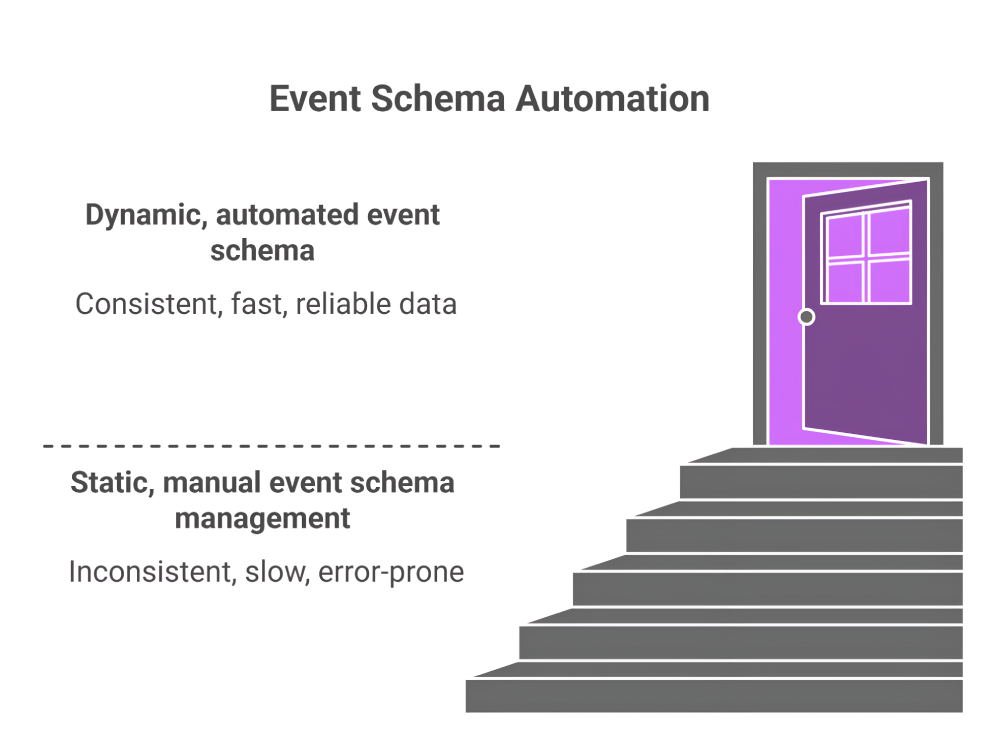
What if your event schema could evolve based on business needs, maintain consistency across teams, and stay aligned without constant manual intervention? That’s the fundamental shift event schema automation brings to your analytics foundation.

Event schema automation represents a move from static documentation to living intelligence. Rather than maintaining spreadsheets manually, these systems generate schemas based on industry best practices, business goals, and measurement requirements.

Think of It as an “Always-On Architect”

1. Designs Standardized Event Blueprints

Modern automation systems don’t just store your GA4 event schema-they help design it. By analyzing your business model, customer journeys, and measurement goals, these systems suggest the right events, parameters, and taxonomies automatically.

For instance, the system might recognize you’re an e-commerce business and automatically recommend standard events like “view_item,” “add_to_cart,” “begin_checkout,” and “purchase” - complete with required and optional parameters based on industry benchmarks.

This smart generation process reduces developer dependency and ensures schemas remain lean, consistent, and scalable from day one.
You start with proven templates customized to your business model, giving every team clear, standardized specifications for what and how to track.

2. Syncs Schema Updates Across Teams Instantly

Instead of scattered documentation across multiple tools, automated systems provide a single source of truth for your entire measurement blueprint. Every team: developers, marketers, analysts, QA - accesses the same current schema specifications.

When updates occur, they happen in one place and become immediately visible to everyone.

No more version confusion. No more teams working from outdated documentation. No more implementation inconsistencies caused by communication gaps.

This centralization fundamentally changes how teams collaborate on measurement.

  • Developers implement events knowing their work aligns with marketing needs.
  • Marketers plan campaigns confident that tracking will capture necessary data.
  • Analysts design reports knowing the underlying structure is consistent.

In short, this is automated data quality checks at the source - ensuring consistency before implementation begins, preventing the schema drift that compromises your entire tag management system and GA4 data integrity.

Event schema automation

The Results You’ll See

Organizations implementing event schema automation experience measurable improvements across their analytics foundation:

  • Consistent Event Tracking Across Web & App: The same “purchase” event captures identical parameters across all touchpoints. Cross-platform analytics finally reconciles accurately because everyone implements from the same measurement blueprint.
  • Faster Implementation Cycles: Developers receive clear, standardized specifications immediately. Product launches proceed without measurement bottlenecks because schema requirements are immediately accessible and unambiguous.
  • Fewer Reporting Disputes: When schema specifications are clear, centralized, and accessible, teams stop arguing about definitions. This reduction in friction accelerates everything - from campaign launches to product releases to reporting cycles.
  • Reliable GA4 Data: With consistent schema implementation, your GA4 data integrity becomes trustworthy. Leadership makes confident decisions based on analytics that actually reflect reality rather than measurement inconsistencies.

The Bigger Picture: Measurement Excellence

Event schema automation doesn’t work in isolation. It’s the foundational pillar in a comprehensive approach to tracking consistency and GA4 data integrity.

Here’s how it fits into Tatvic’s measurement excellence framework:

Pillar 1: Event Schema Automation provides the measurement blueprint-ensuring definitions stay current, consistent, and aligned across teams. It’s the foundation upon which all other measurement processes build.

Pillar 2: Tag Auditor validates that events fire correctly according to schema specifications, catching implementation issues through automated data quality checks before they reach production.

Pillar 3: GTM Health Checker ensures your container implements the schema efficiently, maintaining configuration health and preventing conflicts that undermine tracking consistency.

Pillar 4: Data Sanity Automation verifies that collected data matches schema expectations throughout its journey into GA4, providing end-to-end validation of your analytics foundation.

Pillar 5: Additional advanced capabilities complete the framework, addressing continuous optimization and intelligence across your measurement ecosystem.

Together, these create comprehensive protection for measurement integrity - from schema design through implementation to validation. This integrated approach represents a fundamental shift in how organizations approach analytics infrastructure.

Instead of treating schema as static documentation, you maintain a living measurement blueprint that evolves with your business. Each element addresses a specific vulnerability. Event Schema Automation provides the blueprint. AI-powered tag audit processes confirm it’s implemented correctly. The GTM Health Checker ensures container optimization. Data sanity checks verify end results.

This is how Tatvic AI solutions transform analytics from fragile to reliable - not through isolated point solutions, but through integrated systems that protect measurement integrity at every stage.

Your Path Forward

The evolution of event schema management points toward automation, clarity, and consistency. Organizations adopting these approaches gain measurable advantages, faster implementations, more consistent measurement, and greater confidence in analytics foundations.

Manual schema management will always create bottlenecks. Static documentation will always drift from reality. The question isn’t whether schema inconsistencies exist in your measurement; they likely do.

The real question: Will you discover and address schema gaps before they compromise your entire analytics foundation and impact business decisions across the organization?

Understanding your schema’s actual state, rather than assuming it’s well-documented - represents the first step toward building truly reliable measurement infrastructure that scales with your business growth.

Stop treating your event schema as an afterthought. Start building it as the strategic foundation it should be. The organizations winning with analytics aren’t just collecting more data - they’re ensuring every data point starts from a solid, consistent measurement blueprint.

Ready to uncover the silent gaps in your measurement?

Talk to a Tatvic expert to get a Schema Health Check - and see how Event Schema Automation can transform your GA4 data integrity from inconsistent to insight-ready.

Book a Free Consultation →

Bot Icon
Bot Icon

Tatvic Bot

Explore About Tatvic and Services