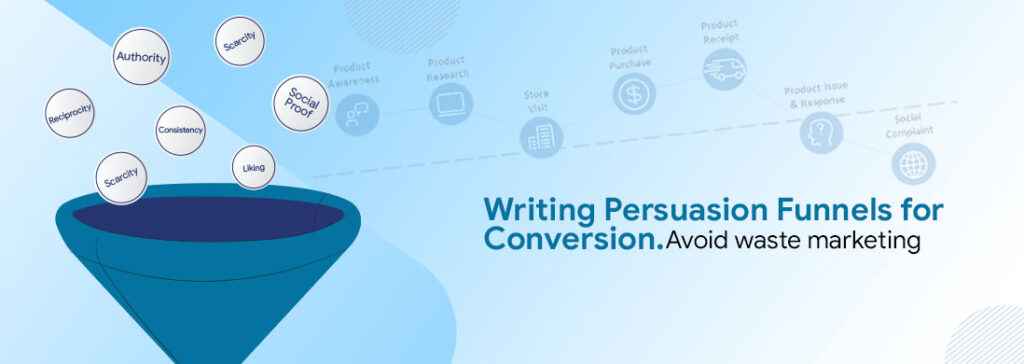
Hello There!

Lorem ipsum dolor sit amet, consectetur adipiscing elit,

What is Conversion Copywriting? How to do Copywriting for Conversion?

The popular worldview is, Conversion Optimization equals UX/UI.

Well, perhaps it’s not! In addition to UX/UI, the good news is that you can do a bit, quite more in fact. As we all know, to be more effective, you need to attract attention, and keep it long enough to nudge the user for the desired action.

And looks alone can’t be the only factor. What else then?

Why not try conversion copywriting?

But persuasive conversion copywriting isn’t easy. However, if you understand the correct principles of persuasion, you can eliminate the guesswork. Create those elusive landing pages that have people lined-up to take action.

Check Out: Few Important Tips to Improve your Contact Us page

How do Conversion Copywriting or Persuasion Funnels Work?

It refers to writing copy for conversions that have a particular conversion goal in mind. A copywriter working on conversion copywriting focuses on a single action and uses familiar words, phrases, and value propositions to persuade readers to act. This is done, for example, on landing pages, product descriptions, ads, and other calls to action.

Conversion copywriting is an essential skill for any growth marketer to develop. It is a tactic that has gained high traction in improving marketing effectiveness. 

So, if you ask, how to write a copy that converts! The best answer is: A compelling copy must do several things as soon as a visitor arrives at a website. Such as engaging them, communicating their unique selling proposition, and, most importantly, garner trust so that they will take the next step and convert.

A Conversion writer might test several versions of the work, conduct user research, and interact heavily with product teams. This is because they find the most effective ways to create a useful copy. 

In this post, we’ll cover how to craft an effective conversion copywriting. Prepare a clear headline for your website or landing page, tactics for deciding on the words themselves, proving they’re doing their intended job, and how “logical leaps” should define what copy goes on a page. 

Just in case you’re wondering what the conversion copywriting formula is!

Conversion copywriting differs from other forms of copywriting in that it requires the skills of a good storyteller, but also has a strong focus on numbers and metrics. 

Conversion rate is calculated by the percentage of visitors who take a desired action on your site, (for eg. purchase or signing up to an email newsletter or so). If we put it this way, an an eg. if you have 1,000 unique visitors and 100 sign up for your product mailing list then you have a 10% conversion rate (100/1,000 = 10%).

Setting your conversion copywriting goals

Before you get started, it’s important to set goals. A goal is a specific objective that you want to achieve by a certain time (and hopefully with a certain level of success).

As a conversion copywriting example, if I was writing a copy for an eCommerce store selling t-shirts, one of my goals would be “increase sales.” But the goal isn’t the result-it’s just a step along the way. The result is actually when we’ve reached our goal: in this case, higher sales.

Here are some Conversion Copywriting Goal examples:

Example: Setting your conversion copywriting goals

Copywriting for Conversion: Creating Unique Selling Proposition

In the world of marketing and sales, a unique selling proposition or USP is a compelling benefit that sets your product apart from its competitors.

Why does this matter? Because it allows you to stand out from the crowd and convert more visitors into customers.

Here are some examples of good USPs:

Example: Creating Unique Selling Proposition


Here are some steps to creating your own:

  • Come up with a few different benefits that your product offers that other similar products don’t have.
  • Brainstorm how you can frame these benefits in a way that makes them compelling to potential customers-make sure they’re specific, relevant, and easy to understand.
  • Narrow down your ideas so that there’s only one main benefit in each paragraph or section of copy-you want each part of the page to be focused on just one thing!

Examine Your Competition

The first step to drafting a great conversion copywriting is understanding who you’re writing for. You may be familiar with the phrase “target audience,”. This can mean different groups for different businesses. To get an idea of what your target audience might be like, try and understand their workday, pain points, and stage of their journey associated with our solution. 

What queries do they have? Which specific keywords are associated with those queries? And which business/brand owners are solving their current needs with what content and campaigns. Take a closer look at how well each competitor ranks compared with one another using tools like SEMrush or Ahrefs. 

Create content answering those questions. What, how, when, where….and who. The story is woven to create a narrative. Engaging and believable enough to nudge them from a state of being unaware, to aware, engage, consider, and trust to take action - a conversion.

Apply Cialdini’s Six Principles of Persuasion

According to Cialdini, six key elements affect shortcuts in decision-making, particularly concerning purchasing and consumption decisions. 

The six key principles Cialdini identified are reciprocity, scarcity, authority, commitment and consistency, liking, and consensus (or social proof). 

The main message that he delivers is that if you understand these six principles, then you can use them to your advantage. To persuade others to take a specific action or buy a particular product.

Throughout his work, he emphasizes the widely accepted concept that decision-making is effortful, so individuals use a lot of rules of thumb and heuristics (shortcuts) when deciding what to do, what to say, or how to act.
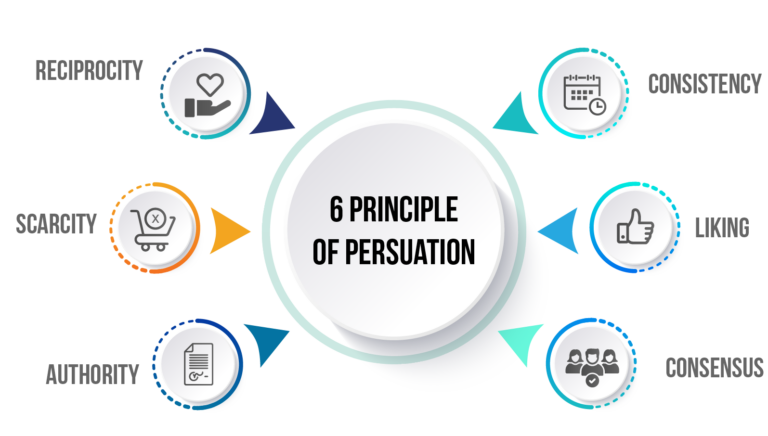
Conversion Copywriting: Cialdini’s Six Principles of Persuasion

The Importance of Creating a Call to Action

The call to action is the part of the page where you tell people what to do next. It’s an important piece of the puzzle because it drives your user behavior. It also helps convert visitors into leads, customers, or both.

  • Be clear and unambiguous: Make sure your CTA (call-to-action) is crystal clear. You can do this by providing a specific action that your audience should take next. Be sure they understand exactly what they need to do. To progress through their buying cycle or get more information about your product or service
  • Stand out from the rest: Your call-to-action should stand out from everything else on the page. So make it big, bold, or loud enough for them not to miss it when scanning down a long webpage
Conversion Copywriting - Call to Action button

Clear Writing is Persuasive Writing

At the end of the day, writing persuasive B2B copy doesn’t have to be complicated. The most powerful conversion tool is clarity. If you can communicate the value of your product, then people who are looking for that value are more likely to buy.

Why don’t you take a quick CRO maturity test and check your results

Painting a visual in words, we want to transport the user into the future and make them feel emotionally invested. Your goal is to make them, however briefly, feel their negative emotions vanish and be replaced by the positive emotions of the future you have created for them.

Earlier you learn to connect a user to your story, the sooner you’ll convert prospects into happy customers.
Mobile App AB Testing with Firebase for Better Conversions

[vc_row][vc_column][vc_column_text]Welcome to the fourth and final part of the Firebase A/B testing series. We have come a long way from talking about Ways to Implement A/B tests to How to Configure and Firebase in Notifications and In-App Messaging. The only remaining crucial element that we are about to cover in this quadrilogy is the Benefits of Firebase A/B Testing and use cases.

Why not dwell into the benefits of Firebase and understand its importance.

Benefits of Firebase A/B Testing in App 

It is important to understand that the Firebase A/B testing can bring successful outcomes based on your end goals. Thus, there are a bunch of benefits to using Firebase. It is quite easy to configure all settings whether it is development, A/B testing, or analytics. Also, it allows a user to test on the device before going live. It leverages to verify all sorts of changes which are configured.

Firebase offers the below features to implement A/B test:

Audiences: Use audience definitions to provide better user experience, behavior and appearance of your app without distributing multiple versions of your app.

Predictions: Target users who have, in a definite manner performed certain actions. Include these users as a part of predictive audiences from Google Analytics for Firebase users. Utilize a predicative set of audiences in the experiment.

Implementation: A user can define parameters in Firebase. Based upon those parameters and its values, you can make changes in the app accordingly. Follow the steps and configuration to publish.

No worry about storage: Having limited storage accessibility in Mobile apps? Firebase allows storing parameters values over cloud servers. Values are cloud hosted.

Analysis and Reporting: What matters most when the A/B test is configured and live? It is Reporting and Analysis. Why so? Because it provides analysis regarding primary goal vs secondary goal metrics and data regarding how A/B test is performing.

Apart from the above benefits, Firebase A/B testing also offers benefits for Remote Config and Notification A/B Test. Let’s check out the benefits of the two:

Benefits of Remote Config A/B test:

  • Realtime change: Take advantage of the parameters feature that can be fetched or modified over a real time basis. This is possible  in app as well as in Firebase console directly via remote server.
  • Activation event: An event ensures and activates the experiment for the user. Users will only be a part of an experiment once the event is triggered.
  • Conditions: Use conditions to provide different parameter values when a condition is met. Conditions can be applied to ensure right users fall into the A/B test variants, segmentation, and so on. This can also be applied based upon Audiences, Predictions, User Properties, Country/Region, User in random percentile and many more.
  • Personalization: Make your mobile app fully personalized using a remote config. It is easy to change configurations at any time.

Benefits of Notification A/B test:

  • Parameter Cache: All configurations majorly handled by Firebase cloud messaging service (FCM) have no parameter caching inside the app.
  • Multiple Notifications: Using notifications, we can send multiple notifications easily on the one go to the targeted audience.
  • Personalize Notifications: It facilitates sending notifications as per your schedule. When you have sale announcements in upcoming days, notifications provide an opportunity to users to experience personalized notifications.
  • Customization: Customized notifications can be sent to the targeted audience.
  • Target Users: Targeting can be achieved by first open, last app open (timing based) and much more..

Hypothesis: Firebase A/B Testing

We are here to help you with the use cases for mobile applications that will lead to accomplish your goals and generate high user retention. These use cases will set an accuracy level as to how Firebase A/B testing works in different scenarios. 

Use case 1

Business category: Lead gen / Business contains the Signup functionality in place.

Scenario: Try to change the design of the sign up and login button with different variants and observe the results.

Goal: Increase in new Sign up / form fill

Use case 2

Business category: Ecommerce / Retail / Booking

Scenario: Changing the position of the CTA button of Add To Cart, to leverage users to click it with ease.

Goal: Increase Detail to Cart ration with Add To Cart events, and we can retarget them by showing advertisements.

Outcome: Multivariate A/B test could be run by changing the positions, Major chances for winning the Versions 1 / 2 / 2.5.

Firebase A/B Testing - Sticky Button

Use case 3

Scenario: Sales would dramatically be affected by a minimum change via deciding the position and place of the promotions. Therefore, how would we make the changes that drive a user’s attention towards promotions?

  1. Here, taking the example of Starbucks that places the promotion at the beginning of the user journey. This leads to creation of urgency for the user at the nearest coffee stop.
  2. Second example is considering the e-commerce app showing the sticky bar on the screens, to bring user attention to discount promo codes. This leads to more AddToCards and purchases.

Goal: Increase in CVR through use of Promo offers.

Expected Outcome: Here comparison is between showing promotions as a variant (containing 50% off offers or any offer campaign) VS not showing promotions on product or home screen. The result is that the variant containing information via showing promotions drives more purchase ration. Thus, Variant A is the winner with 50% more revenue generated by a particular product.

Recommended Parameters to be used: Fire an activation event that measures if the user is actually falling into any variant.

Example of Starbucks promotions


Example of Ecommerce application for promo code


Use case 4

Scenario: For content generation applications we can provide a section where it will leverage app users to view today’s top news/articles having 2-3 lines of description below the image.

Goal: Increase in CTR from landing/home screen of the app

Expected Outcome: Articles/News will be shown in grid view or in a slider.

Use case 5

Scenario: A leadgen app notifies the users for the upcoming webinars, concerts or social events to book the tickets in one go. Also, send the response text with the notification. This will lead towards high numbers of subscriptions and bookings. Further, users will show interest to click the notification for more details!.

Goal: Increase in CVR through use of notifications & user engagement events.

Expected Outcome: This allows showing and notifying the users for events and actions as a new experience to the user. Eventually, this variant will win by 30% increase in user engagement and subscription and if purchased as a goal.

Recommended Parameters to be used: Fire an activation event that measures the user and falls into a variant ‘set up purchase event’ goal.

Example of Conversion through Notifications

Use case 6

Business Category: Banking / Insurance / Lead Gen

Scenario: For Lead-gens or insurance firms it is quite easy to explain features regarding policies/insurance buyers. This makes it uncomplicated to operate various features available on the app. Further, leading to identifying user behavior and actions based on UI changes.

Goal: Increase in product insurance detail screen view and user engagement metrics, and eventually could be an insurance purchase.

Expected Outcome: The variant will carry new UI showing the quick steps towards insurance policy purchase. Eventually, it would lead to 50% increase in purchase with easy landing steps.

Recommended Parameters to be used: Fire an activation event that measures user interest towards purchasing the insurance.

Firebase A/B Testing: Example of Detailed Screen View and User Engagement
Detailed Screen View & User Engagement

To end with…

Firebase has proved to be a great tool for enhancing mobile app performances through its A/B testing feature. Moreover, with the enormous benefits and use cases that we just saw, A/B testing in mobile apps is now an easy task! Why don’t you give it a try?

With this part, we conclude our Firebase A/B Testing 4-part series. Our quadrilogy has been completed on a great note and we received a humongous response from you all!

GA4 360: How it’s a Big Step Forward for Enterprise Analytics

The new Google Analytics 4, popularly known as GA4 360, is causing quite a stir. You might even believe that if you don’t migrate now, you’ll face difficulties in the coming future. Here’s what we recommend.

The existing Universal Analytics version will expire in mid-2023. We encourage all brands to create GA4 360 property now with an aim to have at least one year of data on the new property. To achieve that, we have prepared a quick start checklist for you. This will act as a self-serving instrument to create Google Analytics 4 property. And help you ease into it as your single source of truth in the second half of 2023.

When you upgrade to Google Analytics 4, you will be introduced to a whole new notion of user-centric, event-based analytics. GA4 360 brings in numerous new functionalities and future-ready aspects of streamlining your data processes.

Many professionals (including ourselves) are still hesitant to abandon Universal Analytics entirely and solely utilize GA4 for web projects. Nevertheless, we do see the benefit of Google Analytics 4. Particularly when organizations are gearing up to face a privacy-driven, cookie-less world.  We understand that you will face a transition phase but upon analyzing on a wider scale, we recognized that GA4 360 carries more benefits.

While GA4 has a lot of functionalities that were only a part of Universal Analytics 360 before, let us see what’s in store for us in the GA4 premium version.

Sneak-peak into GA4 360: Premium Features

In addition to premium features specific to Universal Analytics 360, like Unsampled Reporting, Increased Custom Fields, Enhanced Data Freshness, and Custom Funnels, let’s see what New Analytics 360 has to offer:

1. Effective Access Control

Data streams remain integrated with a primary Google Analytics 4 property. There is now the option to personalize and regulate subsets of data. This depends on teams, content, privacy, geography, or other governance requirements. These sub-properties differ from Universal Analytics views. In that, they can have their custom dimensions, audience sharing, integrations, and settings. These were previously only available to alter from a single source.

GA4 360 Property: Manage Users with Effective Control

2. Customized User-interface

The interface of Universal Analytics 360 contains all of the reports, sub-reports, integration reporting regions, multi-channel funnel reports, and custom reports under the same menu. 

Whereas, the new Google Analytics 360 (GA4 360) aligns with executive requirements by giving a more in-depth 360 experience with a configurable interface.

In reality, there are around 117 separate menu selections! Even the most senior GA analysts, as a guest and potential challenges, cannot name every report and sub-report in the correct order. There’s a lot to go through to obtain insights. This is true for all users because not every single report gets navigated to every day, or in most situations, at all.

3. Longer Data Retention

Google Analytics 4 properties allow you to establish data retention periods of up to 14 months. This is about data at the user and event levels, not aggregate data. 

Regular reports will not reveal many differences if the data is removed after that time. But ad-hoc reporting, visualizations, and analysis in the ‘Explore’ area will simply not work. 

This would be a concern for firms that require in-depth multi-year studies. Fortunately, in the new Google Analytics 360 version, data retention can be configured for up to 50 months.

In addition to this, the limits of conversions/goals, audiences, and user properties are also revised from 30 to 50, 100 to 400, and 25 to 100 respectively.

Enable longer data retention with the new GA4 360 feature

4. Sub-properties against Views in UA

The last and the most distinguishing feature of the New Google Analytics 360 would be the ability to let you create Sub properties and Roll properties. 

This feature attracts many large-scale organizations that have to handle large data sets. This enhanced feature of Sub property creation will allow you to decide the custom-defined roles of settings in the new GA4. 

Moreover, the dedicated team for each property can only be entitled to that data set handling. Which is in my view very convenient! This is just compensation for the 360 version where different views were available for analysis. 

The Rollup property will be the Raw data view where all sub-properties can be cumulatively studied.

Create Sub-properties for regulated data access


The new Google Analytics 360 distinguishes itself from the conventional product by offering big(ger) data, unsampled analysis, and powerful governance. It also offers the possibility of easier data advocacy with customizations.

And why New Google Analytics - GA4 360?

What better way than going through some real business scenarios to understand the benefits of New Analytics 360:

Use Case 1:

Consider an organization with multiple teams using the same Google Analytics data for different purposes. 

The Analytics team is using it for insight generation, the Technical team is using it for debugging and capturing advanced data points, the Marketing team is using it for audience generation and campaign management, and so on. 

In this scenario, not all teams would necessarily need access to the entire dataset but probably just parts of it.

For example, the Marketing team might not need the debugging data that is helping Analysts create audiences for that team. On the contrary, analysts might need access to all the data points but do not necessarily have to take care of Google Ads linking. 

Google Analytics 4 does not provide an option to create views. Thus, this is a great alternative to handle such scenarios.

Use Case  2:

You will be able to design your user roles to manage feature access for specific groups of users.

For example, you could create a role for an agency partner to identify which campaigns are driving conversions on your website. At the same time, they wouldn’t have access to revenue or organic traffic data. 

Groups of reports like customer acquisition can also have special user roles assigned to them. So they are accessible to concerned users only. This way your workers and partners will be able to access the data they require while remaining compliant with your regulations.

Use Case 3:

When larger and multiple teams are working on the same Google Analytics data, it becomes important to keep a track of the changes. You would need to track changes in the configuration or overall set-up that could eventually affect the data collection process. 

For instance, the Marketing team recently modified the Google Ads account linked to your Google Analytics property because they have different Ads accounts now for different lines of business. 

For this reason, they have created separate sub-properties to link one account to each of them based on the collected data. This becomes important information for analysts who would want to generate audiences accordingly. This is why the new Google Analytics 360 has come up with Enhanced Change History and Audit functionality.

In a nutshell…

The new enterprise version of Google Analytics 360 (GA4 360) is quite sophisticated and well-equipped with many advanced features. It has many more uplifted use cases for remarketing, optimized lead generation, and various Google products. All of these are linking parts from its advanced analytical reporting and generating insights abilities. Remember, we have created a quick-start checklist to make the transition from UA to GA4 simple and easy. 

Do let us know if you need any support or have queries! To start your migration journey know the full details and pricing plans here. 

Bot Icon
Bot Icon

Tatvic Bot

Explore About Tatvic and Services