Hello There!

Lorem ipsum dolor sit amet, consectetur adipiscing elit,

AI Analytics: Why Most Teams Discover Problems Too Late

Marketing analytics has evolved significantly over the past decade. Today, teams have access to detailed dashboards, multi-channel attribution models, and near real-time reporting capabilities. Campaign performance, user journeys, and conversion metrics are no longer hidden behind fragmented systems-they are visible, measurable, and accessible at scale.

Yet despite this progress, one persistent problem continues to impact marketing performance.

Teams can see what is happening.
But they often realize what changed far too late to act effectively.

This gap between data visibility and timely awareness is where most inefficiencies in modern analytics systems originate. And in performance-driven environments, this delay does not just affect reporting-it directly affects revenue outcomes.

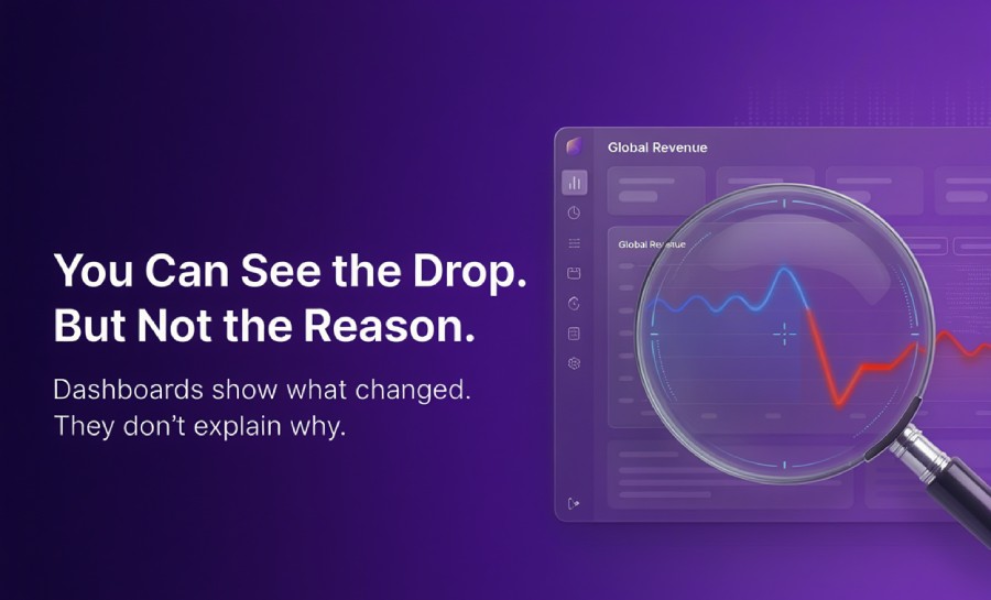
This is precisely where AI analytics is beginning to redefine how analytics systems operate. Instead of simply enabling access to data, AI analytics focuses on detecting meaningful changes as they happen and enabling faster decision-making.

Analytics Today Is Built for Investigation, Not Detection

Most analytics platforms in use today-whether it is Google Analytics 4, Adobe Analytics, or similar tools-are fundamentally designed for exploration. They are highly effective at organizing data, enabling segmentation, and allowing teams to analyze performance across multiple dimensions.

However, they are not designed to proactively identify what matters most.

In practice, this means that analytics systems function more like repositories of information rather than active intelligence layers. They store and present data, but they do not interpret it in a way that prioritizes immediate action.

As a result, teams rely heavily on manual workflows.
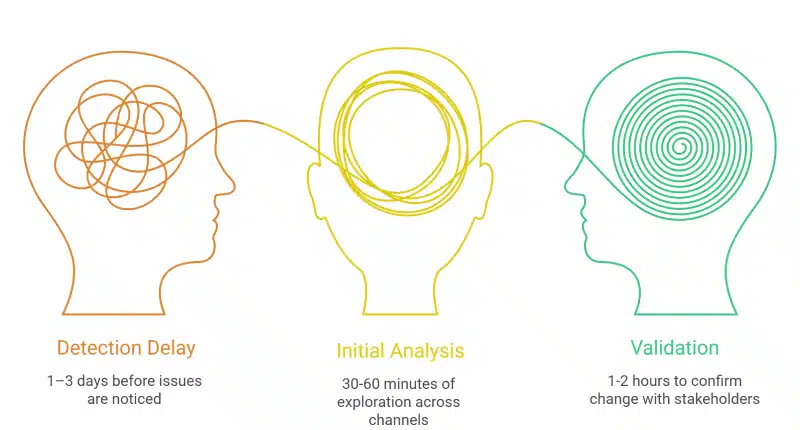
A marketer logs into a dashboard, reviews key metrics, compares trends, and tries to identify whether something has changed. This process is repeated daily or weekly, depending on the team’s operating rhythm.

The limitation here is subtle but critical.

Performance changes do not occur when dashboards are checked.
They occur continuously.

And this disconnect creates a delay between when an issue arises and when it is discovered.

This limitation is explored further in: What if you didn’t have to explore the data?

The Real Problem: Detection Lag

To understand the impact of this gap, it is important to look at how detection typically happens in real-world workflows.

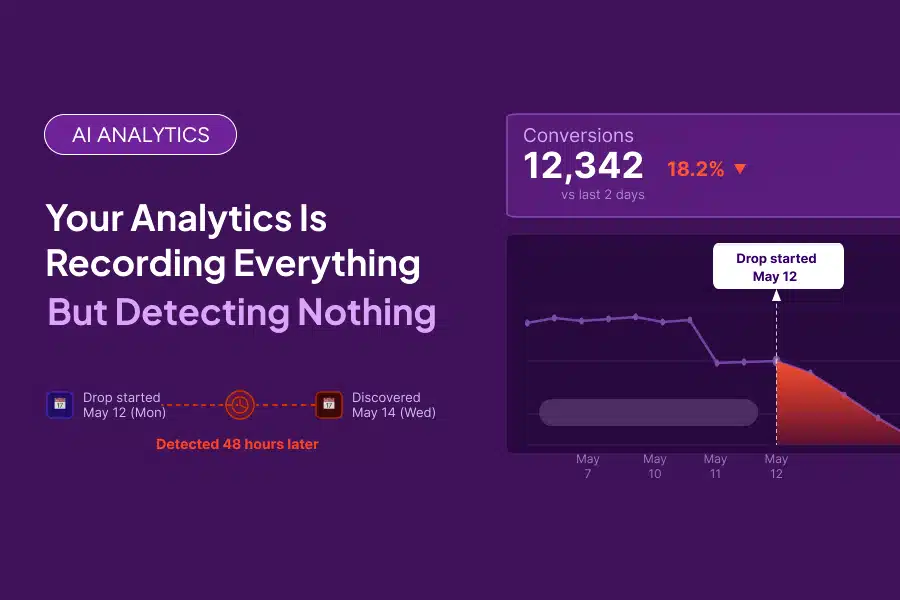
Consider a common scenario. A campaign begins to underperform due to a change in bidding strategy, audience targeting, or external market conditions. The decline is not immediately obvious-it happens gradually over a few hours or a day.

Since no alert is triggered, the issue remains unnoticed.

It is only during a routine dashboard check-often one or two days later-that someone notices a dip in performance. At this point, the team begins investigating the issue, analyzing trends, and validating whether the change is significant.

By the time corrective action is taken, the impact has already occurred.

Budget has been spent inefficiently.
Conversions have declined.
Opportunities for early optimization have been missed.

This is what is referred to as detection lag.

And it is one of the most overlooked sources of inefficiency in marketing analytics.

Detection lag is not just a delay in awareness. It is a delay in action-and that delay has compounding consequences.

This is the core problem that AI analytics is designed to address.

Why Traditional Analytics Workflows Break at Scale

As marketing systems grow more complex, the limitations of manual analytics workflows become more pronounced.

Modern marketing environments involve multiple channels, campaigns, audience segments, and data streams. Each of these variables introduces additional layers of complexity, making it increasingly difficult to identify meaningful changes quickly.

In such environments, manual analysis does not scale effectively.

Teams are required to:

  • review multiple dashboards
  • segment data across dimensions
  • identify patterns manually
  • validate findings across tools

This process is not only time-consuming but also prone to inconsistency. Different team members may interpret the same data differently, leading to delays in decision-making.

More data does not simplify decision-making. Without the right systems, it increases the effort required to reach clarity.

This is where the role of AI analytics becomes critical.

The Hidden Metric Most Teams Ignore: Time-to-Detection

While marketing teams are highly focused on performance metrics such as conversion rate, return on ad spend (ROAS), and customer acquisition cost (CAC), very few track a metric that directly influences all of them.

That metric is time-to-detection.

Time-to-detection refers to the duration between when a performance change occurs and when it is identified.

This metric is critical because it determines how quickly corrective action can begin.

A delay of even 24-48 hours can significantly impact performance, especially in high-spend environments. During this time, underperforming campaigns continue to consume budget, and high-performing opportunities remain under-optimized.

According to Gartner, organizations often fail to fully leverage their analytics investments due to delays in insight generation and inefficient data utilization.

This highlights an important reality.

The challenge is not a lack of data.
It is the inability to act on data at the right time.

AI Analytics: Shifting from Passive Data to Active Intelligence

AI analytics introduces a fundamental shift in how analytics systems operate.

Instead of relying on users to explore data and identify issues, AI analytics continuously monitors performance metrics and detects anomalies automatically. It evaluates data in real time, compares it against historical patterns, and identifies deviations that require attention.

This transforms analytics from a passive system into an active intelligence layer.

With AI analytics, teams are no longer dependent on manual checks. Instead, they receive timely insights that highlight what has changed, where the change has occurred, and why it matters.

This shift significantly reduces the time required to move from data observation to decision-making.
What AI-Powered Analytics Looks Like in Practice

To understand the practical impact of AI analytics, it is helpful to compare how workflows operate with and without it.

Without AI Analytics

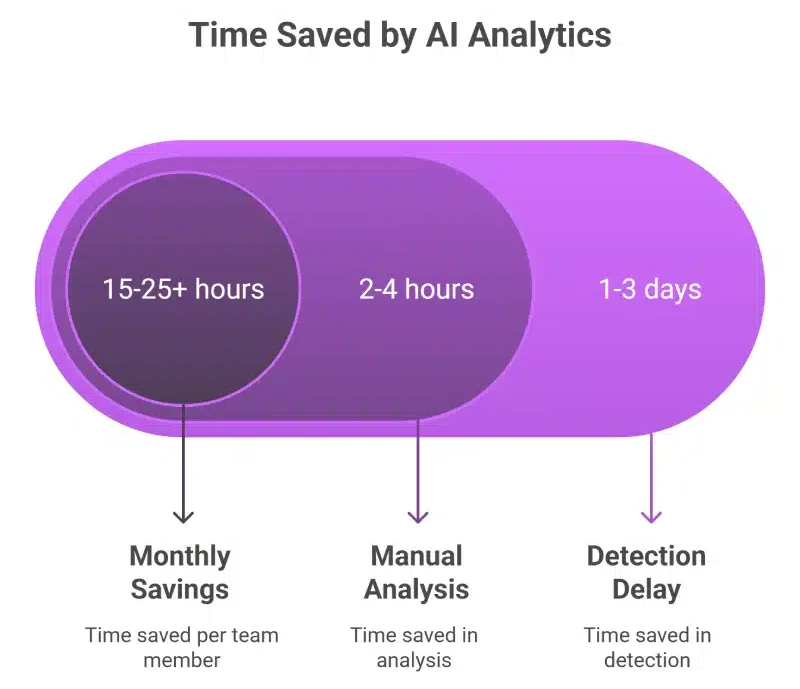
A retail brand running multiple campaigns experiences a gradual decline in conversions due to a change in bidding strategy. The decline begins on a Monday but goes unnoticed because there are no alerts.

By Wednesday, the team notices a drop during a routine dashboard review.

They begin analyzing:

  • campaign performance
  • channel-level data
  • device segmentation
  • geographic trends

After spending considerable time exploring the data, they identify the root cause and take corrective action.

By this time, two to three days of inefficient spend have already occurred.

With AI Analytics

In the same scenario, AI analytics detects the anomaly on Monday itself.

The system identifies that the performance deviation is outside expected patterns and surfaces an insight such as:

“Conversions have dropped by 15%, primarily driven by Paid Search. The decline is linked to recent changes in bidding strategy and exceeds expected variance.”

The team receives this insight immediately and can act within hours.

The difference is not just operational efficiency-it is financial impact.

Pain Points vs Outcomes: A Clear Contrast

Without AI analytics, teams experience:

  • delayed awareness of performance issues
  • significant time spent on manual analysis
  • reactive decision-making
  • increased risk of wasted budget

With AI analytics, teams benefit from:

  • near real-time detection of anomalies
  • reduced dependency on manual workflows
  • faster and more confident decision-making
  • improved campaign stability and efficiency

This contrast highlights why AI analytics is not just an enhancement but a necessity for modern marketing systems.

The Measurable Business Impact of AI Analytics

The impact of AI analytics can be quantified across multiple dimensions.

Research from McKinsey & Company indicates that organizations using AI in marketing can achieve improvements of up to 20-30% in ROI.

Similarly, Deloitte highlights that AI-driven organizations are able to respond more quickly to market changes and operate with greater efficiency.

These improvements are driven by:

  • reduced detection delays
  • faster decision-making cycles
  • more efficient allocation of resources

Over time, these benefits compound, leading to sustained improvements in marketing performance.

Why This Gap Is Becoming More Expensive

As marketing systems become more dynamic, the cost of delayed detection continues to increase.

Automation, real-time bidding, and multi-channel strategies amplify the impact of even small inefficiencies. If a system reacts late, it continues to execute outdated strategies, leading to further performance decline.

This makes AI analytics a foundational capability rather than an optional enhancement.

Organizations that adopt it early gain a significant advantage in terms of speed, efficiency, and performance consistency.

AI Analytics and the Evolution Toward Agentic AI

AI analytics plays a critical role in enabling more advanced systems such as Agentic AI.

While AI analytics focuses on detecting and interpreting changes, Agentic AI extends this capability by enabling automated actions based on those insights.

Together, they create a continuous loop:

  • detection
  • interpretation
  • execution

This evolution is explored further in: Marketing decision speed with AI Analytics

The Cost of Waiting

One of the most overlooked aspects of analytics transformation is the cost of inaction.

Organizations often delay adopting new approaches because existing systems appear to function adequately. However, this delay results in repeated inefficiencies over time.

Each campaign cycle without AI analytics introduces:

  • avoidable performance losses
  • repeated manual effort
  • missed optimization opportunities

These costs are not always visible in a single report, but they accumulate over time.

The real cost is not the problem itself. It is how long it continues before being addressed.

Moving from Insight to Action

Recognizing the gap is only the first step.

The next step is quantifying its impact and identifying where improvements can be made.

Tools such as:

can help organizations evaluate the potential benefits of adopting AI analytics and determine their readiness for implementation.

This shifts the conversation from theoretical value to measurable impact.

Conclusion

The evolution of analytics is no longer about improving visibility.

It is about improving responsiveness.

The ability to detect and act on changes quickly is becoming a key differentiator in marketing performance.

AI analytics enables this shift by transforming analytics systems from passive reporting tools into active intelligence layers.

And as marketing environments continue to evolve, this capability will become essential for organizations looking to maintain a competitive edge.

Landing Page Personalization: Stop Paying for Traffic That Bounces

Your Landing Page Is the Hole in the Ecommerce Bucket; And You Keep Filling From the Top

Let’s skip the part where I tell you ecommerce is growing fast and the market is huge.

You know that. You’re in it.

What you might not have stared at long enough is this: Baymard Institute pulled together 48 independent studies on shopping behavior and found that the average cart abandonment rate in 2025 sits at 70.19%. Seven out of ten people who got close enough to buy, close enough to add something to a cart, didn’t. And Baymard’s own modelling says that better page and checkout design could recover $260 billion in lost orders every year across US and EU ecommerce.

Not new customers. Not bigger ad budgets. Better pages.

That’s the part most brands don’t want to look at, because it means the problem isn’t outside, it’s inside. The traffic isn’t failing you. Your landing page is.

Nobody Wants to Feel Like They Landed on the Wrong Page

Here’s what actually happens when someone clicks your ad.

They arrive with a specific thought in their head. Maybe they were looking for a particular product. Maybe they’re a return visitor who already knows your brand and just needs one more nudge. Maybe they’re completely new, skeptical, and need a reason to trust you in about four seconds. Whatever the case, they arrive as a specific person, with a specific context and a specific need.

And most of the time, your landing page ignores all of that.

Same headline for everyone. Same hero image. Same generic “Shop Now” button. It’s a page built for the average visitor, which, in practice, means it’s built for nobody, because nobody thinks of themselves as average.

McKinsey put some real numbers on what this costs. Their Next in Personalization research found that 71% of consumers expect personalized interactions from the brands they buy from. And 76% get frustrated when that doesn’t happen. They don’t write angry emails. They just leave. And they don’t come back.

What’s quietly devastating about that statistic is the other side of it. The same McKinsey research found that 76% of consumers said personalized communications were a key factor in whether they even considered a brand. Not whether they liked the brand. Whether they considered it in the first place. And 78% said personalized content made them more likely to repurchase.

So personalization isn’t just about squeezing a few extra points of conversion rate. It’s about whether you’re in the consideration set at all - and whether the people who do buy come back.

The Gap Between What Brands Think They’re Doing and What Customers Actually Experience

There’s a Salesforce stat that I find weirdly uncomfortable every time I read it.

Their State of the Connected Customer report found that 66% of customers expect brands to understand their needs and preferences. Fine. Brands know this. They talk about it in every strategy deck. But here’s the part that stings: only 34% of those customers believe brands actually deliver on it.

Two-thirds of your shoppers arrive expecting to feel understood. Fewer than half of them do.

And this isn’t just a feelings problem - it’s a revenue problem. Gartner’s 2024 CMO Spend Survey found that 22% of marketing organizations reported gaps in their digital commerce capabilities that were actively preventing them from hitting business goals. That number was 14% the year before. The gap isn’t closing. It’s widening - even as brands pour more money into driving traffic to those same underperforming pages.

More traffic into a leaking funnel doesn’t fix the leak. It just makes it more expensive.

What Actually Happens When You Fix It

Okay, so personalization matters. That’s not a controversial take anymore. The more useful question is: how much does it actually move the needle, in terms brands can take to a CFO?

McKinsey’s data on this is pretty consistent. Personalization, when it’s executed well, not just “we put your first name in the email” but genuinely tailored experience, drives 10-15% revenue lift on average, with some companies seeing up to 25%. It can cut customer acquisition costs by up to 50%. It increases marketing ROI by 10-30%.

BCG went bigger in their 2024 research. They found that brands leading on personalization are growing revenue roughly 10 percentage points faster than their peers, and they’re positioned to capture $570 billion in incremental retail growth by the end of the decade. Not a slice of existing revenue. New revenue that will go to whoever earns it.

There’s also the retention angle, which tends to get underweighted in conversion-focused discussions. Bain & Company’s research, the work that essentially defined how the industry thinks about customer loyalty, established that a 5% improvement in customer retention can lift profits by 25-95%. That’s not a typo. The range is wide because it depends on sector, but the direction is always the same: keeping customers is dramatically more profitable than finding new ones.

And the bridge between acquisition and retention runs directly through the landing page experience. If someone’s first visit feels generic, there may not be a second one.

So Why Isn’t Everyone Already Doing This?

Honestly? Because personalization at scale is hard, or at least it was, until recently.

You can manually build five landing page variants. You can test two headlines against each other. But you can’t manually create a tailored experience for every meaningful combination of traffic source, device type, behavioral history, geographic context, and purchase intent signal. There are too many variables and not enough hours in any team’s day.

This is the gap that agentic AI is specifically designed to close.

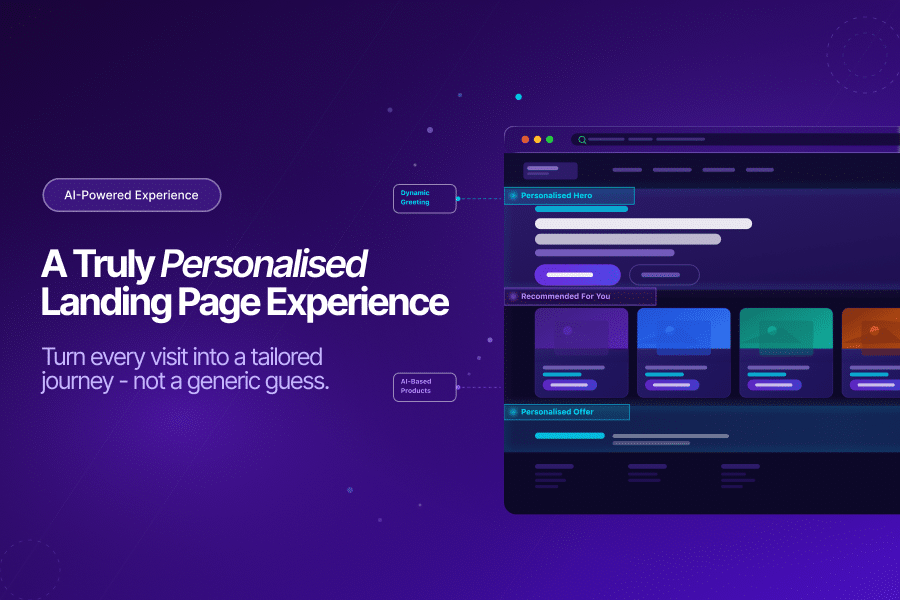
Agentic AI doesn’t just analyze data and produce a recommendation for a human to act on. It reads signals in real time and acts, adjusting what a visitor sees based on who they are, where they came from, what they’ve done before, and what they’re most likely to respond to. It’s the difference between a one-size-fits-all storefront and a page that actually meets each visitor where they are.

Deloitte’s research on this is fairly direct. 63% of global retailers now believe that companies without AI agents will fall behind competitors within two years. Not eventually. Two years. McKinsey frames the commercial upside just as plainly: agentic AI could generate up to $1 trillion in US B2C ecommerce revenue by 2030, with global projections of $3-5 trillion.

These numbers are big enough to feel hypothetical. Here’s something more concrete. During the 2025 holiday season, Salesforce and Adobe tracked AI-influenced shopping driving 20% of all retail sales globally, generating $262 billion in revenue through personalized recommendations and engagement. That wasn’t a forecast. That was last November and December.

What This Looks Like in Practice

It might help to talk about what actually changes when a brand takes landing page personalization seriously.

ASOS applied machine learning to customize product listings and landing pages for individual visitors, specifically for return customers who already had behavioral history. The result was a 13% lift in conversion rate. Not from more traffic. Not from a redesign. From showing the right visitor the right page.

Bain & Company cites Sephora as the clearest benchmark for what loyalty-driven personalization looks like at scale. Sephora combines purchase history, real-time browsing behavior, and individual preference data to personalize homepage content and product recommendations for every loyalty member, online and in-store. It works because the experience feels continuous. It remembers you. It knows what you like. It doesn’t show you things that have nothing to do with you.

That’s the standard shoppers are starting to hold all brands to. Not just luxury or beauty. All brands.

The Real Cost Is Waiting

Here’s a question worth sitting with.

If 70% of the shoppers hitting your landing pages right now are leaving without converting - and McKinsey says personalization drives 10-15% revenue lift while cutting acquisition costs in half, what does another quarter of inaction actually cost you?

Run the math on your own numbers. Take your monthly traffic. Apply a 70% abandonment rate. Then apply a 10-15% lift from better personalization. The number you get is the revenue you’re currently not capturing from traffic you’re already paying for.

The personalization gap is real, it’s measurable, and it’s solvable. Agentic AI means it’s no longer a question of whether brands can deliver personalized landing experiences at scale; it’s a question of whether they choose to.

The ones choosing to are building a compounding advantage. The ones waiting are paying for traffic that keeps bouncing.

Tatvic works with brands to close the gap between traffic and revenue through agentic AI-powered landing page personalization and customer experience optimization. If you want to talk about what your current pages are leaving on the table, we’re happy to dig in.

AI Analytics in Marketing: What If You Didn’t Have to Explore Data to Understand It?

AI Analytics in Marketing: The Missing Layer Between Data and Action

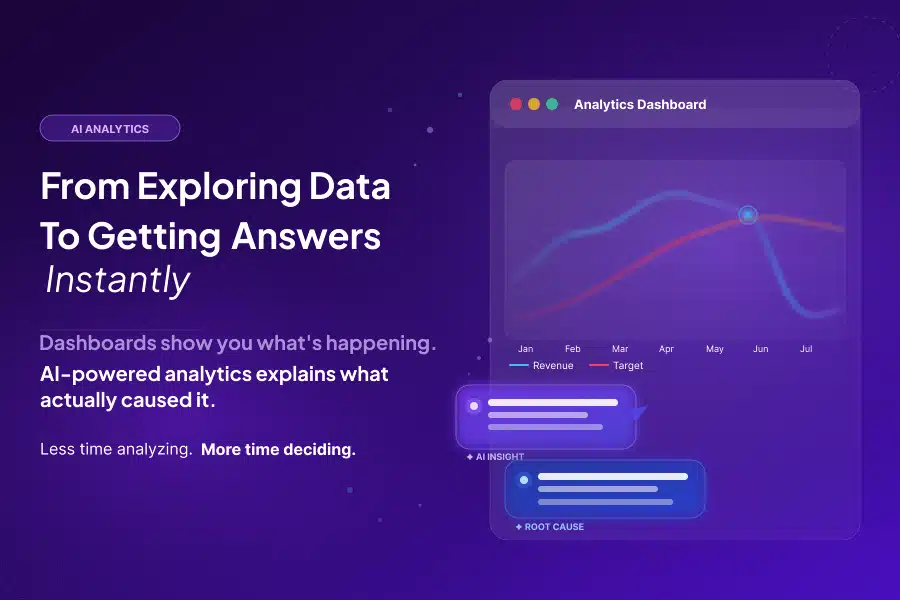
AI analytics in marketing is no longer just about reporting performance - it’s about reducing the time it takes to understand and act on it.

Over the past decade, marketing analytics has evolved significantly. Tools like Google Analytics 4 have made data more accessible, structured, and reliable. Most organizations today have invested heavily in dashboards, tracking, and reporting layers to strengthen their analytics setup.

But even with this progress, something still feels slower than it should.

Teams can see what’s happening almost instantly. Yet understanding what the data actually means - and deciding what to do next - still takes time.

This shift from data access to data interpretation is something we explored in detail in our earlier piece on how AI Analytics: Marketing Decision-Making Speed blog impacts decision speed.

This is exactly where AI analytics is beginning to redefine how modern marketing teams operate.

What is AI Analytics in Marketing?

AI analytics refers to the use of artificial intelligence to analyze marketing data, identify patterns, and generate actionable insights that improve marketing decision making.

Unlike traditional marketing analytics, AI analytics helps teams move beyond reporting by answering:

  • Why performance changes are happening
  • What factors are driving those changes
  • What actions should be taken next

This shift is what makes AI powered analytics a critical layer in modern analytics workflows.

The Evolution of Marketing Analytics: What Changed, and What Didn’t

To understand why this problem exists, it helps to look at how marketing analytics has evolved.

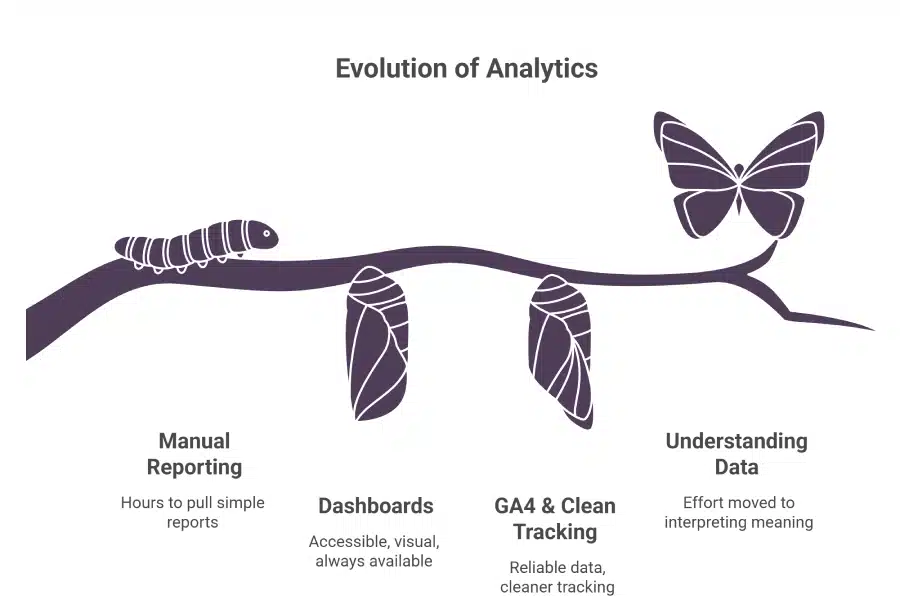
Earlier, analytics was heavily manual. Teams depended on multiple tools, spreadsheets, and delayed reporting cycles. Pulling even a basic campaign report required time, coordination, and validation. Data existed - but accessing it was difficult.

Then came structured platforms like Google Analytics 4, which transformed how teams interacted with data.

These platforms made analytics:

  • Centralized across channels
  • Available in near real time
  • Easier to visualize through dashboards

This was a major leap forward for marketing analytics. However, while access improved, interpretation did not evolve at the same pace.

Even today, most analytics systems are designed to show data - not explain it. Teams still rely on manual workflows to understand why something happened and what actions should follow. This is where AI analytics begins to play a critical role.

The Real Bottleneck in Marketing Analytics

Most organizations today have a mature marketing analytics setup. They have:

  • Clean event tracking
  • Structured dashboards
  • Defined KPIs
  • Cross-channel visibility

On the surface, this looks like a fully optimized analytics system. But when performance changes occur, decision-making still slows down.

The issue is no longer data quality or reporting accuracy.
The issue is how long it takes to interpret the data.

Without AI analytics, teams still rely on manual workflows to connect data points, validate assumptions, and derive insights. This is where time gets consumed, and where decision speed breaks down.

What Happens After a Performance Drop (In Reality)

Consider a typical scenario.

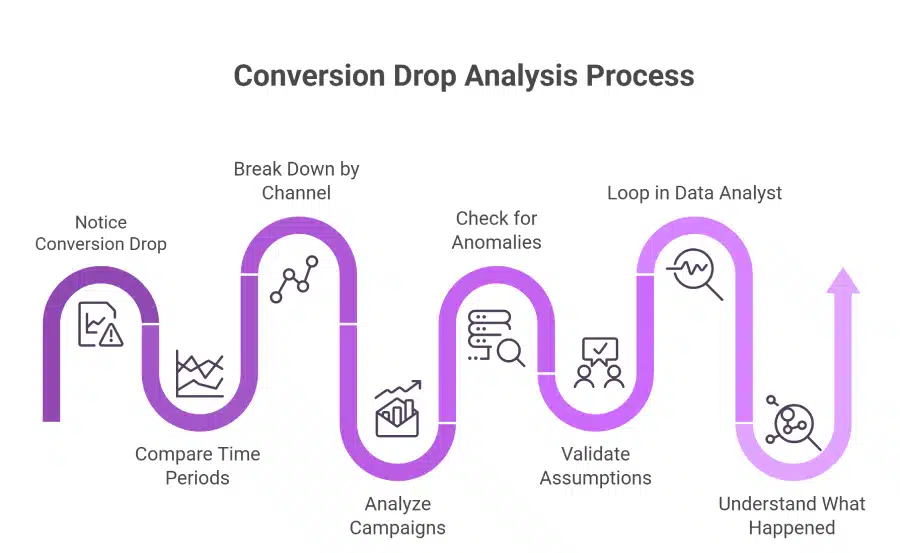
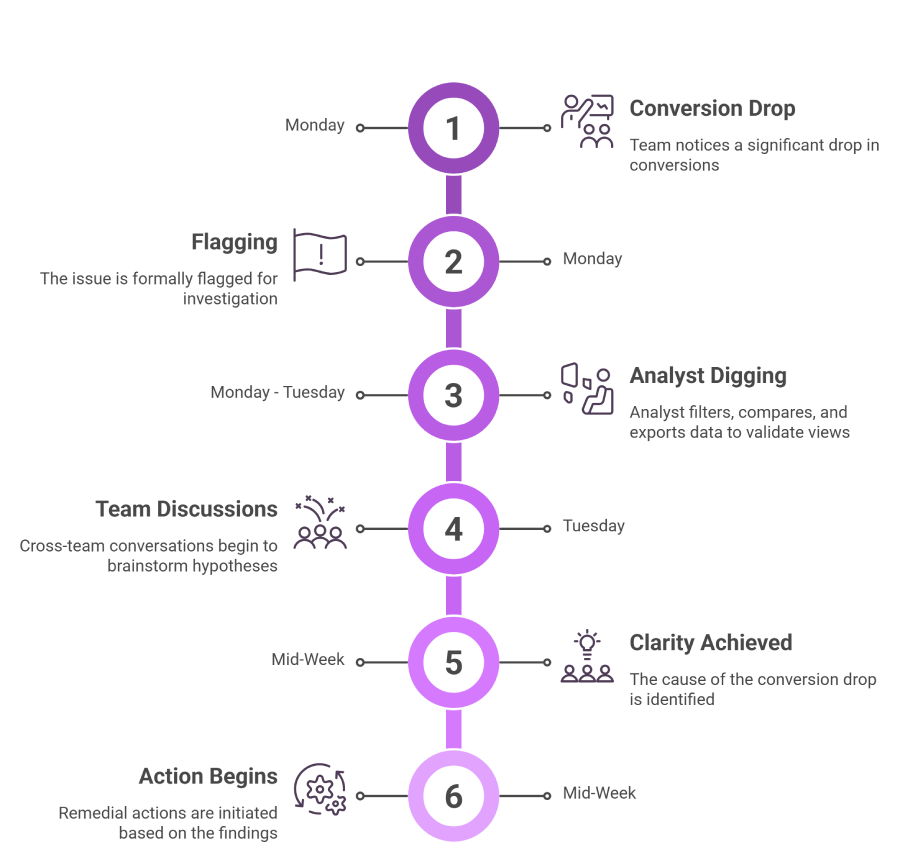
A drop in conversions is detected in your dashboard. The signal is clear, and the data is reliable. But that’s only the starting point.

From there, the team begins a structured investigation process:

  • Comparing performance across time periods
  • Breaking down results by channel
  • Analyzing campaign-level changes
  • Segmenting by audience, device, or geography
  • Validating whether the trend is real or an anomaly

In many cases, a data analyst is involved to conduct deeper analysis.

At this stage, the team is not making decisions yet.
It is still trying to answer a basic question:

“What exactly is happening here?”

This is where time gets consumed. And without AI analytics, this process repeats every time a new question arisesTraditional analytics process that slows marketing decision making speed.

Why This Process Persists Across Teams

The reason this workflow continues is not because teams are inefficient. It’s because traditional analytics tools are designed for exploration.

They are built to answer descriptive questions such as:

  • What changed?
  • Where did it change?
  • How significant is the change?

But they do not directly answer:

  • Why did it change?
  • What caused it?
  • What should we do next?

That gap creates a dependency on manual interpretation.

Even in sophisticated google data analytics setups, teams rely on human judgment to connect data points, validate hypotheses, and derive insights. This makes marketing decision making slower than it should be.

The Hidden Cost of Manual Interpretation

This interpretation gap has a measurable impact on performance. Without AI analytics, teams continue to rely on repetitive manual analysis to bridge this gap.

A significant portion of marketing analytics effort is spent on:

  • Repeating similar analyses for recurring questions
  • Validating insights across multiple stakeholders
  • Explaining findings in different contexts

Over time, this leads to:

  • Delayed decisions
  • Slower optimization cycles
  • Missed opportunities

These are not visible issues in dashboards, but they directly affect outcomes. If you want to quantify what this delay is costing your team, you can estimate the impact using the AI ROI Forecaster.

This is precisely where AI analytics creates value - not by improving visibility, but by improving understanding.

The Shift Toward AI Analytics

The shift toward AI analytics is not just conceptual - it is already delivering measurable impact.

According to research by McKinsey & Company, organizations adopting AI in marketing and sales are seeing significant improvements in performance, efficiency, and ROI.

AI analytics introduces a new way of interacting with data. Instead of starting with dashboards and exploring multiple dimensions manually, teams can start with insights that are already contextualized. This reduces the effort required to interpret data and accelerates decision-making.

At a practical level, AI analytics enables:

  • Automatic detection of anomalies
  • Pattern recognition across large datasets
  • Identification of likely causes
  • Generation of actionable insights

This is what differentiates AI analytics from traditional marketing analytics.

It is not about replacing existing tools.
It is about enhancing them with an interpretation layer.

What AI Powered Analytics Looks Like in Practice

With AI powered analytics, workflows change in a meaningful way.

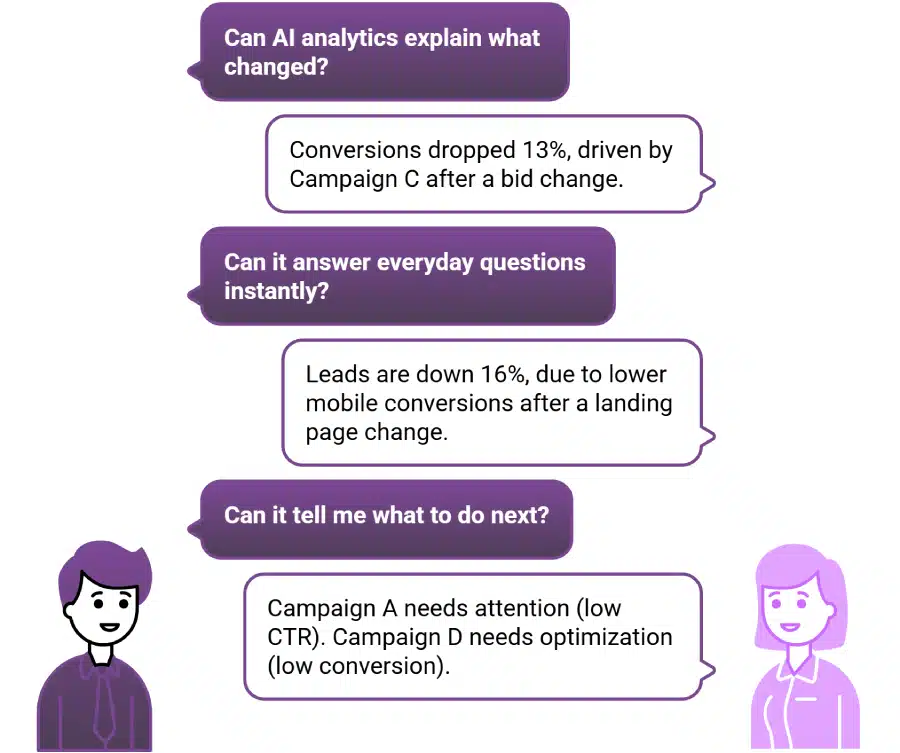
Instead of manually investigating a drop in performance, teams receive insights such as:

  • “Conversions declined by 14% due to reduced engagement in mobile traffic from Campaign A.”
  • “Lead volume dropped due to lower conversion rates on landing page X after a recent update.”

These insights provide immediate context.

The team no longer needs to start from scratch. Instead, it can:

  • Validate the insight
  • Assess business impact
  • Decide on the next step

This shift reduces the time between data and action. That is the real promise of AI analytics.

In fact, we recently broke down a few real-world scenarios - from “simple questions” that take hours to answer, to situations where teams struggle to decide what to do next - in a more conversational format.

The Role of Agentic AI in Analytics

As AI analytics continues to evolve, agentic AI is emerging as a key enabler of continuous intelligence.

Unlike traditional automation, which executes predefined tasks, agentic AI systems can operate more independently. They continuously monitor data, identify changes, and surface insights without requiring manual input.

In the context of marketing analytics, this means:

  • Insights are generated proactively
  • Patterns are identified continuously
  • Teams are alerted to meaningful changes in real time

This transforms analytics from a passive system into an active decision-support layer. Explore how Agentic AI Services for Marketing Transformation can introduce a continuous intelligence layer into your analytics workflows

This is also where modern ai solutions are heading - toward systems that assist not just in reporting, but in understanding and action.

How AI Analytics Improves Marketing Decision Making

The impact of AI analytics on marketing decision making is significant.

Faster Time to Insight

Teams no longer spend hours or days interpreting data. Insights are available much earlier in the process.

Reduced Dependency on Manual Workflows

Routine questions can be answered without repeated analysis, reducing the burden on analysts.

More Consistent Interpretation

Standardized insights reduce variability in how different stakeholders interpret data.

Better Resource Allocation

Teams spend less time analyzing and more time optimizing and experimenting.

Together, these improvements lead to more efficient and effective marketing operations.

AI Analytics Use Cases in Marketing

To understand how this works in practice, AI analytics use cases in marketing highlight where teams gain the most value. Some common AI analytics use cases include:

  1. Campaign Performance Monitoring
    AI analytics identifies underperforming campaigns and highlights the root cause before significant budget is wasted.
  2. Conversion Drop Analysis
    Instead of manual investigation, AI analytics pinpoints the exact drivers behind performance changes.
  3. Cross-Channel Insights
    AI analytics connects performance trends across platforms, providing a unified view of what’s happening.
  4. Opportunity Identification
    AI analytics highlights areas that require attention, enabling teams to act faster.

These use cases demonstrate how AI analytics moves beyond reporting into actionable intelligence.

Evaluating Your Current Analytics Setup

Most organizations evaluate their analytics maturity based on:

  • Data quality
  • Tracking accuracy
  • Reporting capabilities

While these are important, they do not fully capture effectiveness.

A more relevant question is: How much effort does it take to get an answer?

If answering a simple question requires multiple steps, coordination, or extended analysis, it indicates that the analytics setup is incomplete. This is where AI analytics can create the most impact.

From Dashboards to an Analytics Intelligence Layer

Modern marketing analytics is evolving into a layered system.

Foundation Layer:

  • Data collection
  • Tracking (Google Analytics 4)
  • Reporting dashboards

Intelligence Layer:

  • AI analytics
  • AI powered analytics
  • Agentic AI

The intelligence layer focuses on interpretation.

It continuously analyzes data, connects signals to causes, and surfaces insights without requiring repeated manual effort. This is what defines an analytics intelligence layer.

The Strategic Advantage of AI Analytics

The real value of AI analytics lies in speed.

In competitive environments, the ability to understand data quickly leads to faster decisions. Faster decisions lead to better outcomes.

Organizations that adopt AI analytics gain:

  • Faster optimization cycles
  • Reduced wasted spend
  • Improved campaign performance

This is not just an operational improvement.
It is a competitive advantage.

Where Most Organizations Get It Wrong

Many organizations assume that improving dashboards will solve their analytics challenges.

In reality:

  • More dashboards increase complexity
  • More data does not equal better decisions

Another common mistake is treating AI analytics as a standalone tool.

It is not just a tool.
It is a shift in how analytics workflows operate.

Without aligning workflows, even the best AI analytics solutions will not deliver full value.

Closing Perspective

Analytics has always evolved to reduce effort.

First, it reduced the effort of collecting data.
Then, it reduced the effort of accessing it.

Now, it is reducing the effort of understanding it. This is where AI analytics is making the biggest impact.

By transforming how insights are generated and consumed, AI analytics enables teams to move faster from data to decision. It reduces manual effort, improves clarity, and supports better marketing decision making.

The advantage today is no longer about having more data. It is about understanding it faster - and acting on it sooner.

→ Explore how Agentic AI Services for Marketing Transformation can introduce a continuous intelligence layer into your analytics workflows

Tatvic | Automate your marketing with Agentic AI

AI Powered Analytics | Why Marketing Decision-Making Is Still Slow - and How to Fix It

AI Analytics: From Dashboards to Decisions

Where Marketing Decision-Making Slows Down

For years, marketing teams were solving for one core problem: They couldn’t trust their analytics.

Different dashboards showed different numbers.
Attribution didn’t add up.
Teams spent more time validating marketing analytics than using it.

So naturally, the focus shifted:

  • Better tracking
  • Cleaner Google Analytics 4 implementations
  • Standardized dashboards
  • Stronger reporting layers

And to be fair - this worked.

Today, many organizations finally have reliable analytics. They trust their data. But something unexpected happened next: Decision-making didn’t speed up. This is exactly where AI analytics is changing how modern marketing teams operate.

What Is AI Analytics in Marketing?

AI analytics in marketing refers to the use of artificial intelligence to analyze data, identify patterns, and generate actionable insights that improve marketing decision making.

Unlike traditional marketing analytics, which focuses on dashboards and reporting, AI analytics goes a step further. It helps teams understand:

  • Why performance changes are happening
  • What factors are driving those changes
  • What actions should be taken next

This is what makes AI powered analytics fundamentally different. Instead of relying entirely on a data analyst, teams can use intelligent systems to:

  • Detect anomalies in real time
  • Analyze cross-channel performance
  • Surface insights proactively
  • Recommend next best actions

In practice, this means your analytics evolves from:
‘Reporting what happened‘ to ‘Explaining what’s happening - and guiding what to do next‘

This shift is central to modern ai solutions and is increasingly powered by advancements like agentic AI, which enables continuous monitoring and decision support. This is why AI analytics is becoming a critical layer in modern marketing systems.

If Data Isn’t the Problem, What Is?

Most teams assume that once data is fixed, decisions should become faster. But in reality, the bottleneck hasn’t disappeared. It has moved.

From: “Can we trust this data?”

To: “What does this data actually mean - and what should we do next?”

And that second question is where things slow down again. Because while data collection and reporting have matured, data interpretation is still manual. This is where modern AI analytics enters the conversation.

The Hidden Bottleneck in Marketing Analytics

Let’s look at how this plays out in a typical marketing analytics workflow.

A team today has:

  • Clean analytics implementation
  • Accurate tracking
  • Structured dashboards
  • Cross-channel visibility

Everything looks right. But when performance drops:

What looks like a simple performance drop turns into a multi-day process - not because the data is wrong, but because understanding it takes time. This is where marketing decision-making speed breaks down. Every delay between signal and clarity slows action, extends impact, and reduces the ability to respond in real time. Without AI analytics, this interpretation gap continues to slow down decision-making.

Nothing Is Broken. But It’s Still Slow.

This is the reality of modern analytics. The issue is no longer:

  • Data quality
  • Reporting accuracy

The issue is: Time taken to interpret data

And that’s exactly the gap AI powered analytics is designed to solve. If you want to understand the real impact on your business, you can evaluate the potential ROI of faster decisions with the AI ROI Forecaster

The Core Limitation of Dashboards

Most marketing dashboards are designed to answer one question:

“What changed?”

They can show:

  • Drop in conversions
  • Channel-level performance
  • Campaign-level trends

But they don’t explain:

  • Why the change happened
  • Whether it’s temporary or systemic
  • What action should be taken

The biggest limitation impacting marketing decision-making speed is lack of automated interpretation. This creates a gap. And that gap is filled manually - every single time.

Why AI Analytics Is Becoming Essential

The shift toward AI analytics isn’t theoretical - it’s already delivering measurable impact.

Research compiled from firms including McKinsey Digital (2026) shows that AI in marketing can drive an average ROI improvement of around 35%.

At the same time, broader studies indicate that organizations using AI in marketing and sales are already seeing tangible gains in performance and efficiency.

This reinforces a clear shift: The competitive advantage is moving from access to data → speed of understanding.

Instead of just showing data, it helps teams:

  • Detect anomalies automatically
  • Analyze patterns across dimensions
  • Identify likely causes
  • Recommend next steps

This is where AI powered analytics transforms marketing decision making.

Why Marketing Analytics Still Feels Slow

Even with AI analytics capabilities emerging, most teams are still operating with manual interpretation layers where teams face the following challenges: 

1. Analysis Is Reactive

Teams analyze data after something goes wrong.

This means:

  • Insights come late
  • Impact has already occurred
  • Opportunities are missed

2. Analysts Become a Bottleneck

As data complexity increases, so does reliance on analysts.

They handle:

  • Ad-hoc queries
  • Deep dives
  • Reporting requests
  • Data validation

When multiple stakeholders ask questions, everything slows down.

3. Interpretation Isn’t Standardized

Two people can look at the same dashboard and reach different conclusions.

Why?

Because interpretation depends on:

  • Context
  • Experience
  • Assumptions

This leads to:

  • More discussions
  • Delayed decisions
  • Lack of consistency

4. Decision Latency Impacts Performance

This is the hidden cost.

In marketing:

Timing matters as much as the decision itself.

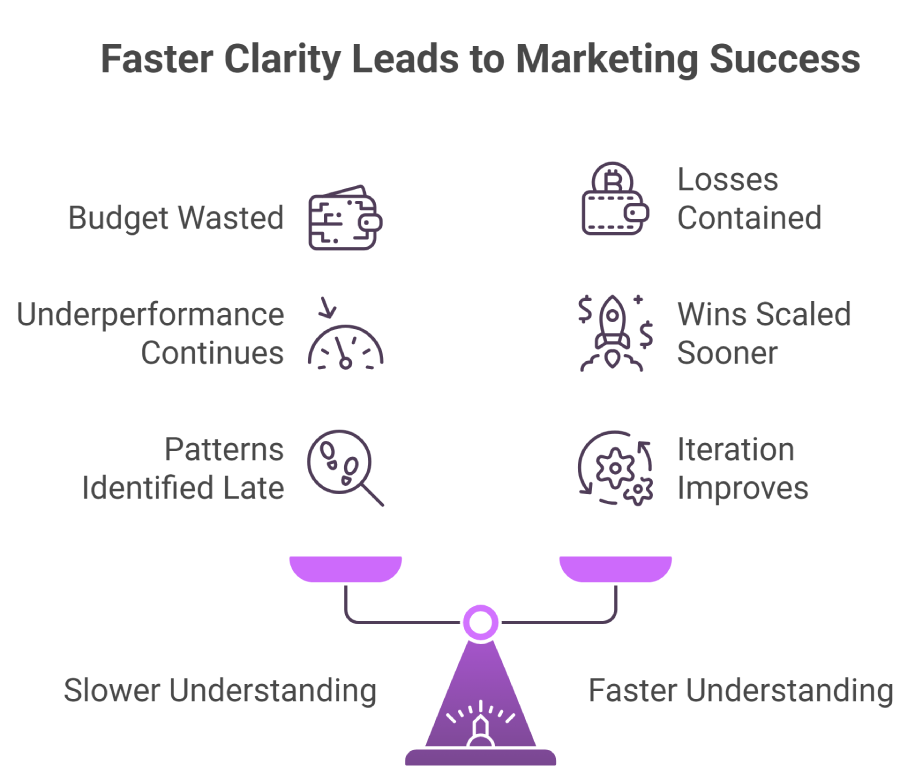
If understanding is delayed:

  • Budgets are wasted before correction
  • Underperformance continues longer
  • Winning strategies are identified late

Decision latency directly reduces marketing decision-making speed across teams.

The Real Shift: From Data Accuracy to Decision Speed

Over the last few years, organizations have optimized for: Data accuracy, tracking reliability, and reporting consistency but the next evolution isn’t better dashboards. It’s analytics intelligence powered by ai solutions.

It’s about: How fast your team can move from data → insight → action

This is where most organizations still struggle.

Introducing Analytics Intelligence

This is where AI analytics evolves into a true intelligence layer.

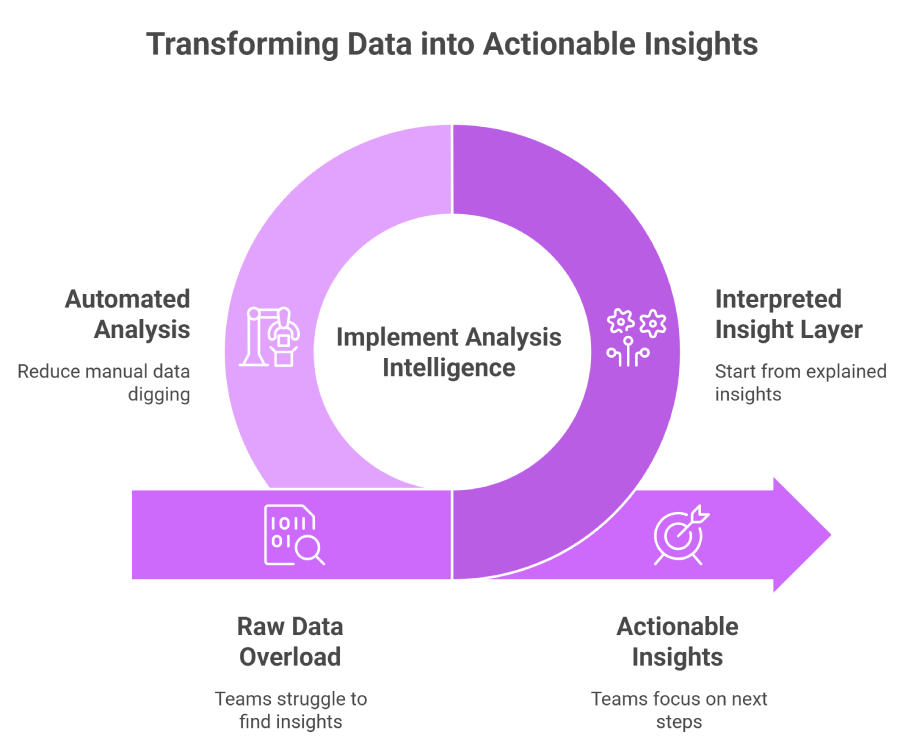
An Analytics Intelligence Layer

This sits on top of your existing analytics setup and focuses on:

  • Continuous performance monitoring
  • Automated analysis of changes
  • Contextual explanation of trends
  • Identification of likely causes

Instead of starting with raw data,
teams start with interpreted insights.

Is Your Current Process Ready for This Shift?

Not every analytics workflow is ready for an intelligence layer. The key question is: Where is your team still dependent on manual analysis? This is where evaluating your internal workflows becomes critical.

→ Use the AI Process Eligibility Calculator to identify where AI analytics can create the most impact

From Manual Analysis to AI-Powered Clarity

Let’s revisit the earlier scenario. Instead of spending 2-5 days analyzing data, the team receives:

“Conversions dropped 18% yesterday, primarily from paid search.
The decline is concentrated in Campaign X after a recent bid adjustment.”

Now the conversation changes.

From: “What happened?”

To: “What should we do next?”

This shift reduces:

  • Time spent analyzing
  • Back-and-forth discussions
  • Dependency on manual workflows

And compresses decision cycles from days to hours. With AI analytics, teams no longer start from raw data - they start from insight.

Does This Replace Analysts or Teams?

No, and it shouldn’t.

The role of AI Analytics Intelligence is not to replace human expertise. It’s to enhance it.

Teams still:

  • Validate insights
  • Apply business context
  • Make final decisions

But they start from a position of clarity, not confusion.

Why This Matters More Than Ever

Marketing environments today are more complex than ever.

  • More channels
  • More campaigns
  • More segmentation
  • More data

At the same time:

  • Decision cycles are shorter
  • Expectations are higher
  • Teams are leaner

In this environment: AI use cases in analytics are no longer optional - they’re a competitive advantage.

How to Identify If You Have a Decision Speed Problem

Ask yourself:

  • How long does it take to understand a performance drop?
  • How many people are involved in analysis?
  • How often do decisions get delayed due to unclear insights?
  • How quickly can your team act on new opportunities?

If the answer is measured in days,
there’s a clear opportunity to improve.

From Reporting to Decision Intelligence

Most organizations have already invested in: Marketing analytics tools, data pipelines, reporting dashboards

But reporting only answers: “What happened?”

To improve performance, you need systems that answer: “Why did it happen - and what should we do next?”

That’s the shift from:     Reporting     to    Decision Intelligence

The Role of Agentic AI in Analytics

Agentic AI takes this further. Instead of just analyzing data, it can:

  • Continuously monitor performance
  • Trigger insights automatically
  • Assist in decision workflows

This creates a system where analytics is no longer passive - it becomes active.  Not just to inform decisions. But to support how marketing actually operates at scale.

Closing Thought

Fixing your data was a critical step. But it was never the final one. Because clean data doesn’t create clarity on its own. And in today’s environment:

The advantage doesn’t come from having more data.
It comes from understanding it faster - and acting on it sooner.

Improving marketing decision-making speed is no longer about fixing data. It is about reducing the time between insight and action. The faster teams interpret what is happening, the faster they can respond - and that is where competitive advantage now lies. This is the real promise of AI analytics - faster understanding, faster action, and better outcomes.

Explore what faster, more consistent decision-making could look like:

If your team is still spending days moving from data to action, it may be time to rethink how your AI analytics layer operates.

→ Start your Analytics Intelligence discussion
→ Evaluate your AI readiness

Bot Icon
Bot Icon

Tatvic Bot

Explore About Tatvic and Services